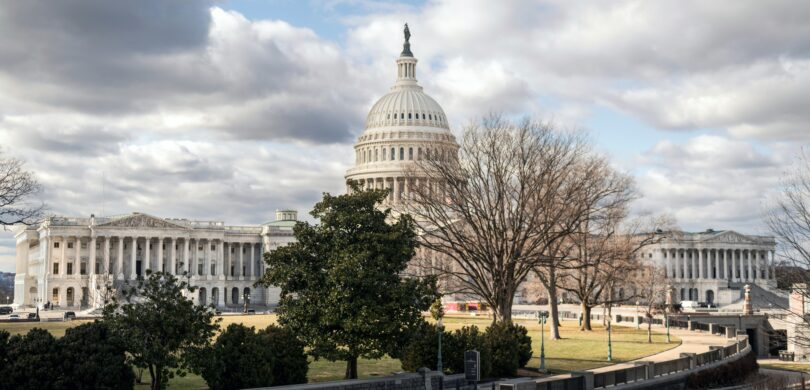
Public policy work, especially at the state level, tends to be cyclical. Most state legislatures are busiest during their “regular session” in the first few months of the year before adjourning in late spring or early summer. Elsewhere, states like California, Massachusetts, and Wisconsin are “in session” for nearly the full year but are reliably busy at certain times each year (August and September in California).
But, because public policy refuses to be that predictable, policy professionals have to keep their eyes out for special legislative sessions. Read on for more details about these pop-up lawmaking periods and where they have shown up in 2025.
What is a “Special Session”?
“Special session” (or sometimes an “extraordinary session”) refers to the meeting of a legislature outside of their regular meeting cadence or structure. There is variability in the rules and processes around special sessions, but they are a part of every state’s legislative process. Thirteen states limit the ability to call a special session to the Governor. Additional rules in some states limit the frequency and length of special sessions, or the topics that may be legislated within them.
The presence of these sessions in each state requires awareness from public policy professionals. While the end of a legislative session may allow advocates time to reflect on their progress as well as their work to be done (while hopefully fitting in some vacation!), they should actively monitor discussions about special sessions, especially where legislative opportunities and risks may come back to life.
What States Have Called Special Sessions in 2025?
As of September 8, 2025 there have been 12 special sessions called in 2025 across the following states:
Colorado
Colorado lawmakers returned to Denver during the last full week of August to address a shortfall in the state’s budget related to the passage of the One Big Beautiful Bill Act by Congress. Lawmakers also debated changes to AI regulation passed in 2024 that is due to come into force in 2026.
Florida
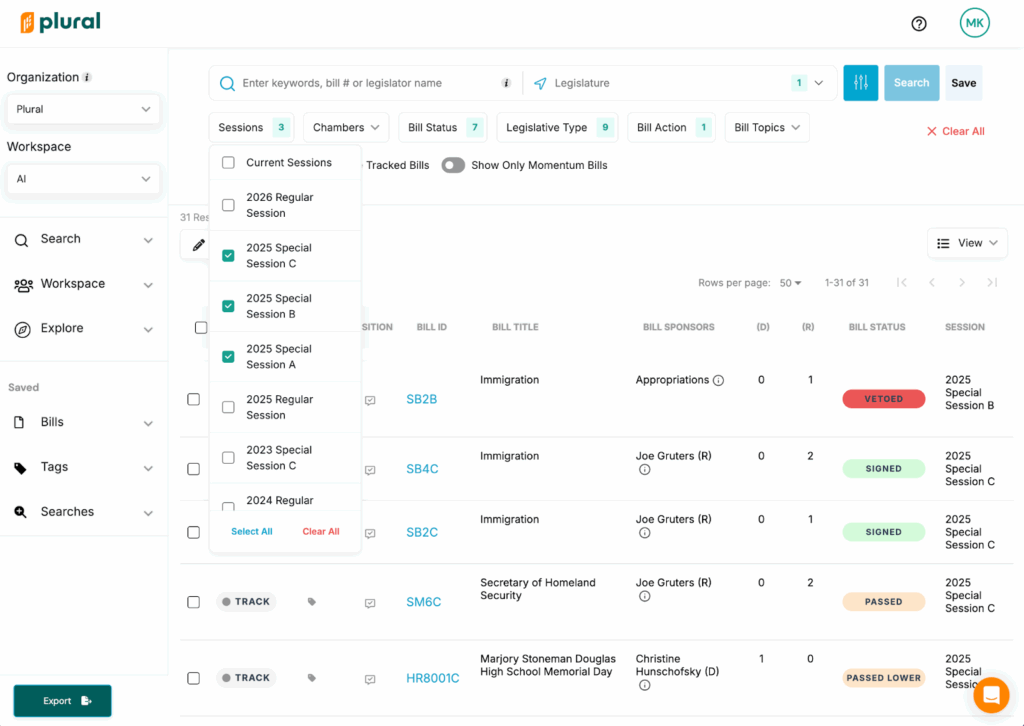
Legislators in Florida convened for three separate special sessions before their regular session kicked off in March, 2025. These special sessions were largely focussed on immigration and resulted in the passage of two new laws (SB 2C & SB 4C).
Minnesota
Minnesota legislators held a one-day special session to pass 15 bills primarily related to the state budget on June 9th. Following the tragic mass shooting at the Church of the Annunciation in Minneapolis on August 27th, Governor Tim Walz indicated he would call for an additional special legislative session this fall to focus on measures to reduce gun violence.
Mississippi
After failing to pass a budget during the regular session, Mississippi lawmakers returned to Jackson for two days in May to finish their work.
Missouri
An early June special session in Missouri saw legislators debate disaster relief funding as well as tax and spending proposals to encourage professional sports teams to remain in Kansas City.
More recently, Missouri legislators returned in early September in an effort to pass a new congressional map that is more favorable to Republicans and to limit the initiative petition ballot process that has been used in recent years to protect abortion access, increase the minimum wage, and legalize recreational marijuana.
South Dakota
In late September South Dakota lawmakers are due to convene a targeted special session to debate the construction of a new men’s prison facility.
Tennessee
While the state’s regular session was ongoing, Tennessee lawmakers used a special session to pass education and immigration proposals in an expedited fashion. The special session allowed proponents of these measures to apply pressure for a quick passage and to fast-track the effective dates and implementation of this legislation.
Texas
Texas lawmakers have been at the center of the most discussed special sessions this summer. The first special session, called in part to pass new congressional maps more favorable to Republicans, was halted by a walkout from Democratic lawmakers that prevented a quorum. Following a standoff and plenty of political posturing, lawmakers returned in mid-August for a second special session that saw Republicans pass a package of their priorities including that new map.
Need help building your team’s AI policy strategy?
Reach out to us to schedule a consultation, get a downloadable copy of our AI policy guide, or see how we help clients lead with confidence in the age of artificial intelligence.
Plural’s AI-powered legislation tracker offers not just data, but foresight, providing real-time updates, predictive analytics, and strategic insights. No matter your needs, we have a plan for you.