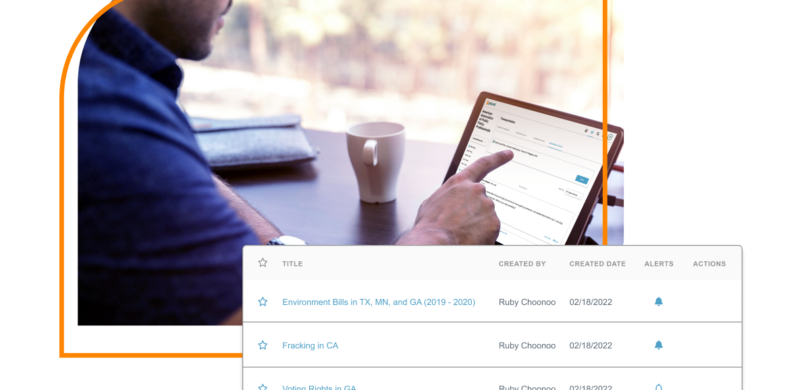
The enterprise buyer’s guide to evaluating legislative tracking tools — and understanding what separates a monitoring tool from a true intelligence platform.
You already know you need it. The question is which one.
Legislative tracking software has become a non-negotiable part of the enterprise government affairs stack. State legislatures collectively introduce more than 200,000 bills per year. Federal regulatory activity generates tens of thousands of additional data points. No team — regardless of size, expertise, or institutional knowledge — can monitor that volume manually without missing things that matter.
But not all legislative tracking software is built the same way. The market includes a wide spectrum of solutions — from lightweight bill monitors that send keyword alerts, to enterprise intelligence platforms that apply AI to analyze, summarize, prioritize, and connect legislation to your compliance and risk infrastructure.
This guide explains what legislative tracking software actually does, how the technology works, what separates entry-level tools from enterprise-grade platforms, and what questions to ask before you sign a contract.
What is legislative tracking software?
Legislative tracking software is a technology platform that monitors legislative activity — bill introductions, committee hearings, amendments, floor votes, and final outcomes — across one or more jurisdictions, and surfaces relevant information to the people who need to act on it.
At its most basic, a legislative tracking tool answers the question: what is happening in the legislature that affects my organization? At its most sophisticated, it answers a more valuable question: what is likely to happen, and what should we do about it before it does?
The core functions of any legislative tracking platform include:
- Monitoring: Continuously scanning legislative databases for new bills, amendments, and status changes across tracked jurisdictions.
- Filtering: Surfacing legislation that matches your organization’s issue areas, keywords, industry classifications, or custom criteria.
- Alerting: Notifying the right people when relevant bills move — ideally at the right stage of the lifecycle, not just at passage.
- Organizing: Providing a centralized workspace where teams can tag, annotate, prioritize, and collaborate on tracked legislation.
- Reporting: Generating summaries and exports that communicate legislative activity to internal stakeholders and leadership.
Legislative tracking vs. legislative intelligence: what’s the difference?
Tracking tells you what is happening. Intelligence tells you what it means and what to do next.
A tracking tool monitors bills and sends alerts. A legislative intelligence platform analyzes bill content, predicts viability, surfaces regulatory risk signals, and connects legislative activity to your broader compliance and governance workflow.
The distinction matters at scale. For a team monitoring legislation across 20 or 40 states, the difference between tracking and intelligence is the difference between being informed and being prepared.
How does legislative tracking software work?
The mechanics vary significantly by platform, but enterprise-grade legislative tracking software typically operates in four layers.
1. Data ingestion and normalization
Legislative data is notoriously inconsistent across jurisdictions. Every state legislature formats its data differently. Bill numbering conventions vary. Committee structures differ. Session calendars are incompatible.
The first challenge any legislative tracking platform solves is ingesting data from 50+ state legislatures and the federal government and normalizing it into a consistent, searchable format.
2. Relevance filtering and AI analysis
With a clean data foundation, the platform applies filters to surface what matters to your organization. Entry-level tools do this through keyword matching — if a bill contains “data privacy” in the text, it gets flagged.
More sophisticated platforms, like our Legislative Intelligence, apply natural language processing and AI to understand bill content contextually, identifying legislation that is relevant to your issue areas even when your keywords don’t appear verbatim.
Our AI analysis includes bill summarization (condensing dense legislative text into readable plain-language summaries), similarity detection (identifying model bills and companion legislation across states), and momentum scoring (predicting which bills are likely to advance based on committee composition, sponsor patterns, and historical session data).
3. Alerting and workflow management
Once relevant legislation is identified, the platform needs to get the right information to the right person at the right time. This is where many tools fall short. A generic alert that fires every time any change occurs on a tracked bill quickly becomes noise — teams learn to ignore it.
Enterprise-grade alerting is specific and role-aware. A government affairs manager needs to know when a bill passes committee. A compliance officer needs to know when it passes the chamber. An executive needs a weekly summary, not daily pings. The ability to configure alert logic — by lifecycle stage, by priority level, by audience — is a feature that separates functional tools from useful ones.
4. Integration with the broader enterprise stack
The fourth layer is where most stand-alone legislative tracking tools reach their limit. For a government affairs team that operates independently, a standalone tool may be sufficient. But for enterprises where legislative intelligence needs to flow into compliance workflows, risk assessments, and policy management systems, integration is essential.
This means data portability and native integrations with GRC platforms and compliance management systems like SAI360. Our partnership provides a unified platform where legislative intelligence and compliance action exist in the same environment — so the gap between knowing a regulation is changing and responding to it is measured in hours, not weeks.
Why integrated compliance workflow is the enterprise differentiator
Most legislative tracking platforms operate as standalone point solutions. They tell you what legislation exists. They do not connect that intelligence to your compliance obligations, your policy management workflow, or your risk register.
For enterprises where legislative change directly creates compliance requirements — healthcare, financial services, manufacturing, data-intensive industries — the disconnect between tracking and compliance action is a meaningful operational risk.
Plural Legislative Intelligence powered by SAI360 is the only platform in this market natively integrated with an enterprise GRC stack, meaning the gap from legislative signal to compliance response exists within a single system.
Ready to see what your team is missing?
Plural Legislative Intelligence powered by SAI360 gives government affairs teams real-time visibility into state and federal legislative activity — with AI-powered bill analysis, viability signals, and stakeholder engagement workflows built in.
And it’s the only platform that combines with integrated compliance workflow. Learn more by scheduling a live walkthrough.