If your government affairs team is still waiting on Congress to establish a national framework for artificial intelligence, it may be time to shift your gaze. While Washington deliberates, state legislatures across the country are moving on AI policy at breakneck speed—drafting legislation, shaping tech compliance standards, and laying the groundwork for a complex patchwork of state-level governance.
In a recent session hosted by Plural, Host Ben Duda sat down with Senior Policy Analyst Max Knutsen to break down the biggest AI legislative developments of 2026 and preview what state affairs teams should prepare for heading into 2027.
Here are the key takeaways, emerging themes, and strategic considerations every government relations professional needs on their radar.
1. The “California Effect” and De Facto National Standards
One of the defining realities of state-level AI policymaking is extraterritorial impact. As an OpenAI global affairs lead recently acknowledged, modern AI policy remains firmly anchored in the states.
When large market states like California, New York, or Illinois pass comprehensive regulations, AI developers face an operational choice: build separate, state-specific product tiers, or adjust their baseline models nationwide to satisfy the strictest standard. Most often, they choose the latter.
“A legislator in California can have a significant impact on your interactions with a chatbot across the country in Maine.”
— Max Knutsen, Senior Policy Analyst, Plural
A prime example highlighted during the session is Illinois’ benchmark legislation regulating AI in mental health and therapy services. What began as a state-level requirement for clinician disclosures and crisis-escalation protocols quickly became a nationwide product design consideration for conversational AI platforms.
GR Takeaway: Tracking bills in high-population states isn’t just relevant if your organization operates there locally. A single bill enacted in Sacramento or Springfield can alter the operational baseline for your entire industry.
2. The Data Center Debate: Where Tech Meets Local Utilities
While much of the early AI discourse centered on algorithm ethics and model safety, the physical backbone of AI—data centers and energy infrastructure—has ignited one of the most intense legislative debates of 2026.
This issue cuts across traditional partisan lines. Communities are raising concerns over grid capacity, water usage, and whether residential ratepayers will foot the bill for massive utility upgrades required by high-density data centers and crypto mining operations.
Case in Point: Oklahoma’s HB 2992
Oklahoma’s Data Center Customer Ratepayer Protection Act of 2026 represents a blueprint for how states are handling this pushback:
- Advance Transparency: Mandating disclosure of energy demands before development breaks ground.
- Cost Allocation: Requiring data center operators to fund their own share of electricity and infrastructure buildouts rather than passing costs to local consumers and small businesses.
While cost-protection measures address pocketbook concerns, opposition is already evolving to include broader questions around environmental impact, local zoning, and public health.
GR Takeaway: Infrastructure issues are deeply localized. Watch for unexpected coalitions between consumer advocates, fiscal conservatives, and environmental organizations pushing for stricter zoning and utility tariffs on digital infrastructure.
3. Education: Balancing Guardrails with Workforce Readiness
State education committees have emerged as active testing grounds for AI policy, navigating the tension between protecting students and preparing future workers.
Currently, state approaches fall into two distinct tracks:
- Curriculum Integration & Workforce Readiness: States like Alabama have advanced legislation integrating AI instruction into graduation requirements alongside existing computer science coursework, aiming to prepare high schoolers for an AI-augmented job market.
- Restrictive Measures & Technology Audits: Concurrently, concerns regarding critical thinking, academic integrity, and youth mental health are driving renewed scrutiny of classroom tech. Rather than rushing into outright bans, many states are commissioning formal studies. In Maine, for instance, lawmakers passed legislation conducting a statewide census of technology and AI usage across public schools.
GR Takeaway: “Study bills” are essential early warning indicators. A study commissioned in 2026 often serves as the legislative blueprint for enforceable compliance mandates in 2027 and 2028.
4. What to Watch for the Rest of 2026
Before turning full attention to next year’s sessions, several end-of-year milestones will set the tone:
- Gubernatorial Action in California: Dozens of AI bills have reached the governor’s desk, spanning workforce protections, labor standards, and consumer safety.
- Full-Time Legislatures: Michigan and Ohio remain active year-round and continue to debate data center regulations and public-sector AI adoption.
- The Midterm Dynamic: In key battleground states across the Midwest, local resistance to large-scale data center facilities has entered candidate platforms on both sides of the aisle. The political rhetoric that wins out this fall will establish the legislative mandates governors and state legislators claim when taking office in January.
Looking Ahead to 2027: Preparing Your Team
With biennial legislatures like Texas and Nevada returning to regular session in 2027, the volume and velocity of state technology legislation will accelerate significantly.
To stay ahead of regulatory drift and divergent state standards:
- Move Past K-Street Centric Monitoring: Relying solely on federal intelligence leaves organizations exposed to state-level compliance shifts that happen much faster than federal rulemaking.
- Map Downstream Regulatory Effects: Evaluate whether bills in front-runner states will force your internal teams or technology vendors to modify systems nationwide.
- Engage During the Study Phase: If your organization has subject matter expertise, participate when state agencies and task forces conduct their preliminary studies—well before formal committee hearings begin.
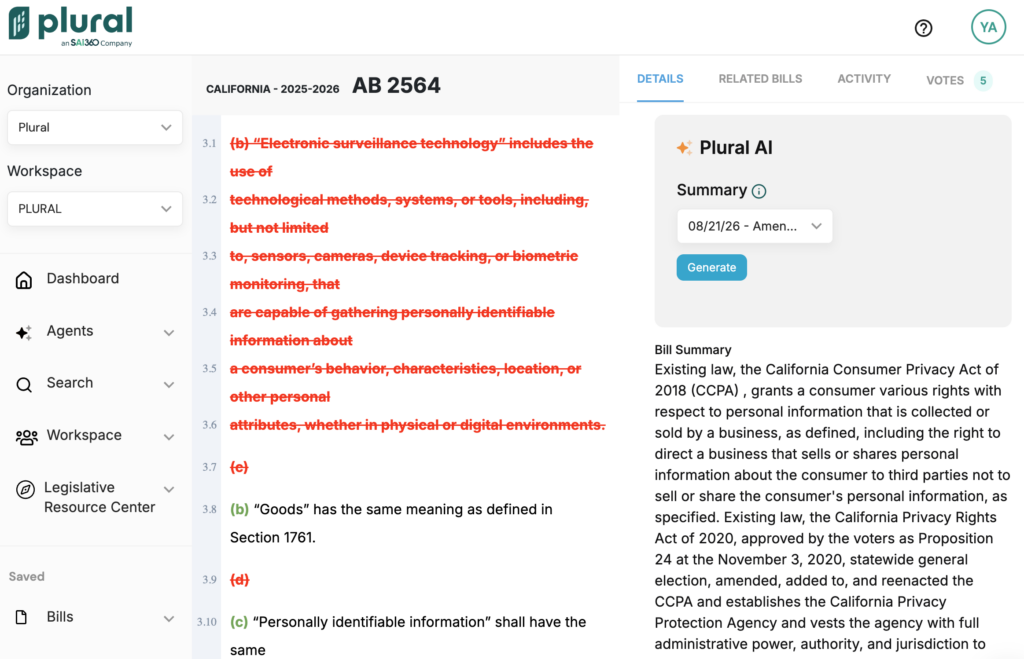
Looking for a smarter way to track state-level AI legislation across all 50 statehouses? Learn how Plural gives government relations teams real-time legislative intelligence, AI-forward bill tracking, and collaborative workflow tools built to scale.
The better legislative tracking solution. See for yourself.
Plural Policy gives government relations and advocacy teams visibility into state and federal legislative activity. Beyond a typical legislative tracker, Plural provides AI-powered bill analysis, viability signals, and stakeholder engagement workflows built in. And it’s the only platform that combines this with integrated regulatory monitoring features. Learn more by scheduling a walkthrough.