Track bills and regulations across all 50 states, DC, Puerto Rico, Congress, and 40+ countries.






COVERAGE
Legislative and regulatory data from every US jurisdiction and 40+ countries.
50
STATES
40+
COUNTRIES
DC + PR
TERRITORIES
CONGRESS
FEDERAL
Everything a government affairs team does, in one place.
Find what’s moving, understand what it means, know who to call, and report it out.
SEARCH
Ask for what you’re looking for. In plain English.
Type what you actually mean. ‘Ohio cannabis licensing,’ ‘bills that would preempt local rent control,’ ‘anything moving on data privacy in the Southeast.’ Plural handles the rest. No boolean operators, no quotation marks, no wildcards, no syntax to remember.
Saved searches run continuously and alert you the moment something matches.


AI SUMMARIES AND ANALYSIS
A 200-page bill, explained in the time it takes to read this.
Every bill and regulation gets summarized on arrival. What it does, what changed since the last version, and what it touches. Purpose-built for legislative and regulatory text.
Every summary links back to the source text, so you can verify any line.
LEGISLATORS AND STAFF
Know who’s behind the bill, and who to call about it.
Sponsors, co-sponsors, committee assignments, voting history, and the staffers who actually handle the issue. Contact details included. When a bill matters to you, you already know whose door to knock on.
Staff contacts across all 50 states and Congress.

REPORTING
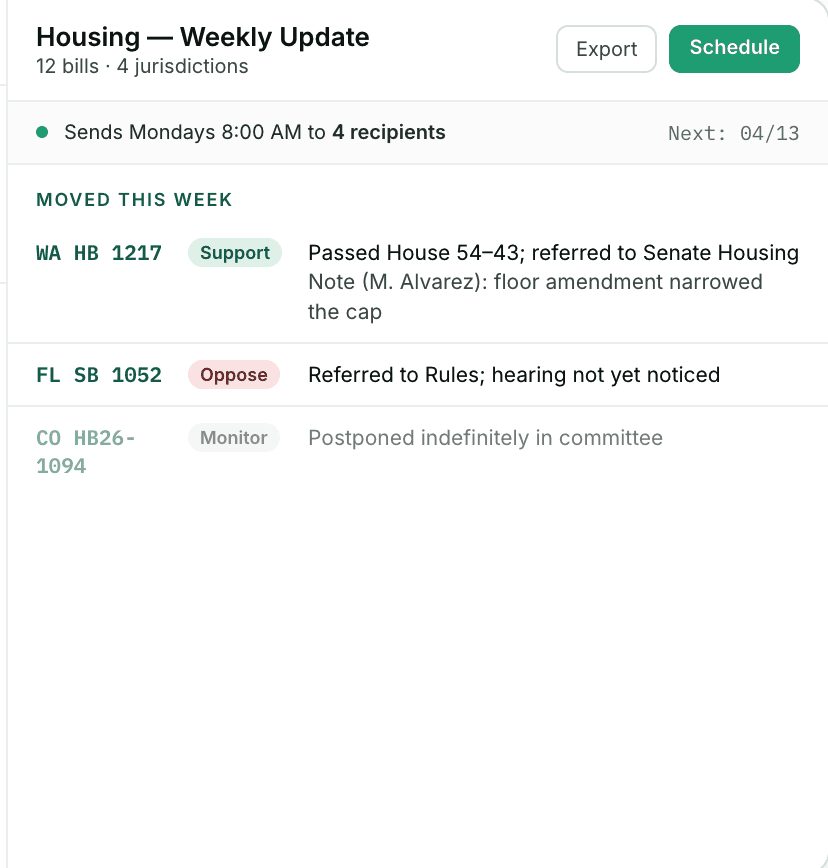
A report your executives will actually read.
Turn what you’re tracking into a report without rebuilding it in a document every week. Choose the bills, the fields, and the order. Positions, latest actions, and your team’s notes come with them. Export it, or put it on a schedule and stop thinking about it.
Positions and your team’s notes travel into the report with the bill.
And the parts that keep a team running.
Triage
Assign bills, set positions, add notes, and move things through your team’s process. Everyone sees the same status.
Dashboards
Build a view for each issue area, client, or region. Filter once, check it daily.
Alerts
Get notified the moment a bill you’re tracking moves, a hearing is noticed, or a saved search matches.
Plans
Whether you’re one person tracking a handful of states or a team covering all fifty, there’s a plan that fits.
FOR INDIVIDUALS
Essential
For one person covering a handful of jurisdictions.
$609 per year, per seat
Or $59 monthly. Annual saves you $99.
✓ Unlimited bill tracking in Congress, all 50 states, Puerto Rico, and DC
✓ One seat
✓ Does not include Plural AI or collaboration features
Get Started
MOST POPULAR
Professional
For small teams that need AI and shared workflow.
$5,000 per year
✓ Everything in Essential
✓ Access to AI-powered insights tools
✓ Legislative staff data, hearings, and committees
✓ Export data and share interactive bill lists
✓ License flexibility for teams
Book a Demo
FOR LARGE TEAMS
Enterprise
For government affairs functions with compliance, legal, and executive stakeholders.
Custom pricing
✓ Everything in Professional
✓ All AI-powered insights tools
✓ Premium reporting
✓ Unlimited users and collaboration
✓ Premium support and policy guidance
✓ Multi-factor authentication
✓ Dedicated customer support
Contact Sales
See it on your own jurisdictions.
Thirty minutes, your states, your issue areas. You’ll know within the first ten whether this fits how your team works.