
Category: Product

  • Why is Public Policy Technology Hard? Analyzing Policy from a Data Perspective

    Why is Public Policy Technology Hard? Analyzing Policy from a Data Perspective

    From the early days of the internet, optimists argued it could be a singular force for democratization. The internet’s growth and advancement over the past two decades has indeed increased access to information. One can now easily translate texts from other language, hear and share the viewpoints of activists around the world, and access balanced historical perspectives.

    But, in many ways, it doesn’t feel as though technology has made the systems and operations of our government more accessible. Expanding access to information is an important step towards transparency. However, it does little to bring citizens into the government processes that can determine their fundamental rights. The Supreme Court, for example, only made live audio of oral arguments available to the public during the COVID pandemic. Those who tune into a Supreme Court oral argument may find themselves justifiably intimidated and confused by the complex jargon and procedure that embodies much of the court’s work.

    The most impactful technologies don’t just present data — they make it accessible and actionable. Google Maps, for example, doesn’t just show me a map. It also takes the preparation out of a road trip by suggesting a route that will suit my needs. Part of the mass appeal of ChatGPT and Bard is the accessible manner in which they present their answers. 

    So it seems natural that technology should play a role in broadening access to the public policy information that shapes our daily lives. But developing, distributing, and accessing this technology hasn’t been straightforward. Solving for this gap is a major aspect of Plural’s mission. Since 2009, Plural and OpenStates have built open democracy tools and provided access to public policy data. We’re proud to support advocacy organizations, journalists, researchers, and many others.

    In that time, we’ve learned a lot about the challenge of building accessible public policy technology. In this blog, I summarize a few of the key challenges in building software to analyze public policy data. I also provide some examples of how our tools have met those challenges. 

    High Stakes for Data Quality and Accuracy

    One challenge in gathering and presenting public policy data for public consumption lies in the value of that data. It can be highly-impactful, sometimes controversial information. Whether an amendment to the state budget or a vote on a key bill, it’s crucial that the data we present is accurate and complete.

    The public hearing data we provide, for example, provides citizens with a unique opportunity to impact the democratic process. Just one missed hearing could have a massive impact on an individual’s interaction with their government. This is true for most individuals accessing public policy technology — whether for their job or their own advocacy. 

    It’s for these reasons that we gather our data from primary sources, typically legislative bodies themselves. Relying on secondary sources like news reporting would introduce the opportunity for bias. Consolidating information from primary data sources and presenting it in an accessible, intuitive format is essential. 

    Our commitment to data quality and accuracy benefits the AI models we use to provide policy insights. Because we provide a wealth of highly organized public policy data, we are able to confidently leverage AI to summarize legislation, identify bill topics, and assess the salience of a bill.

    Countless Primary Sources of Public Policy Data

    There’s a wide range of primary data sources. This vastness is another challenge of providing access to comprehensive public policy data. In the United States, processes that impact public policy happen most visibly at our legislatures. However, they also occur in agencies, executive offices, courthouses, and city halls. 

    The nature of policymaking is such that a debate over a local ordinance considered by your school board (of which there are more than 10,000) may be more impactful to your daily life than actions in Congress. 

    Those looking to build useful, accessible policy technology must strike a balance between comprehensiveness and their own capacity. Generally speaking, federal and state data is more readily available than local data. It’s much easier to incorporate into policy technology. However, we must also look at the value this data provides, roughly a delta between how easy it would be to access the information without the technology versus with. The value of state and federal data is smaller, compared to local data.

    Timeliness

    Public policy data is most valuable soon after it becomes available. Timeliness is crucial when it comes to public policy technology.

    Many state legislatures are confined by strict deadlines. These restrict when they can introduce legislation, pass bills out of their committees and chambers, and wrap up work. It seems to be the nature of legislators to take full advantage of every last second before these deadlines. We often see rushes of activity right before they hit. 

    Anyone who has closely followed a few state legislative sessions will have experienced the long nights of work as session comes to an end. During this time, legislators are far more active than on typical session days. We see bills that have had no activity for months pass through both chambers in an hour. For those on the ground, it can be difficult to stay ahead of this activity. This dynamic presents a challenge to providers of public policy data as well. 

    Plural uses a combination of domain knowledge, technical expertise, and a robust arsenal of data scrapers to ensure we are constantly monitoring for new data and presenting it to our users in a timely fashion. 

    Legislative Documents Aren’t Designed for Readability

    MN HF 5406 (2023-2024) at the source site.

    Even if we’ve surmounted the challenges raised above, challenges may persist. We often run into the same issue met by those tuning into live Supreme Court arguments — while the impact and importance of the information is clear, the exact meaning is not always apparent or easy to digest.

    The technical nature of legislation is partially unavoidable given the context. Tax code is likely destined to be complex, no matter how you format it. However, the structure of legislation itself can make its proposed changes confusing for a layperson. In most states, most legislation presents existing statute text. It indicates proposed additive language, often by underlining, as well as proposed removed text, often struck through. A few states, including Massachusetts and Tennessee, as well as Congress, simply describe the proposed changes without providing the source statute text.

    The bill shown on the left is proposing to modify the purpose of a grant for a community activity center to improve accommodations for those with disabilities. Someone familiar with legislative documents might gather this information quickly. However, it’s unreasonable to expect that the average person who wishes to engage with the legislative process might do the same.

    Plural makes digesting this complex information easier. Our tool provides a more intuitive markup, clearly indicating proposed changes. Further, Plural also provides an AI-generated summary built using a model specifically designed for this type of text. 

    Plural’s Find Your Legislator Tool: Public Policy Technology Use Case

    One of the most common needs of individuals looking to engage with the public policy process is to get in touch with their representative(s). But finding this information and acting on it can prove challenging. 

    Plural’s solution is our widely popular Find Your Legislator Tool. Using the Find Your Legislator Tool is simple. Users simply enter their address to quickly see their representatives at the state and federal levels. Users can also see a map of their districts.


    MN HF 5406 (2023-2024) in Plural.

    But Plural goes beyond simply providing this information in an easy-to-access format. We also empower users with the information they need to make this data actionable. By clicking into a legislator’s page, users can see contact information for the selected representative. They’ll also see the bills that legislator has sponsored as well as their voting history.

    Cleanly organized public policy data is at the heart of Plural’s offerings. We also leverage AI and intuitive design to ensure that the public policy process is approachable for everybody. But the process wasn’t simple, and we’ve met our fair share of challenges along the way. Our belief is that encountering these challenges, and overcoming them with our users, is valuable. It’s a key aspect of delivering on our mission to enable democratic engagement through technology.

    Get Started With Plural

    Plural helps professional public policy teams and concerned constituents alike get and stay ahead in the public policy landscape. With Plural, you’ll:

    • Access superior public policy data 
    • Be the first to know about new bills and changes in bill status
    • Streamline your day with seamless organization features
    • Harness the power of time-saving AI tools to gain insights into individual bills and the entire legislative landscape
    • Keep everyone on the same page with internal collaboration and external reporting all in one place

    Interested in getting started? Create a free account or book a demo today!

    More Resources for Public Policy Teams

  • Plural for Medical Associations

    Plural for Medical Associations

    Medical associations play a crucial role in shaping healthcare policy. Within these organizations, public policy teams have a key responsibility. They’re tasked with ensuring that legislative developments align with best practices and standards of care. Overall, they must ensure that healthcare systems benefit both providers and patients. Given these complex challenges, medical associations must effectively track legislation, manage stakeholder relationships, and advocate for their members’ interests.

    In this blog, we’ll discuss the various areas of legislation that impact medical associations. We’ll also discuss how Plural helps medical associations maximize their policy impact.

    The Policy Environment

    Various areas of legislation impact medical associations. This includes healthcare reform, drug pricing, and research funding, among others. Learn more below.

    Healthcare Reform

    Medical associations are at the forefront of healthcare reform discussions. They advocate for policies that ensure equitable access to healthcare and improve quality of care. Any new developments can have profound impacts on how healthcare services are delivered and financed. This includes changes to healthcare coverage, payment models, and new patient care protocols. Medical associations must stay informed about legislative developments in these areas. This awareness allows them to effectively represent their members and help shape policies that foster a sustainable healthcare system.

    Regulatory Compliance

    The healthcare sector is subject to a myriad of frequently-updated regulations. They cover everything from patient privacy and data security to clinical practices and facility standards. Medical associations must help their members understand and navigate these regulations. Compliance is not just adherence to laws, but also ensuring that the highest standards of patient care and safety are met.

    Drug Pricing

    The cost of medications remains a critical issue in healthcare policy. Medical associations are actively involved in the dialogue surrounding drug pricing. They advocate for legislation that makes medications affordable. At the same time, they also encourage the innovation necessary to develop new treatments. Understanding the complexities of pharmaceutical pricing, including the roles of manufacturers, insurers, and government programs, is essential for effective advocacy.

    Medical Research Funding

    Advocating for research funding is another key area of focus for medical associations. Medical research is the backbone of advancement. Securing funding is crucial. This involves engaging with legislative bodies to ensure that government grants and subsidies are allocated to support vital research projects. Effective stakeholder management is key to this process. Medical associations must also monitor and influence the budgetary allocations at federal and state levels. They must make the case for the importance of continued investment in medical research.

    Plural’s Strategic Advantage

    Top medical associations trust Plural for their legislative tracking and stakeholder engagement needs. Plural’s suite of tools is designed to empower medical associations to manage the legislative complexities of the healthcare sector more effectively. Learn more about how Plural meets the challenge below.

    Best-in-Class Data

    Access to comprehensive and up-to-date legislative information is crucial for staying informed about changes that impact healthcare policy and regulations. Plural enables medical associations to stay up-to-date on legislative trends and developments. This includes:

    • Tools to discover everything there is to know about a bill
    • Legislator and staffer information
    • Historical data
    • AI-powered insights
    • And more!

    With Plural, medical associations turn potential policy threats into manageable challenges.

    Advanced Search Tools

    With Plural, it’s easy for medical associations to filter through the noise to find relevant bills. Advanced search capabilities allow users to pinpoint specific legislation affecting healthcare. Search by keyword, legislature, session, bill status, and more. This precision helps associations focus their efforts on the most impactful issues, saving time and enhancing the effectiveness of their advocacy.

    Real-Time Updates

    The healthcare policy landscape can change rapidly. Plural’s real-time updates ensure that medical associations receive immediate notifications about legislative developments. These insights allowing them to respond swiftly and keep their members informed.

    Global Bill Search

    Thousands of bills are introduced in each jurisdiction throughout each legislative session. For medical associations, finding the exact bills that matter can feel like searching for a needle in a haystack. The ability to quickly and efficiently find the bills that matter is the key to staying ahead. Plural’s Global Bill Search streamlines the discovery process and brings relevant legislation to the forefront. Global Bill Search helps medical associations discover the national landscape of legislation impacting their goals and objectives.

    Momentum Indicator

    Identifying which bills are gaining traction is crucial for medical associations. These insights guide strategic planning and advocacy. Yet, without the right tools, policy teams must rely on manual tracking and intuition. This often leads to missed opportunities and misallocated resources. Plural’s Momentum Indicator offers a novel way to assess a bill’s traction and potential for progress. With the Momentum Indicator, discovering which bills are likely to become law is quick and simple.

    Why Plural Is Indispensable for Medical Associations

    Medical associations are committed to advancing healthcare standards and best practices. Plural offers a robust solution for navigating the complex world of healthcare policy. With Plural, medical associations can not only keep up with, but also actively influence this dynamic policy field. By adopting a proactive approach, medical associations ensure that they can efficiently represent the interests of both healthcare providers and patients, promoting a healthier future for all.

    Are you ready to enhance your legislative tracking and advocacy efforts? Sign up for a demo today and empower your medical association to lead in healthcare policy.

    More Resources for Public Policy Teams

  • Plural for Real Estate Companies

    Plural for Real Estate Companies

    What are real estate policy issues faced by companies in the sector? Between taxes, urban development and more, Plural is a helpful tool for real estate companies looking to track public policy. Learn more today!

    Real estate is one of the most highly invested assets. Despite this, the U.S. is facing many housing crises throughout the country. Real estate companies must be aware of legislative decisions made in their jurisdictions. Tracking legislation is an essential step in making educated assessments of their actions within the market and for their businesses. 

    Plural allows real estate companies to track legislation together. Plural offers a user-friendly search engine, features that make understanding policy easy, and a supportive team that can answer your questions. 

    In this blog, we’ll discuss the various areas of legislation that impact the real estate market. We’ll also discuss how Plural helps real estate companies maximize their policy impact.

    Real Estate Policy Issues

    Various areas of legislation impact the real estate market. This includes zoning laws, environmental compliance, and taxation, among others. Policy issues can impact real estate companies’ regulatory compliance, market dynamics, strategic planning, risk management, and corporate responsibility. Learn more below.

    Issues Affecting Regulatory Compliance

    Zoning Laws

    For real estate companies, zoning laws are fundamental in shaping property development. They designate specific land uses, influencing what can be built and where. For example, a zoning law reclassifying a suburban residential area to commercial use can drastically alter development prospects, enabling the construction of shopping centers or office buildings. This shift can create lucrative opportunities for real estate companies. However, it also poses challenges in navigating new market dynamics.

    There are many arising challenges in zoning laws. Increasingly popular in recent years, inclusive zoning refers to a range of policies and practices that mandate or provide incentives for the inclusion of affordable housing units in new developments. Inclusive zoning encourages mixed income neighborhoods and increases the supply of affordable housing.

    Building Codes and Safety Regulations

    Adhering to building codes and safety regulations is equally critical. These codes ensure that structures meet safety and health standards. They protect occupants and enhance building longevity. Non-compliance can have consequences, including hefty fines, legal disputes, and forced closures. Owners might face remediation costs and litigation if a building fails a safety inspection due to outdated fire prevention systems.

    Environmental Regulations

    Environmental regulations are increasingly necessary for real estate development. These laws mandate sustainable practices, such as energy-efficient design and pollution control. For example, a real estate company developing a property in a coastal area might need to implement erosion control measures and preserve natural habitats to meet regulatory standards. Failure to comply can result in project delays, increased costs, and potential legal action.

    Policy Issues With Financial Implications

    Tax Legislation

    Changes in tax legislation can have a profound impact on the profitability of real estate investments. This includes changes to property taxes, capital gains taxes, and others. An increase in property taxes can significantly raise the cost of holding and maintaining properties. Conversely, decreasing capital gains taxes can make real estate investments more attractive by enhancing after-tax returns.

    Tax incentives can also play a pivotal role in real estate investment decisions. Consider a scenario where a government introduces tax breaks for developing affordable housing. Such incentives can lead real estate companies to prioritize these projects, not only for the financial benefits but also for the positive community impact. By leveraging these tax incentives, companies can improve their financial outcomes while contributing to the common good.

    Tax legislation is notoriously difficult to understand. Real estate companies must act fast to gain an advantage. Plural’s AI-powered tools, including bill summarization, help users quickly understand legislation.

    Government Funding and Subsidies

    Various forms of government funding and subsidies are available for real estate projects. These financial opportunities can reduce project costs and enhance profitability. For example, a real estate company that secures a government grant for green building initiatives can lower its development expenses and increase its market appeal. 

    By tracking and utilizing these financial opportunities, real estate companies can:

    • Optimize their investment strategies
    • Maximize returns
    • Ensure long-term financial stability

    Staying informed about changes in tax legislation and available subsidies allows companies to take full advantage of beneficial programs.

    Issues Affecting Market Dynamics

    Understanding market dynamics is essential for real estate companies, particularly rent control and tenant protection laws.

    Rent Control Laws

    Rent control laws have required notices and start dates which landowners should be readily aware of. These laws aim to protect tenants and promote market stability. They can also influence decisions on property investments and upgrades. Tenant protection laws, which cover issues like eviction processes and lease terms, add another layer of regulation. These laws may change the administrative processes.

    Mortgage and Lending Laws

    Mortgage and lending laws also play a critical role in shaping the real estate market. Legislation affecting these factors can alter market demand and buyer behavior. Stricter lending regulations make it harder for buyers to secure loans, reducing demand for properties. Conversely, favorable mortgage terms can stimulate market activity by making homeownership more accessible. Keeping abreast of these laws helps real estate companies anticipate market shifts and adjust their strategies accordingly.

    Issues Impacting Strategic Planning

    Urban Development Policies

    Urban development policies play a key role in shaping the landscape of cities and towns. Laws related to urban planning and infrastructure development can create new opportunities for real estate companies. For example, when a city plans to develop a new transportation hub, nearby properties can become more valuable, attracting investors and developers. Real estate companies can leverage these policies by strategically acquiring and developing properties in areas slated for infrastructure improvements, thus gaining a competitive edge.

    These opportunities are usually released on a quarterly basis. Getting notified of upcoming opportunities in real-time is essential. With real-time alerts, Plural helps real estate companies stay up-to-date on important legislation.

    Economic Policies

    Economic policies also impact the real estate market. This includes interest rate adjustments, fiscal stimulus measures, and employment initiatives. Lower interest rates can boost housing demand by making mortgages more affordable. Fiscal stimulus measures can increase disposable income, leading to higher real estate investment. Historical examples include the policies enacted after the 2008 financial crisis, which significantly influenced market dynamics. The economic impacts of the COVID-19 pandemic are yet another example, which experts are continuing to study today.

    By understanding and anticipating the effects of economic policies, real estate companies can better navigate market fluctuations and capitalize on emerging trends.

    Policy Issues Impacting Corporate Responsibility 

    Sustainability and social responsibility are increasingly vital in the real estate sector. Laws promoting sustainable development are crucial for environmental protection. These include green building standards and energy efficiency requirements, among others. Compliance with these laws goes beyond protecting the environment. It also enhances a company’s reputation and market appeal, attracting eco-conscious clients and investors.

    For real estate companies, staying up-to-date on legislative changes is imperative. It ensures compliance, optimizes financial strategies, and offers a competitive edge. As the industry evolves, adapting to an ever-changing legal landscape will be pivotal for success. How does Plural help real estate companies meet the challenge?

    Plural for Real Estate Companies

    Top real estate companies trust Plural for their legislative tracking and stakeholder engagement needs. Learn more about how Plural meets the challenge below.

    Best-In-Class Data

    Plural’s suite of tools allows for efficient deep dives into legislative information. This includes:

    • Tools to discover everything there is to know about a bill
    • Legislator and staffer information
    • Historical data
    • AI-powered insights
    • And more!

    With Plural, real estate companies turn potential policy threats into manageable challenges.

    Advanced Search Tools

    With Plural, it’s easy to filter through the noise to find relevant data with advanced search capabilities. Advanced search functionality is a game-changer. Search by keyword, legislature, session, bill status, and more. Plural helps real estate companies uncover the bills that affect their bottom line.

    Real-Time Updates

    Public policy moves fast — Plural helps real estate companies discover key information quickly. With real-time notifications, Plural users never miss an update. This immediacy transforms real estate companies’ ability to stay ahead and develop actionable strategies.

    Global Bill Search

    Thousands of bills are introduced in each jurisdiction throughout each legislative session. For real estate companies, finding the exact bills that matter can feel like searching for a needle in a haystack. The ability to quickly and efficiently find the bills that matter is the key to staying ahead. Plural’s Global Bill Search feature offers a sophisticated search engine designed to streamline the discovery process and bring relevant legislation to the forefront. Global Bill Search helps real estate companies discover the national landscape of legislation that impacts their bottom line and operating environment.

    Momentum Indicator

    Identifying which bills are gaining traction is crucial for real estate companies. These insights guide strategic planning and advocacy. Yet, without the right tools, policy teams must rely on manual tracking and intuition. This often leads to missed opportunities and misallocated resources. Plural’s Momentum Indicator offers real estate companies a novel way to assess a bill’s traction and potential for progress. With the Momentum Indicator, discovering which bills are likely to become law is quick and simple.

    Why Plural Is Indispensable for Real Estate Companies

    Real estate companies operate in the complex interplay of policy, economic, and societal challenges. In this context, Plural is a powerful ally. Plural offers more than insights; it provides a strategic advantage. With Plural’s tools and insights, real estate companies navigate the policy landscape with confidence. Plural helps real estate companies ensure that they are well-prepared to face future challenges and seize current opportunities.

    Interested in learning more? Book a demo today!

    More Resources for Public Policy Teams

  • What Makes Plural the Best Legislative Tracking Software?

    What Makes Plural the Best Legislative Tracking Software?

    Plural’s legislative solutions, including intuitive design and AI-powered insights, make it the best policy tracking tool. Learn more today.

    In the world of public policy, success is all about finding what you need, when you need it. Top public policy teams need a tool that works with them, not against them. But what sets Plural apart?

    • Premium legislative data
    • Real-time updates
    • Intuitive design
    • AI-powered insights
    • Customizable organization features
    • Unlimited collaboration
    • Personalized customer support
    • Accessible plans and pricing

    Plural’s legislative solutions get you there faster than the competition. Learn more below!

    Premium Legislative Data

    Plural provides extensive and real-time legislative data. View comprehensive bill data and see legislator and key staffer information for all 50 U.S. states, U.S. Congress, the District of Columbia, and Puerto Rico. Plural’s thorough and immediate updates ensure you are always informed with the latest legislative developments. Its powerful search capabilities, which include AI-powered processing, make it easy to find what you need to know.

    Real-Time Updates

    Public policy moves fast. Plural’s sophisticated algorithms ensure you’ll never get caught with out-of-date information. With an advanced data scraping cadence, Plural guarantees more accurate and up-to-date information, giving you a decisive edge.

    While many legislative tracking tools only update daily, a key differentiator with Plural is real-time alerts. Getting updated in real-time ensures that you are the first to know about important legislative changes, allowing for timely and informed decision-making.

    Intuitive Design

    You deserve a policy tracking tool that works with you, not against you. Plural’s focus on ease of use ensures that you spend less time navigating the platform and more time leveraging its full capabilities.

    Many legislative tracking tools link to the PDF file of a bill’s text on the originating state’s legislative website. If you’re monitoring legislation across multiple states, it can be time-consuming and confusing to figure out how best to read and understand bills across different formatting styles. In Plural, all bill text is digital, and all bill pages a uniform look. This allows you to easily read through bill text regardless of its originating legislature.

    AI-Powered Insights

    Policy success isn’t just about being the first to know about key updates. The insights you glean from the information you receive can deepen your impact. With Plural, it’s easy to use AI to deepen your policy insights. Plural’s AI-powered tools help you foresee legislative outcomes and make more strategic decisions – giving you and your policy team a significant edge.

    Find similar bills, including companion, reintroduced, and omnibus bills, all in one place. Search across jurisdictions to understand the legislative landscape of a given issue area. Discover which bills are likely to gain momentum and adapt your strategy accordingly. Save time reading dense, detailed bill text and discover the key aspects of a bill with AI-powered bill summaries and bill version comparisons.

    Customizable Organization Features

    Public policy work is messy, but your tracking tool shouldn’t be. Plural’s organization tools help you cut through the noise. You can streamline your policy work by creating custom tags to organize bills. Plus, you can complete bulk actions to tag or track many bills at once, and free up time for what really matters.

    Unlimited Collaboration

    Policy work doesn’t happen in a vacuum. Plural is an all-in-one tool for you to collaborate with teammates internally and easily communicate with external stakeholders. Unlimited workspaces means you can keep work separated by issue area, teams or clients. Within each workspace, you can annotate bills, share notes, upload files, and comment back and forth with teammates.

    With Plural’s reporting features, you can also export key bill data or share curated bill lists with anyone, whether or not they have a Plural account.

    Personalized Customer Support 

    At Plural, we’re an extension of your team. Plural provides personalized, one-to-one customer support. Your dedicated Customer Success Manager is available via phone, chat or email. Your team will receive personalized onboarding and follow-up training as needed. Plus, with a Premium plan, you can request custom reports and policy guidance from our knowledgeable team of policy experts. 

    Accessible Plans and Pricing

    Plural’s pricing structure accommodates teams of all sizes, without compromising on features. With Plural, it’s easier than ever to take your policy impact to the next level. Get started today with the best legislative solutions on the market.

    More Resources for Public Policy Teams

  • VIDEO | How to Find Legislative Staff Directory Information in Plural

    VIDEO | How to Find Legislative Staff Directory Information in Plural

    In the complex world of government relations, building strong connections with legislative staff is crucial. These are the key players who can navigate the legislative labyrinth and help turn your policy goals into reality.

    In this video, we walk through how to find legislative staff directory information in Plural.

    How To Find Legislative Staff Directory Information in Plural

    Find legislative staff directory information on the respective legislator’s page in Plural. You can access a legislator’s page via either the explorer tool or through clicking on the legislator’s name on a bill detail page.

    1. Once on the legislator’s page, navigate to the “Staff Directory” tab towards the top right of the page. Here, you can access a comprehensive database of legislative staffers across various levels of government.
    2. To find a specific staffer, use the search bar. You can search by name, position, or even the legislative issue they handle. This function is incredibly helpful if you’re looking to connect with someone with a certain title, or who specifically handles your policy area of interest. Please note that data on a staffer’s policy area is only available for select jurisdictions, including Congress.
    3. Once you’ve found the staffers of interest, view their name, title, contact details, and policy areas. This detailed view lets you tailor your communication effectively, ensuring that you reach out with relevant and informed messages.”

    We welcome your feedback. If you discover any inaccurate directory information, let us know. To report an inaccuracy in staff directory information simply click on the three vertical dots toward the top right corner of the staffer’s directory details.

    Get Started With Plural

    With Plural, you’re well-equipped to build meaningful relationships that empower your government relations efforts. Start connecting today and make a real impact. Create a free account or book a demo today!

    More Resources for Public Policy Teams

  • Streamlining Legislative Discovery: Using Boolean Search to Find Specific Social Media Legislation

    Streamlining Legislative Discovery: Using Boolean Search to Find Specific Social Media Legislation

    Discovery is a massive component of a successful legislative tracking effort. Distilling the tidal wave of incoming legislation into a manageable flow for analysis and action is necessary to ensure your team can effectively act on all legislation that matters to you. 

    At Plural, we work with our clients to build saved searches that run constantly. When a new bill of importance is introduced, our clients are updated in real-time. The advocacy and research work that our clients use Plural for varies widely. However, they share a core desire for discovery: show me 100% of the bills I care about, and as few extraneous bills as possible. Plural is tasked with cutting down the haystack in the needle-in-a-haystack analogy. 

    The Plural Solution for Legislative Discovery

    Our solution for this seemingly universal problem is why many advocacy and government affairs teams choose and stick with Plural. In short, it includes three interventions that we feel we are uniquely qualified to complete:

    1. Plural has an unprecedented trove of high-quality, cleanly organized legislative data. This starting point ensures that we have access to what you’re looking to find. 
    2. Plural is designed to aid intelligent discovery. Our users can navigate that trove of data easily, via our intuitive advanced search features. This includes boolean logic capability, AI-driven filters including our momentum indicator and bill topics, and bill recommendations.
    3. Our research and customer experience teams take a hands-on approach to understanding client issue areas and maximizing the effectiveness of their discovery processes in Plural. We are always available to brainstorm search terms and to set up new workflows, and our extensive experience solving client discovery needs contributes to our broad understanding of public policy as a whole. 

    The most effective searches are highly targeted at a specific policy type and take advantage of all of Plural’s search capabilities. Let’s walk through how we build an effective nationwide search using boolean logic in Plural. 

    Use Case: Finding Legislation Regulating Children’s Exposure to Social Media Algorithms

    Throughout the 2024 legislative sessions, we’ve seen a significant focus on regulating social media companies and their products. In particular, children’s use of these technologies has been a key focus. This trend was sparked by:

    • A growing digital privacy movement
    • Skepticism towards social media companies including TikTok
    • The rapid advancement of artificial intelligence and machine learning technologies

    In recent months, lawmakers across the country have introduced legislation that would require social media companies to limit the use of algorithms used to display content in a way that increases engagement. Critics argue these algorithms promote unhealthy social media behaviors. California’s SB 976 has been the subject of multiple hearings this month. The bill seeks to increase parental influence over minors’ accounts and restrict certain activities during nighttime and school hours. Meanwhile, New York’s Stop Addictive Feeds Exploitation (SAFE) for Kids Act defines and prohibits the use of “addictive feeds” for minors. The Act was considered last year and could see another attempt at passage before session ends in June.

    These bills have garnered interest from social media companies, education officials, advocates, and parents. As such, it’s a good use case for us to see how we can craft a nationwide search to isolate this type of legislation and avoid overwhelming search results.

    Crafting Our Search

    Identifying a clear and concise definition of the legislation you’re looking for is a helpful first step in building a search. Of course, most teams will end up with many searches that together cover their policy agenda. Here, however, we’re focused on one which we can define as “legislation that would require social media companies to restrict access to or change content display for minors.”

    Next, break this definition down into digestible parts that we can include in our search. Keep in mind, our goal is to find and use language that is always included in the bills we are looking for, but rarely used in irrelevant legislation. In this example, we know that we want to isolate three things within the legislation:

    • It applies to social media applications or companies
    • It applies to children
    • It focuses on algorithmic content display, “addictive feeds,” or restricting access

    Boolean logic will let us search for legislation that includes each of these units via multiple terms using the “OR” clause. We will also be able to connect these three parts via the “AND” clause. Let’s review.

    It applies to social media applications or companies.

    The term “social media” shows up in a lot of legislation — we see 1,552 bills in active legislative sessions. However, it’s also quite descriptive and will do a good job of isolating those bills that deal with social media companies, platforms, and applications. We can start our search with “social media.”

    It applies to children.

    Kids are great! They’re also the subject of a ton of legislation across all types of topics, from education, to healthcare, to criminal justice. What we are aiming to do with this section of our search is to limit those 1,552 social media bills down to only those that contain provisions related to children. We can do that by connecting a few typical ways that children are referenced in legislation. An “OR” clause, e.g. “Minor” OR “Minors” OR “Children” OR “Kids” should cover our bases. When we combine that with our first aspect of our search, we get “Social Media” AND (“Minor” OR “Minors” OR “Children” OR “Kids”. This search returns 683 results. Good progress!

    It focuses on algorithmic content display, “addictive feeds”, or restricting access.

    These are fairly technical terms that likely won’t show up in many unrelated bills. Let’s add “Algorithm” OR “Algorithmic” OR “Addictive” OR “Restrict access” to our search. Doing so will further distill the results to only bills that relate to children’s use of social media and focus on these aspects of social media use. 

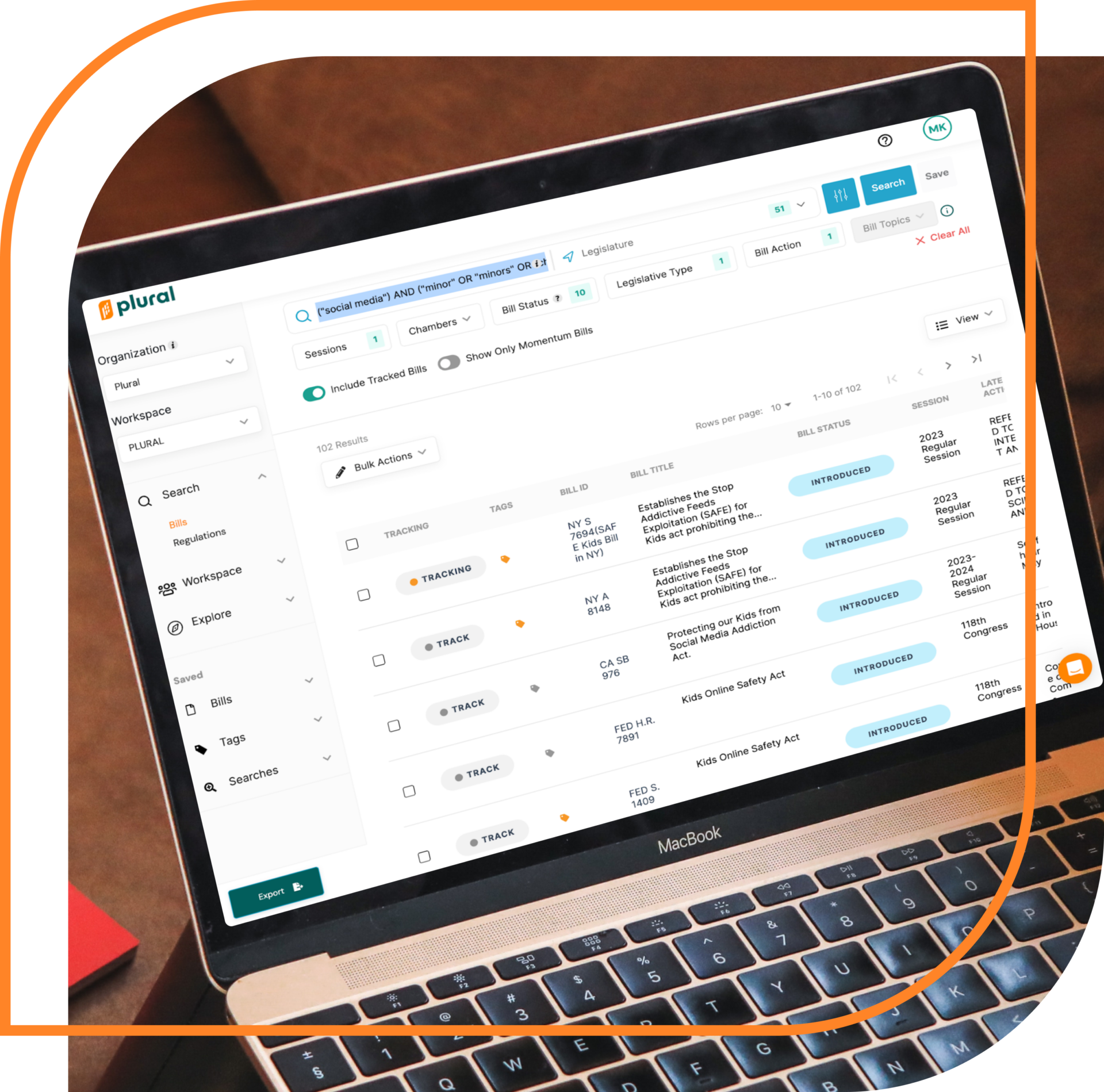
    Our search now reads ‘“Social Media” AND Minor” OR “Minors” OR “Children” OR “Kids AND “Algorithm” OR “Algorithmic” OR “Addictive” OR “Restrict Access”‘. It now returns 102 results, including both the California bill and the New York bill mentioned above! Not bad for a nationwide search on a hot-button issue.

    Using Boolean Searching for Your Legislative Discovery

    While the specifics of this example may not apply to your use case, everyone can benefit from mowing down some of the haystack in their search. This is work we love to partner with you on, so don’t hesitate to reach out today!

    Get Started With Plural

    Regardless of your policy focus, Plural helps you get and stay ahead in the legislative landscape. With Plural, you’ll:

    • Access superior public policy data 
    • Be the first to know about new bills and changes in bill status
    • Streamline your day with seamless organization features
    • Harness the power of time-saving AI tools to gain insights into individual bills and the entire legislative landscape
    • Keep everyone on the same page with internal collaboration and external reporting all in one place

    Create a free account or book a demo today!

    More Resources for Public Policy Teams

  • VIDEO | Discover and Connect With Legislators Using Plural

    VIDEO | Discover and Connect With Legislators Using Plural

    Welcome to Plural, your gateway to in-depth policy insights across 53 U.S. jurisdictions. In this video, we’ll dive into how you can utilize our tools to discover and connect with legislators.

    Get started with Plural today to make informed connections that matter.

  • Crafting an Efficient Rapid Response Campaign With Plural

    Crafting an Efficient Rapid Response Campaign With Plural

    A rapid response campaign is an organization’s effort to respond to key events. Learn how to use Plural for rapid response to public policy developments today!

    Government relations and advocacy work require organizers to balance a focus on the past, present, and future. Advocates must use historical context like past legislative activity to inform their work. Doing so helps to:

    • Ensure compliance with laws
    • Inform policy positions
    • Contextualize current events

    At the same time, they must be forward-thinking. Proactively planning their organizations’ agenda and identifying upcoming threats or opportunities is key. Various processes and tools allow us to analyze past activity and anticipate what is to come. Often, the most challenging aspect of this work is responding to unexpected events or changes in the present. 

    This work is often referred to as rapid response. Rapid response can be as important to an organization’s advocacy strategy as past learnings or future agendas. But the irregular and unexpected nature of rapid response work can mean that this key aspect of a holistic advocacy process is overlooked in our day-to-day work. Although the events that may trigger a rapid response campaign are, by nature, sudden, effective rapid response management should be given time and focus in periods of crisis and calm. Read on to learn more about rapid response work within the government relations and advocacy space. Plus, we’ll discuss how Plural can set your team up for success in rapid response work. 

    What Is a Rapid Response Campaign?

    In public policy work, rapid response refers to an organization’s efforts to respond to an emergent development, event, opportunity, or crisis. Events that might trigger a rapid response include:

    • A positive event, such as a sudden legislative win
    • A negative event, such as a public health crisis
    • A specific event, such as an unexpected change in leadership at an organization
    • A general event, such as an international security incident

    Because rapid-response campaigns react to unexpected occurrences, strategies must be malleable and dynamic. When an event occurs, an organization with a proper rapid-response strategy will already have a game plan for determining its course of action. 

    A significant portion of rapid response is communications. Organizations need to quickly and effectively communicate their position, needs, or recommendations to their target audiences. This communications strategy often includes press releases, news conferences, and media engagements. As we see this play out in our daily lives, it can seem natural that a company will release a statement after receiving a large grant, or that a politician will hold a news conference following a natural disaster. However, such organized responses only take place after hours of preparation. When it comes to communications, it is important to consider factors such as who their audience is and how they want to reach them. 

    But communication is often just one aspect of a rapid response. Organizations also respond with direct action, policy changes, and material support. The onset of the COVID pandemic in 2020 provides us with countless examples of rapid response, including from within the public policy space. Organizations had to address the start of the pandemic and developments within it with clear communication. They also had to manage workplace safety decisions, public health protocols, and extra support for the most vulnerable. 

    Robust rapid response plans account for necessary communications as well as any additional action needed. They’ll also include a periodic review to analyze the effectiveness of implementations. 

    Key Steps to a Successful Rapid Response Campaign

    As mentioned above, successful rapid-response campaigns begin far before the trigger event occurs. Each organization’s rapid response strategy should be customized to fit their specific needs and opportunities. However, we have listed a few core steps in rapid response planning and execution below. 

    Monitoring The Issues

    First, it is important to understand which issues will require rapid response. For established organizations, this can be done by assessing organizational history. Find where communication or action has been made in the past. All organizations should clearly define the issues that require rapid response. Generally, this includes those that:

    • Have a significant effect on the organization’s mission, purpose, or impact. 
    • Require the organization to act or communicate quickly. This could be due to an approaching deadline or because the organization needs to lead with communications.

    It is worth applying a narrow definition of the two bullet points above. Doing so helps identify the most impactful issues to your organization. With this knowledge, it’s straightforward to identify what channels to monitor to stay on top of developments in that space.

    Once you have determined the circumstances that trigger a rapid response, then assess how you can monitor these circumstances. Aim to identify a trigger event proactively, before it arises. In some cases, issues requiring rapid response will be publicized and therefore obvious. In others, an impactful issue may not be noticed by outside organizations or the news. Within this context, a timely response may rely on your ability to monitor your issue space. This issue often arises for advocacy issues working on very complex, but important, legislative issues. Often, the populations impacted by the issue at hand may rely on these advocacy organizations to identify a new policy proposal and discern what it could mean for them before taking action. Without a way to monitor public policy around-the-clock, organizations risk finding out about important developments when it is already too late.

    Understanding Your Audience

    Organizations should already be aware of their various audiences and how to reach them. While each rapid response strategy may involve different audiences, communication typically goes to:

    Advocates and Affected Community Members

    It’s important to have the ability to quickly contact those who may be impacted by a new policy development. This is especially true for non-profits or service organizations.

    Media Members

    The media can be a useful amplifier for your message, including press releases, announcements, or other key statements. Finding and building rapport with a diverse set of media members before you may need to contact them is vital. 

    Employees

    Rapid response may be necessary to communicate information within your organization. This is especially true for large organizations. Be aware of not only who needs information, but also who they should receive that information from. Regularly review an organization chart to identify the pathways through which information should be shared.

    Developing and Maintaining Organizational Information

    When it comes to rapid response communication, it is important to identify what you want to say and who you want to say it to. Defined audiences from above can make your audience selection much more efficient. As for what you want to say, it will of course be reliant on the often unexpected situation at hand. Reference past communications, templated designs, and static background information, like your organization’s mission and history. This information should be readily available to review and utilize when forming communications.

    It’s also important to have clearly defined decision-making roles within your rapid response strategy. Decision-makers can vary depending on the issue at hand. However, they should be as consistent as possible to ensure you are able to move quickly and decisively. Information about this structure should be communicated to those decision-makers so they are aware of and prepared for their role. 

    Reacting Quickly

    Rapid response is only as effective as it is timely. Traditional announcements, positions, or actions taken by an organization may be deliberated over and planned for months. Rapid response reactions must maintain the same level of validity and clarity while being made within hours or days. Once your rapid response processes are set up, reacting quickly should be as easy as following protocol. It’s important to trust the established process while also taking note of where it could be improved. 

    Engaging With Partners and Stakeholders

    A core team of decision-makers is important for moving quickly and efficiently. However, there may be additional stakeholders that should remain apprised of your activity. Generally, it can be helpful to think of this audience as those you want to keep informed, but don’t necessarily need approval or consultation from. A common example is a partner organization working in a similar space. You may want to keep this aligned organization apprised of any positions or actions you are taking. Doing so helps ensure consistency and efficiency. It also helps build rapport and trust with stakeholders, while also decreasing the likelihood of mixed messages reaching your audience. 

    Evaluating Your Impact

    As with any organizational process, it is important to track performance and find areas for improvement. Depending on your organization, your rapid response protocol may be utilized five times during a legislative session, or once a year. Regardless of the frequency of use, consistently review the impact of each use. One easy strategy is to create a form or survey for those involved in the process. Questions could include:

    • How would you define the primary objective of this rapid response campaign?
    • Who would you define as the audience of this rapid response campaign?
    • Do you feel we achieved our objective? Why or why not?
    • Do you feel we reached our audience? Why or why not?
    • What went well during the campaign?
    • What could have gone smoother throughout the campaign?

    Using Plural for Rapid Response Campaigns

    Regulatory action is a common source of anxiety and impact for organizations of all sizes. Legislative intelligence tools like Plural are extraordinarily useful within the rapid response context. Plural’s AI-based productivity features are a key differentiator when it comes to rapid response. 

    Plural allows for improved and automated legislative monitoring through intelligent searches. Your searches will run constantly in the jurisdictions of interest to you. When developments arise, you’ll be notified in real-time. Whether it is an unexpected amendment, an upcoming public hearing, or the passage of a new law, Plural is the first step in the rapid response process. 

    Plural’s open data and collaboration features unlock new ways to engage your audiences and stakeholders. Our AI summarizes complex legislation into the simplest terms, enabling you to quickly take informed action. In addition, Plural’s public tags allow you to share customized lists of legislation with your audience, giving them all the information and tools they need to react. In all, Plural helps you bridge the gap between the government and your audience. 

    Finally, Plural’s flexible structure allows for you to organize and act from within the tool. Organizations use Plural’s Workspaces to communicate with various audiences, reviewing those communications alongside the source material. This is helpful within the process of reacting to a new legislative development. It also improves your ability to assess impact. This information will always be available to you to review, share, add to, and edit. Plural is your all-in-one rapid response home-base. 

    Beyond research, advocacy, and education, rapid response is a core use case for Plural. Interested in learning more about how Plural can work for your organization? Book a consult today!

    More Public Policy Resources

  • Plural for Telecom Companies

    Plural for Telecom Companies

    Telecom companies operate in a rapidly evolving sector. In this context, technology advances and regulatory changes happen at breakneck speed. Their success hinges on staying ahead of several critical public policy issues. These include spectrum allocation, net neutrality, and cybersecurity and broadband access. Policy issues don’t just affect how telecom companies deliver services. They also impact how they compete and innovate in the marketplace.

    In this complex landscape, Plural is an indispensable tool for telecom companies. With Plural, these companies gain access to real-time updates and in-depth analysis of policy changes. This information allows them to anticipate and proactively respond to new bills. Plural’s platform enables telecom companies to stay informed, engage in policy advocacy, and make strategic decisions that align with their business goals and regulatory requirements.

    Key Public Policy Issues for Telecom Companies

    Public policy can impact telecom companies’ effectiveness and success. As such, monitoring bills as they move through the legislative process is essential. Plural helps telecom companies mitigate policy challenges, gain a strategic advantage, and serve their customers .

    Learn more about the specific public policy issues that impact telecom companies. Plus, begin to learn about how Plural helps telecom companies track these issues.

    Spectrum Allocation and Management: A Balancing Act

    Access to spectrum is the lifeblood of the telecom industry. It’s essential for everything from mobile phone services to broadband. Telecom companies’ approach to spectrum allocation is not just about ensuring access. Their approach must incorporate effective management of this scarce resource. Efficient spectrum management helps minimize interference and maximize public benefit.

    Telecom companies must advocate for policies that ensure they have the spectrum they need to serve their customers. With premium policy data and advanced search tools, Plural mitigates the challenge of discovering relevant bills. Plural helps telecom companies track the landscape of spectrum allocation and management policies.

    Net Neutrality: The Fair Traffic Debate

    Net neutrality is the principle that all internet traffic should be treated equally. This topic is another hot-button issue for telecom companies, who often find themselves in the middle of this debate. Policies around traffic prioritization and service levels impact their business models and customer service strategies. Plural offers data- and AI-driven insights, helping telecom companies stay ahead of key policies.

    Cybersecurity: Protecting the Network

    Cyber threats loom large in our digital era. Telecom companies are the front line of defense. They’re responsible for protecting network infrastructure and customer data. Supporting policies that bolster cybersecurity measures and establish clear data privacy guidelines is crucial for telecom companies. This support helps telecom companies maintain trust and ensure the integrity of their services. With tools like AI-generated bill topics, Global Bill Search, and advanced search, Plural helps telecom companies stay ahead of the game.

    Broadband Access: Expanding Digital Frontiers

    Despite widespread adoption of digital technologies, the digital divide persists. Expanding broadband access to underserved areas is not just a business opportunity for telecom companies. It’s also a chance to make a significant societal impact. Telecom companies often advocate for policies that promote infrastructure investment and market competition. In doing so, they play a key role in bridging the digital divide. To aid telecom companies on this journey, Plural offers tools for effective stakeholder engagement and internal communications.

    Tax Policy: Fueling Investment and Innovation

    Tax policies have significant impacts on telecom companies’ operating environment and bottom line. These policies can enable or prevent them from investing in new technologies and infrastructure. Favorable tax conditions support innovation and expansion, helping to drive the industry forward. Plural’s advanced search functionality and real-time updates help telecom companies in this endeavor.

    Plural for Telecom Companies

    Top telecom companies trust Plural for their legislative tracking and stakeholder engagement needs. Learn more about how Plural meets the challenge below.

    Best-In-Class Data

    Plural’s suite of tools allows for efficient deep dives into legislative information. This includes:

    • Tools to discover everything there is to know about a bill
    • Legislator and staffer information
    • Historical data
    • AI-powered insights
    • And more!

    With Plural, telecom companies turn potential policy threats into manageable challenges.

    Advanced Search

    Plural’s advanced search capabilities make it easy to filter through the noise to find relevant bills. Advanced search functionality is a game-changer for telecom companies. Search by keyword, legislature, session, bill status, and more. Plural helps telecom companies uncover the bills that affect their bottom line, customer service, and more.

    Tracking and Real-time Updates

    Public policy moves fast — Plural helps telecom companies discover key information quickly. Once telecom companies find the bills that matter, tracking them is simple. With real-time notifications on tracked bills, Plural users never miss an update. This immediacy transforms telecom companies’ ability to stay ahead and develop actionable strategies.

    Momentum Indicator

    Identifying which bills are gaining traction is crucial for telecom companies. These insights guide strategic planning and advocacy. Yet, without the right tools, policy teams must rely on manual tracking and intuition. This often leads to missed opportunities and misallocated resources. Plural’s Momentum Indicator offers telecom companies a novel way to assess a bill’s traction and potential for progress. With the Momentum Indicator, discovering which bills are likely to become law is quick and simple. This knowledge helps adjust their strategies and effectively influence policy.

    Global Bill Search

    Thousands of bills are introduced in each jurisdiction throughout each legislative session. For telecom companies, finding the exact bills that matter can feel like searching for a needle in a haystack. The ability to quickly and efficiently find the bills that matter is the key to staying ahead. Plural’s Global Bill Search is a sophisticated search engine that streamlines the discovery process to bring relevant legislation to the forefront. Global Bill Search helps telecom companies discover the national landscape of legislation on the topics that matter.

    AI Bill Topics

    For telecom companies, quickly identifying legislation that directly impacts their interests is critical. Plural’s AI-detected bill topics automatically detect and categorize bills into topics using advanced machine learning algorithms. This feature offers a panoramic view of the legislative landscape. Bill topics enable telecom companies to quickly hone in on bills that matter most to their work.

    Legislator and Staffer Data

    Success in public policy and advocacy comes down to who you know. Plural makes it easy to discover legislator and staffer data, helping telecom companies streamline their advocacy efforts. Between advocating for net neutrality or broadband access, Plural is a trusted partner for telecom companies.

    Upload Files, Make Annotations, Mention Teammates

    Once connections are made and meetings are set, Plural helps telecom companies stay organized. Plural is an all-in-one tool to organize public policy and advocacy work. Within Workspaces, policy teams can upload files, make annotations, and mention teammates in their work, all in one place.

    Public Tags

    Finally, Plural’s public tags help telecom companies share their public policy and advocacy work with stakeholders. Public tags redefine how policy teams communicate legislative information. Tags offer a clear, customizable system to organize and share legislative bills with anyone outside of Plural.

    Why Plural is Indispensable for Telecom Companies

    By leveraging Plural, telecom companies go beyond reacting to fast-paced changes. They’re able to shape the future of telecommunications. Plural helps telecom companies ensure they remain competitive and continue to deliver innovative, high-quality services to their customers.

    Interested in learning more? Book a demo today!

    More Resources for Public Policy Teams

  • Plural for Insurance Companies: Mastering Public Policy for a Resilient Future

    Plural for Insurance Companies: Mastering Public Policy for a Resilient Future

    Insurance companies operate in a dynamic environment where adaptability is crucial. Shifts in public policy can turn the tide overnight, changing their operating environment. Liability risks, economic uncertainties, and climate change further complicate these dynamics.

    Developing a keen awareness and proactive management of policy developments can help insurance companies safeguard their interests and ensure regulatory compliance. They need robust tools to stay ahead and maintain their edge. In this context, having a tool like Plural isn’t just useful; it’s essential.

    Plural helps insurance companies gain real-time legislative insights. Best-in-class data helps companies make cutting-edge, data-driven decisions that protect their interests. With Plural, insurance companies can go beyond reacting to the world’s changes. They’re able to strategize effectively, staying ahead of industry trends and policy shifts. Plural helps ensure that insurance companies’ operations are both resilient and forward thinking.

    Key Public Policy Issues for Insurance Companies

    Public policy can impact insurance companies’ bottom line or the business environment they operate in. As such, monitoring bills as they move through the legislative process is essential. Learn more about the specific public policy issues that impact insurance companies. Plus, begin to learn about how Plural helps insurance companies monitor these issues.

    Understanding Liability and Navigating Lawsuits

    The threat of liability lawsuits is ever-present. For insurers, these aren’t just potential financial setbacks. They’re puzzles that require precise, preemptive strategies. In this context, insurance companies often seek to influence policy that favors fair liability standards. Timely data also helps mitigate risks and allows insurance companies to stay informed.

    Plural’s advanced search tools and real-time updates help mitigate these challenges. These tools help insurance companies gain a strategic advantage, informing advocacy and decision-making processes. Plural’s best-in-class public policy data ensures that insurance companies get comprehensive information in real-time.

    Economic Stability: Navigating Uncertainties

    Our economic is constantly fluctuating. Given this context, insurance companies play the long game. They seek to balance risk and reward amidst uncertainties. They also look to policies that ensure stability and growth. In Plural, insurance companies gain a partner that offers more than just forecasts. Plural provides a panoramic view of the economic landscape (or the landscape of any policy issue.) With this perspective, insurance companies can build a foundation not just for stability, but for growth.

    Innovating with Health Care Reform

    As health care policies evolve, insurance providers must stay informed. This knowledge helps them remain competitive and compliant. Plural provides in-depth data on every policy issue, healthcare included. Comprehensive data aids insurance companies in developing strategies that align with new regulations and market demands.

    The Climate Change Imperative

    Climate change presents unique risks to the insurance industry. Natural disasters are becoming all to common, impacting companies’ bottom line. Plural’s tools allow insurance companies to access the latest policy developments on climate change. As such, Plural helps facilitate informed decision-making on sustainable practices, risk management, policy advocacy, and climate resilience.

    Securing the Future: Cybersecurity Concerns

    Cybersecurity is a critical issue for insurance firms. Insurers guard vast amounts of sensitive data. This responsibility comes with its own set of challenges. Plural equips insurance companies with the latest in cybersecurity policy trends. With this information, insurance companies ensure that protecting data isn’t just a priority but a promise kept.

    Plural for Insurance Companies

    Top insurance companies trust Plural for their legislative tracking and stakeholder engagement needs. Learn more about how Plural meets the challenge below.

    Best-In-Class Data

    Plural’s suite of tools allows for efficient deep dives into legislative information. This includes:

    • Tools to discover everything there is to know about a bill
    • Legislator and staffer information
    • Historical data
    • AI-powered insights
    • And more!

    With Plural, insurance companies turn potential threats into manageable challenges.

    Advanced Search Tools

    With Plural, it’s easy to filter through the noise to find relevant data with advanced search capabilities. Advanced search functionality is a game-changer. Search by keyword, legislature, session, bill status, and more. Plural helps insurance companies uncover the bills that affect their bottom line.

    Real-Time Updates

    Public policy moves fast — Plural helps insurance companies discover key information quickly. With real-time notifications, Plural users never miss an update. This immediacy transforms insurance companies’ ability to stay ahead and develop actionable strategies.

    Global Bill Search

    Thousands of bills are introduced in each jurisdiction throughout each legislative session. For insurance companies, finding the exact bills that matter can feel like searching for a needle in a haystack. The ability to quickly and efficiently find the bills that matter is the key to staying ahead in the world of public policy. Plural’s Global Bill Search feature offers a sophisticated search engine designed to streamline the discovery process and bring relevant legislation to the forefront. Global Bill Search helps insurance companies discover the national landscape of legislation that impacts their bottom line and operating environment.

    Momentum Indicator

    Identifying which bills are gaining traction is crucial for insurance companies. These insights guide strategic planning and advocacy. Yet, without the right tools, policy professionals must rely on manual tracking and intuition. This often leads to missed opportunities and misallocated resources. Plural’s Momentum Indicator offers insurance companies a novel way to assess a bill’s traction and potential for progress. With the Momentum Indicator, discovering which bills are likely to become law is quick and simple. This knowledge helps adjust their strategies and effectively influence policy.

    Why Plural Is Indispensable for Insurance Companies

    Insurance companies operate in the complex interplay of policy, economic, and societal challenges. In this context, they find Plural to be a powerful ally. Plural offers more than insights; it provides a strategic advantage in a world where policies change as quickly as the weather. With Plural’s tools and insights, insurance companies navigate the policy landscape with confidence. Plural helps ensure that insurance companies are well-prepared to face future challenges and seize current opportunities.

    Interested in learning more? Book a demo today!

    More Resources for Public Policy Teams

  • Revolutionizing Public Policy Research in Academia: Plural for Universities

    Revolutionizing Public Policy Research in Academia: Plural for Universities

    When it comes to academic research, technology presents unparalleled opportunities. This is especially true within public policy, legislative, and government studies. Colleges and universities stand at the forefront of this effort, tasked with providing helpful information and shaping students into prepared professionals.

    Studying public policy and government data comes with unique challenges. The sheer volume of information available can be overwhelming, making it difficult for students and researchers to pinpoint relevant data amidst the noise. Further, the existing infrastructure for accessing legislative information is often outdated, fragmented, and decidedly not user-friendly. These challenges unnecessarily complicate the policy research process.

    Software tools like Plural become indispensable in this context. With best-in-class public policy data, Plural serves as a navigational aid, guiding students and researchers through the research process. Plural enables users to access, analyze, and synthesize information with greater efficiency and accuracy.

    By streamlining the policy research process, Plural goes beyond enhancing academic work. Adding Plural to your University’s tech stack helps ensure that students are equipped with real-world public policy skills. Adopting software tools like Plural are a critical step towards preparing the next generation of policy leaders.

    Plural for Universities

    Plural has partnered with universities across the country. Through harnessing the power of Plural’s public policy intelligence tool, researchers and students can generate powerful insights into history, current trends, representation, and more. Learn more below.

    Best-in-Class Public Policy Data

    No matter what issue you’re researching, Plural offers an intuitive, easy-to-use solution. Plural’s best-in-class public policy data ensures that students and researchers get comprehensive information in real-time.

    Plural’s suite of tools allows for efficient deep dives into legislative information. This includes:

    • Tools to discover everything there is to know about a bill
    • Legislator and staffer information
    • Historical data
    • AI-powered insights
    • And more!

    Plural helps students and researchers develop real-world, comprehensive policy intelligence. Understanding the nuances of policy changes, legislative developments, and their implications sets the tone for impactful research and informed debate.

    Advanced Search, Advanced Insights

    With Plural, it’s easy to filter through the noise to find relevant data with advanced search capabilities. Advanced search functionality is a game-changer for public policy students and researchers. Search by keyword, legislature, session, bill status, and more. Plural helps students and researchers uncover what they’re looking for.

    Precise querying ensures that they can find specific legislative documents, legislator information, and historical data relevant to their work. With easy access to the right information, students and researchers can begin generating impactful insights and knowledge. Advanced search’s helpfulness goes beyond access. It’s about enabling researchers to build a more nuanced, comprehensive understanding of policy.

    Real-Time Updates

    Public policy moves fast — Plural helps students and researchers discover key information quickly. With real-time notifications, Plural users never miss an update. When it comes to research, success hinges on the relevancy of the information at hand. Real-time updates ensure that research is always grounded in the most current data. This immediacy transforms students’ and researchers’ ability to contribute timely and relevant insights to academic and policy discussions, significantly enhancing their success and impact in the field.

    Collaboration Without Limits

    At Plural, we know that an effective education is built on knowledge-sharing and collaboration. What’s more, in the field of public policy research, where perspectives from various disciplines can enrich analysis, the ability to work together effortlessly is invaluable. That’s why we never limit collaboration.

    Plural encourages seamless collaboration, breaking down traditional barriers within academic institutions. Tag legislation based on topics, and invite peers to securely collaborate on projects, even if they don’t have a Plural account. Students can even create separate secure workspaces for each project.

    Seamless Organization

    Public policy research can be messy. Plural helps students and researchers organize their thoughts and work. Best-in-class collaboration tools allow you to keep your peers and colleagues in the loop. Organize bills with tags, upload files, add notes and annotations, and more, all in one place.

    Preparing the Next Generation

    Leading institutions like Columbia University and the University of Minnesota trust Plural to enhance their students’ and researchers’ policy work.

    The benefits of Plural for policy research go beyond immediate improvements to research output and collaboration. Plural plays a crucial role in preparing the next generation of policy professionals. By integrating Plural into their curriculum, universities offer a hands-on experience with the complexities of policy research. Plural equips students with the skills needed to navigate and influence policy.

    As universities adapt to and incorporate technology, tools like Plural become increasingly critical. In Plural, academic institutions have a robust partner in their efforts to contribute to policy discourse and prepare students for their future.

    Plural for Universities: Get Started

    Plural is not just another software provider; it’s a pivotal partner for academic institutions dedicated to leading the charge in public policy research. By offering tools that enhance access to data, streamline research processes, and foster collaboration, Plural sets a new standard for academic research in the digital age.

    Interested in learning more about Plural? Book a demo today!

    More Resources for Public Policy Researchers

  • How to Use Policy Monitoring Tools

    How to Use Policy Monitoring Tools

    Adding Plural’s Momentum Indicator to your suite of policy monitoring tools can enhance your legislative strategy. Learn more today!

    In the dynamic world of policy work, timing is everything. The ability to anticipate legislative movement gives policy professionals a strategic edge. However, gauging the momentum of a bill is no small feat. Plural’s Momentum Indicator offers a novel way to assess a bill’s traction and potential for progress.

    The Challenge of Predicting Legislative Progress

    Identifying which bills are gaining traction is crucial for strategic planning and advocacy. Yet, without the right tools, policy professionals must rely on manual tracking and intuition. This often leads to missed opportunities and misallocated resources.

    Plural’s Momentum Indicator: Your Legislative Monitoring Tool

    Plural’s Momentum Indicator helps policy teams cut through the uncertainty. The Momentum Indicator provides a visual cue that indicates a bill’s momentum at a glance. Utilizing AI and comprehensive legislative data, the Momentum Indicator offers a predictive insight into the potential movement of legislation.

    How It Works

    Examining Historical Data

    To develop the Momentum Indicator, the Plural team began by examining data from previous sessions. This includes:

    • Which bills went up for a passage vote in one or more chambers
    • The actions on those bills
    • Whether those bills were signed by executives

    Training an AI Model

    A machine learning model was trained using the historical legislative data. The model was trained to find patterns and make predictions about which historical bills would be most likely to come up for a vote. By the end of this process, Plural developed a predictive machine learning system capable of identifying bills with potential momentum.

    Easily Find Bills With Momentum

    Plural users can filter their search results to only show bills with potential momentum. To do so, open advanced search filter options and turn on “Show Only Momentum Bills.”

    Real-Time Updates

    The Momentum Indicator is updated in real time, reflecting the latest developments. As such, it ensures that policy professionals have the most current information at their disposal.

    Where to Find It

    Plural makes identifying bills with potential momentum easier than ever. Bills with potential momentum will have a pulse icon next to the Track button and on their Bill Detail page. Plural users can evaluate a bill’s momentum without diving into the details. As such, the Momentum Indicator allows for more efficient prioritization.

    Benefits Unpacked

    Strategic Insight

    Gain an immediate understanding of a bill’s likelihood to advance. The Momentum Indicator helps inform strategic decisions and advocacy efforts.

    Efficiency in Tracking

    Save time by focusing on bills with significant momentum. With efficient tracking, policy teams avoid the pitfalls of tracking legislation that is unlikely to move forward.

    Enhanced Awareness

    Stay ahead of legislative trends by monitoring the momentum of bills across various jurisdictions and topics.

    Get Started With Plural‘s Policy Monitoring Tools

    Get ahead with Plural’s Momentum Indicator. Sign up for a demo today and start leveraging real-time legislative insights. Don’t let critical movements catch you by surprise; let the Momentum Indicator be your guide to the legislative landscape.

    Have Plural’s policy monitoring tools helped shape your legislative strategy? We invite you to share your experiences, highlighting how this tool has made a difference in your policy work. Your story can illuminate the path for others seeking to navigate the complexities of legislation with confidence. Share your experience at support@pluralpolicy.com.

    More Resources for Public Policy Teams