At Plural, our top priority is delivering the right public policy data to you, when and how you need it. Our platform is designed to categorize and deliver policy intelligence that is:
Comprehensive – You’ll never miss a bill.
Relevant – Targeted searches cut through the noise so you get only what matters.
Timely – Notifications arrive when you need them, in a format that’s easy to digest.
Beyond data delivery, Plural’s AI-powered analysis, intuitive interface, and collaboration tools help policy professionals act on insights more efficiently.
Stay in Control of Your Notifications
In this blog, we’ll show you how Plural’s customizable legislative bill notification settings let you receive updates at the cadence that best fits your workflow. We’ll also walk through an example of how different team members might automate their notifications to meet their specific needs.
Plural’s Four Notification Types
Plural organizes notifications into four distinct categories, making it easy for teams to optimize their data delivery. Each team member can adjust the frequency—or opt out—of any notification type to ensure they’re getting just the right amount of information.
Bill Update Notifications
Most Important For: Understanding Key Bill Movements
Plural will send you alerts of recent action on bills you are tracking in Plural via Bill Update Notifications. These emails will include each of your tracked bills with new actions, alongside a description of that new action and a link to visit the bill page within your Plural instance. Users leverage bill update notifications to keep their eye on the progress of the bills that matter to them most and to be the first informed about an upcoming public hearing or vote.
Saved Search Notifications
Most Important For: Bill Discovery
Plural’s saved search tool can do your team’s discovery work for you. After crafting a search that returns the bills a user cares about, they can save it to run constantly in the background and be alerted anytime a new result matches that search criteria. Saved Search Notifications highlight the newly introduced or amended legislation that your team needs to be aware of.
Recommended Bills Notifications
Most Important For: A Second Layer of Bill Discovery
In addition to the bills surfaced by your saved searches, Plural offers an additional tool to enhance your bill discovery through Recommended Bills. These recommendations, sent once weekly, are based on issue areas that matter to you. While these results are less tailored to your specific use case, they can serve well as an additional net to capture any legislation of interest you may have missed, or to monitor the pulse of an issue area within a jurisdiction.
Collaboration Notifications
Most Important For: Monitoring Team Activity, Engaging Team Members
Unlike similar tools, Plural was built with collaboration in mind. We understand that policy isn’t made in a vacuum and that advocacy teams must work with various (internal and external) stakeholders in their efforts to fight for their communities. Plural’s collaboration features allow you to easily share legislation, curate bill lists alongside team members, and collaboratively markup policy proposals. Collaboration notifications alert you to this activity, This can be especially useful for communication with stakeholders who may not be in the tool every day. If I know that I will need to ask our legal counsel questions periodically, but that they won’t be doing day-to-day tracking, I can ensure they have just their collaboration notifications turned on so that when I tag them in a bill asking for feedback I know it will stand out in their inbox.
Customizing Your Notifications
Each user has full control over which notifications they receive and how often. You can choose to get updates in real time, daily, or weekly.
Beyond these basic settings, Plural offers even more customization. Users can enable notifications for specific saved searches or adjust settings within individual workspaces. Many teams take advantage of this flexibility by setting general updates to daily or weekly while keeping real-time alerts for their most critical bills.
Example Use-Case: Policy Tracking for a Multi-layered, Distributive Team
Suppose Civic Eagle Associates (CEA) tracks state legislation across the country for their clients. CEA has a team of policy staff tasked with identifying new legislation that may be of interest to their clients, legislative consultants who create reports for clients, and legal counsel offering analysis to legislative consultants.
Policy Staff would benefit from turning on saved search emails at a daily cadence. This would allow them to log on each day with a list of bills to analyze to determine whether they fit into a client’s legislative interests. Bill update notifications would be less important to this group as they are primarily interested in bill discovery.
Legislative Consultants, on the other hand, could use saved search notifications sparingly but would want bill update notifications turned on at a daily or as soon as possible cadence. These bill notification emails could serve as the starting point for the updates they will send to their clients. Legislative Consultants would also turn their collaboration emails on to ensure they are updated when they receive a tag from Legal Counsel or Policy Staff.
Legal Counsel, who in this scenario is largely involved only when their analysis is needed, could rely primarily on collaboration emails to alert them whenever their help is needed.
Conclusion
Every year, we help thousands of users cut through the noise and stay on top of the legislative action that matters most to them. Customizable notifications are a key part of making this possible. With Plural, policy professionals can trust that they’re receiving accurate, timely updates tailored to their specific needs. Teams can align notifications with their workflows and responsibilities, improving efficiency in their advocacy efforts.
As we continue expanding our data, enhancing our tools, and refining the user experience, we’ll keep evolving our alert system to deliver even more value.
At Plural we’re proud to announce the launch of our newest tool for better understanding legislation, Plural Policy Analyzer.
Policy Analyzer is an AI Assistant that takes in legislation and distills its bill text into accurate and concise summarization of what the legislation is doing.
If you’ve been following our brand for awhile, you’ll know that Plural has been dedicated to making best-in-class software available for policy professionals, government affairs teams, and advocacy organizations. Since 2019, we’ve been utilizing the power of AI in our core product — Plural Bill Tracking & Intelligence — to help teams monitor, analyze, and collaborate on legislation. And while we still offer this tool with its robust features, we’ve recognized that there is an interest in a lightweight tool for rapid analysis.
“As policy landscapes grow increasingly intricate, everyone needs robust tools to stay ahead. The Plural Policy Analyzer is our answer to this demand. It not only saves time but also ensures that users are equipped with meaningful insights to influence their work, and not just using any ‘AI’ tool.” – Damola Ogundipe, CEO.
What makes Plural Policy Analyzer different from ChatGPT?
Utilizing artificial intelligence to help our users better understand and respond to public policy processes has been central to our thesis at Plural since our founding. The public policy process is changing and there is a need for responsible application of AI in this space.
Through internal testing, research, user interviews, and comparisons with similar tools like ChatGPT and Gemini, we know that the success of our tool is because it is distinct in the following ways:
Brevity& Clarity – A key function of any bill summary is to be clear and concise in a way that saves the user time when they choose to review the summary rather than the complete text. Plural’s summaries are designed to be consistently clear and concise. ChatGPT summaries are wordy, and often carry over some of the structure of the bill text itself, making them challenging to read quickly.
Accuracy – Another key function of a bill summary is that it is accurate. We have designed Plural’s tool to generate summaries based on a true understanding of a bill’s components, and this results in summaries that don’t contain the inaccuracies that often made their way into the ChatGPT summaries in our analysis.
Precision – As mentioned above, training our model to understand a bill’s unique structure, including additions and deletions, was key to generating summaries that specifically target the changes that a bill is proposing while ignoring extraneous text. The ChatGPT summaries in our analysis often inaccurately summarize existing law found in the bill text as new legislative text that is being proposed. Also, because Base ChatGPT doesn’t have access to information after September 2021, it is unable to generate summaries of bills considered after that time on-demand.
We are constantly measuring the performance of each of our AI-powered tools, adjusting them to improve their output, and creating new ways for users to access these insights.
And now you can access these insights for $29 per month.
The launch of the Policy Analyzer represents Plural’s commitment to empowering organizations with modern technology to navigate the ever-changing policy environment. Designed with input from industry experts and tested in real-world scenarios, the Policy Analyzer aims to be the go-to solution for policy analysis and advocacy.
Public policy doesn’t happen in a vacuum. Rather than falling out of a coconut tree, each bill exists in the context of all that came before it. That’s why, for policy professionals, looking at bills from past sessions and historical legislative data is key.
But navigating through piles of legislative documents can be daunting, especially when you need to access bills from past sessions.
Thankfully, Plural makes it easier than ever to cut through the complexity and zero in on exactly what you need from past sessions.
Get Started With Plural to Easily Search Historical Legislative Data
Don’t let the volume of legislative history slow you down. Use Plural to search efficiently and stay informed about the developments that shaped today’s policies. Start searching past sessions now and bring the power of historical data to your fingertips. Create your free account or book a demo today!
With over 190,000 bills introduced across the United States each legislative session, finding the specific legislation you need can feel like searching for a needle in a haystack. But for policy professionals, finding a legislative research tool that quickly locates relevant bills and helps analyze them is key to making informed decisions.
That’s where Plural comes in. Plural’s legislative research tool streamlines your search with advanced query capabilities. Let’s explore how to harness the power of effective search techniques to navigate this vast legislative landscape.
Get Started With Plural’s Premium Legislative Research Tool
Top public policy teams trust Plural to:
Access superior public policy data
Be the first to know about new bills and changes in bill status
Streamline their day with seamless organization features
Harness the power of time-saving AI tools to gain insights into individual bills and the entire legislative landscape
Keep everyone on the same page with internal collaboration and external reporting all in one place
Plural is the policy collaboration tool that eases the process of working with in-house counsel on policy work. Learn more today.
On average, 109,000 bills are proposed in legislatures across the United States each year. Navigating this intricate and ever-evolving landscape demands keen insight and strategic collaboration. This is especially true when it comes to the partnership between policy teams and in-house counsel. For policy professionals, collaborating with legal experts is crucial. This collaboration unlocks the potential to effectively navigate complex legal landscapes. It also ensures that policy initiatives are impactful and adhere to legal and regulatory standards. Learn more below.
The Critical Role of In-House Counsel in Policy Work
In-house counsel is a pivotal force within any organization. This is particularly true in heavily regulated sectors. These legal experts do more than ensure compliance. They provide strategic insights that significantly influence policy outcomes. Not only do they aid in the task of translating complex legislation into actionable strategies, but they also mitigate risks by forecasting potential legal challenges.
The policy development process is complex. Not only are bills themselves dense and difficult to understand, but their legal implications can be the same. Involving in-house counsel empowers policy teams to leverage legal expertise. Early integration ensures that potential legal vulnerabilities are promptly addressed. From the outset, policy advocacy strategies are aligned with regulatory requirements. This proactive positioning leads to robust, sustainable policy outcomes as legal considerations are woven seamlessly throughout the strategic development and implementation process.
Common Roadblocks to Effective Collaboration
The need for collaboration between legal counsel and policy teams is clear. However, several challenges can hinder effective interactions. A primary challenge is communication. Legal jargon and principles are dense and complex, leading to misinterpretations and inefficiencies amongst policy teams. On the other hand, in-house counsel doesn’t always grasp the full scope of a policy’s implications beyond the legal perspective, focusing too narrowly on compliance.
Furthermore, organizational silos can severely disrupt effective collaboration. Legal and policy departments often operate independently with insufficient inter-departmental communication. These silos delay information sharing and complicate decision-making processes. They often result in missed opportunities for strategic alignment and compliance, underscoring the need for integrated strategies.
Overcoming Barriers: Insights from Research on Collaboration
Adopting modern technological platforms is key. Policy teams and in-house counsel alike need a tool that supports collaborative features, document management, and real-time communication — one that can effectively bridge the gap between policy and legal teams. This technology ensures that every stakeholder has immediate access to the most current updates, documents, and discussions. For policy and legal teams, Plural promotes a unified approach to policy development and execution. Learn more below.
Plural: Enhancing Collaboration Between Teams
Plural is an effective technological solution designed to bridge the gap between policy and legal teams. It offers real-time legislative tracking, collaborative Workspaces, bill annotation tools, and more. These features are all invaluable for teams looking to stay ahead of the curve when it comes to policy and legal work. With Plural, teams ensure that all members, regardless of department, can collaborate effectively. Each member will have instant access to crucial information, and everyone can take part in discussions with informed perspectives.
In particular, Plural’s Workspaces allows teams to:
Upload and organize documents
Track legislative changes
Annotate bills and share notes
What’s more, each update and activity is instantly accessible to all collaborators. Plural not only boosts transparency but also increases the efficiency of both policy and legal work. The end result is a cohesive, aligned strategy that reduces risks and enhances the impact of policy initiatives.
Plural: The Path Forward in Policy Collaboration
Effective collaboration between policy teams and in-house counsel leads to successful policy advocacy. As organizations navigate complex regulatory environments, they need premium collaboration tools and strategies. Leveraging platforms like Plural and cultivating an organizational culture that prioritizes open, regular communication can transform obstacles into opportunities. With Plural, top organizations ensure that their policy advocacy not only complies with legal standards but also achieves its intended impact.
What were Georgia’s health and social services laws from the 2023-2024 session? Read Plural’s AI-generated end-of-session report today.
At Plural, our mission is to enhance access to and understanding of the public policy developments that impact our daily lives. We strive to improve transparency by simplifying access to public information. To achieve this, we’ve harnessed technology to simplify processing and engaging with this information.
Harnessing the power of AI to innovate has been a key part of our strategy since our founding. While our approach to applying AI to public policy data has always been multifaceted, we’ve recently focused on generating comprehensive insights by utilizing our diverse datasets. Our latest innovation exemplifies this evolution in our AI strategy: Plural’s end-of-session report generator.
Originally piloted in Minnesota and now expanding across jurisdictions, this tool allows users to produce analyses of legislative actions on a range of topics throughout a single legislative session. All of our AI-driven insights are firmly grounded in primary public policy data — such as bill texts and voting records — rather than external sources like media reports. This commitment to core data ensures accuracy and minimizes bias. We continue to encourage users to view AI-generated tools as partners in research and writing and to carefully review and refine analyses to suit their specific needs.
Below, you can explore one of these reports, which evaluates legislative developments in healthcare and social services during Georgia’s 2023-2024 session.
Georgia 2023-24 Legislative Session: End of Session Report – Health and Social Services
This report summarizes key changes proposed by bills related to Health and Social Services during the latest Georgia legislative session.
Access to Care & Service Delivery:
Expanding Telehealth: HB 441 authorizes and regulates teledentistry, requiring health insurers to cover these services comparably to in-person care.
Rural Healthcare Workforce: HB 872 expands the service cancelable loan program to include dental students, aiming to attract dentists to underserved rural areas.
Supporting Nursing Workforce: SB 246 establishes a student loan repayment program for nursing faculty to address workforce shortages. SB 449 streamlines the certified nurse aide process and creates a provisional program for military medical personnel.
Strengthening Long-Term Care: HB 309 enhances financial stability requirements for personal care homes and assisted living communities to ensure continuity of care for residents. HB 1335 revises staffing requirements for these facilities, aiming to improve resident safety and well-being.
Improving Ambulance Services: HB 453 eliminates the annual license fee for ambulance services, potentially impacting funding and oversight mechanisms.
Public Health & Disease Management:
Addressing the Opioid Crisis: HB 395 authorizes schools to stock and administer opioid antagonists, expanding access to these life-saving drugs. HB 1028 authorizes standing orders for opioid antagonists and post-exposure prophylaxis for HIV prevention.
Combating Sexually Transmitted Infections: SB 46 mandates HIV and syphilis testing for pregnant women at various stages of pregnancy, aiming to improve early detection and treatment.
Supporting Individuals with Diabetes: HB 1183 requires schools to provide information on Type 1 and Type 2 diabetes to parents and guardians of students in grades 6-12.
Enhancing Cancer Care: SB 223 authorizes reimbursement for patient-incurred expenses related to cancer clinical trials, aiming to improve access to these trials. SB 315 regulates cost-sharing for diagnostic and supplemental breast screening examinations, ensuring they are comparable to mammograms.
Mental Health & Substance Use:
Expanding Access to Mental Health Services: HB 414 creates a grant program within the Department of Veterans Service to support behavioral health services for service members, veterans, and their families. SB 480 establishes a student loan repayment program for mental health and substance use professionals serving in underserved areas.
Protecting Healthcare Professionals: HB 455 establishes professional programs to address career fatigue and wellness among healthcare professionals, providing confidentiality and liability protections.
Addressing Alzheimer’s and Dementia: SB 571 adjusts the update cycle for the Georgia Alzheimer’s and Related Dementias State Plan to every four years and revises the advisory council’s membership and responsibilities.
Children & Families:
Supporting Foster Care: SB 216 authorizes longer respite care periods for foster parents, providing them with greater flexibility and support. SB 401 aims to improve data collection and reporting on foster care cases in juvenile courts.
Protecting Children with Epilepsy: SB 45 establishes “A.J.’s Law,” requiring schools to implement seizure action plans and train personnel to support students with epilepsy.
Addressing Child Support: SB 454 updates child support guidelines, focusing on low-income adjustments and parenting time considerations.
Other Notable Changes:
Prohibiting COVID-19 Vaccination Proof Requirements: SB 1 permanently prohibits state and local governments from requiring proof of COVID-19 vaccination for government services, with limited exceptions.
Limiting Liability for Mental Health Providers: HB 1409 limits liability for mental health care providers in certain circumstances, aiming to address workforce challenges.
Enhancing Hospital Safety: HB 383 enacts the “Safer Hospitals Act,” allowing hospitals to employ peace officers and enhancing penalties for assaults on healthcare workers.
Increasing Transparency in Healthcare: SB 197 enacts the “Health Care Practitioners Truth and Transparency Act,” requiring clear identification of healthcare practitioners’ qualifications and prohibiting misleading advertising. SB 505 enhances financial transparency requirements for hospitals.
Looking Ahead:
This legislative session saw significant activity in the Health and Social Services arena. The long-term impact of these proposed changes will depend on implementation and future legislative action. Key areas to watch include:
Workforce Development: Will loan repayment programs and other initiatives effectively address shortages in healthcare professions?
Access to Mental Health & Substance Use Treatment: Will new funding and programs translate into improved access to care?
Impact of New Regulations: How will changes to licensing, reporting, and other requirements affect healthcare providers and patients?
This report provides a high-level overview of key changes proposed during the legislative session. Further analysis and monitoring will be necessary to fully understand the implications for Georgia’s health and social services landscape.
Get Started With Plural
Top public policy teams in Georgia and across the United States trust Plural with their legislative tracking needs. With Plural, you’ll:
Access superior public policy data
Be the first to know about new bills and changes in bill status
Streamline your day with seamless organization features
Harness the power of time-saving AI tools to gain insights into individual bills and the entire legislative landscape
Keep everyone on the same page with internal collaboration and external reporting all in one place
Busy, dispersed public policy teams streamline their public policy workflow with Plural. Learn more about Plural’s solutions today.
Staying organized and maintaining efficient communication across a dispersed team can be daunting. Imagine a team spread across different locations. Some are analyzing legislation from home, others are strategizing and attending meetings in the bustling halls of the capitol. Despite their varying environments, they all share a common goal: to stay on top of high-priority bills.
This is where Plural shines. As an all-in-one tool designed for public policy professionals, Plural not only simplifies the legislative tracking process but also ensures that everyone is aligned and informed. Learn more about Plural’s solutions for dispersed teams.
Plural’s Legislative Tracking Solutions for Dispersed Public Policy Teams
Here’s how dispersed teams can leverage Plural to maximize their effectiveness and streamline their public policy workflow.
1. Searching for Legislation
The journey in Plural begins with efficiently searching through vast amounts of legislative information. With advanced search features, teams can quickly identify relevant legislation. Plural’s search functionality (and the entire tool) is intuitive and straightforward. Users can filter by session, jurisdiction, bill topic, and more. This functionality is critical when teams need to act quickly on legislative opportunities or threats. Plural is an indispensable tool for policy analysts and legislative aides alike, ensuring they’re always a step ahead.
2. Tracking Legislative Developments
Once the key pieces of legislation are identified, tracking their progress is crucial. Plural’s tracking tool enables users to receive real-time updates on bill movements, amendments, hearings, and more. This ensures that no critical information is missed and that the team can respond proactively to any changes. Customizable notifications cut through the noise to keep team members up-to-date on relevant developments. This proactive approach helps teams prepare their responses or adjust their strategies in real-time. Plural’s tracking tools and real-time notifications are invaluable during high-stakes legislative sessions.
3. Organizing with Tags and Workspaces
The next step is effectively organizing legislative information. This is where Plural’s robust Workspaces feature comes into play. Teams can create unlimited, customized Workspaces catering to specific projects or focus areas. Within these Workspaces, users can tag and categorize bills, making it easy to retrieve and discuss them during meetings or strategy sessions.
Plural’s organization tools extend to managing documentation and notes related to each bill. Notes and uploaded files are all stored securely and accessible by any team member, regardless of their location. Such organized systems reduce the time spent searching for information and allow teams to spend more time on planning and decision-making.
4. Collaborating and Communicating
Effective communication is vital for any team, especially those that are not physically co-located. Plural facilitates seamless communication and collaboration through integrated messaging systems and shared notes. Team members can exchange ideas, provide updates, and solicit feedback instantaneously. With Plural, they ensure that everyone is informed and engaged in real-time decision-making. Plural fosters a collaborative environment where all voices are heard, regardless of their physical location.
5. Utilizing AI-Driven Insights
Plural also incorporates AI-driven tools to enhance legislative insights. Plural users harness the power of AI to generate bill summaries and identify similar bills, among other tasks. These insights significantly speed up the legislative research process. AI capabilities help teams quickly understand complex legislative texts and find related documents. With Plural’s AI-powered tools, teams enhance their ability to strategize and act effectively. Plural’s high-tech support is crucial in enabling teams to navigate the dense and complicated public policy landscape.
Plural: The Best Legislative Tracking Tool for Dispersed Teams
Plural integrates searching, tracking, organizing, and communicating into a seamless public policy workflow. In doing so, Plural ensures that public policy teams are not only informed but also prepared to act swiftly and effectively. What’s more, the platform’s intuitive design and comprehensive features allow teams to spend less time managing information and more time making impactful decisions.
Plural is more than just a tool; it’s a partner in public policy management. It enables teams to amplify their impact by ensuring that every member, no matter their location, is working from the same well-organized playbook. As public policy evolves rapidly, Plural can make the difference between reacting to changes and shaping them.
The pharmaceutical industry is complex and highly regulated. Within this environment, staying informed about public policy developments is not just advantageous — it’s essential. Professionals within the pharmaceutical industry need to stay up-to-date on regulatory changes, healthcare reforms, patent laws, compliance requirements, and more. Each can dramatically affect how pharmaceutical companies operate and compete. It’s clear that pharmaceutical companies need a tool that can guide them through this maze. Plural is an indispensable tool for these companies, helping them monitor relevant legislative and regulatory changes. With Plural, it’s easier than ever to create adaptive strategies, maintain compliance, and innovate effectively. Learn more below.
Key Public Policy Topics for Pharmaceutical Companies
Policy professionals working for pharmaceutical companies need to be aware of a myriad of public policy issues. Whether discrete or intersecting, each can have a dramatic impact on how the company operates. Let’s dig deeper.
Drug Approval Processes
Changes in drug approval processes can have significant implications for pharmaceutical companies. These shifts can alter how companies plan and conduct their research, development, and marketing. Keeping abreast of these changes is crucial for maintaining a competitive edge and reducing the time to market for new therapies.
Pricing and Reimbursement Policies
Legislation affecting drug pricing and reimbursement policies also impacts pharmaceutical companies. These bills can have significant implications for companies’ revenue streams. Monitoring these policies helps companies adjust their pricing strategies. What’s more, successful engagement with policymakers can lead to favorable terms.
Intellectual Property and Patents
For pharmaceutical companies, intellectual property (IP) is a core asset. Changes in patent law and IP protection rules can affect patent lifecycles and exclusivity periods. It’s critical for these companies to track such developments closely to protect their innovations.
Healthcare Reforms
Healthcare reforms can reshape the market in significant ways. Changes can affect everything from drug demand to how treatments are prescribed and administered. Because of this, pharmaceutical companies must stay informed about healthcare policies. Doing so helps them strategically navigate changes in the healthcare landscape.
Compliance and Safety Regulations
Finally, regulatory compliance is a perpetual concern in the pharmaceutical industry. From clinical trial guidelines to safety reporting requirements, companies must ensure they are fully compliant with all relevant regulations to avoid penalties and protect patient safety.
How Plural Meets the Challenge
With this knowledge of the policy topics affecting pharmaceutical companies, let’s explore how Plural meets the challenge.
Advanced Legislative Tracking
Plural makes it simple to track legislation and regulations effectively across multiple jurisdictions. With Plural’s advanced search capabilities and customizable alerts, pharmaceutical companies ensure they’re the first to know about changes that could impact their business.
Stakeholder Mapping Tools
Engaging with legislators and their staff is critical for influencing public policy. Plural’s legislator and staff data helps pharmaceutical companies identify key stakeholders and manage their interactions to advocate for favorable legislative outcomes.
Comprehensive Data Access & Insights
Plural’s best-in-class policy data provides a comprehensive view of the policy environment. This enables pharmaceutical companies to monitor trends and prepare for changes in any market where they operate. What’s more, AI-powered tools enhance insights into bills and streamline legislative research.
Analysis and Reporting Capabilities
Understanding the potential impact of policy changes is crucial. Plural provides powerful analytics tools that allow companies to analyze legislative trends, prepare reports, and develop strategic responses to the shifting regulatory landscape.
Customizable Workspaces
Plural is designed to meet the needs of diverse teams within pharmaceutical companies, from legal and compliance to research and development. Customizable Workspaces allow each team to access and share relevant information efficiently. This feature facilitates better collaboration and information dissemination across the organization.
Plural: The Top Pharmaceutical Public Policy Tool
Effectively monitoring and responding to public policy is crucial for success. Plural equips pharmaceutical companies with the tools they need to stay informed, engage with stakeholders, and navigate the complex regulatory environment confidently. With Plural, pharmaceutical companies can not only react to changes but also proactively influence the policy landscape to support their business goals.
Are you ready to enhance your policy tracking and advocacy efforts? Sign up for a demo with Plural today and discover how our platform can transform your approach to public policy management.
Plural’s modern legislative tracking tool offers significant benefits over spreadsheets and legacy tools.
The legislative environment is fast-paced. Having the right tools can be the difference between staying ahead of the curve or falling behind. For policy professionals, the shift from traditional methods like spreadsheets to more advanced legislative tracking tools like Plural isn’t just a minor upgrade — it’s a transformative leap. This blog post delves into why making this switch is crucial for your team’s productivity. Read now to see how Plural can enhance your legislative tracking efforts.
The Limitations of Traditional Tools
For years, spreadsheets have been the go-to solution for tracking legislative changes. They are familiar and versatile but come with limitations that can impede efficiency. Tracking bills with spreadsheets often involves manual updates, sifting through multiple screens to analyze bills, and a constant battle to maintain accuracy and timeliness. The same is true with legacy legislative tracking tools.
Why Plural?
Plural offers a robust suite of features designed to overcome these limitations. Here’s how Plural stands out:
Real-Time Updates and Data Accuracy
Plural’s best-in-class data scraping cadence ensures that you have the most current information at your fingertips. What’s more, real-time updates mean that your team is always aware of the latest developments without the lag that comes with manual entry.
AI-Generated Bill Summaries
Plural’s AI Bill Summarizer provides concise, accurate summaries of bills. With summaries, it’s easier than ever to digest complex information quickly. This feature saves significant time, reducing the hours spent analyzing dense legislative texts.
Streamlined Collaboration with Workspaces
Plural’s Workspaces facilitate seamless collaboration among team members. Whether you’re in the office or working remotely, everyone can access the same information, share insights, and update each other on developments instantaneously.
Addressing Common Concerns
Despite the clear advantages, transitioning to a new system like Plural can be met with resistance. Here are some common concerns and how Plural addresses them:
Organizational Inertia
Change can be daunting, especially when it involves moving away from long-established practices. However, the switch to Plural is designed to be smooth. Plural is built by policy experts, so the tool itself is designed with the needs and workflows of policy professionals in mind. What’s more, our responsive customer service team is there whenever you need them to assist with onboarding and any issues that arise during the transition.
Cost Concerns
Investing in new technology often comes at a significant cost. However, the efficiency gains from using Plural — such as the hours saved in bill tracking and analysis — translate into cost savings in the long run. Plural users save up to 25 hours per week on tasks related to bill searching and analysis. Learn more about Plural’s pricing here.
Fears About AI
We’ve been working with AI significantly longer than other legislative tracking tools, and the benefits are clear. Plural’s AI model is more advanced and highly trained. But fears remain among many policy teams. While AI is a powerful tool, it also brings concerns about complexity and accuracy. Plural’s AI features are user-friendly and designed with your needs in mind, ensuring that the technology enhances your work rather than complicates it.
Plural’s Modern Legislative Tracking Tool
Making the shift to Plural is not just about adopting new software — it’s about embracing a tool that can transform the way your team operates. With Plural, you’ll ensure that no legislative development is overlooked and that your advocacy efforts are as impactful as possible. By choosing Plural, you are not just keeping up with technology—you are staying ahead of the competition. Book a demo to learn more about Plural’s modern legislative tracking tool today.
Plural’s public policy organization tools make it easy to stay on the same page. Learn more about voice memos today.
Public policy moves fast. Every day brings new developments, new challenges, and new opportunities. Whether you’re in the office, on the road, or in a meeting, staying connected and organized is crucial. Your team needs an all-in-one tool that can keep up with you, one that lets you communicate seamlessly and manage every aspect of your work in one place.
Plural users record and save voice memos for a number of different purposes. But it’s not just about recording your thoughts and updates. Plural ensures your voice memos are organized right where they belong, so you can always find that critical piece of information when you need it. No more digging through emails or notes — your thoughts and insights are stored alongside your other key documents, all in one place.
Plural is the best tool to meet broadband companies’ policy tracking needs. Learn more and get started today.
In the rapidly evolving telecom sector, broadband companies are at the forefront of innovation and infrastructure development. But they also face a complex regulatory landscape. Policy or regulatory changes can significantly impact their operational capabilities and strategic decision-making. Public policy decisions on net neutrality, broadband expansion, digital privacy, and more can create both obstacles and opportunities. Broadband companies need a comprehensive tool to meet the challenge. Plural provides a sophisticated set of tools to navigate public policy effectively. With Plural, broadband companies ensure they can grow and innovate while staying up-to-date on public policy.
Understanding the Policy Landscape
Various areas of legislation impact broadband companies. This includes net neutrality, broadband expansion, and digital privacy laws, among others. Learn more below.
Net Neutrality
The debate over net neutrality poses significant implications for broadband companies. These decisions can impact how broadband services are provided and how internet traffic is managed. Shifting regulatory frameworks can affect everything from pricing strategies to network management practices. Within an evolving environment, broadband companies must stay informed about all legislative movements. Plural’s real-time updates allow companies to receive updates as they happen. With Plural, broadband companies ensure they’re never caught off-guard by new regulations or changes in the law.
Broadband Expansion Programs
Broadband expansion programs involve government investment in expanding broadband access to underserved communities. As these programs proliferate, there are many implications for existing providers. While expansion programs can offer new business opportunities, they also bring a host of regulatory requirements and competitive challenges. Plural enables broadband companies to track many aspects related to expansion efforts, including:
Government funding
Regulatory changes
Partnership opportunities
With Plural, it’s easier than ever to strategize effectively and capitalize on new growth areas.
Digital Privacy Laws
Consumer data privacy is a hot topic. Within this context, broadband companies must navigate an increasingly complex stringent regulatory environment. New laws and regulations can drastically affect how broadband companies collect, store, and use consumer data. Plural helps companies monitor these changes across different jurisdictions. Plural provides the insights needed to adjust business practices and maintain compliance while upholding consumer trust.
Plural’s Comprehensive Tools for Broadband Companies
Given these challenges, Plural provides an invaluable service to broadband companies. Top broadband companies trust Plural for their legislative tracking and stakeholder engagement needs. Learn more about how Plural meets the challenge below.
Best-in-Class Data
Plural’s comprehensive database offers up-to-date legislative information across various jurisdictions. This allows for quick access to relevant data, enabling swift responses to relevant changes. The depth and breadth of Plural’s data is unmatched, providing a panoramic view of the legislative landscape. This includes:
Tools to discover everything there is to know about a bill
Legislator and staffer information
Historical data
AI-powered insights
And more!
With Plural, broadband companies turn potential policy threats into manageable challenges.
Advanced Search Tools
Plural’s advanced search capabilities are unmatched. With Plural, it’s easy to filter through the noise to find relevant data. Users can efficiently sift through vast amounts of legislative data to find the specific information that impacts their business areas. Search by keyword, legislature, session, bill status, and more. This saves valuable time and resources, making policy analysis more efficient. Plural helps broadband companies uncover the bills that affect their bottom line.
Real-Time Updates
The legislative environment is incredibly dynamic, with new proposals and regulations emerging rapidly. Plural helps broadband companies discover key information immediately. With real-time notifications, Plural users never miss an update. This immediacy transforms broadband companies’ ability to stay ahead and develop actionable strategies.
Advanced Legislative Tracking
Keeping up with the fast-paced changes in telecommunications law requires robust tools. Plural’s advanced search capabilities allow users to quickly filter relevant legislation and regulations. Customizable alerts ensure that stakeholders are aware of new developments as soon as they occur. Plural facilitates a proactive rather than reactive approach to regulatory compliance and advocacy.
Strategic Insights and Analytics
Understanding the broader implications of potential legislative changes helps broadband companies make informed decisions. With Plural, it’s easier than ever to gain a comprehensive view of the policy landscape and anticipate policy trends.
Global Bill Search
Thousands of bills are introduced in each jurisdiction throughout each legislative session. As broadband companies expand, tracking legislation in multiple jurisdictions becomes a daunting task. The ability to quickly and efficiently find the bills that matter is key to staying ahead. Plural’s Global Bill Search simplifies this task. Plural users unlock a sophisticated search engine designed to streamline the legislative discovery process and bring relevant bills to the forefront. This means that broadband companies can monitor national policy developments from a single platform. Global Bill Search helps broadband companies companies ensure compliance and streamline strategic planning.
Momentum Indicator
Understanding the potential trajectory of legislation is crucial for broadband companies. These insights help ensure compliance and guide strategic planning and advocacy. Yet, without the right tools, policy teams must rely on manual tracking and intuition. This often leads to missed opportunities and misallocated resources. Plural’s Momentum Indicator offers broadband companies a novel way to assess a bill’s traction and potential for progress. The Momentum Indicator uses AI to forecast the likelihood of a bill’s advancement or failure.
Unlimited Collaboration and Organization
Stakeholder Engagement Management
In the world of public policy, relationships are everything. Building and maintaining relationships with key policymakers, regulatory bodies, and industry groups is crucial for influencing outcomes that favor the broadband sector. Plural helps companies identify and engage with these critical figures effectively. With Plural, broadband companies enhance their lobbying efforts and increase their influence over policy decisions.
Customizable Workspaces
Broadband companies often manage many projects and teams, each with specific needs and objectives. Plural’s customizable Workspaces allow for tailored environments where teams can collaborate efficiently. Whether it’s a legal team assessing regulatory impacts or a marketing team examining new broadband expansion zones, Workspaces ensure that the right information is accessible to the right people at the right time.
Get Started With Plural
Broadband companies navigate a complex web of public policy challenges. Plural offers a comprehensive solution to meet these needs. With Plural, broadband companies not only stay informed but also enhance their strategic planning and compliance efforts. With premium data, collaboration, and AI-powered insights, Plural empowers broadband companies to not just react to changes but to proactively shape the policy environment to better suit their needs and goals.
Are you ready to take control of your public policy strategy? Book a demo today to discover how Plural can help streamline your policy monitoring and advocacy efforts. With Plural, it’s easier than ever to stay ahead in the fast-paced world of telecommunications.
This blog delves into Plural’s AI-generated end-of-session report for Minnesota. Learn more and get started today.
At Plural, we’re committed to increasing access to and understanding of the public policy developments that shape our lives. We aim to increase transparency by providing easier access to public information. To this end, we’re leveraging technology to make digesting and acting on that information less intimidating.
Careful but ambitious adoption of artificial intelligence has been central to this strategy and has helped us expand access to legislative data. While we’ve always pursued a multifaceted approach in applying artificial intelligence to public policy data, we’ve recently moved towards creating comprehensive insights by leveraging our various datasets. The growth in our AI strategy and development can be seen with our latest release, Plural’s end-of-session report generator.
This tool, piloted in Minnesota before expansion to other jurisdictions, allows users to generate analyses of legislative action on various topics throughout a single legislative session. Like all of our AI features, these insights are rooted deeply in the source public policy data — bill text, votes, etc. — and not in external information like media coverage. This focus on the core policy data we have access to preserves accuracy and removes bias. As ever, we advise users to treat AI-generation tools as research and writing partners and to closely review and edit analyses for their own needs.
Below you can take a look at one of these reports, assessing developments in Education and Childcare policy during the 2023-2024 session of the Minnesota Legislature.
Minnesota Legislative Session 2023-2024: End of Session Report – Education and Childcare
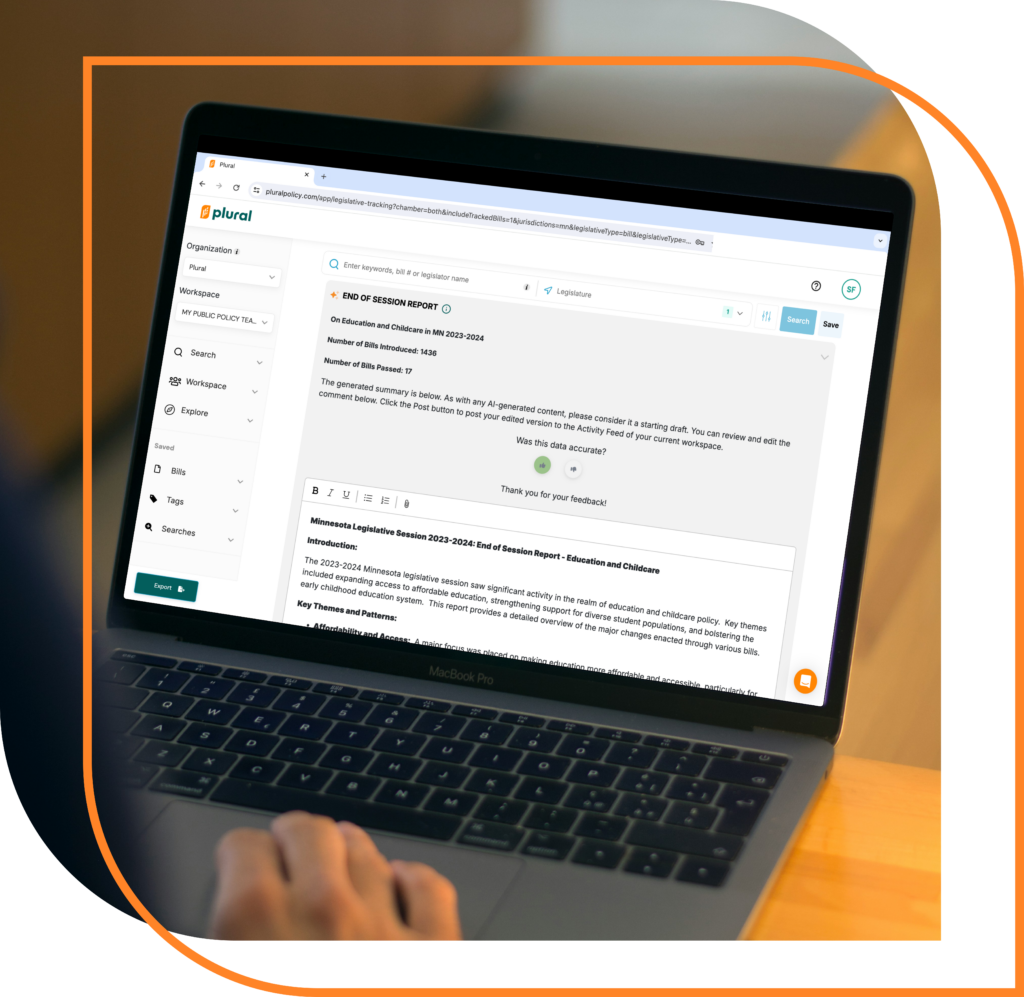
Read the full text of Plural’s AI-generated end-of-session report for Minnesota’s Education and Childcare legislation throughout the 2023-2024 legislative session.
Plural’s AI-generated end-of-session report on education and childcare in Minnesota for the 2023-2024 legislative session. Read the full text in the opposite column and below.
Introduction
The 2023-2024 Minnesota legislative session saw significant activity in the realm of education and childcare policy. Key themes included expanding access to affordable education, strengthening support for diverse student populations, and bolstering the early childhood education system. This report provides a detailed overview of the major changes enacted through various bills.
Key Themes and Patterns
Affordability and Access: A major focus was placed on making education more affordable and accessible, particularly for low-income families and underrepresented groups. This is evident in the establishment of the North Star Promise tuition-free program (HF2073), expansion of early learning scholarships (HF2292), and provision of free school meals for all students (HF5).
Equity and Inclusion: Several bills addressed educational equity by mandating ethnic studies curricula (HF2497), expanding American Indian education programs (HF2497, HF5237), and strengthening protections for students with disabilities (HF121, SF3567).
Workforce Development: Recognizing the critical need for qualified educators, the legislature passed bills to support the early childhood education workforce through grant programs (HF2292) and address teacher shortages by modifying licensure requirements (HF2497, SF3567).
Mental Health and Well-being: The session saw increased attention to student mental health, with bills requiring mental health instruction (SF3567) and expanding access to telehealth services in schools (SF3567).
Extremely Important Changes
Free School Meals for All Students (HF5): This landmark legislation guarantees free breakfast and lunch to all Minnesota students, regardless of income, eliminating financial barriers to school meals.
North Star Promise Tuition-Free Program (HF2073): This program aims to make college more affordable by providing tuition-free education to eligible students from families earning under $80,000.
Expansion of Early Learning Scholarships (HF2292): This initiative broadens access to high-quality early care and learning by expanding eligibility and increasing funding for early learning scholarships.
Mandated Ethnic Studies Curriculum (HF2497): This bill requires high schools to offer ethnic studies courses and mandates ethnic studies instruction in elementary and middle schools, promoting cultural understanding and inclusivity.
Strengthened Human Rights Protections (HF4109): This bill significantly expands and strengthens Minnesota’s human rights laws, broadening definitions of protected classes, increasing penalties for discrimination, and providing additional remedies for victims.
Bill Summaries
1. HF112 – Review of Physical Education Standards Delayed: This bill delays the review of physical education standards in Minnesota by four years, moving the start date from the 2022-2023 school year to the 2026-2027 school year.
2. HF1126 – Postsecondary Attainment Goals, Student Financial Aid, Institutional Licensure Provisions, and Institutional Grant Program Policy Changes Provided: This bill enacts various changes to higher education policies, including expanding postsecondary attainment goals, modifying grant and scholarship programs, refining definitions and exemptions for institutions, and adjusting data reporting requirements.
3. HF121 – Competency Attainment; Technical Changes Made, and Money Appropriated: This bill aims to improve the process of assessing and addressing competency issues in criminal proceedings, focusing on helping defendants attain competency. It includes terminology changes, refined definitions, clarified procedures for competency examinations, and establishes standards for competency attainment programs.
4. HF1486 – Supervised Practice of Alcohol and Drug Counseling by Former Students Allowed for Limited Time, HIV Training Requirements Modified in Substance Use Disorder Treatment Programs, Withdrawal Management License Requirements Modified, and Substance Use Disorder Treatment Client Record Documentation Requirements Modified: This bill allows recent graduates in alcohol and drug counseling to practice under supervision for a limited time, updates HIV training requirements in substance use disorder treatment programs, expands eligible facilities for withdrawal management program licensing, and modifies documentation requirements for client records.
5. HF2073 – Higher Education Finance and Policy Bill: This bill provides funding and policy changes for higher education, including increased appropriations for various institutions, creation of new scholarship and student aid programs (including the North Star Promise program), establishment of support centers, and modifications to grant programs and reporting requirements.
6. HF2292 – Early Learning Scholarships, Head Start, and Early Education Programs Modified; Early Childhood Educator Programs Provided; Reports Required; and Money Appropriated: This bill modifies Head Start funding, establishes the Great Start Scholarships Program, expands early learning scholarship eligibility, increases developmental screening aid, requires licensed teachers for preschool programs, creates an early childhood educator grant program, modifies the Quality Rating and Improvement System, and increases funding for various early childhood programs.
7. HF2497 – Education Finance Bill: This bill establishes new requirements for American Indian education and ethnic studies, makes changes to teacher licensure, creates new grant programs, prohibits American Indian mascots in schools, and makes various changes to curriculum, standards, and education programs.
8. HF3100 – Pension Finance Bill: This bill focuses on public pension plans, reducing the assumed investment rate of return, modifying postretirement adjustments, reducing vesting requirements, adjusting contribution rates, and providing direct state aid to various plans.
9. HF3489 – School Resource Officers; Public Safety Provided, Grounds for Use of Reasonable Force in Schools Modified, School Resource Officer Duties Defined and Minimum Training Requirements Established, School Resource Officer Model Policy Development Required, and Money Appropriated: This bill clarifies the role of school resource officers, modifies the grounds for use of force in schools, establishes specific duties and training requirements for SROs, mandates the development of a model SRO policy, and provides funding for implementation.
10. HF3613 – Forecasted Metro Mobility Funding Clarifications Provided, Education Forecast Adjustments Effective Date Provided, and Money Appropriated: This bill makes technical corrections to the forecasted Metro Mobility funding statute, changes effective dates related to education forecast adjustments, and provides a retroactive effective date for a separate piece of legislation.
11. HF4024 – Higher Education Policy and Finance Bill: This bill modifies funding for ALS research grants, expands eligibility for the Fostering Independence Higher Education Grants program, adjusts funding for the North Star Promise scholarship program, establishes new policies for campus sexual misconduct and criminal records in admissions, regulates online program management companies, implements protections for pregnant and parenting students, modifies requirements for private career schools, and makes various technical changes to higher education statutes.
12. HF4109 – Human Rights Law Provided, and Civil Penalties and Other Remedies Provided: This bill significantly expands and strengthens Minnesota’s human rights laws by broadening definitions of protected classes, increasing penalties for discrimination, and providing additional remedies for victims.
13. HF4518 – Education Finance Forecast Adjustments Made, and Money Appropriated: This bill proposes adjustments to education finance appropriations for fiscal years 2024 and 2025, covering various areas of education funding, including general education, special education, early childhood education, and facilities.
14. HF5 – Free School Lunch and Breakfast Provided for Students, and Money Appropriated: This bill establishes a comprehensive free school meals program in Minnesota, providing funding to ensure all students can receive free breakfast and lunch. It also adjusts related funding mechanisms and allocates resources for implementation.
15. HF5040 – Pensions Supplemental Budget Bill: This bill proposes changes to various public employee pension and retirement plans, including adjusting retirement ages, contribution rates, benefit formulas, and eligibility criteria for different plans.
16. HF5237 – Education Supplemental Budget Bill: This bill makes extensive changes to laws related to children, education, child protection, and family services. Key proposals include modifying education funding provisions, implementing the “Read Act,” expanding American Indian education programs, revising teacher policies, updating charter school regulations, and making changes to child protection laws, foster care, adoption procedures, and support services.
17. SF3567 – Omnibus Education Policy Bill: This bill makes numerous technical and policy changes across multiple areas of K-12 education, including education excellence, teacher licensure and training, reading instruction, special education, charter schools, nutrition and libraries, health and safety, early learning, and education partnerships.
Conclusion
The 2023-2024 Minnesota legislative session brought about substantial changes to education and childcare policies, reflecting a commitment to expanding access, promoting equity, and supporting the well-being of all learners. These changes are expected to have a significant impact on the state’s education system and the lives of children and families for years to come.
Get Started With Plural’s AI-Generated End-of-Session Reports
Top public policy teams in Minnesota and across the country trust Plural for their legislative intelligence needs. With Plural, you’ll:
Access superior public policy data
Be the first to know about new bills and changes in bill status
Streamline your day with seamless organization features
Harness the power of time-saving AI tools to gain insights into individual bills and the entire legislative landscape
Keep everyone on the same page with internal collaboration and external reporting all in one place
Interested in getting started? Create a free account or book a demo today!