
Author: Yemi Adewunmi

  • How To Prepare for the 2024 Legislative Sessions

    How To Prepare for the 2024 Legislative Sessions

    The start of the 2024 legislative sessions is right around the corner. As your team completes its legislative session prep, learn more about our strategies to supercharge your legislative impact.

    Preparing for the legislative session takes a significant amount of time. To prepare for the legislative session, your team’s priorities might include researching issues, reviewing priorities, and setting goals. In this article, we’ll explore strategies to:

    • Research and understand the issues. 
    • Review your constituent concerns, priorities, or your organization’s mission. 
    • Set legislative goals – the more focused the better! 

    The work you put in ahead of session can be pivotal in determining your legislative success. Whether you’re an active citizen, advocate, or legislative leader, these tips can inform your policy work.

    Understand the Legislative Process

    Understanding the legislative process is key to successful legislative organizing and advocacy. Whether you’re working in Congress or in State House(s), there are a few important steps to understand.

    Introductions

    Bills are introduced between January and October, depending on the jurisdiction. Typically, prefiled bills are introduced earliest. Prefiled bills are bills from previous sessions that have not been voted through yet. They reflect the priorities of political parties and leading legislators. Taking a close look at the first introduced bills from leaders. This might include the Speaker and minority leaders of the House and Senate. These bills will give you helpful insights into priority issues for the session. 

    Committee Assignments

    Committee assignments occur after bill introductions. These assignments are related to the bills’ topic of focus, as well as any approvals required within each bill. For instance, a bill focusing on increased budget for education would likely be assigned to two committees — the Education Committee and the Appropriations or Budget Committee. This is because the bill focuses on both education and budget. The Education Committee would determine whether the bill is appropriate and realistic. Further, the Appropriations or Budget Committee would be required to approve or deny the investment.

    Committee Actions

    The chair of each committee decides whether to allow the bill to be heard and debated. This can include a period for public testimony, either for or against the bill. This also means that the chair has the power to stifle the progress of legislation by not allowing for debate or hearings. This is where the phrase “died in committee” comes from. Bills that die are not be sent to the floor of the chamber for a vote by all elected members. 

    Floor Debates and Voting

    After a bill successfully moves out of committee, it heads to the floor for debate and voting. During a floor debate, legislators provide speeches for or against the bill in front of the entire chamber. During a vote, each member has the opportunity to vote ‘yes’, ‘no’, or abstain from voting. If a bill does not pass, the presiding leader may reintroduce it for a debate and re-vote. 

    Preparing for the Legislative Session: What To Look Out For

    There are many ways to approach organizing, advocating, and lobbying during a legislative session. Funding, personnel, time, and other factors may determine your approach. Here are a few key things to look out for as you determine how to push forward in your legislative efforts.  

    The Politics of Legislative Responses

    With the 24-hour news cycle, legislative responses be well-timed. Researching, honing in on constituent concerns, and setting legislative goals is key. Connecting with key staff and legislators becomes crucial as the topic you’re advocating for is at the head of the news cycle. Strategizing these connections can also elevate your issue to the forefront of the conversation. For instance, say your organization’s mission is to increase access to healthcare. It’s essential to be prepared with written materials, statistics, and events by March, when annual insurance plans are renewed. 

    Hearings

    Hearings are essential aspects of the legislative process. They can be informal, with interested constituents and elected officials. Hearings can also be more formal, in the case of committee hearings. During a hearing, experts provide essential information to the public and elected officials. They examine the legislation’s positive and negative impacts.

    Legislator and Staffer Information

    Paying attention to legislator and staff data is key to planning for the legislative session. Since the legislative session is the busiest time of year for legislators, oftentimes your main contact will be staff. Staffers provide legislators with information, research, and news on the bills at hand. Keeping in contact with staff members is a key step in coalition building. Gathering support from legislators is a crucial step towards collective action on the issues you care about.

    With Plural, it’s easy to discover legislator and staffer data — get started today.

    When Does the Legislative Session Start?

    The legislative session is right around the corner. Most states will begin their sessions within the first two weeks of January. Using Plural to monitor bills, read priority statements, and learning about legislators will be essential to an educated start to the session.

    Book a Demo

    Plural is the legislative tracking and intelligence tool of choice for effective public policy teams. Plural’s premium data, tools to get organized and collaborate, and revolutionary AI-powered insights will supercharge your policy impact. Book a demo today to learn more.


    More Resources for Public Policy Teams

  • Quick Guide: Is Plural Right for Your Organization?

    Quick Guide: Is Plural Right for Your Organization?

    Is Plural the right policy tracking tool for your organization in 2024? To determine if Plural is right for you, consider these key questions.

    The 2024 legislative sessions are right around the corner. Kentucky, Mississippi, and Ohio, among other states, will convene on January 2nd. Many more states will convene in the first few weeks of 2024. Is your team prepared?

    Use this guide to determine if Plural is the ideal fit for your organization’s needs. Plural streamlines your legislative tracking process, making it simpler and more efficient.

    Deciding if Plural Is Your Ideal Software Solution

    To determine if Plural is the right tool for you, consider these key questions.

    Comprehensive Bill Tracking and Policy Data

    Are you responsible for covering one or more policy areas for your organization?

    Plural’s extensive data covers all 50 states, Washington, D.C., Puerto Rico, and U.S. Congress. (Plus Nigeria and South Africa!) This includes all bills and resolutions submitted to each legislature. Further, Plural offers comprehensive legislator, committee, and jurisdictional information.

    With Plural, it’s easy to search for bills in your key policy areas. You’ll receive automatic, real-time updates on the bills you’re tracking. With Plural, you’ll always be informed about the latest legislative developments.

    Enhancing Collaboration, Communication, and Information-Sharing

    Do you collaborate with colleagues and external stakeholders on policy coverage?

    At Plural, we know effective policy work doesn’t happen in a vacuum – it’s a collaborative effort. That’s why we never charge per seat, so you can add every member of your team, plus external stakeholders. Plus, Plural offers unlimited, free onboardings and trainings. We’re your partner in ensuring that your entire team is making the most of Plural.

    Is communication and organization a pain-point within your team?

    Plural allows for efficient organization of conversations about bills, replacing cumbersome email chains. Create unlimited, secure workspaces to collaborate with your team. Organize workspaces by issue area, jurisdiction, client, and more. Use annotation and note-sharing tools to share crucial policy information with team members. Plural ensures everyone is on the same page.

    Is it beneficial for you to share information with external allied organizations?

    Plural enables you to invite external organizations to your Workspaces. This fosters easier collaboration and information sharing on legislative matters. Plus, Plural’s public tags offer a clear, customizable system to organize and share bills. Plural transforms how policy teams manage, categorize, and communicate legislative information.

    Leveraging AI Tools for Enhanced Legislative Insights

    Are you looking to leverage AI tools for deeper policy insights?

    Plural offers revolutionary AI tools offering insights, trend analysis, and legislative forecasts. With Plural, it’s easy to use AI to deepen your policy insights.

    Find similar bills, including companion, reintroduced, and omnibus bills, all in one place. Search across jurisdictions to understand the legislative landscape of a given issue area. Discover which bills are likely to gain momentum and adapt your strategy.

    Plus, users can now generate bill summaries using AI! Save time reading dense, detailed bill text and discover the key aspects of a bill, all with a click of a button.

    Assessing Satisfaction with Current Legislative Tools

    Are you relying on a spreadsheet and state legislative websites for policy tracking?

    Plural eliminates the risk of missing important updates on bills you’re monitoring. Receive instant updates on bill updates, like amendments or committee changes. Further, you can make use of tags for convenient labeling, easy access, and seamless organization.

    Are you satisfied with your current legislative tracker and policy management setup?

    Plural offers a more streamlined, intuitive approach to keeping up with legislative developments. Its seamless design, premium data, and organizational capabilities will enhance your experience. More and more policy experts are making the switch from legacy tools to Plural.

    Get Started With Plural‘s Policy Tracking Tool in 2024

    You deserve a legislative tracking tool that works with you, not against you. Plural will simplify and enhance your public policy work.

    When it comes to superior data, a commitment to innovation, an easy-to-use tool, and personalized support, Plural stands out as a top choice for policy tracking tools in 2024.

    Interested in learning more? Create a free account or book a demo today.

  • AI Tools for Productivity

    AI Tools for Productivity

    In an era where time is a luxury, technological advancements, particularly Artificial Intelligence (AI), have emerged as the game-changer in daily productivity. At its core, AI is a multifaceted discipline of computer science that mimics human intelligence processes through algorithms and data-driven responses. How can it be implemented in your day-to-day? There are many tools that can increase your productivity and efficiency. Read our overview and see how Plural’s revolutionary AI-powered features can increase your productivity and policy impact.

    Types of AI Tools for Productivity

    The landscape of AI tools is vast and varied, offering solutions tailored to diverse needs:

    • AI Assistants: Beyond the familiar Siri and Alexa, AI personal assistants are revolutionizing time management and task completion with their ability to schedule meetings, set reminders, and even make reservations using natural language processing.
    • Meeting Transcript Generators: No more frantic note-taking during meetings! These tools accurately transcribe the spoken word in real-time, ensuring you capture every detail and can focus entirely on the discussion at hand.
    • Writing Tools: AI-driven writing assistants like Grammarly and the Hemingway App not only correct grammatical errors but also enhance writing style and tone, making content creation a breeze.

    Benefits of AI Tools for Productivity

    Increase Efficiency and Accuracy

    By automating mundane tasks, AI tools free up time for more strategic activities, driving efficiency. They’re not prone to human error, thereby increasing accuracy in task completion.

    Automate Repetitive Tasks

    Whether it’s data entry or sorting emails, AI takes over repetitive, time-consuming tasks, allowing you to focus on core business functions that require human creativity and intelligence.

    Create High-Quality Content

    From generating insightful data reports to creating engaging social media posts, AI tools provide high-quality content quickly, meeting the real-time demands of modern business.

    …and more!

    When it comes to sector-specific AI tools, the options and opportunities are endless. From healthcare to public policy, AI has many helpful applications.

    Considerations When Choosing an AI Tool for Productivity

    Despite the allure, AI tools are not a one-size-fits-all solution. It’s crucial to consider the specific needs of your business, the tool’s compatibility with other systems in use, and the learning curve involved in implementation. Moreover, while AI significantly enhances productivity, it doesn’t spell the end of human involvement. Instead, it augments human capabilities, allowing for a more strategic allocation of human intellect where it matters most.

    AI in Public Policy

    In the world of public policy, every decision can shape the future, and every second counts. How can artificial intelligence help?

    The opportunity exists for the legislative process to become more responsive and inclusive. The technology of artificial intelligence can be applied in any context; what it does is perform tasks in smart and efficient ways by learning from models that it’s given. The more data it is given to learn from, the smarter the technology gets at understanding the data and answering questions. The information that the system is learning can then be given back to us policy shapers and changemakers so that we can make better data-driven decisions in the legislative process. Read more from Plural co-founder Yemi Adewunmi here.

    AI is a pivotal ally for policy teams — helping to analyze patterns, predict outcomes, and unlock insights at unprecedented speed. It’s clear that AI is a transformative force for policy teams, enhancing their efficiency and driving impactful and informed decision-making. At the cutting edge of public policy work, AI isn’t just about moving faster — it’s about working smarter, turning data into decisions, and insights into results.

    Plural: Harnessing the Power of AI

    Plural’s AI-powered features are what really sets us apart from the competition. See what’s happening with similar legislation across the country, find out where bill language reappears 

    over time, and even find out which bills are gaining momentum. 

    Here are a few highlights:

    • AI-Generated Bill Summaries: Save hours reading through long, dense bill text. Quickly understand and share the impact of proposed legislation. Learn more here.
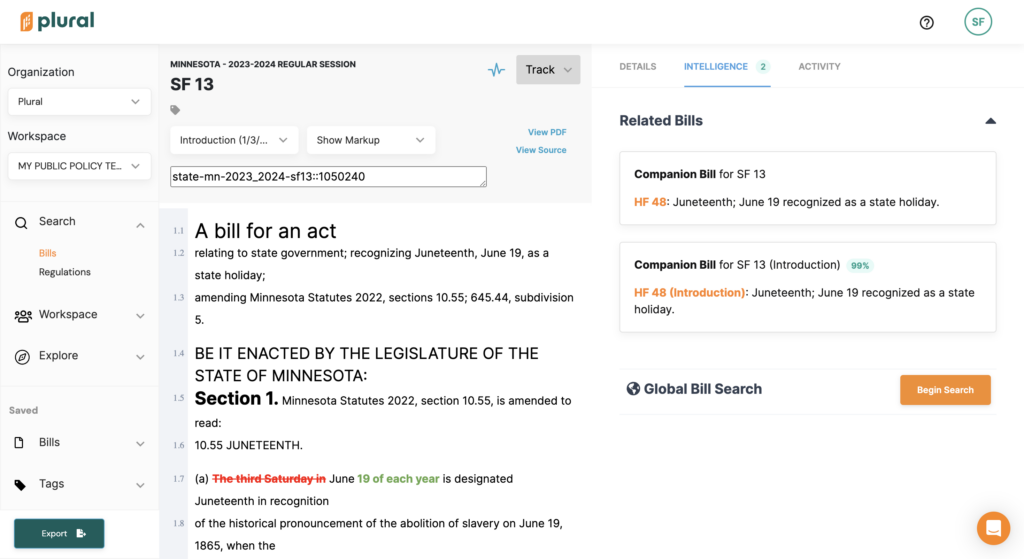
    • Related Bills: Quickly identify bills related to the one you’re viewing. See the relationship and the level of similarity, based on automated text analysis
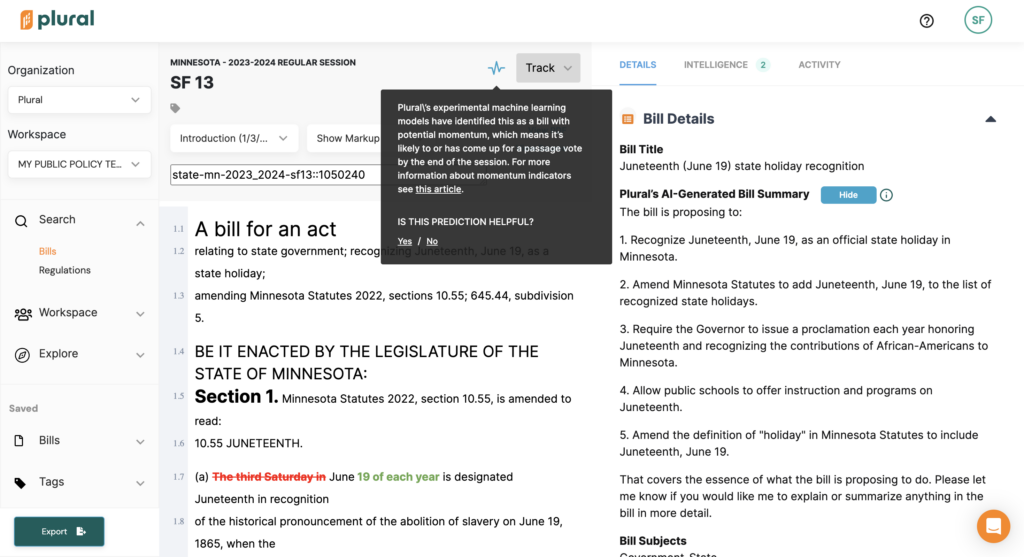
    • Momentum Indicator: Discover which bills are likely to come up for a vote before the end of the legislative session.
    • Additional AI Insights: Discover companion bills, reintroduced bills, and omnibus bills to gain a deeper understanding of the legislative landscape.
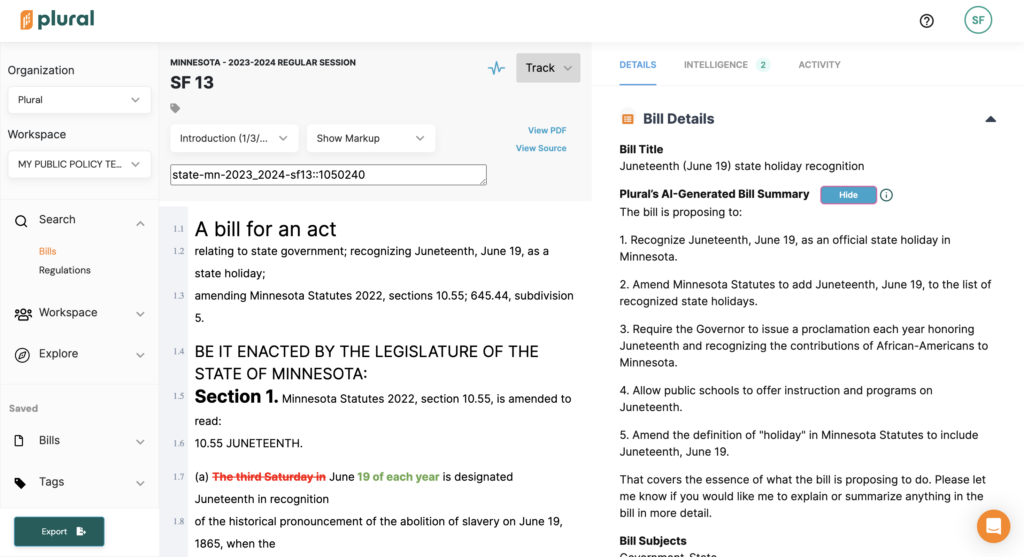
    Plural’s AI-powered bill summarization tool condenses long, dense bill text into a short summary that retains the key details of the bill.

    Get Started With Plural’s AI Tools for Productivity

    With Plural’s AI-powered tools, it’s easier than ever to elevate your policy work from informed to insightful. Interested in learning how Plural can work for your team? Book a demo today!

    Explore More Resources

  • VIDEO | Explore Plural’s Revolutionary AI-Powered Tools

    VIDEO | Explore Plural’s Revolutionary AI-Powered Tools

    In the world of public policy, every decision can shape the future, and every second counts. How can artificial intelligence help? Plural’s AI-powered policy tracker is the legislative tracking tool of choice for impactful policy teams.

    AI is a pivotal ally for policy teams — helping to analyze patterns, predict outcomes, and unlock insights at unprecedented speed. It’s clear that AI is a transformative force for policy teams, enhancing their efficiency and driving impactful and informed decision-making. At the cutting edge of public policy work, AI isn’t just about moving faster — it’s about working smarter, turning data into decisions, and insights into results.

    Plural’s AI-Powered Tools

    Plural stands at the forefront of the AI revolution. With our Premium plan, you’ll unlock a suite of AI-powered features designed for those who demand excellence in their legislative tracking, stakeholder management, and organizational tools. Plural’s AI-powered policy tracker is the policy tracking tool of choice for impactful policy teams.

    With Plural, it’s easy to discover similar bills, like companion bills. Find all related bills in the “Intelligence” tab of a bill detail page.
    Plural’s AI-powered bill summarization tool condenses long, dense bill text into a short summary that retains the key details of the bill.
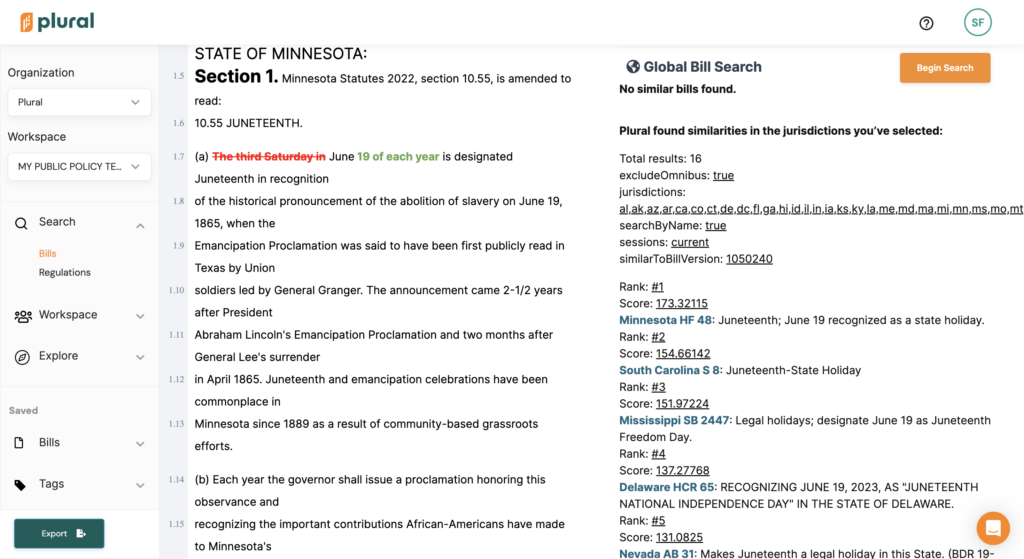
    Use Plural’s Global Bill Search Tool to see whether similar bills have been introduced across multiple jurisdictions.
    During the legislative session, use Plural’s Momentum Indicator to see which bills are likely to come up for a vote by the end of session.

    Learn more from Amber, our Administrative Director:

    Get Started With Plural’s AI-Powered Policy Tracker

    With Plural’s AI-powered tools, it’s easier than ever to elevate your policy work from informed to insightful. Interested in learning how Plural can work for your team? Book a demo today!

    Explore More Resources for Policy Teams

  • Stay Ahead in 2024: Plural’s Custom Legislative Solutions for Every Team

    Stay Ahead in 2024: Plural’s Custom Legislative Solutions for Every Team

    The 2024 legislative sessions are right around the corner — is your team ready? When it comes to policy tracking tools in 2024, you have many options. Plural’s tailored solutions are perfectly catered to your team’s size, budget, and needs.

    In 2022, total federal lobbying spending skyrocketed to $4.1 billion – the highest since 2010. With conglomerates dishing out millions of dollars to advocate for and against policies on both the state and federal levels, organizations with tighter budgets face an uphill battle.

    Plural’s expanded legislative tracking, stakeholder management, and collaboration offerings come at a time when full participation in the policy creation is crucial. Plus, Plural is a minority and women-owned technology company that’s committed to innovation. When you choose Plural as your tool of choice, you won’t be getting an outdated legacy tool or supporting a company with a culture of just pandering to stakeholders. We are continually innovating ways to make our data impactful, and we’re committed to doing the right thing. Plural users are happy and productive.

    Let’s dig into your options.

    Plural Free Account

    A free Plural account is perfect for the individual who wants to stay civically engaged on public policy. Thousands of Plural users take advantage of our free offering. With a free account, you’ll access best-in-class legislative data from 53 jurisdictions — all 50 United States, Washington, D.C., Puerto Rico, and U.S. Congress. You can also search and track bills across all 53 states and jurisdictions.

    Worried that a free tool won’t be robust and accurate? The old rule of “you get what you pay for” is a thing of the past. Not only does Plural offer the most robust legislative data, but it’s also the most intuitive and easy-to-use tool on the market. We scrape our data more frequently than our competitors, with a custom cadence that’s catered to each legislature. With Plural, your days of getting caught with outdated information are over.

    Think you’ll need more? Don’t worry — once you create a free account and start using Plural, you can upgrade anytime.

    Plural Basic Plan — NEW!

    Plural’s Basic Plan is perfect for small teams who only need to track one jurisdiction, but still need expanded functionality. 

    With Plural’s Basic Plan, you can search and track bills in one state, get custom alerts for your tracked bills, and get real-time alerts on saved searches. It comes with full access to Plural for two users, who can create one collaborative workspace for notes, issue management, and more. Plus, you can create customizable markups, shared notes, and annotations on bills, and upload external files. Teams who use this tier really appreciate the high quality data and ability to collaborate.  

    We recently created our Basic Plan for those small policy teams that need to pack a punch. Sound familiar? In the world of public policy, being the first to know and getting your team on the same page as fast as possible is the key to success. Plural’s Basic Plan will help you achieve your goals. With our Basic Plan, we’ve taken our robust legislative data and paired it with powerful organization and collaboration tools. However, at the same time, we know that budget is often a pain point for small policy teams. That’s why our Basic Plan is just $3,500 per year.

    Plural’s Premium Plan

    Plural’s Premium Plan is perfect for multi-jurisdiction public policy teams, advocacy groups, and researchers. In addition to searching and tracking  bills, organizing your work, and collaborating with your team, you can unlock revolutionary tools to deepen your policy insights and enhance your collaboration. 

    And with unlimited secure digital workspaces, you can create a home for every team, client, or campaign — annotate bills, share analyses, and plan next steps all in one place. What’s more, you can easily export your data for reporting and further analysis.Plural allows you to give up legacy systems and spreadsheets. Plus, we never charge per seat. With Plural, you can collaborate with anyone on your team (or even external stakeholders!) without concern for additional fees.

    Plural Premium: Revolutionary AI-Powered Features

    Plural’s AI-powered features are what really sets us apart from the competition. See what’s happening with similar legislation across the country, find out where bill language reappears over time, and even find out which bills are gaining momentum. 

    Here are a few highlights:

    • AI-Generated Bill Summaries: Save hours reading through long, dense bill text. Quickly understand and share the impact of proposed legislation
    • Related Bills: Quickly identify bills related to the one you’re viewing. See the relationship and the level of similarity, based on automated text analysis
    • Momentum Indicator: Discover which bills are likely to come up for a vote before the end of the legislative session.
    • Additional AI Insights: Discover companion bills, reintroduced bills, and omnibus bills to gain a deeper understanding of the legislative landscape.

    Plus, soon, Plural will help you discover bill topics and version-to-version bill summaries with the power of AI. With Plural, you’ll never miss an opportunity to influence legislation.

    Find similar bills and use Plural’s Global Bill Search Tool in the “Intelligence” tab of a bill detail page.
    Plural’s AI-powered bill summarization tool condenses long, dense bill text into a short summary that retains the key details of the bill.

    Plural Premium: Unmatched Customer Support

    Finally, at Plural, we know successful policy work doesn’t happen in a vacuum — it’s a collective effort. That’s why we offer personalized, one-to-one customer support.

    With Plural, you won’t feel lost in a big, complicated corporate structure. Your dedicated Customer Support Specialist is always available via chat or email. We offer free, unlimited onboardings and trainings to make sure your team is getting the most out of Plural.

    Plus, Premium Plan users can also request custom reports and policy guidance from Plural’s knowledgeable team of Policy Experts. With Plural, it’s like having a team of legislative researchers, attorneys and policy experts working for you around the clock… without the price tag. 

    Coming Soon to Plural

    If you missed our product roadmap webinar, we just announced these new features that are available now to Plural users:

    • Vote data. Plural users can now see how a bill was voted on, or how Legislators have voted on certain bills in Plural right alongside your work. We want to help save you time tracking a bill’s movements, and also make it easy to share vote information in multiple formats, like a legislative scorecard for example. Vote data can be found both on a Bill or Legislator’s activity feed.
    • Federal staffer data. We know that managing relationships and discussing legislative priorities with lawmakers is critical, but can be labor-intensive. With Plural, up-to-date information you need is at your fingertips. You can find federal staffer data on our new “Staff Directory” tab right on the Legislator’s page. Plus, state staffer data is also coming soon!
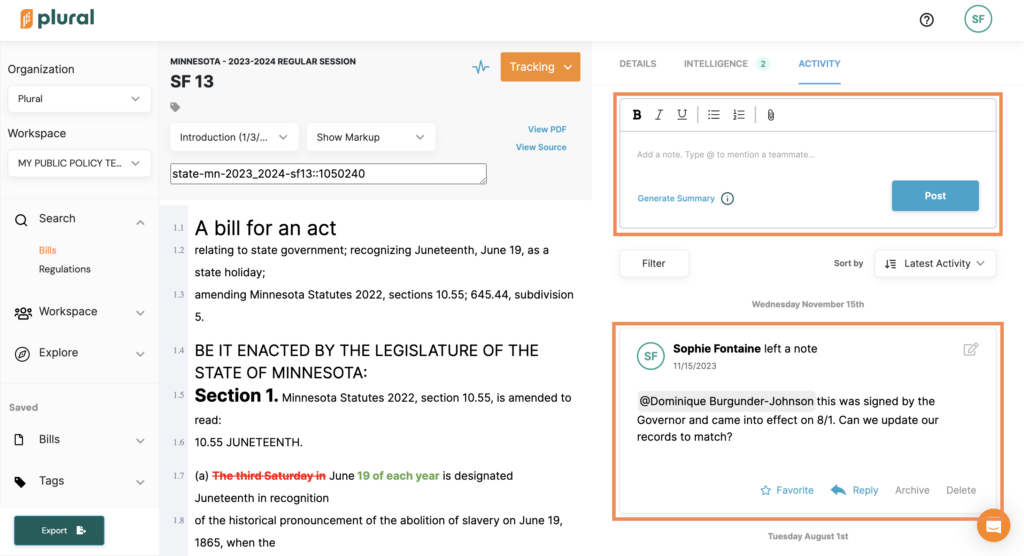
    • Mention teammates. Tag or “@” mention your teammates (similar to other collaboration or messaging software like Slack, Microsoft Teams) If there’s a particular update on a bill, legislator, or any other update that you want to flag immediately for your teammates, simply mention them in the activity feed. Tagged teammates get notified directly in their inbox with the context and information they need. We know that collaboration is a crucial part of public policy work, and hope that this feature and others helps facilitate smooth and effective collaboration within Plural.

    Want to learn more about any of the features mentioned above? It’s best to meet with one of our Policy Experts for a live demo in Plural.

    Get Started With Plural

    Leading organizations trust Plural for their legislative tracking, stakeholder collaboration, and organizational needs. Our partners include the Associated Press, Google, and many advocacy organizations across the globe. With Plural, it’s like having a team of legislative researchers, attorneys and policy experts working for you around the clock… without the price tag. 

    Interested in getting started? Dig deeper into our pricing plans, create a free account, or get started with your Basic or Premium plan today.


    Explore More Resources for Public Policy Teams

  • Tools for Legislative Research

    Tools for Legislative Research

    In an era where public policy impacts every sector, understanding legislation is crucial. Policy professionals, academics, and interested citizens alike need robust tools for legislative research. Having the right tools can transform complex data into actionable insights. Innovative tools are reshaping how we interact with legislative documents. In particular, Plural’s premium data and advanced tools can revolutionize your legislative research.

    What is Legislative Research?

    Legislative research involves the comprehensive study of congressional documents. This can include analyzing bills and other legislative materials. This research seeks to understand the intent, application, and potential implications of policy. Legislative research helps us understand and contextualize our policy landscape. This includes existing laws, proposed bills, and historical legislation.

    Understanding the Legislative Process

    The legislative process in the United States is intricate. Understanding how ideas transform into policy is key to engaging with our government. This journey involves many steps, from the introduction of a bill to its enactment as law. Understanding this flow is foundational for effective legislative research.

    The Value of Comprehensive Legislative Data

    Legislative research can seem daunting. Thousands of bills are introduced each session. Plus, there are dozens of jurisdictions and decades of past sessions to explore. This is where the value of robust data is clear — comprehensive data is key to successful research. Researchers need a tool that synthesizes data and presents it in an intuitive manner.

    Steps in the Legislative Research Process

    Define the Scope

    Determine the focus of your research. This could be a specific piece of legislation, a policy area, or a legislative session.

    Gather Primary Sources

    Start with direct links to legislative documents. This includes bills, statutes, and committee reports.

    Explore Secondary Sources

    These provide analyses and interpretations of legislative intent. Secondary sources are invaluable for deeper insight.

    Analyze and Synthesize

    Cross-reference materials to build a comprehensive view of the subject.

    Stay Updated

    Legislative action is a dynamic process. Use reliable tools to keep abreast of new developments.

    Tools for Legislative Research

    Several tools can enhance legislative research. For instance, state legislative websites offer direct access to a plethora of documents. Libraries and government archives provide historical data that’s crucial for understanding legislative context. Subscription databases can also serve as powerful tools, offering sophisticated search options.

    Plural for Legislative Research

    Plural takes legislative research to the next level. It offers features designed for thorough analysis and efficient workflow. Plural is the tool of choice for many researchers.

    Advanced Search

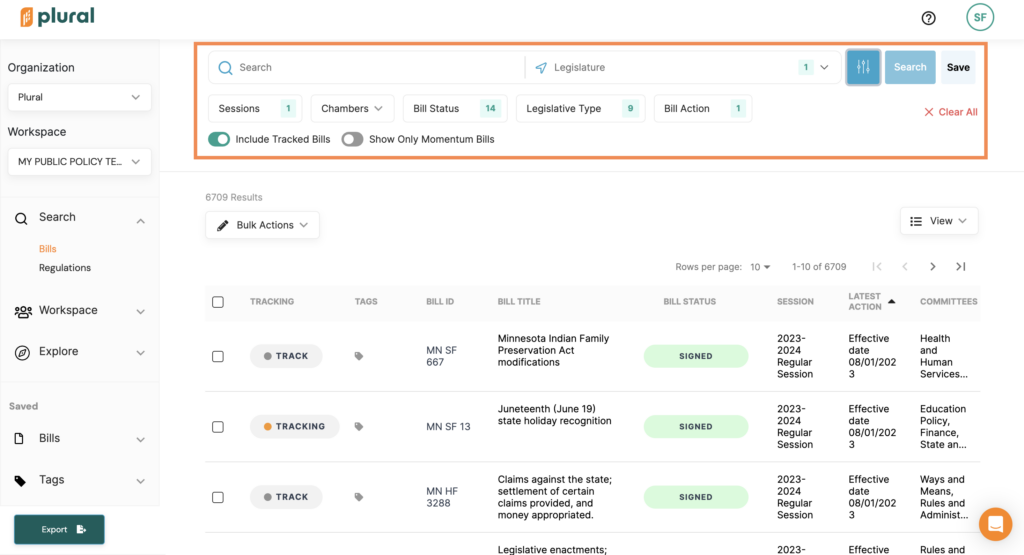
    Plural’s advanced search options allows users to pinpoint relevant legislation. Use specific search phrases to narrow your search, or explore via various filters.

    Filter your search result by session, chamber, bill status, legislative type, bill action, and more.

    Annotation Tools and Notetaking

    Interact with legislative data using Plural’s annotation tools. You can highlight, make notes, and compile your insights right on the platform.

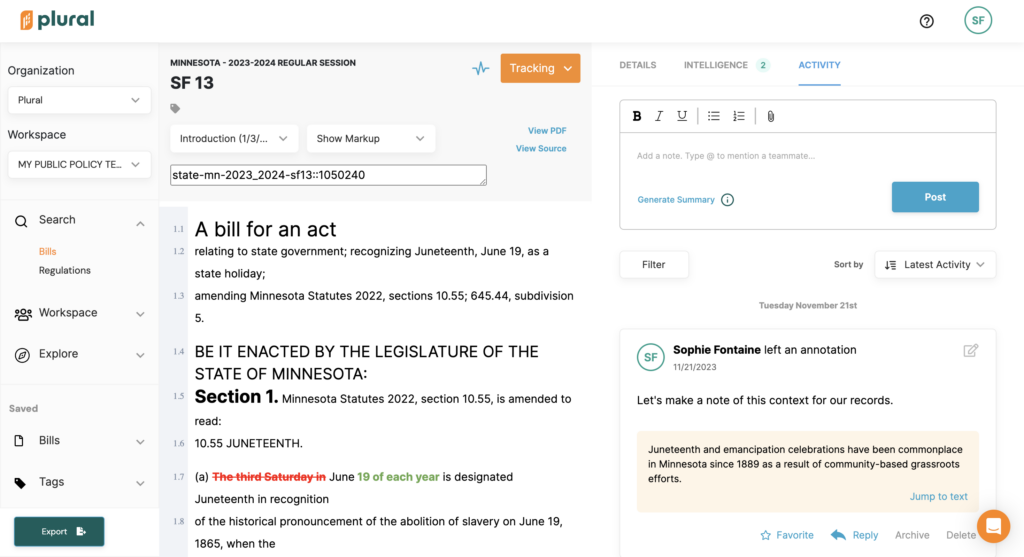
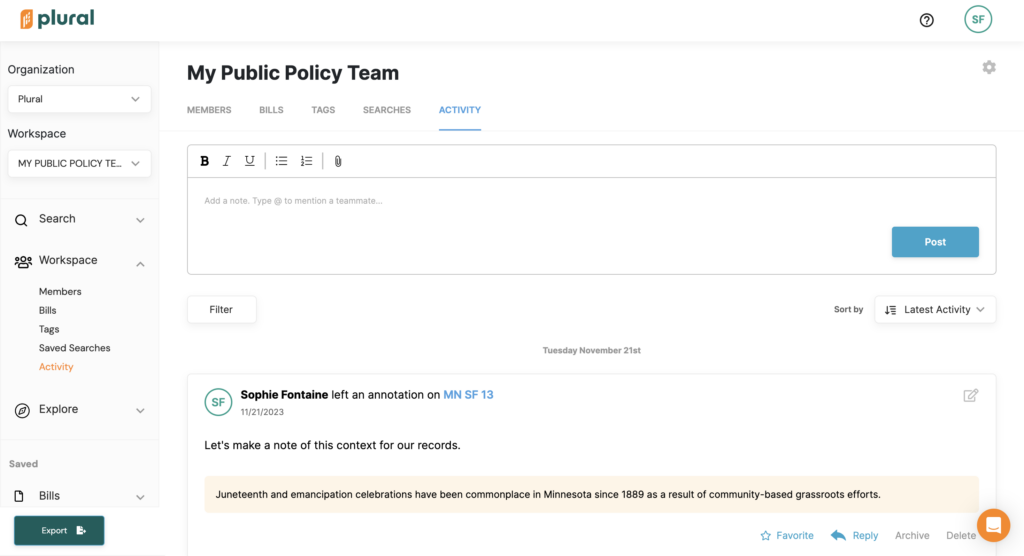
    Leave notes, mention teammates, attach files, generate AI-powered summaries, and more, all in the Activity tab on a Bill Detail page.
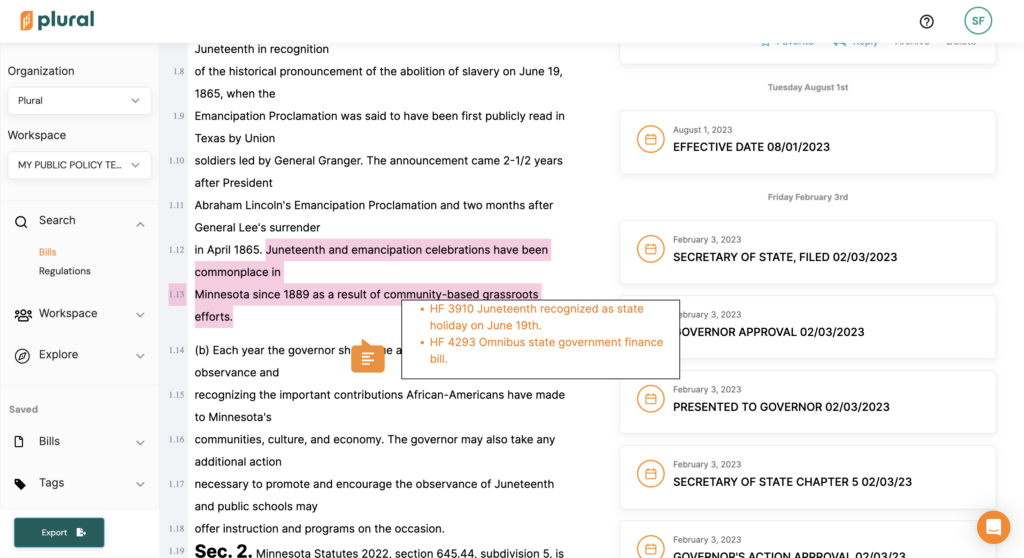
    Interact directly with bill text and discover related bills to unlock the legislative landscape of an issue area.
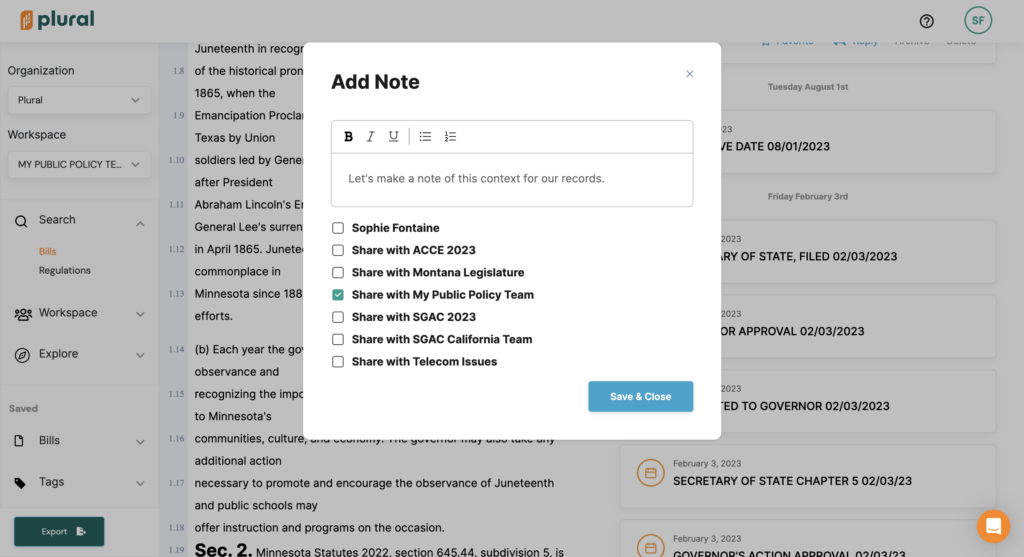
    Annotate bill text and choose which workspace(s) to share your notes with.
    Annotations will appear in the Activity tab on a bill detail page.

    Workspaces

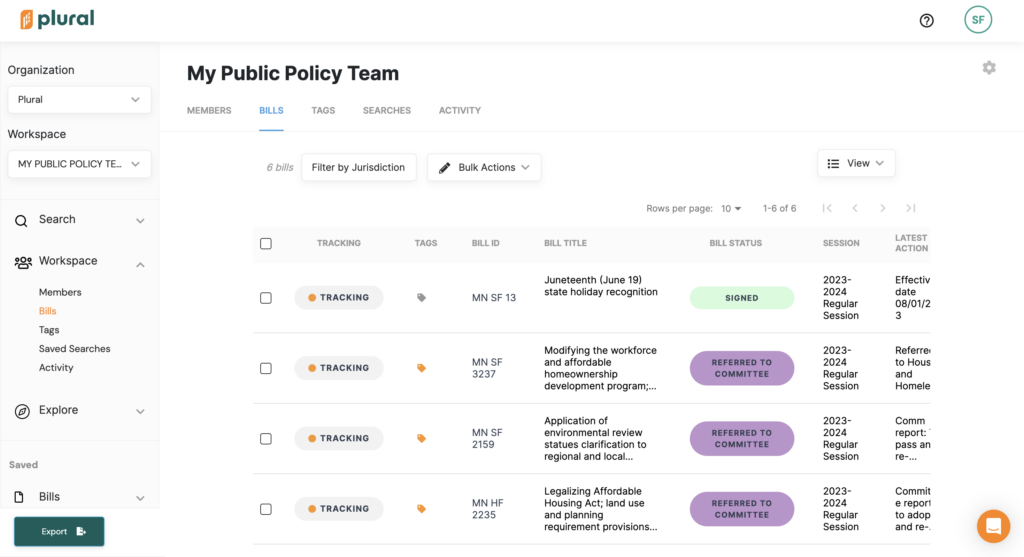
    Plural’s secure digital Workspaces enable seamless collaborative efforts, streamlining shared projects with teammates. Your Workspace houses any and all details related to the bills your team is tracking, the tags you’ve created, the searches you’ve saved, and any activity you’ve generated in Plural.

    View the bills your team is tracking, their title, status, session, and latest action, all in one place. Find this information on the Bills tab of your Workspace page.
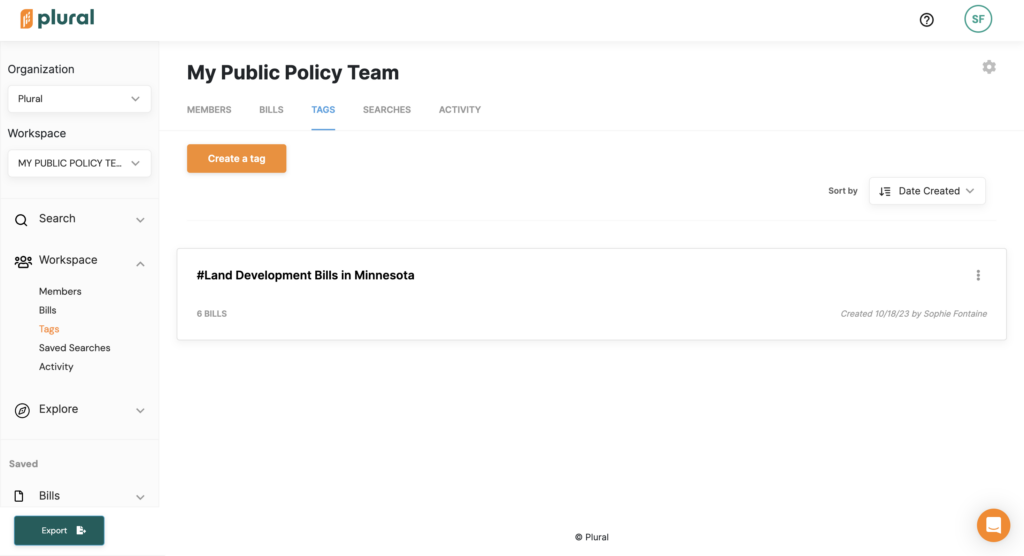
    Create custom tags to organize and categorize bills. Find any tags your team has created in the Tags tab of your Workspace page.
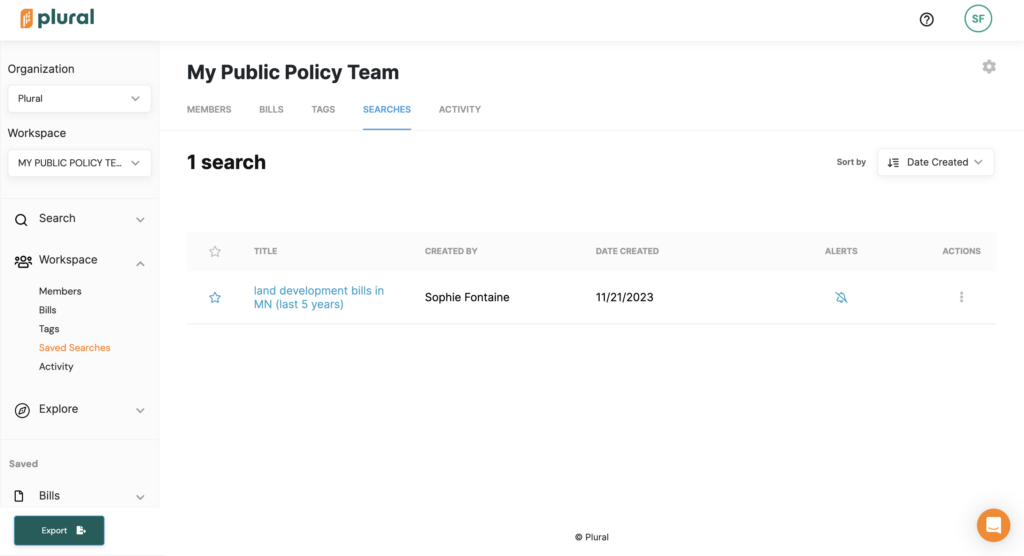
    Save your searches and get notified of new results. Find your team’s saved searches in the Searches tab of your workspace.
    Get a glimpse of all of the activity your team has created, all in one place. This includes annotations, notes, mentions, uploads, and more. Find this in the Activity tab of your workspace page.

    Comprehensive Legislative Histories

    Plural contains session data dating back decades. Delve into historical context, an essential aspect of understanding legislative trends.

    Single-State Subscription

    Plural provides tailored solutions, including single-state subscriptions for focused research.

    Get Started With Plural

    Navigating the legislative environment doesn’t have to be daunting. Accessing the right tools simplifies this process. The correct tools can make legislative research streamlined, informative, and even enjoyable.

    Plural stands out as a transformative tool for legislative research. At Plural, we’re committed to empowering professionals to conduct thorough, efficient legislative research. Our tools help policy pros find what matters, get organized, collaborate effectively, and even dig deeper.

    Interested in learning how Plural can work for your legislative research needs? Create a free account or book a demo today!

  • 2023 Product Roadmap Webinar

    2023 Product Roadmap Webinar

    The 2024 sessions are right around the corner! At Plural, we’re always building out new features and tools to help you achieve your public policy goals. Interested in learning more?

    On Thursday, November 16th, the Plural Product team hosted a review of new features added to Plural throughout 2023 and shared a preview of what’s to come in 2024, including:

    • Federal regulatory dockets
    • Staffer data
    • AI-generated bill summaries

    Didn’t get a chance to tune in? Watch the recording or view the slides now!

  • Technology for Advocacy Work: Benefits and Looking Ahead

    Technology for Advocacy Work: Benefits and Looking Ahead

    In an age where technology permeates every facet of our lives, it’s no wonder it has become a pivotal force in advocacy work. From mobile technology enhancing real-time communication, to AI-driven tools analyzing complex data for precise strategy development, digital advancements are revolutionizing how we approach change. Technology is also bridging the “digital divide.” It amplifies voices from communities of color and enables impactful connections in civic affairs. This article explores the multifaceted benefits of integrating technology into advocacy, illustrating how it not only optimizes efforts but is also becoming indispensable in modern advocacy landscapes.

    Incorporating Tech Into Your Advocacy Day-to-Day

    Incorporating technology into advocacy work transforms efficiency, reach, and effectiveness. Digital tools streamline operations, from organizing databases to facilitating communication across distances, making coordination seamless. Social networks extend reach, mobilizing larger audiences and diverse demographics, while analytics on social networking sites provide insights into public sentiment, guiding strategy. Furthermore, technology empowers real-time updates and feedback, fostering dynamic and responsive advocacy efforts. Technology also democratizes information. It grants all stakeholders access to crucial data and a platform for their voices. This is particularly important in the advocacy context, as technology can provide information and services for underserved groups, like communities of color.

    Complementing the Advocacy Cycle

    The advocacy cycle, from identifying issues to mobilizing stakeholders and influencing policy, is significantly enhanced by technology. Digital technology supports robust research, comprehensive analysis, and the deployment of targeted, data-driven strategies. It allows for the tracking of legislative changes, the analysis of vast amounts of data for informed decision-making, and the ability to forecast outcomes based on current trends. In essence, technology acts as a force multiplier in advocacy, enhancing each stage of the cycle, ensuring strategies are precise, adaptable, and effective.

    Use Cases: Technology for Advocacy

    The real-world applications of technology in advocacy are vast and varied, demonstrating its critical role in contemporary civic engagement efforts.

    Identifying Advocacy Issues

    Technology aids in the swift identification of key issues, with AI-driven tools mining data from diverse sources for emerging trends, and social media providing real-time public sentiment analysis. This rapid issue identification allows organizations to stay ahead, responding proactively rather than reactively.

    Mobilizing Stakeholders

    Digital platforms and social networks are instrumental in mobilizing stakeholders. They facilitate the swift dissemination of information, the coordination of mass movements, and provide forums for discussion and organization, galvanizing public participation in advocacy issues.

    Research and Analysis

    Here, technology’s prowess is unmatched. Platforms like Plural, for instance, offer legislative tracking, ensuring users are abreast of the latest developments in their advocacy areas. They provide comprehensive data analysis, helping advocates to strategize effectively, understand the legislative landscape, and prepare data-backed positions, significantly enhancing the prospect of achieving desired outcomes.

    Paths Forward: Technology for Advocacy Work

    As we look ahead, the role of technology in advocacy is set to grow even more significant. The potential of AI in analyzing data, predicting trends, and personalizing outreach strategies presents opportunities for more nuanced and effective advocacy. However, this path forward isn’t without challenges. Advocates must navigate data privacy concerns, the digital divide, and the need for human-centric approaches in technology use. But, with thoughtful engagement, technology represents a frontier of possibilities for amplifying advocacy work, making it more inclusive, impactful, and representative of the diverse voices it seeks to champion.

    Plural: Legislative Tracking Technology for Advocacy Teams

    Plural is the legislative tracking tool of choice for public policy teams at advocacy and nonprofit organizations. Interested in getting started? Create a free account or book a demo today.

  • VIDEO | Find What You’re Looking For With Plural’s Advanced Features

    VIDEO | Find What You’re Looking For With Plural’s Advanced Features

    Plural’s advanced features can streamline your public policy work, helping you easily find what you’re looking for and allowing you to amplify your impact.

    How does Plural help you find what you’re looking for?

    • Use advanced search features to narrow down your query
    • Save your searches and get notified of new results
    • Harness the power of AI powered tools to discover bills with momentum and similar bills

    Learn more from Dominique, our director of CX Design!

  • What Do Congressional Staffers Spend Their Time On?

    What Do Congressional Staffers Spend Their Time On?

    What are key congressional staff positions? What do they spend their time on? Read our overview of the importance of congressional staff and key challenges they face. Plus, learn more about congressional staffer data, coming soon to Plural.

    When we think of Congress, we often think of the senators and representatives who make the laws. However, behind the scenes, an army of congressional staffers plays critical roles in the legislative process, from crafting policy to communicating with constituents. Understanding what these staffers do is key to understanding how our government functions.

    What Is a Congressional Staffer?

    A congressional staffer works to support a congressperson’s duties. These individuals handle a myriad of tasks, such as conducting research, drafting legislation, engaging with constituents, and much more. Their efforts ensure the smooth operation of both individual offices and the legislative process at large.

    Key Roles of Congressional Staff

    Congressional staff members fulfill various roles, each crucial to the functionality of congressional offices and the overall legislative process.

    Chief of Staff and Administrative Assistants

    The Chief of Staff oversees operations in the congressperson’s offices, managing staff, and acting as the primary advisor. Administrative Assistants, on the other hand, perform vital administrative tasks, including managing finances, office supplies, and logistical details that keep the office running.

    Legislative Directors, Legislative Counsels, and Senior Legislative Analysts

    These professionals are at the heart of the legislative process. Legislative Directors supervise the legislative staff and develop policy initiatives. Legislative Counsels provide legal advice and draft legislation, while Senior Legislative Analysts research and analyze policy proposals and legislation.

    Communications Directors and Press Secretaries

    Communications Directors strategize and oversee the congressperson’s messaging and media presence. Press Secretaries interface directly with the media, writing press releases, and arranging interviews. They ensure that the public and the press understand the congressperson’s work and stances.

    Legislative Assistants

    Legislative Assistants focus on specific policy areas, conducting research, and advising the congressperson on related issues. They often draft legislation, meet with stakeholders, and represent the congressperson in committee meetings.

    Schedulers

    Schedulers manage the congressperson’s time, a complex task given the myriad demands, including committee meetings, constituent meetings, and floor sessions. They ensure the member’s day runs smoothly and efficiently.

    Case Workers

    Case workers are the bridge between constituents and the federal government. They help constituents navigate federal agencies and solve problems, providing a crucial service that underscores the representative nature of Congress.

    Other Key Roles

    Other staffers include Committee Staffers who support the work of congressional committees, and District Office Staff who handle the needs of constituents within the member’s district. Each role is tailored to the specific needs of the office and the district or state.

    The Importance of Congressional Staff

    Staffers are the backbone of Congress. They provide the research, expertise, and administrative support that allow Congress to function. Their work, though often unseen, is crucial in shaping and guiding our nation’s laws and policies.

    Challenges Faced By Congressional Staff

    Despite their critical roles, congressional staffers face significant challenges. They often work long hours with low pay, under high pressure, and intense scrutiny. Additionally, the divisive political climate can make their work even more challenging. Despite this, many staffers find the job rewarding, knowing they’re making a difference in their country’s governance.

    Get Started With Plural’s Congressional Staff Data

    With Plural, it’s easier than ever to get and stay ahead in the public policy landscape. Plural makes it easy for policy teams to:

    • Access superior public policy data 
    • Be the first to know about new bills and changes in bill status
    • Streamline your day with seamless organization features
    • Harness the power of AI to gain insights into individual bills and the entire legislative landscape
    • Keep everyone on the same page with internal collaboration and external reporting all in one place

    PLUS: Staffer data is coming soon to Plural! Find important information on key staffers, including contact info. Interested in learning more? Create a free account or book a demo today!

  • How Is AI Used in Lobbying?

    How Is AI Used in Lobbying?

    Discussions surrounding the use of AI in lobbying have come to the forefront as AI has surged in popularity. Between data analysis, stakeholder mapping, and issue tracking, AI has many applications in lobbying. Read our overview and learn how Plural harnesses the power of AI.

    Artificial Intelligence (AI) refers to machines programmed to think and learn like humans. AI is a broad field with a recent surge in popularity, use, and controversy.

    AI’s applications across sectors has been a key subject of discussion. In the field of lobbying, AI has many potential applications. This includes data analysis, predictive analytics, communications, stakeholder mapping, and policy issue tracking. As AI continues to evolve, many more uses are still discovered and created.

    The Current Landscape of AI, Lobbying, and Public Policy

    Congressional hearings have sought to understand the use of AI in lobbying and public policy. They’ve examined AI’s strengths and dangers, as well as the Biden administration’s AI policies.

    On October 30, 2023, President Biden signed an Executive Order regarding AI. The Order outlines appropriate government use of AI. It also sets forth a modernization plan for the federal government’s AI infrastructure. With this plan, the Administration hopes to ensure that the government does not “fall behind” when it comes to AI technology.

    The Order also includes multiple directives regarding AI. These directives relate to understanding discriminatory AI, the ethics of AI, and consumer protections.

    How Is AI Used in Lobbying?

    In lobbying, AI has many uses. This includes data analysis, predictive analytics, communications, stakeholder mapping, and policy issue tracking. These processes are AI-driven, but followed through with human oversight. The type of oversight can determine the level of accuracy and influence.

    Data Analysis

    AI-powered data analysis helps users quickly and efficiently analyze vast amounts of data. This includes legislative data, public opinion polls, and social media trends. These analyses provide information within minutes, allowing for fast and effective responses.

    Predictive Analytics

    Predictive analytics can predict future political and legislative trends based on historical data. Lobbyists can anticipate changes, identify potential allies and opponents, and adjust their strategies.

    Communications Tools

    AI-powered communications tools include chatbots and natural language processing (NLP) tools. These tools can help lobbyists automate communication with constituents, lawmakers, and the public. These tools can also assist in crafting persuasive messaging and responses.

    Stakeholder Mapping

    When it comes to stakeholder mapping, AI assists with identifying and categorizing stakeholders. With these tools, lobbyists can tailor their approaches, including messaging and communications.

    Issue Tracking

    AI can continuously monitor legislation, regulations, and public sentiment related to specific issues. This enables lobbyists to stay informed and adjust their strategies as needed.

    The Benefits and Risks of AI in Lobbying

    AI-driven lobbying offers numerous practical benefits, including enhanced efficiency, cost-effectiveness, and the ability to process vast quantities of data for precise insights. Societally, AI has the potential to democratize lobbying by providing tools accessible to individual citizens, not just corporate lobbyists.

    However, risks exist. The ‘black box’ nature of AI algorithms can raise transparency and ethical concerns, and the reliance on data makes bias a perennial issue. Moreover, the automation of content generation poses an existential threat to the authenticity of public discourse.

    Conversations around AI’s benefits and risks focus on bias, discrimination, and ongoing stereotypes. These issues proliferate AI software because AI is built by humans, to attempt to think like humans. Recently, the Biden administration announced an AI Bill of Rights. The Bill of Rights aims to lessen the impacts of these biases in AI software.

    Reducing and eliminating AI discrimination is particularly important in criminal justice policy. This area of policy is relatively new, with immense lobbying firms and groups. The newly announced executive order aims to ensure fairness throughout the justice system. It sets forth best practices for using AI in various aspects of the criminal justice system, including sentencing, parole, probation, pretrial release, detention, crime forecasting, predictive policing, and forensic analysis.

    Overall, reducing the risks of AI in lobbying requires eliminating the stereotypes and biases used to create AI.

    Looking Ahead: AI in Lobbying

    The field of AI-driven policy and lobbying is still in development. At Plural, we know that AI will be central to the field of policy, lobbying, and advocacy. Harnessing ethical AI usage will be key.

    Technology gives us an immense amount of useful, impactful, and necessary information. Often, however, the amount of information we encounter each day is difficult for any one person or group to process. AI allows people to gather and process information quickly, allowing for greater efficiency.

    With the 2024 presidential election on the horizon, AI’s role in lobbying is expected to grow. Technological advancements will further refine predictive analyses, and as society grapples with digital misinformation, the demand for verifiable, AI-generated content will surge. Lobbying groups, particularly in tech-centric locales like Silicon Valley, may increasingly rely on AI to navigate the legislative process at the federal level.

    How Plural Uses AI

    Policymaking is complicated, and bills are often lengthy and difficult to digest. Translating between policymakers and the people impacted by policy is crucial. Plural utilizes AI to assist our users in finding, tracking, and learning about key bills.

    Plural stands at the forefront of this AI revolution in lobbying. With advanced search options, users can pinpoint relevant legislative documents, discover related bills, and adapt strategies using the Momentum Indicator. The AI Bill Summarizer condenses complex bill texts, saving invaluable time. By combining human oversight with AI’s analytical power, Plural provides confidence levels unseen in traditional lobbying practices.

    Get Started With Plural

    With Plural, it’s easier than ever to get and stay ahead in the public policy landscape. Plural makes it easy for policy teams to:

    • Access superior public policy data 
    • Be the first to know about new bills and changes in bill status
    • Streamline your day with seamless organization features
    • Harness the power of AI to gain insights into individual bills and the entire legislative landscape
    • Keep everyone on the same page with internal collaboration and external reporting all in one place

    Interested in learning more? Create a free account or book a demo today!

  • VIDEO | Get Organized With Plural’s Advanced Features

    VIDEO | Get Organized With Plural’s Advanced Features

    Plural’s advanced features can streamline your public policy work, helping you get organized and allowing you to amplify your impact.

    How does Plural help you get organized?

    • Track or un-track many bills at once
    • Create custom tags to categorize bills
    • Publish public tags to share a list of bills with audiences outside Plural
    • Keep individual and shared work separate

    Learn more from Dominique, our director of CX Design: