Author: Yemi Adewunmi

  • Need to Know: The Bipartisan Infrastructure Bill

    Need to Know: The Bipartisan Infrastructure Bill

    The Infrastructure and Jobs Act, H.R. 3684, was signed into law by President Joe Biden in November of 2021. The Act was the culmination of nearly a decade of negotiations over investments in America’s infrastructure. Debates over what would be included or excluded from the bill and whether it could receive bipartisan support dominated much of President Biden’s first year in the White House. The debates, negotiations and ultimate passage of the Act were just the beginning, though — once the Infrastructure Investment and Jobs Act did become law, individuals, businesses, states and municipalities were all eager to learn how they could benefit from the $1.2 trillion in spending authorized by the bill. 

    In the years since the bill’s first introduction, we have been able to begin to see the impact of its provisions and learn more about the continued funding opportunities created by the legislation. Read on to learn more about how this law came to be as well as its ongoing impacts.

    The Starting Point: The Build Back Better Plan

    The Biden-Harris Administration came into office after campaigning on the “Build Back Better Plan”, which proposed massive investments in three categories.

    The American Rescue Plan – Largely focused on COVID-19 pandemic relief, and including extended unemployment benefits, direct stimulus payments, and extensive relief funding for schools, hospitals and businesses, this $1.9 trillion package became law in March of 2021 at H.R. 1319.

    The American Jobs Plan – Commonly understood as a combination of “physical infrastructure,” like roads and bridges, and “human infrastructure,” like access to child and home care. The American Jobs Plan proposed more than $2 trillion in investments and policy changes including those aimed at rebuilding aging infrastructure, climate change mitigation and resilience, and workforce development.

    The American Families Plan – More focused on social policy, the American Families Plan proposed spending nearly $2 trillion on childcare, universal pre-kindergarten, subsidized paid family and medical leave, as well as additional progressive priorities.

    Of these three original proposals, only the American Rescue Plan passed into law in a form that resembled the ambitious proposal the Biden administration originally outlined. Moderate Democrats and Republicans, whose support was especially crucial in the Senate, were staunchly opposed to spending over $3.5 trillion to enact the American Jobs Plan and the American Families Plan, forcing the Administration and Congressional leadership to the bargaining table.

    Bipartisan Efforts to Reach an Infrastructure Deal

    Once it became clear that the Administration’s original proposals would not pass through Congress, White House officials worked with centrist Senators to craft a less expensive bill primarily focused on “physical infrastructure” that could win enough support to pass through Congress. The result was the Infrastructure Investment and Jobs Act, a $1.2 trillion bill ($550 trillion being newly authorized spending) that passed with 67 votes in the Senate and 228 in the House of Representatives. 

    Once it became clear that the Biden-Harris Administration’s original proposals would not pass through Congress, White House officials worked with centrist Senators to craft a less expensive bill primarily focused on “physical infrastructure” that could win enough support to pass through Congress.

    A concurrent push to adopt proposals from the American Families Plan and some “human infrastructure” proposals in the American Jobs Plan under the name the Build Back Better Act (H.R. 5376) was doomed in 2021 by a lack of support from moderate Democrat Senator Joe Manchin. This bill came back to life as the Inflation Reduction Act in the Summer of 2022 and was passed into law with party-line support by Democrats. 

    The Infrastructure Investment and Jobs Act and the Inflation Reduction Act were less ambitious than the proposals in the original Build Back Better framework, but their passage represented the culmination of the Administration’s work to get as many of their priorities through a closely divided Congress as possible. Understanding the Infrastructure Bill’s path through Congress and into law can be helpful in understanding the key components and impacts of this historic federal investment.

    Key Provisions of the Infrastructure Investment and Jobs Act

    While the price tag of the Infrastructure Investment and Jobs Act is often listed as $1.2 trillion, it is important to note that about $650 billion of that is directed towards the reauthorization of existing transportation infrastructure programs. The remaining $550 billion is what is commonly referred to as “new spending”. Among the initiatives covered in this new spending are the following:

    • $125+ billion to repair, expand and improve the efficiency of travel including through investments in rail, airports, public transit and electric vehicles. 
    • $110 billion to repair and rebuild roads and bridges.
    • $65 billion to upgrade, and modernize America’s electric grid with the goals of reducing power outages and expanding access to renewable and clean energy.
    • $65 billion to broadband infrastructure development including funds for broadband in rural areas and payment assistance programs for low-income families without internet access. 
    • $55 billion to invest in water infrastructure and eliminate lead service pipes.

    Funding the Infrastructure Plan

    According to the bill’s advocates, the chief selling points for moderate and conservative legislators, and for voters, was that new spending would not come with additional taxes on individual income. While this claim is debatable, it comes from scoring done by the nonpartisan Congressional Budget Office and the bipartisan Joint Committee on Taxation. Among the new revenues and savings that cover this $550 billion in new spending are the following:

    • $300+ billion of unused COVID relief dollars, recouped fraudulently paid COVID unemployment benefits, and states returning unused COVID funds was repurposed to support the bill’s initiatives. 
    • $87 billion in proceeds from past and future spectrum and c-band auctions.
    • $56 billion in estimated economic growth based on a projected 33% return on investment in the long-term infrastructure projects included in the bill. 
    • $49 billion from delaying a Medicare Part D rebate rule that would cost the Government money. 
    • $34 billion from an increase in mortgage fees ($21 billion) and superfund sites ($13 billion).
    • $28 billion from further regulating cryptocurrency.

    What’s Next?

    According to the White House, over $220 billion in funding from the law has been awarded to over 32,000 specific projects across 4,500 communities throughout the country. The largest investments have broadly gone to the largest economies, with communities in California, Texas, New York and Florida receiving the most funding overall. Fact sheets breaking down investments from the bill in each state are available here

    Additionally, new stories of how this money is or could be spent locally are constantly popping up. Check out these recent stories found by the Plural team, as of June 2023:

    Remarkably, while $220 billion in new funding has already been allocated, more than 50% of the new funding authorized by the law is still to be allocated. The funding of projects, and their impacts, will be far-reaching for years to come — a deep understanding of the law that authorized that funding is incredibly valuable in anticipating and analyzing that impact.

    Explore the Bill on Plural

    You can read the full text of the Infrastructure Investment and Jobs Act and explore details including sponsors, past versions and votes all formatted in Plural’s easy-to-use bill details page here.

  • Prove Your Worth: Pro Tips for Creating a Legislative Report

    Prove Your Worth: Pro Tips for Creating a Legislative Report

    The legislative session, or week or year may have wrapped up, but your work is hardly over – it’s time for those (dreaded?) legislative reports!

    If you don’t report it, it didn’t happen, right? And if you can’t find the data you need to document all of your work throughout the session, you can’t report on it. 

    What were those bill numbers? Where was that note? Who was in that meeting? What was that final vote count?

    Why Create a Legislative Report?

    Creating a legislative report is a key mechanism for proving the impact of your role, your team and your organization. It showcases the tangible results of your work to your board, stakeholders and community members. Boards and funders in particular want to be able to draw clear lines between the value that your organization is delivering and the dollars invested to support your work. In summary, it’s a critical tool for maintaining funding and support, in addition to demonstrating the ROI for additional support.

    The Biggest Pro Tip of Them All: Plan Ahead

    Having a strong system for keeping all of your important documents and files organized throughout the session can help make the process of legislative report preparation as pain-free as possible. However, the reality is that bill text, notes and documents can live everywhere from your desk, to your inbox, to your computer drive, to the “cloud”, to that group text message thread filled with animated gifs, key notes from legislator meetings and everyone’s lunch order.

    The biggest pro tip for crafting a legislative report is to start planning for what you will be reporting on before the session even begins. That way, you can model your system of keeping information organized around your eventual legislative report needs. 

    You probably already do this at the highest level by developing an annual legislative agenda. So, once you’ve finalized your legislative agenda, you can use that to shape your plans for keeping all of your critical data and information organized throughout the session.

    Establish Your System Before Session Begins

    It starts with creating a system organized around the classic WWWWWH framework. Consider: 

    • WHO will you need to provide the legislative report to? Your funders, board of directors, executive team, your membership or another audience? Thinking about your audience(s) ahead of time can help determine the length of your legislative report, level of detail in the report, what types of information you choose to include and exclude, the format of the report and how data is presented in it.
    • WHAT does your audience need to know about? Funders might have very specific reporting preferences. Boards and executive teams may want very high level summaries. Your organization’s membership or the media may welcome a more detailed, educational legislative report.
    • WHEN or how often will you need to provide your legislative report? Is your audience expecting updates daily, weekly or at the end of the session? Will the information be reused later in the year for an annual report? Is it tied to your organization’s annual cycle for employee reviews or budget process? You may have to provide a legislative report on similar data multiple times to different audiences at different frequencies, making it all the more critical to have information that’s well organized and easily accessible to you.
    • WHERE will the information for your legislative report need to be presented? What format will the report be in (e.g., slides, digital documents, printed documents)? It’s especially ideal to have a system for presenting your data interactively if you’ll be reporting in a digital format, or to have data that can be easily exported into a spreadsheet for audiences that need a report that’s further into the weeds.
    • WHY are you providing this information? What action do you hope to generate from your audience(s) (e.g., renewed funding, a positive annual review, increased membership engagement)? Make sure you’re documenting the work you’re doing that demonstrates the concrete actions you and your team took that led to key outcomes.
    • HOW will you organize and gather the information needed? Are you a one-person operation or will this be a highly collaborative process that involves gathering input from others within or outside of your organization? The answer to this question should be informed by your answers to the who, what, when, where and why questions that precede it. Planning ahead on where you’re going to store files, what labels you’re going to use to organize those files and what standard formats you want information presented in — for instance, formats for testimonies, analysis notes, media clips, or otherwise — will save you hours (possibly even days!) when it comes time to develop your legislative report.

    How Plural Can Make Your Legislative Report Easier 

    Plural offers a simple and intuitive one-stop-solution for public policy teams to keep all of the information they need for a legislative report in a single, well-organized tool.

    Find Essential Legislative Info Quickly 

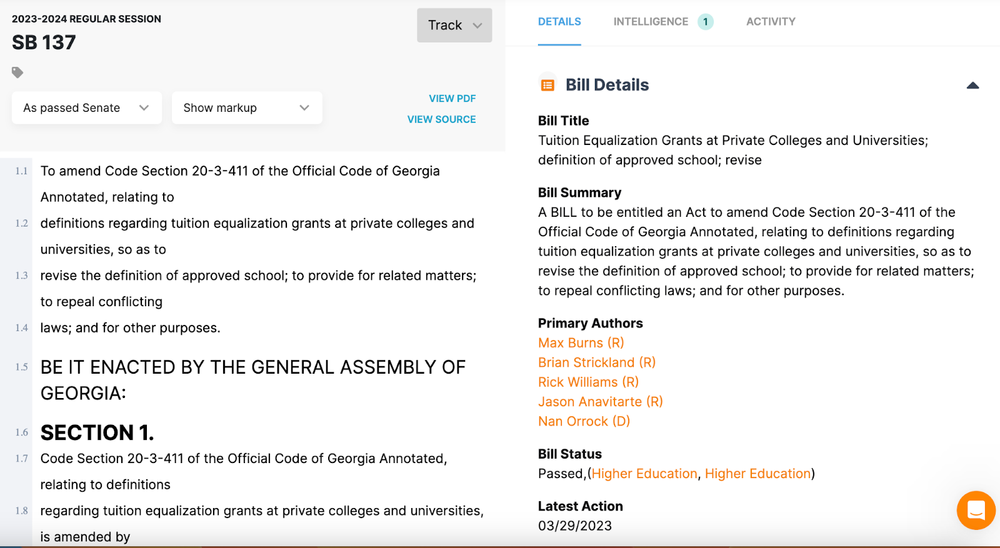
    Plural’s best-in-class data makes it easy to find information about any bill that’s been introduced in the most current and recent sessions of all 50 U.S state legislatures, the U.S. Congress, Puerto Rico and the District of Columbia. In addition to providing full bill text complete with line numbers, Plural’s bill detail pages include the bill’s number and title, author and co-sponsor, originating committee information and a summary of key actions that were taken on the bill.

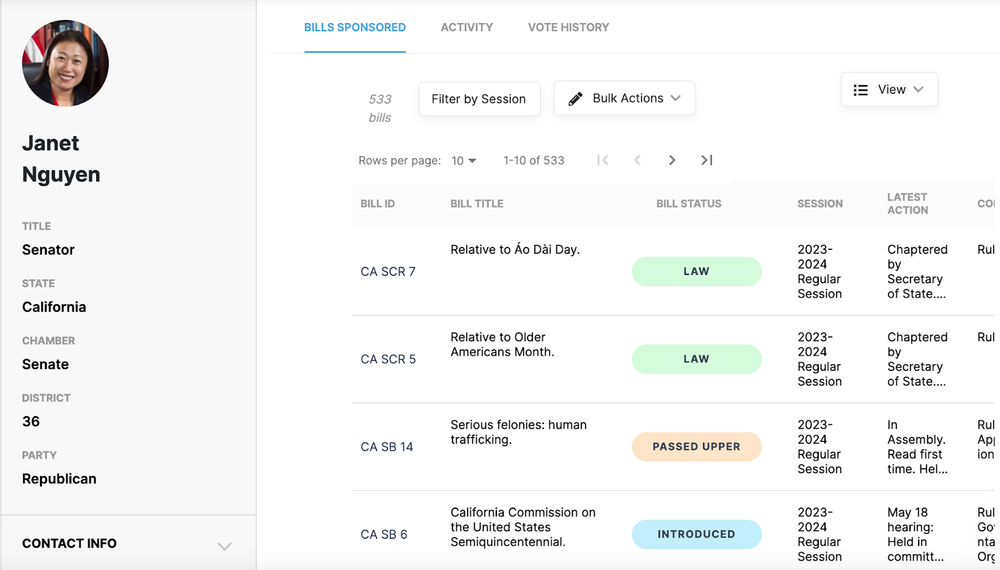
    In addition to bill information, you can also find key information for legislators across 52 U.S. jurisdictions, as well as a list of all bills each legislator has authored or co-sponsored, and their legislative voting records

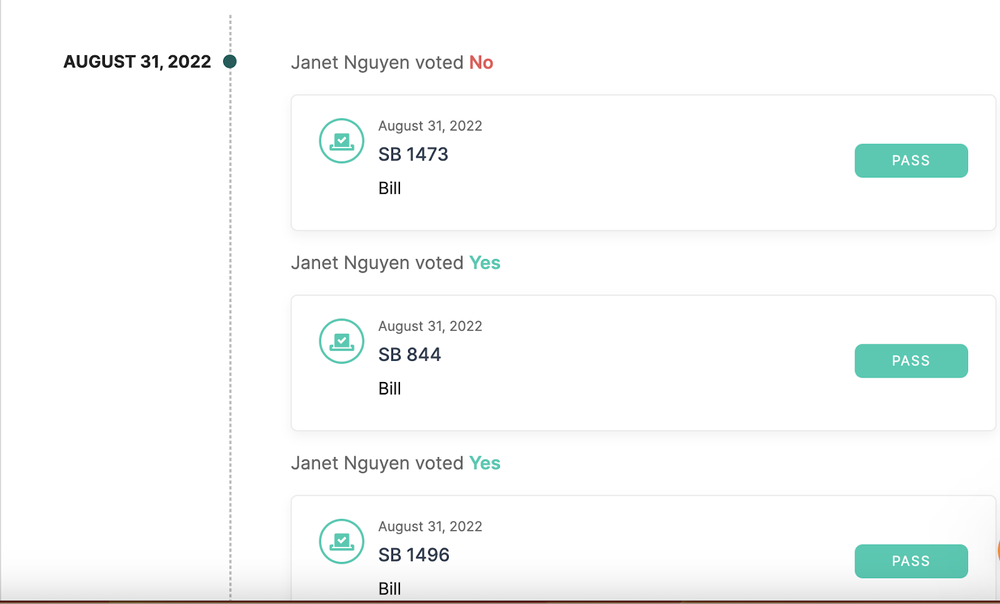
    Plural also provides vote data by individual legislator or bill, which means you can easily confirm pass/fail votes on your bills of interest and dig into how your legislators of interest voted on key bills.

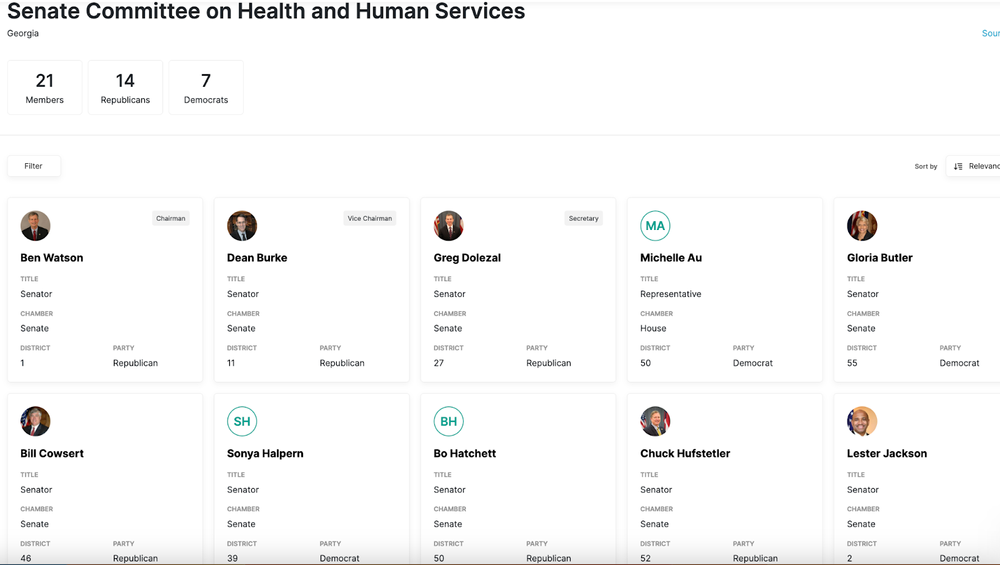
    AND, you can also find key committee information such as membership and leadership.

    Take Your Reporting to the Next Level with the Power of AI

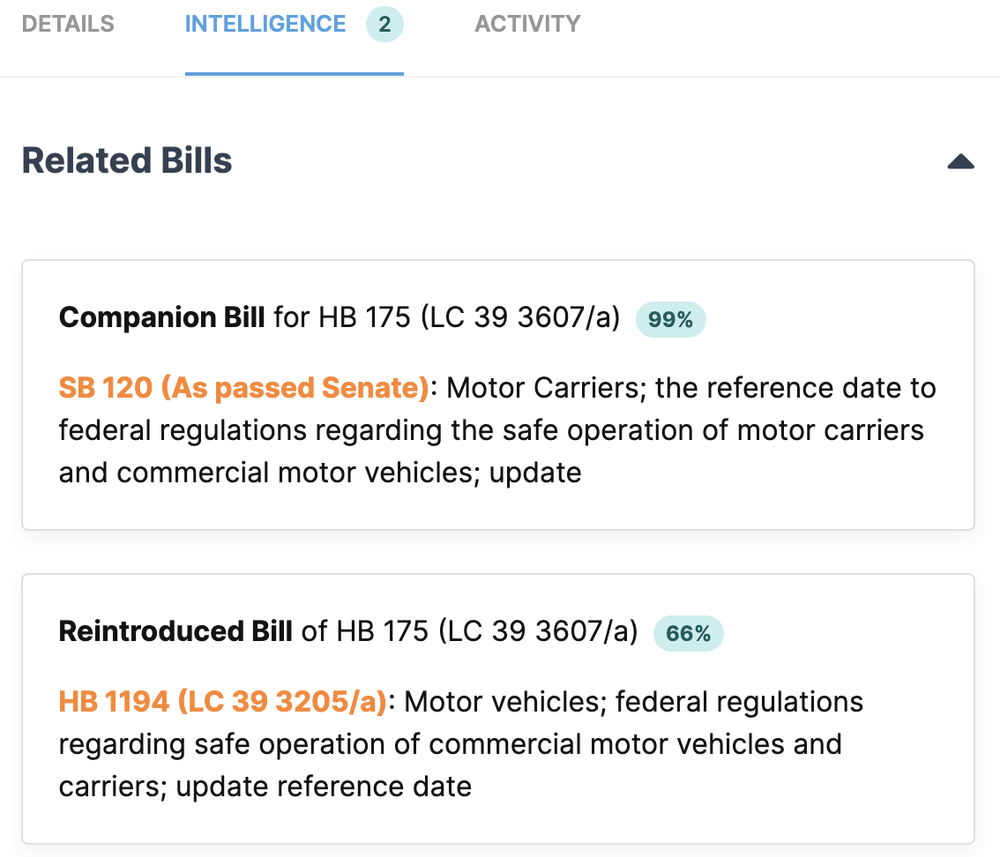
    Plural harnesses the power of AI to strengthen the insights you can include in your legislative report. Plural’s Highly Similar Bill feature helps you quickly identify bills that are related or similar to another bill. Or, you can identify patterns in bills across jurisdictions through the use of Plural’s Global Bill Search.

    Plural’s AI-powered Momentum Indicator can also help you easily identify bills that had the best chance of movement during the session.

    Keep Everyone and Everything on the Same Page

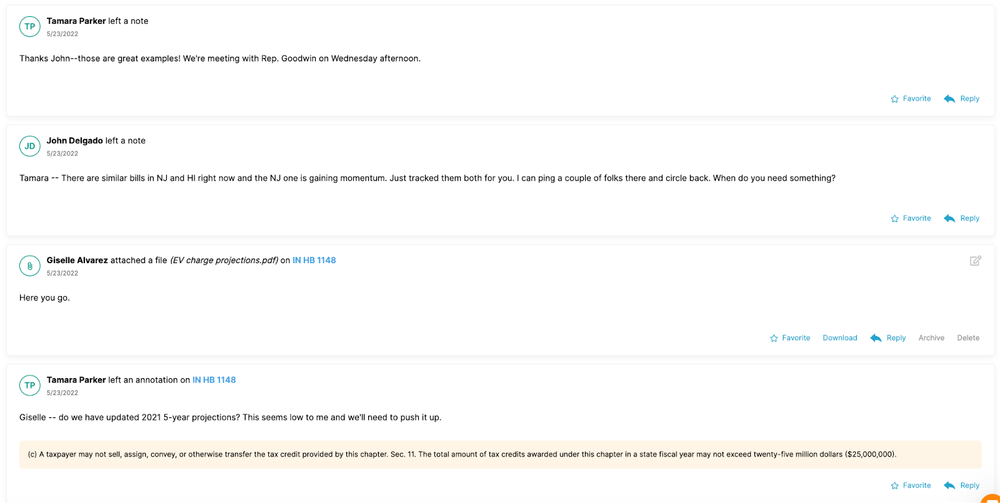
    Plural’s workspaces provide a way for you to organize your collaborators, bills, notes and files by topic, project, team, campaign or client. No more searching across email, text messages, documents and hand-written notes.

    Within a workspace, you and your team can create and share notes from staffer meetings on legislator profile pages, annotate bill text, and upload files such as testimony documents, voice memos or media clips that are easily accessible to everyone else in your workspace. No more chasing people at reporting time to get what you need or sifting through dozens of different file formats. It will all be in your workspace – already organized.

    Plus, with no limit to the number of workspaces you can create, you can easily keep files, notes, and bills that are associated with one client, team or topic separate from others – in the cloud and secure – with access available only to those that should truly have it.

    Get and Stay Organized from the Start

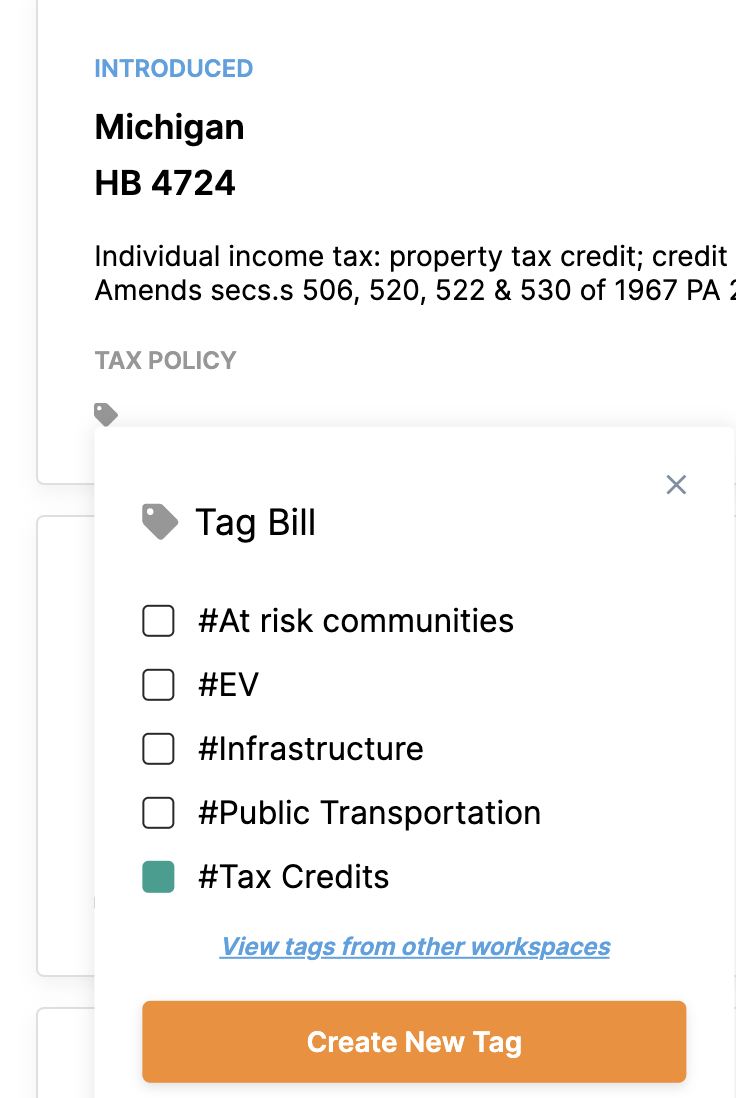
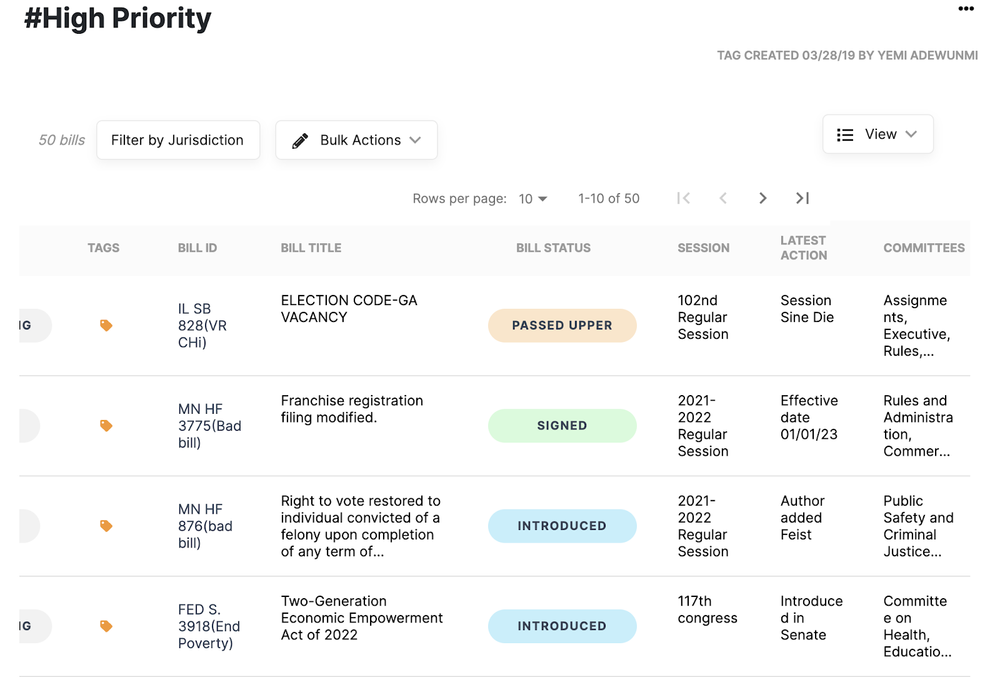
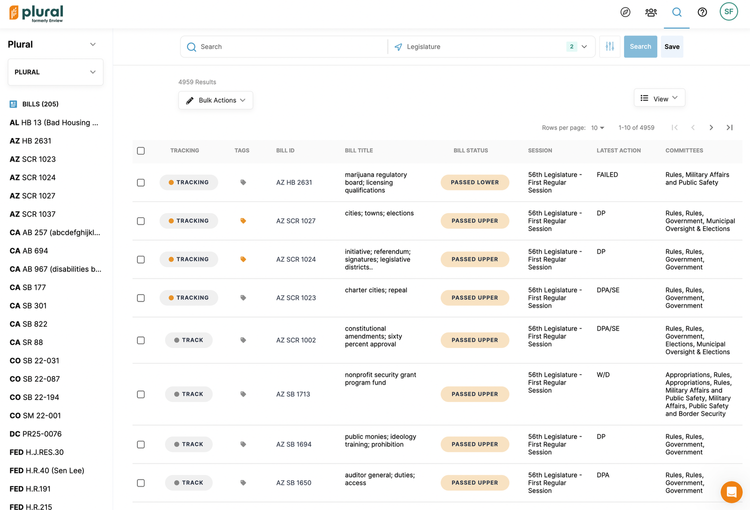
    Plural’s tag feature is like a virtual folder system for you to keep your bills of interest organized. Create a “support” and a “oppose” tag, for instance, and apply them to relevant bills, making it simple to find this important category of bills when needed. Additional oft-used tags are “high priority” or “low priority;” or by topic such as “education” “healthcare” and “budget.” There’s no limit to the number of tags you can create in Plural or to the number of tags that can be associated with bills, making it easy for you to find your bills across a variety of useful categories.

    Make Your Legislative Report Interactive

    Tags are a quick and easy way to organize and find your bills of interest internally, and can also serve as a handy way to share a group of bills with audiences outside of Plural. Plural’s public tag feature allows you to share a link to all of the “support” or “oppose” bills that can be accessed by anyone who has the link. Once viewing the list of bills associated with that tag, they’ll be able to click into the bill number and see a summary of key information about the bill and view the bill’s full text. All without any additional work needed from you or a Plural log in needed from them.

    Dig Deeper

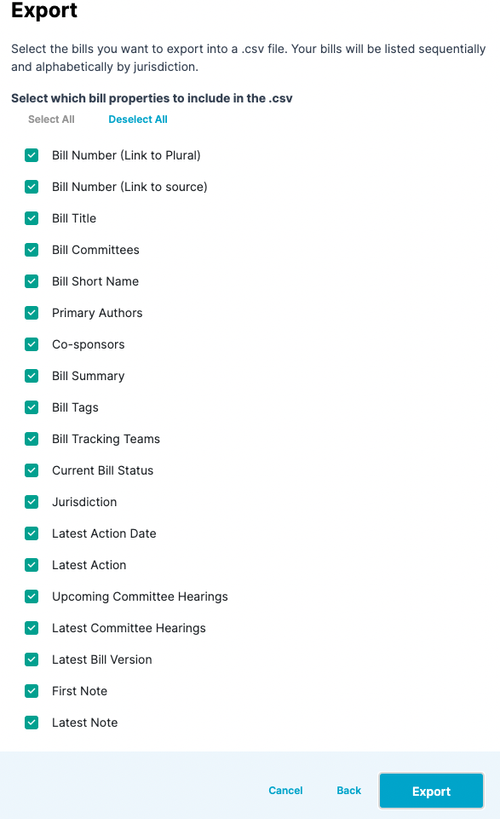
    Need to do more complex and in-depth analysis on a group of dozens, hundreds or even thousands of bills? Need to convert raw data into charts and graphs? You can easily export your data from Plural into a .csv file to conduct further analysis and data configuration as needed.

    Need help getting started?

    Creating a legislative report is key to proving the impact of your role, your team and your organization. It showcases the tangible results of your work to your board, stakeholders and community members.

    Need help getting started? Download our end-of-session report template today!

    You Deserve a Break

    Whether it’s the end of the week, the end of session or the end of a budget or calendar year, you and your team have already put in the hardest part of the work. Let the legislative reporting process be the easier part. With planning, organization and commitment to process you can knock out stellar reports that demonstrate the value that you, your team and your organization bring – in a fraction of the time.

    PLUS, there’s an added bonus – a stellar legislative report isn’t just for someone else’s benefit, but will be a critical asset when it comes to your planning and strategizing process for the next session.

    Ready to start creating a more organized system for monitoring, documenting and reporting on your public policy work all in one easy place?

  • Need to Know: The Federal Debt Ceiling

    Need to Know: The Federal Debt Ceiling

    Once every few years, we hear politicians and the media begin talk about the debt limit, also known as the debt ceiling. The conversation, which includes vague references to the disastrous economic consequences of surpassing the limit, slowly builds momentum and urgency until a deal to avoid crisis is struck, and talk of the debt limit recedes. 

    Amidst the chaos of what can seem like a regularly-scheduled financial crisis, it’s easy to lose track of what is actually being debated, which is the increase of a congressionally-defined cap on the amount of money that the federal government can borrow to pay its bills. Read on to learn what exactly the debt limit is, why approaching or breaching the limit could be risky, and how the 2023 debt limit negotiations fit in.

    What Is the Debt Limit?

    A core tenet of the separation of powers set up by the United State Constitution is that only Congress can authorize the borrowing of money by the federal government, typically through the issuance of bonds. Before 1917, Congress would specifically authorize borrowing when the federal government needed to. This process changed when unpredictable spending needs during World Wars I and II led to the creation (in 1917) and further establishment (in 1939) of a general limit on the national debt, which we now know as the debt limit. 

    In 1941, Congress passed an act raising that debt ceiling to $65 billion, meaning that Congress would need to act before the federal government’s debts reached that limit. Since 1941, Congress has passed more than 100 debt ceiling increases, oftentimes with little fanfare or controversy. 

    There are two basic approaches to “increasing the debt ceiling”:

    1. Congress can simply raise the amount of money that the federal government can borrow, or
    2. Congress can “suspend” the debt ceiling for a set period of time, granting the government the ability to borrow beyond the existing ceiling, and meet its financial obligations, through that period.

    In both cases, a debt ceiling increase is only a temporary solution. To understand why this common procedure is so often at the center of Congress’ most heated battles, it is important to understand the impact of hitting the debt ceiling.

    What Happens if the Debt Ceiling Is Breached?

    Generally speaking, Congress directs the federal government’s income via taxes, and its expenses, like social security, payroll for federal employees, and interest on existing debt, through appropriations bills. Because the expenses almost always exceed the income, the Treasury Department must take on debt to pay the government’s bills via bond sales. If the debt limit is reached, and the Treasury is no longer able to raise funds via debt, there will not be enough money for Congress to pay for all of its expenses. 

    The United States technically hit its debt ceiling in January 2023, but Treasury Department “extraordinary measures” allowed the government to keep paying its expenses for over six months. The date at which even those extraordinary measures would fail to allow the federal government to pay all of its bills is known as the “x-date”, and it is difficult for even financial experts to precisely predict.

    Congressional leaders and the White House were able to pass a deal before the x-date in 2023, but what would happen if that x-date was reached? Economists have debated this question for decades, and it is impossible to predict exactly what would happen. But, in a general sense, the federal government would need to decide which bills to pay, and which payments to miss. 

    It is commonly thought that, after reaching the x-date, the government would first delay federal employee paychecks and/or payments through federal programs like Medicare and Social Security before failing to make payments on existing debt, which would cause a default. Experts agree that a default would have disastrous impacts on the stock market, the national and global economy, and any American who relies on programs like SNAP or veterans benefits to get by.

    Why Do We Constantly Find Ourselves Nearing the Debt Ceiling?

    Given the turmoil that default could cause, it can be hard to understand why Congressional leaders struggle to agree on increasing the debt ceiling. In fact, strong arguments could be made for eliminating the debt ceiling altogether — no other country has a similarly restrictive debt ceiling; Denmark is the only other country with an absolute debt limit, but it is kept well above current borrowing to avoid ever approaching the limit.

    The truth is that the debt ceiling is so often at the center of massive political debates because of the turmoil that a default would cause. Missing social security payments, weakening the United States’ borrowing reputation, and the other impacts of a default end up being an invaluable bargaining chip for one party to use to win policy concessions from the other party. In a strictly political sense, debt limit negotiations require the support of both chambers of Congress and the White House, and anybody with enough power can effectively tie their support of increasing the debt limit to their policy priorities.

    2023 Debt Ceiling Negotiations

    Once Republicans took control of the House of Representatives following the 2022 midterm elections, a looming fight over the debt ceiling, technically hit in January 2023 but with an estimated x-date in early June, began to take shape. President Biden first called for a “clean increase”, meaning an increase that is unattached to any other policy changes, through the 2024 elections. The President’s logic makes sense, as a clean increase would prevent him from having to win GOP support of policy changes. Further, the extension through 2024 would prevent the debt ceiling from becoming a liability for the President during campaign season. 

    House Republicans, led by newly appointed Speaker Kevin McCarthy, were never going to let this happen. Without Republican control of the Senate or White House, the debt ceiling negotiations became one of McCarthy’s first and only opportunities to force concessions from Democrats. Republican demands mostly centered on federal government spending, which they view as out-of-control. Republicans proposed non-defense spending caps that would have drastically limited the growth of federal spending for the next decade and more aggressive work requirements for government programs like SNAP and Medicaid. 

    In the end, the White House and House Republican leadership were able to get their respective parties to pass H.R. 3746 to suspend the debt limit through the 2024 elections, cap non-defense spending in 2024 and 2025, and expand work requirements for those receiving food stamps to older individuals. Other policy changes in the bill will expedite approval of a natural gas pipeline in West Virginia (a win for their delegation), end the pause on student loan payments beginning in September (a Republican ask that aligns with the President’s existing plans), and cut IRS spending created by the Inflation Reduction Act (a Republican win). 

    Once again, Congressional leadership were able to avoid default at the last minute, but leaders are clearly getting more comfortable with approaching the debt limit, and the 2024 election will determine exactly what the next fight looks like.

    Want to gain greater insights into the U.S. federal government?

  • Building an Effective Tech Stack for Your Advocacy Organization

    Building an Effective Tech Stack for Your Advocacy Organization

    Leading an advocacy organization involves countless tasks and responsibilities. Leaders can make their work more streamlined by utilizing advocacy technology solutions to optimize their workflow. Work smarter by updating your organization’s tech stack.

    The Benefits of Incorporating Tech Into Your Daily Work

    Technology can help nonprofits achieve success by helping teams and leaders work smarter. Today’s leading software solutions are designed to flexibly fit your workflow, provide automations, and help teams collaborate with ease. 

    The major challenges of operating a nonprofit organization include managing expectations across your team and effectively communicating information, both internally and externally. Whether your organization is fundraising for a cause or coordinating an advocacy campaign, alignment amongst your team is critical to achieving your goals. Technology tools can help with this.

    Technology can help nonprofits achieve success by helping teams and leaders work smarter.

    Choosing the Right Tech Tools and Approaches

    There are a variety of technology tools that will help you operate your organization more efficiently. Here I share 3 categories of tools, but there are many more ways that you can leverage modern software solutions.

    Task and Document Management 

    Keeping up with day to day tasks and responsibilities can be incredibly challenging when you have a never ending to-do list. As leaders in our organizations, we find that there is always something that can be done. One of the best ways to manage the list is to use a task management tool that has a web, desktop and mobile app, which allows you to access your list from anywhere. Apps like Asana, Trello and Notion are great tools because they allow you to set due dates, attach links and documents, and assign roles to tasks. 

    Stakeholder Management Software or CRM

    As an organizer and leader, you will want a tool to help you keep track of all of your contacts that your organization interacts with — volunteers, donors, constituents, community groups, etc. It’s helpful to have a central system to manage information about all of these types of stakeholders, like a rolodex. It’s also helpful if your tool connects to social media applications so that you can also track your online community.

    Bonterra is valuable for organizations as it provides an integrated suite of tools for managing donor relationships, fundraising, advocacy, email marketing, and analytics, enabling organizations to streamline operations, improve efficiency, and increase their impact.

    Salesforce offers a comprehensive, cloud-based CRM platform that allows businesses to efficiently manage customer relationships, sales pipelines, service operations, and marketing efforts, while also providing analytics and AI capabilities for informed decision-making.

    Fundraising Software

    Raising funds for your organization is a major responsibility and can be very difficult to accomplish without an organized system. You’ll want a tech solution that will enable you to track progress towards your goals. 

    DonorPerfect offers a specialized, comprehensive CRM system designed for nonprofits, enabling efficient donor management, fundraising, event coordination, and data analysis, thereby enhancing their fundraising efforts and improving donor relations.

    Network for Good offers user-friendly donor management and fundraising software designed specifically for nonprofits, facilitating donor engagement, tracking donations, and streamlining fundraising efforts, thus promoting organizational growth and impact.

    Legislative Tracking Tools

    If your organization is involved in public policy advocacy or lobbying, new tech tools are available to help manage the work of keeping track of fast-moving legislation. First, your organization will want to identify which jurisdictions that it wants to track policy in. Next, you’ll find that Congress, state legislatures, and many local and municipal legislatures publish proposed legislation, or bills, on its government website. By searching through the legislation, your team can decide which policies to keep track of. 

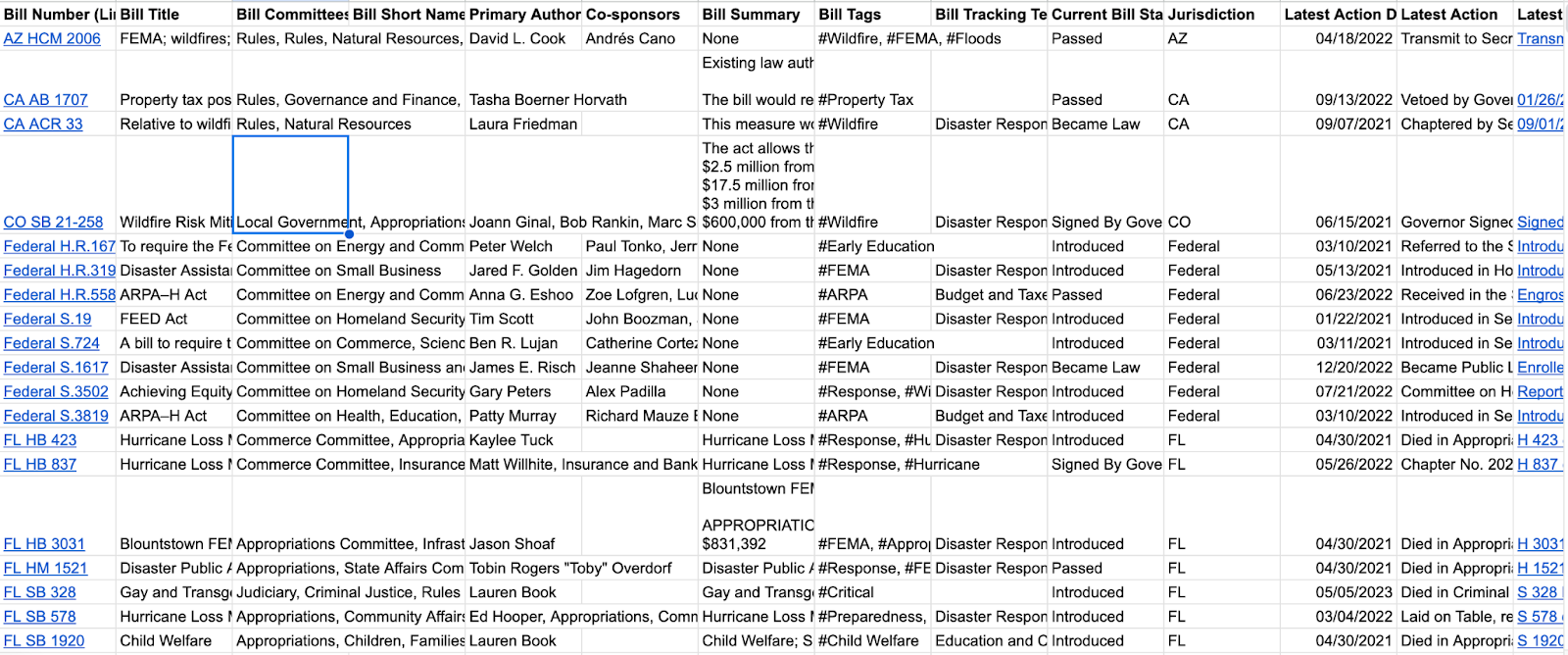
    Many organizations will use a tool like a shareable document or spreadsheet to organize the information regarding legislation being tracked. These tools generally allow a team to share relevant information to the right people.  However, there are more efficient ways to track public policy. With modern solutions like Plural, organizations can more easily discover important information from the legislature and automate their work with proposed legislation.

    Add Plural to Your Tech Stack Today

    Plural is the most intelligent software tool that gives you easy access to legislation that impacts your organization. While other options in the market are loaded with bulky features and are overpriced for advocacy organizations, Plural empowers your organization and your team with easy functionality, automated notifications about fast-moving public policy, and unlimited access to sharing policy information with your stakeholders.

  • Honoring the Contributions of the LGBTQIA+ Community to Our Democracy

    Honoring the Contributions of the LGBTQIA+ Community to Our Democracy

    As we celebrate Pride Month, it’s essential to reflect on the significant contributions of the LGBTQIA+ community to our country’s democracy. In recent years, the queer community has been impacted by the passage of legislation that directly impacts their rights and well-being. This month, we honor the bravery and resilience of the queer community. Plural stands committed to preserving and protecting the invaluable benefits that diversity brings to our democracy.

    Legislation Impacting Transgender Individuals

    Recent legislation, such as Texas SB 14 and SB 1029, has brought attention to the struggle faced by transgender individuals in our current political climate. SB 14 prohibits doctors in Texas from providing gender-affirming care to Texans under the age of 18. This law, set to become effective in September of this year, forces trans youth to halt essential gender affirming treatments, adversely impacting their physical and mental well-being. SB 1029, if passed, would have made nearly all forms of gender-affirming care illegal in Texas, affecting both trans youth and adults.

    Queer Trailblazers in Politics

    Amidst these challenges, queer trailblazers in politics have emerged, breaking barriers and reshaping the political landscape. Pete Buttigieg, Maura Healey, Zooey Zephyr, Todd Gloria, and many others have made history by becoming the first openly queer individuals in their positions and have exhibited courage and determination in navigating the current political climate. For instance, Zooey Zephyr, a representative in the Montana state legislature, protested a bill that restricts trans individuals from receiving gender-affirming healthcare. Her unwavering commitment drew hundreds of protestors to the state capitol, shedding light on the importance of preserving access to inclusive healthcare.

    The Power of Diversity in Democracy

    At Plural, we believe that diversity is the backbone of a robust democracy. It’s crucial to ensure that all voices are heard and represented in our legislative processes. Embracing different viewpoints allows for a more inclusive and comprehensive decision-making process. With enhanced collaboration features and automatic, mobile-friendly notifications, Plural empower individuals and organizations to actively engage with legislation, never missing an update. By preserving and protecting diversity, we strive to foster a democracy that truly represents its constituency.

    Pride Month serves as a reminder of the remarkable contributions and resilience of the queer community. Despite the challenges they face, queer individuals continue to shape our democracy. As we celebrate, Plural recognizes the trailblazers in politics who have shattered barriers, amplifying the voices of the queer community. Plural remains dedicated to supporting and advocating for the diversity that enriches our democratic system. Together, we can ensure a future where every individual, regardless of their sexual orientation or gender identity, can participate fully and thrive within our democracy. Happy Pride Month!

  • How to Lobby at the State Level

    How to Lobby at the State Level

    Lobbying at the state level is the practice of engaging with lawmakers and policymakers to advocate for a particular cause or interest and being compensated for the act of political influence. It is an organized way for individuals or groups to express their opinions, share information, and attempt to influence the decisions made by the state government. The words “advocate” and “lobbyist” are often used interchangeably, as both often work to influence politics and policy at the state and federal level. However, each fulfill a different role and are considered legally different by every state government’s regulations. The most significant difference between advocates and lobbyists is that advocates are not paid to participate, while lobbyists are. Lobbyists can work for almost any group, including corporate firms, private companies, non-profit organizations, trade organizations, political interest groups, and even individuals seeking to impact policy. Some of a lobbyist’s general functions include establishing relationships with key decision-makers, holding meetings with government officials, attending public hearings and committee meetings, and, most importantly, monitoring and tracking policy to stay informed, relevant, and strategic.

    Lobbying at the State vs. Federal Level

    Lobbying at the state level versus at the federal level is very similar, but there are some key differences between the two practices, including: jurisdiction, the scope of authority of each legislature, and the differences in the legislative process between state governments and the federal government.

    Jurisdiction

    First, the jurisdiction of the federal government encompasses all states in the United States. As such, policy objectives when lobbying the federal government are often broader. Further, federal policies impact the entire American population, generating a higher level of impact on a broad range of different groups, organizations, and communities. Laws passed by state legislatures, on the other hand, only affect the citizens of a given state.

    Scope

    Another key difference between state and federal policy is the type of differing types of issues that each can address. For example, state governments handle matters of education, healthcare, transportation, and other localized issues. In comparison, the federal government is tasked with handling issues that impact and regulate the entire county, such as immigration policy, the military, international relations and conflict, and commerce.  

    Therefore, should a lobbyist be charged with the responsibility of impacting immigration policy, their efforts are more likely to be targeted at the federal level, since the federal government has a higher scope of authority on the issue.

    Legislative Processes

    Lastly, the difference in legislative processes between individual state governments and the federal government are immense and often require specialized knowledge. State and Federal governments have different rules for who may introduce bills, how committees are run, and even how voting will occur in their respective legislative chambers. These differences create  the need for lobbyists who understand these differences and are able to continue to leverage influence, strategize and support in order to continue to defend their respective causes within a specific legislative context.

    Six Steps to Effective Lobbying

    Lobbyists, in essence, are messengers who work to convey their concerns, ideas, and policy suggestions to elected officials, legislative staff, and other political decision-makers. While the specific process and legal requirements behind lobbying and policy influence do depend on each specific state and its regulations, here are six steps to help you successfully lobby at the state level:

    Determine Your Legislative Priority

    First, determine your legislative priority by  narrowing down the “what”, “when”, and “how” parameters of your organization’s mission and goals. For example, if your goal is to increase equity within education systems in the state of California, Michigan, or Texas, ask yourself: what specific problem must be addressed in my state in order to reach my goal of educational equity? Answering this question will allow you to narrow down exactly what needs to be addressed. It is essential to consider a broad variety of ideas and conduct thorough research and analysis to understand the dynamics of your problem, and how it will be most successfully addressed. 

    Next, identify the “when”. When understanding a problem you are likely to come up with a laundry list of issues that must be solved, and creative solutions that are essential to implement. Answering ‘when’, reminds one to think intentionally within the context of the current legislative session, what will be most impactful, and identify the current state of political interest in your topic. For example, when seeking educational equity in California, defining ‘when’ will include analyzing what factors are necessary for your change to occur, you will want to set your strategies on when your issues will become the most salient. Such as during an election year. During election years there is momentum and will from legislators to make policy improvements that positively impact their constituents, often education is one of these all encompassing issues. 

    Finally, identify the “how” by creating a list of strategies and goals that will enable you to create a successful legislative plan. Defining how you will strategize comes from understanding the audiences that are both against and for your suggested policy adjustment. Continuing the example of education equity in California, it will likely be most advantageous to have a strong relationship with PTA (Parent Teacher Associations) boards, student leaders who you coordinate with to amplify the necessity of your issue and the state should be in an economic state that has space to request additional programs in the states education budget. The combination of identifying what, when, and how allows you to create a clear legislative strategy  that is  consistent with your mission and relevant within the current political context.

    Identify Your Target Lawmaker(s)

    Now that you have your legislative priorities clear, it is essential to identify your target elected officials, legislative staff members, and coalition leaders. The individuals who are essential to identify will be those with whom your goals align, or those who may be a roadblock to you achieving your goals. 

    In order to identify those who will work to assist you in completing your goals, conduct research on the representatives who govern the area most impacted by your policy issues and become familiar with their legislative goals for the session to determine if there is alignment. You can also identify news, politics, and academic leaders within the research that support your cause, as they will be helpful in generating knowledge and awareness of your campaign issue. 

    In order to identify those who may work against you, look at the voting records of the state you are planning to lobby within, seek out their voting history on the issue you are lobbying for and identify those who have a consistent track record of voting against projects like yours. 

    Use Plural to identify key political officials on the committees that will be reviewing your policy proposals. Within Plural you can search for any legislator and be immediately provided with the comprehensive list of their office contact information, committee assignments, vote data and all of their authored and co-sponsored bills. Further, you and your team can make notes in the legislator’s profile. Having one location for this level of essential data is critical for lobbying. Lobbying opportunities can present themselves at unexpected moments, sometimes in elevators, hallways, or post committee meetings to have the ability to look up a legislator’s name and understand their political perspective and key roles in the legislature provides a key advantage to those who utilize Plural to lobby and track policy.

    Refine Your Messaging

    Next, it is essential to define your messaging as an individual and organization when lobbying. Establishing your messaging involves understanding your audience, the issue at hand, and  your proposed solution. Your messaging is essential to a successful lobbying campaign — how people understand and connect with your campaign can generate political will. 

    A unique way to refine your messaging is to connect your issue and policy solution to a compelling narrative. This can happen by connecting policymakers with the community of individuals who are directly affected by the policy you are seeking to change, humanizing the overall issue.

    When engaging with individual staff members and elected officials, be sure to emphasize the local impact of your policy proposal and how it aligns with constituent needs and interests. Provide specific examples or stories that illustrate the positive effects on their district or region and be sure to personalize the issue to make it more relatable and relevant.

    Consider Your Approach

    When considering how to approach your lobbying efforts at the State Capitol, there are many ways to engage with the political process. Be sure to research the legislative process, the state budget, influential government officials and staff members, and, most importantly, your state’s guidelines surrounding engagement with politics and policy. 

    There are many different approaches to engagement with staff members and elected officials, including 1:1 meetings, organized events, volunteer efforts, fundraising dinners, state capitol protests, or simply running into them in the halls of the Capitol building. Each approach provides benefits or disadvantages, in order to make each a success focus first on building relationships as they are core to the political process.

    Reach Out

    Reaching out to elected officials and government employees can be an intimidating experience, especially when you are not sure where to start. 

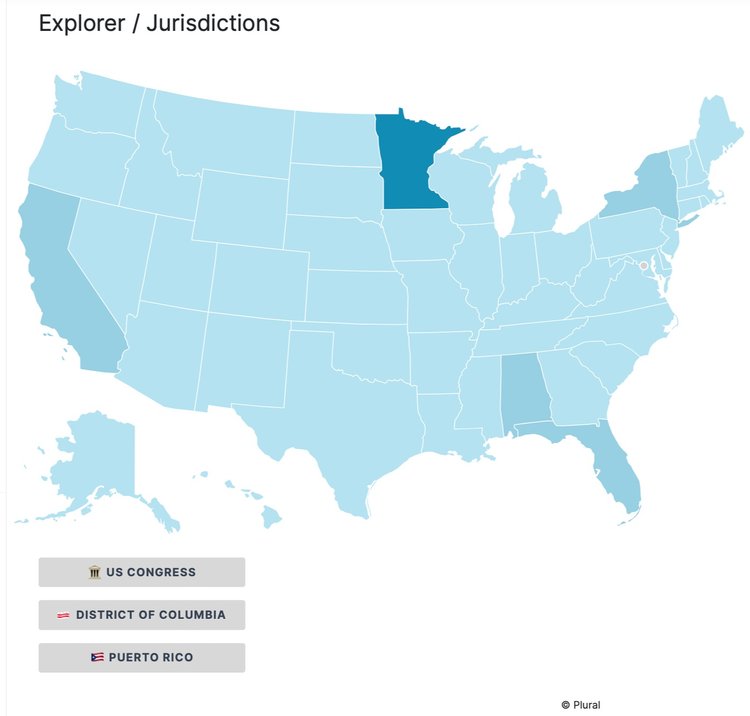
    A great place to start is by researching and connecting with people on committees where many of your bills will pass through. For example, a lobbyist who works for an education non-profit will want to research the education committee members and reach out to individuals who align with their ideals. Using Plural, a lobbyist could begin with our Jurisdictions Map, locate their state, and then view all the committees in the state legislature. Plural provides the partisan party makeup of each committee and the structure of each committee. This information is valuable to a state-level lobbyist in strategizing connections and building issue awareness in order to pass essential legislation.

    Remember to Follow Up

    Always remember to follow up. Staying connected and relevant in today’s world can be difficult; make it a fundamental task to stay in touch with your representatives and political coalitions as a lobbyist or advocate. 

    When lobbying, there will be many policies that connect to your mission and require your consistent attention. Using Plural, you can track individual bills that you are focusing on for the legislative session in your state. While tracking a bill, Plural will notify you of upcoming events and actions on the bill prior to essential vote days, or days when your bill will be read in committee you should follow up with your representatives about their necessary support. This follow-up can be a  reminder of the research gathered by your organization proving that the policy would be positively impactful for the community you represent.

    Plural for Lobbyists

    Impacting state policy is no easy task – as such, state-level lobbying is most often a coordinated, team effort because of the level of work that it takes to make an impact on state policy. Using Plural, a small team of lobbyists can do the work of a large organization by intelligently tracking policy, keeping people connected to important events, and creating workspaces optimized for collaboration. 

    As a state-level lobbyist, one of your most important duties is to track multiple bills as they move through committees and chambers within your respective state capitol. Plural streamlines bill tracking so that your team can all be aware of the priority bills that will be watched most closely throughout the session. Further, as a lobbyist, it is essential to build relationships with the correct government officials, utilizing Plural you can easily find contact info for committee leadership and  majority or minority leaders of the House and Senate. . Quick access to information on government officials increases democratic access by making it easier to connect with one’s representatives. 

    Lastly,  Plural is a collaborative tool for members of your organization and team to connect with the legislative process and bill text directly. Team members can annotate bill text, highlight areas, make notes and share these actions with all members of your team to keep people informed, up to date and hold a critical eye to the text of complicated legislation.

    Looking for a solution to streamline your lobbying work?

  • 2023 End of Session Report | Texas Legislature

    2023 End of Session Report | Texas Legislature

    At the start of the 2023 Legislative Session, Governor Greg Abbott began his eighth year as Governor of Texas. He outlined his legislative goals in the annual State of the State address in February 2023, naming the following legislative priorities: public health initiatives, stopping the border crisis, election integrity, abortion restrictions, education, and building upon the state’s economic opportunity. Texas’ Legislative Sessions occur only every two years, making this the first session since 2021. 

    The Texas House of Representatives has 150 seats – 86 Republican and 64 Democratic, and the Senate has 31 seats – 19 Republican and 12 Democratic. With this balance and Abbot as Governor, all three levels of the Texan government are majority Republican-controlled.

    Before the session began in January, the Republican majority shared its legislative priorities: Protect our Elections, Secure the Border, Ban Gender Modification of Children, Stop Sexualizing Texas Kids, Ban Democrat Chairs, Abolish Abortion in Texas, Defend Our Gun Rights, and Defend Parental Rights and Educational Freedom.

    Key Data: 2023 Texas Legislature

    Throughout this year’s Legislative Session, which took place from January 10-May 29, Texas passed 512 bills out of the 10,322 introduced that focused on economic investments, education, and healthcare. During the 2021 session, Texas passed into law 1,139 out of 12,235 introduced bills that focused on economic investments, education, public health, appropriations, and crime policy.

    Legislative Trends in Texas

    In 2022, the political party makeup of the federal government fluctuated from the Democrats controlling all three levels to a split government (Republican-controlled House and a Democrat-controlled Senate and Executive Branch). When a split of this nature occurs, federal legislation is less likely to pass, so the pressure was on for states to meet their parties’ legislative goals. In Texas, four key issues dominated the Legislature’s focus: 

    1. The rights of transgender individuals
    2. Abortion access
    3. Equity in education
    4. Gun control

    Interested in learning more? Download the full end of session report for the 2023 Texas Legislature.

  • Understanding the Federal Budget Process

    Understanding the Federal Budget Process

    The constant evolution of the budget process, coupled with how much of the negotiations happen behind closed doors, can make following the process intimidating. But the outsized impact of these large legislative packages, along with the regularity with which Congress must engage in this process, makes following the budget essential. Understanding the key steps in this process will put you on the right path to being the budget expert in your organization.

    What Is the Federal Budget Process?

    The modern federal budget process, largely defined by the Congressional Budget Act of 1974, is the prescribed timeline by which the federal government should determine its annual spending and revenue levels each year. The government’s fiscal year runs from October 1 to September 30, and the budget process lays the tracks for each of the involved parties, including federal agencies, both chambers of Congress, and the President, to influence, debate, and approve funding for the next fiscal year ahead of the October 1 deadline. 

    Increasingly over the past 15 years, Congress has deviated from the federal budget process’ deadlines by missing deadlines or skipping steps. While it seems counterintuitive, amidst the uncertainty of the informal budget process that exists in practice today, a greater understanding of the traditional budget process is vital to understand where Congress is, and where they must get to, in order to keep the government funded.

    Mandatory and Discretionary Spending

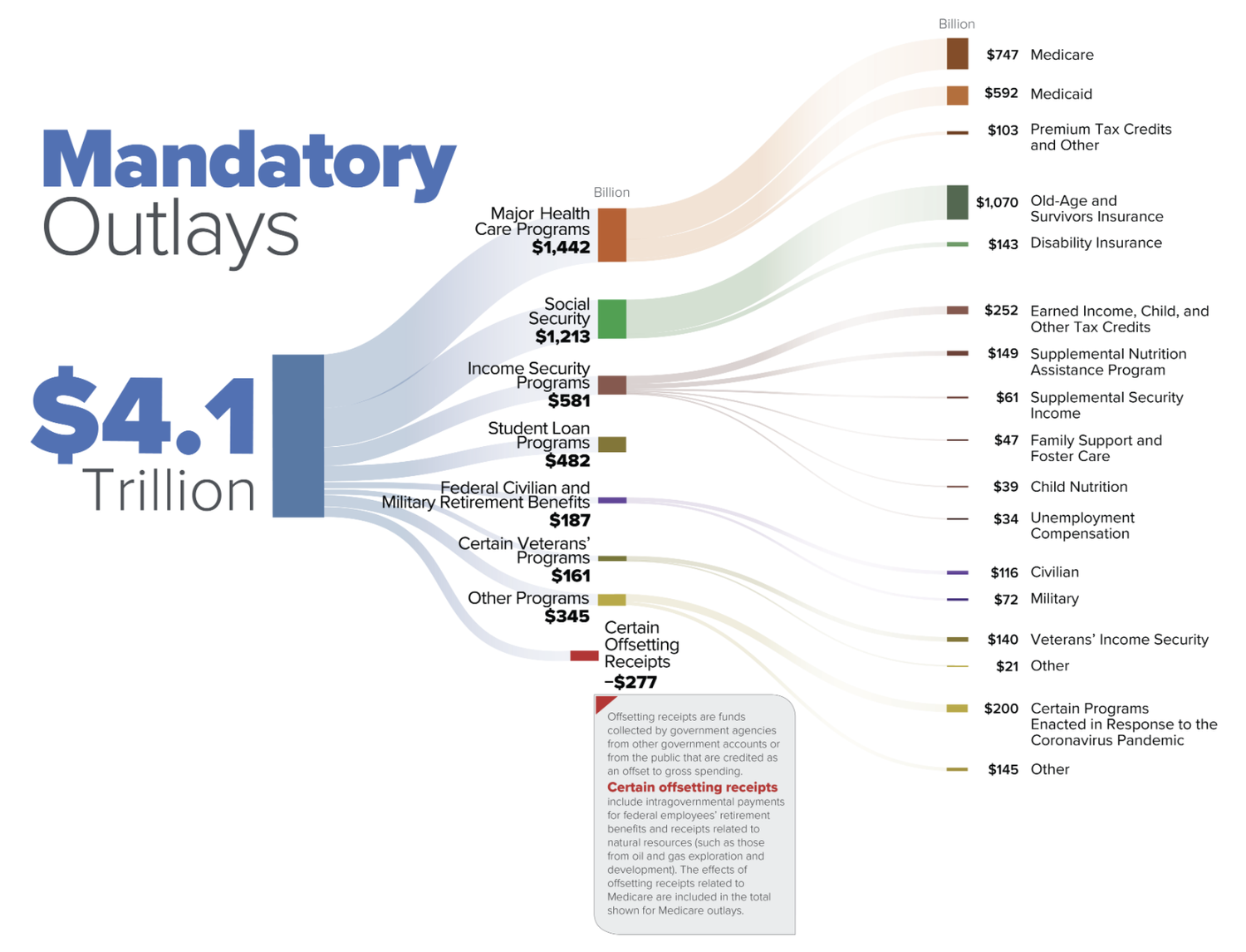
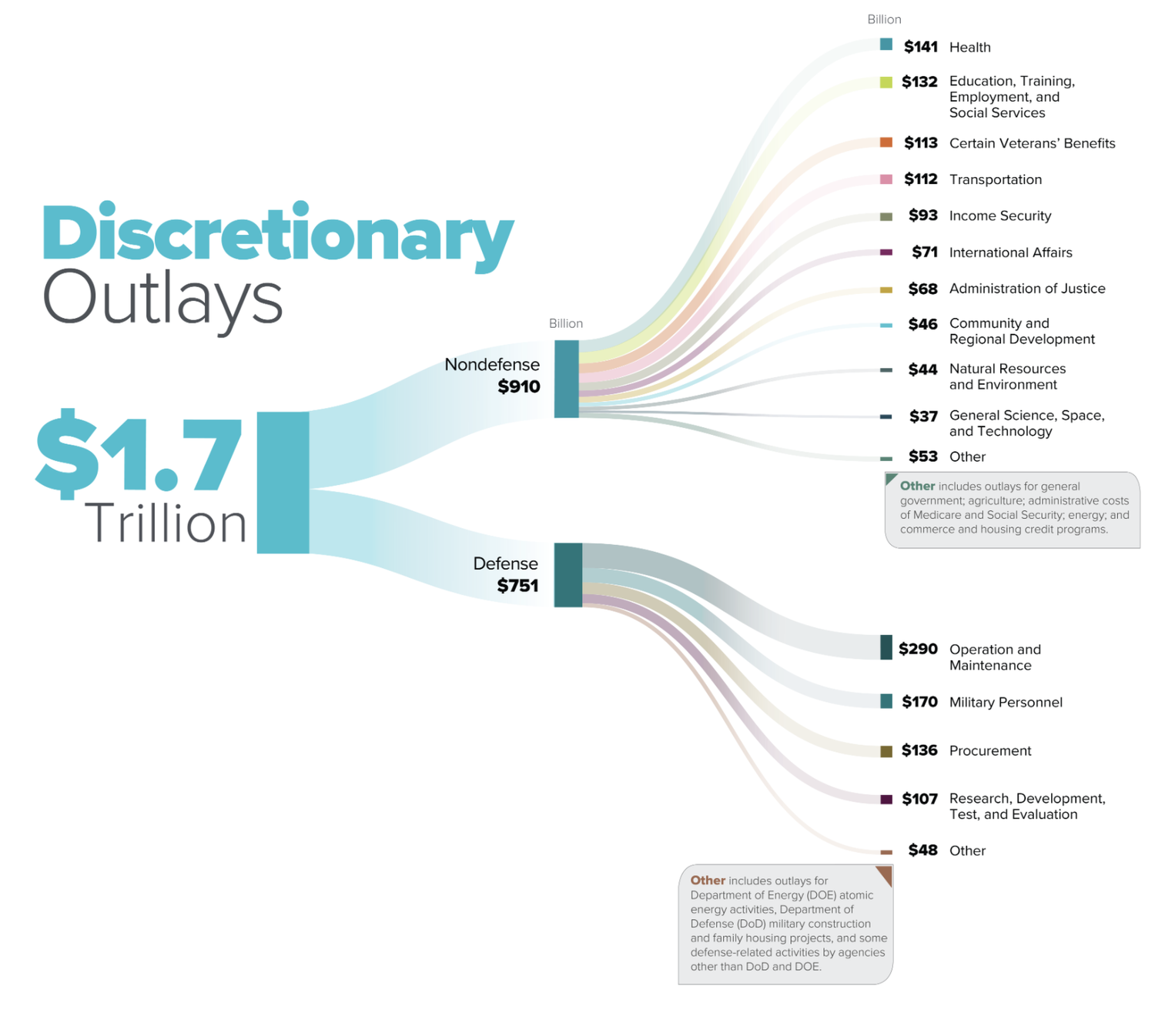
    Federal spending is commonly categorized into two distinct categories, mandatory spending and discretionary spending —interest payments on existing debt make up the remainder of the government’s spending budget. 

    Mandatory spending includes funding for programs that have their funding levels determined by existing law. Most mandatory funding categories are determined by existing laws, which establish social benefit programs, like Social Security, and set forth the criteria used to determine who is eligible. Spending on Social Security, therefore, is determined by how many individuals are eligible, and the benefits they are owed as defined by existing law, making it mandatory spending. The only way to impact mandatory spending is for Congress to amend that existing law, typically by expanding or restricting eligibility to these programs.

    Source: Congressional Budget Office

    By contrast, the dollar amount and specific use of discretionary spending is not determined by any existing law. Despite its name, discretionary spending is no less important than mandatory spending, as it is the tool that Congress uses to fund the federal agencies responsible for education and defense programs, along with many other priorities. For example, a large portion of discretionary spending is directed towards agencies like the Centers for Disease Control and the National Institutes of Health, for their work researching and improving public health. Under the federal budget process, discretionary spending is formulated, debated, and passed by the House and Senate Appropriations Committees.

    Source: Congressional Budget Office

    Spending vs. Revenues

    Like any budget, the federal budget balances spending against income, known as revenues. The government’s revenues are derived from taxes and fees that,like mandatory spending, are traditionally determined by existing law. During the budget process, Congress can attempt to change revenue levels by amending existing tax law, or passing new tax law. However, this isn’t a necessary component of the budget process, and revenues generally receive less consideration than discretionary spending.

    Source: Congressional Budget Office

    Stages of the Federal Budget Process

    The incredibly complex and important process of  appropriating and receiving trillions of dollars can be understood in the following 4 steps:

    • The President’s Budget Submission – Generally submitted in early February, this is the President’s opportunity to lay out their proposed spending plan for the next year.
    • Congressional Hearings – Following the release of the President’s Budget Plan, Congressional Committees hold hearings for agency leaders to promote and defend the President’s proposed funding for their agencies.
    • Budget Resolution – After consideration of the President’s proposal, and hearing from agency leaders, the House and Senate may pass their outline of a budget proposal, known as a Budget Resolution. 
    • Consideration and Passage of Appropriations Bills – Following the limits set by the budget resolution, the House and Senate Appropriations Committees consider and pass bills that detail spending on discretionary programs in the next fiscal year, known as Appropriations Bills. Following passage out of committee, these bills are voted on by the full chambers, and any differences between proposals will be worked out in Conference Committee before a final passage is sent to the President for their signature. 

    In practice, the budget process can often deviate from these four steps, and include other tools and procedures.

    The President’s Budget Submission

    Kicking off the annual budget process is the President’s Budget, typically submitted in February. This detailed report is the result of months of hard work by agency staff and includes top-level recommendations for government expenditures and revenues, as well as proposed spending in the 20 budget function categories, including transportation, Social Security, national defense, and so on.

    While incredibly detailed, the President’s Budget holds no legal authority, and is generally quite different from what ultimately ends up being passed into law. With that being said, this is one of the President’s best opportunities to turn their campaign promises into proposed policy before Congress.

    Congressional Hearings

    Each spring, both chambers of Congress host congressional hearings to question agency heads about the proposed funding for their programs as outlined in the President’s Budget. Depending on the partisan makeup of Congress, and the agency leader, these hearings can be some of the most contentious on a Committee’s calendar. Just as the budget submission is an opportunity for the President to lay out their priorities, these hearings are an opportunity for members of Congress to challenge those priorities, or offer their own priorities.

    The Congressional Budget Resolution

    Following these hearings, Congress may release its own outline for the next year’s budget, known as a budget resolution. This proposal is first created by the House and Senate Budget Committees, before being passed by each chamber. Compared to the President’s Budget Submission, a Congressional Budget Resolution is far less detailed, typically outlining just overall spending and revenue targets, and offering some direction to appropriations committees. This resolution may also include reconciliation instructions that direct a committee to produce legislation making changes to mandatory programs or revenues. As a concurrent resolution, this plan must be approved by both chambers of Congress, but it is not signed by the President and does not become law. 

    It is important to note that Congress is not required to pass a budget resolution. Since 2000, Congress has only passed a budget resolution around 50% of the time. Instead, the House and Senate often instead pass “deeming resolutions”, which  allow individual chambers to proceed on budget-related work without coming to an inter-chamber agreement first.

    Appropriations Bills

    With spending targets set, either through a budget resolution or other means, House and Senate Appropriations Subcommittees conduct hearings to deliberate on the budget(s) of the agencies and programs under their jurisdiction. The subcommittees pass their subject-specific bills out to the larger Appropriations Committee, where the full committee votes on sending the bill to the floor of the House or Senate. 

    Once these appropriations bills reach the floor of their chamber, the full legislative body will debate and vote on the proposals. Resulting from this process is two sets of appropriations bills, one House-approved and one Senate-approved, that a Conference Committee consisting of members from both chambers then considers and combines into a consolidated proposal. The Conference Committee proposal then must pass the Senate and House once more, before heading to the President’s desk for signature. 

    In theory, the bill should be signed by the President in advance of the October 1 fiscal year beginning, so that the government is consistently funded. However, as explained further below, the process to pass an annual budget can often stretch well beyond the beginning of the fiscal year.

    Visualizing the Federal Budget Process With a Flowchart

    Understanding the federal budget process is key to understanding how our government works and developing strategies to achieve your organization’s goals.

    Other Considerations

    Reconciliation

    As mentioned above, the Congressional budget resolution may contain reconciliation instructions that direct certain committees to consider and pass legislation, making specific changes impacting spending, revenues, or the debt limit. These instructions only direct the specific committees to pass legislation that makes a certain impact to spending, revenues, or the debt limit, and do not dictate the specific policies that should be enacted. 

    Because these bills are derived from the Congressional Budget Resolution, as outlined by the Congressional Budget Act, they are able to move through the Senate without needing its usual 60-vote majority to end a filibuster (more on that here).

    The Debt Limit

    Connected to the federal budget process, both procedurally and politically, is the issue of our national debt. Federal government spending typically outpaces the revenues generated by taxes and fees, resulting in a deficit that increases our national debt year after year. Since World War I, Congress has regularly authorized new borrowing to cover those deficits by raising or suspending a cap on the amount of debt that the government is allowed to hold, known as a “debt limit”. 

    If the government were to hit the debt limit, it would be unable to meet its debt obligations and would begin to default. Defaulting, which the U.S. has never done, could have disastrous impacts on the domestic and global economy. It is because of the disastrous impacts of default that Democrats and Republicans often tie policy priorities to the debt limit. If one party views increasing the debt limit as essential, the other party may see an opportunity to demand a partisan priority, like spending reductions, in order to commit their support. The debt limit has often been suspended until the beginning of the fiscal year so that the two Congressional tasks of funding the government and ensuring it doesn’t hit the debt limit are tied together.

    What Happens if Congress Doesn’t Pass a Budget by October 1?

    Outside of passing an annual budget outlining funding for the next fiscal year by October 1, Congress has two options: 1) Pass a continuing resolution or 2) Enter a government shutdown.

    By far the less disruptive option, a continuing resolution simply leaves in place existing funding levels, sometimes with small adjustments, for agencies and programs as they were during the previous fiscal year. Continuing resolutions generally expire once a proper budget has been passed or a certain date has passed, whichever comes first. Continuing resolutions offer negotiators in Congress extra time to work out a budget agreement without entering a government shutdown. An increasingly popular tool, there have been 33 continuing resolutions passed in the past 10 years. 

    Absent a comprehensive budget bill or a continuing resolution, the government enters what is known as a shutdown. During this time, only the “essential” services and functions remain active, like active duty military employment and programs relying on mandatory spending. “Non-essential” government employees may be furloughed, and government-run facilities like museums and national parks may be closed. Similar to hitting the debt limit, the negative impacts of a government shutdown are often used as a bargaining chip in partisan budgetary negotiations. The government has shut down three times in the past ten years, for a total of 54 days.

    Download our federal budget process flowchart to unlock greater insights into the functioning of our federal government.

  • Plural for Membership Organizations

    Plural for Membership Organizations

    As a membership organization, your role is twofold: providing value to your members and retaining, as well as increasing, membership engagement.

    Software and technological infrastructure solutions like Plural give membership organizations a strategic edge with AI driven regulatory, federal, and state public policy insights. Our automated bill tracking and collaborative experience removes administrative and manual barriers, allowing for a greater flow of authentic member, industry partner and stakeholder engagement. 

    Easily Engage With Members

    Membership input can play a vital role in strategy planning and development, ensuring that your members have ownership in the direction and, in turn, benefit of being part of a greater and larger community. Providing engaged members with the infrastructure and tech tools to be able to capture professional networking opportunities, community relationships only increases their ability to strengthen and add value to the membership organization of which they are a part. Plural allows for unlimited users, and our workspaces remove unnecessary email threads and spammed inboxes. Workspaces aligned by committee, issue area, or both launch a central source for membership discussions about regulatory, federal and state public policy risk and impact.

    An Easy-To-Use Tool

    Ease of access can play an enormous role in making or breaking your members’ ability to get and stay informed. Complicated dashboards are often not compatible with your organization’s annual or bi-annual board election and terms. At Plural, we prioritize an enjoyable user experience and have taken extensive steps to ensure that, throughout their entire experience, users enjoy an easy-to-use tool. This includes free, unlimited onboardings, topic specific trainings, and consultations by our policy experts. We are your trusted partner for customer support requests – whether it be poorly timed password resets or ensuring your entire team is on the same page when it comes to navigating Plural.

    At Plural, we prioritize an enjoyable user experience and have taken extensive steps to ensure that, throughout their entire experience, users enjoy an easy-to-use tool.

    Transparent and Consistent Communication

    Professional members trust organizations that are results driven — including providing accessibility and transparency of their mission, efforts and returns. This expectation can only be upheld through consistent reporting and data sharing. Plural’s automated dynamic alerts allow for membership organizations to share information that is concise, direct and accessible to the multitude of social media and web outlets. Whether through weekly newsletters, social media circulation or internal mailers, we want to help you keep your members informed without adding additional responsibilities on to the shoulders of the administration. 

    Staying up-to-date is not an easy task. At Plural, we’ve built intelligent automations and AI-driven features to help you update your membership. Features like through tags do away with burdensome and time consuming tasks associated with managing a membership organization, such as  updating a membership newsletter.

    A Commitment to Driving Results

    Our built-in, customizable reporting tools allow membership organizations to showcase their impact. Activity and bill tracking data can be pulled from the platform to provide accurate data on the efforts of individual committees to report to your board. Let Plural help your organization prove its value.

    Strengthen the Effectiveness of Your Lobby Days

    Plural is an effective resource to help you organize successful Capitol fly-in days. Our state and federal legislator profiles include click-to-call phone numbers, email addresses, and federal staff directory information. What’s more, Plural helps decrease the backlog of information sharing with our mobile-friendly voice-to-text capability and photo sharing.

    Plural is an effective resource to help you organize successful Capitol fly-in days.

    Harness the Power of AI

    Public policy moves fast — if you’re not harnessing the power of intelligent tools that do your work for you, you’re falling behind. Plural’s AI-powered tools like Global Bill Search make it possible to monitor the entire legislative landscape of the issues that matter to your members, allowing your membership organization to position itself as a valuable solution and partner.

    Interested in learning more about the power of Plural for your membership organization?

  • What Is a Grassroots Organization?

    What Is a Grassroots Organization?

    Grassroots organizations are groups of people working together to advocate for a cause in order to create change, or a positive impact. These organizations can be local, state, national or international organizations advocating for change with leaders that may range from teenagers to the elderly, what makes grassroots organizations is the actions of ordinary people working to do extraordinary feats. 

    The term “grassroots” comes from the political and strategic approach of advocacy organizations to either start at the “root” cause of the issue or to approach issues in need of change from a “bottom-up” perspective. Starting at the root of an issue means seeking to understand the problems that may not be visually representative but are caused by unseen factors. While starting from a “bottom-up” perspective is a strategy that is in opposition to the typical “top-down” approach, which is when decisions, strategies and communications are done only by the leadership at the top without input from those below them. 

    A grassroots organization seeks to build collective power from the ideas of the collective community and with those who are closely connected to the issue that the group is working to advocate for improvement.

    Types of Organizations and Causes They Support

    Community-Based Grassroots Organizations

    Local grassroots organizations can be niche in context or broad in addressing the needs of their local community. Local organizations are often working to solve issues that arise within their communities, these can be causes such as environmental clean-up projects, immigration legal efforts within border cities, providing aid to unhoused individuals, and supporting students throughout their education. Often organizations that work on these important projects are integral to communities’ functioning. Local communities and governments can come to rely on the support, input and services that local organizations provide. 

    National Grassroots Organizations

    National grassroots organizations work to solve a problem within their collective community but their advocacy may resonate with communities across the nation leading their organization into a collective action group that represents many. A rising example of this is Moms Demand Action, their organization was founded by the mothers who lost their children in the mass shooting at Sandy Hook Elementary School in 2012. Their response was requesting legislative and political action in response to the tragedy that took their children’s lives and later turned into a movement that many other parents and community members connected with across the United States. Now the organization is a national advocacy group on behalf of gun reform, ending violence and insisting children be safe in their schools. This group took relevant action in response to the issue they faced as a community and it became a grassroots campaign for positive change. 

    Further, national grassroots organizations can have a variety of focuses, for example the American Civil Liberties Union focuses on legal advocacy across the nation to combat instances of discrimination, or questions of constitutionality. The work of advocacy organizations is often non-partisan and instead mission-driven, focusing on solving the issues that face their communities without a specific political party affiliation. 

    International Grassroots Organizations

    International grassroots organizations are similar in their focus as mission-driven organizations that are responding to crises or issues that have arisen out of their communities. What changes is the scope of the problem they are working to solve – international organizations often focus on issues such as poverty, world hunger, sustainability and climate change and the international interests of defending human rights. There are even organizations dedicated to helping people create international grassroots organizations to tackle the difficult problems we face worldwide. 

    Their movement as an organization will function much differently than local or national organizations because the process of coordination becomes more complex. International organizations often must partner with governments, local communities and other advocacy organizations in order to bring about the change they are seeking to achieve. This can mean communicating through multiple languages, interpreting cultural divides, finding cultural connections, and addressing humanitarian conflicts on a much larger scale. 

    Community-based grassroots organizations are often integral to communities’ functioning.

    Examples of Successful Grassroots Organizations

    There are hundreds of successful grassroots organizations that are present within the United States and internationally, what they have in common is a mission that drives their work, collective action and working to solve the ‘roots’ of the issues present in our communities. Some excellent examples are the grassroots organizations who utilize Plural to track policy, and engage critically in the legislative process. 

    The League of Women Voters 

    The League of Women Voters works to build campaigns for voter transparency, fair representation and advocate for laws that protect voters and increase access to fair elections across the United States. Their organization targets the root of the issues regarding elections and voting across the nation. Their campaign continues to be a success with more than 25 million voters protected in 2020. 

    Voices for Racial Justice 

    Voices for Racial Justice is an essential grassworks organization in Minnesota dedicated to “building power through collective cultural and healing strategies for racial justice across Minnesota using organizing, leadership training, community policy and research”. The policy emphasis of their organization seeks to co-create grassroots policy solutions by centering the communities of which would be most impacted by the policy decisions, seeking the result of  BIPOC (Black, Indigenous and People of Color) communities having the tools and collective power to end systems of oppression. 

    Common Cause 

    Common Cause seeks to address voting discrimination, increase election integrity, and respond to voting disinformation within the United States. As a grassroots organization, they advocate for policies that decrease gerrymandering, improve ethics and accountability, as well as, protect democracy. Their efforts had broad impacts, in 1971, one year after establishing their organization that led the grassroots campaign to win the 26th amendment to the United States Constitution, allowing 18-year-olds to vote. 

    How to Become Involved in a Grassroots Organization

    To get involved in grassroots organizations, or grassroots organizing the first step is often deciding, what issue are you the most passionate about or what community am I looking to engage in collective action for? 

    Success within organizing, and advocacy can be measured by one’s level of connection and commitment to the work they are doing. From there one may look to find people in the area that care about the same issues as them. For example, your interest may be to improve the health of the beaches in your city so you can look to see if there is already an organization that contributes to this cause.

    If one does not exist, the most wonderful aspect to grassroots organizing is that you can then create the organization, and campaign yourself. The United States saw this process with the March for Our Lives founders, and the leaders of the Black Lives Matter movement. The leaders in both looked around and found that the people working to solve the problems that affected their communities were making decisions on their behalf and instead these leaders decided the bottom-up strategy of collective action was the most effective route to progress.

    Benefits of Joining a Grassroots Organization

    There are many benefits to joining a grassroots organization, such as finding community, making a positive impact, and potentially starting a movement to advocate for policies, changes and programs that could create more sustainable, thriving, fair and equal communities. 

    When people are engaged in their community and are enabled to be a part of the process of change, they are more likely to create meaningful and long lasting change that can become integral aspects of their communities for years to come. 

    Grassroots organizations and their approach to looking at an issue present in a community, finding the root cause and taking action to solve it are the reasons why local communities, cities, states and countries have the rights and privileges that many are afforded today. Being a part of change-making can be both challenging and rewarding for the individuals involved and their community at large – those who seek to invest their time in organizations such as these will likely find their own sense of community, growth and understanding.

    Interested in exploring tools for grassroots organizations?

  • Takeaways from The Movement Conference 2023: Leveraging Technology for Impact

    Takeaways from The Movement Conference 2023: Leveraging Technology for Impact

    Earlier this month, The Movement Cooperative’s inaugural Movement Conference brought together a community of changemakers, activists, and mission-driven organizations with a strong focus on leveraging technology for impact. The event provided a platform for individuals and organizations to connect, learn, and collaborate in utilizing innovative technological tools and strategies to drive social change.

    The Movement Conference: Uniting Change-Makers

    The Movement Conference served as a gathering ground for passionate changemakers from diverse backgrounds, united by their shared commitment to creating a more just and equitable world. The conference created a vibrant space for attendees to engage in thought-provoking discussions, connect with like-minded individuals, and explore innovative solutions for addressing pressing societal issues.

    Leveraging Technology for Impact: Key Takeaways

    The conference highlighted the transformative potential of technology in empowering mission-driven organizations to make a significant impact. Read on to hear our team’s key takeaways from each focus area.

    Digital Advocacy and Mobilization

    Presenters and experts showcased how digital platforms and social media can serve as powerful tools for advocacy, enabling organizations to reach broader audiences, mobilize supporters, and amplify their messages. Through engaging workshops, attendees learned effective strategies for leveraging these digital tools to create awareness, drive engagement, and inspire action.

    Data-Driven Insights

    The use of data analytics emerged as a critical component of driving impactful change. Attendees were introduced to innovative ways to collect, analyze, and interpret data to gain insights into societal issues, identify patterns, and inform evidence-based decision-making. The integration of data-driven insights enables organizations to focus their efforts, target resources efficiently, and track progress towards their goals.

    Technological Innovations for Grassroots Organizing

    The conference shed light on innovative technological solutions that can strengthen grassroots organizing efforts. From community-based platforms to mobile applications, attendees discovered how technology can facilitate collaboration, resource sharing, and coordination among local activists and organizations. These tools enable communities to connect, exchange ideas, and mobilize collective action more effectively.

    Plural: The Legislative Tracking Tool of Choice for Mission-Driven Organizations

    Plural empowers mission-driven organizations to drive change by providing real-time updates on policy developments. Plural’s comprehensive platform equips organizations with the necessary insights to navigate the complexities of the legislative landscape. By tracking bills, identifying key decision-makers, and monitoring policy changes, organizations can strategically position themselves to influence the legislative agenda, creating an impact that aligns with their mission and values.

    As mission-driven organizations continue their vital work, Plural stands as a trusted partner, empowering them with comprehensive legislative tracking capabilities. With Plural, changemakers can navigate the legislative landscape, advocate for meaningful policies, and drive lasting impact.

  • Empowering AANHPI Civic Engagement and Advocacy

    Empowering AANHPI Civic Engagement and Advocacy

    May is Asian American and Native Hawaiian/Pacific Islander (AANHPI) Heritage Month, a time to celebrate the contributions of AANHPI individuals to American democracy and public policy. Plural recognizes the importance of this month and the ongoing struggles faced by the AANHPI community.

    AANHPI individuals have made significant contributions to leadership positions in government, serving in positions such as Cabinet Secretaries, Governors, Members of Congress, and state and local officials. This representation is crucial in ensuring that the AANHPI community is represented in policy-making and advocacy efforts.

    Representative Andy Kim, a former diplomat and advisor to Generals Petraeus and Allen, is the first Democratic member of Congress of Korean descent. Former NY state assembly member Yuh-Line Niou was the first Asian American elected to the State Assembly for her district, which includes Chinatown, the Financial District, Battery Park City, and the Lower East Side. Their contributions have impacted policy-making and advocacy efforts. For example, Niou has been a vocal advocate for affordable housing and tenants’ rights, while Representative Kim has worked to address economic inequality and promote access to healthcare.

    The Importance of Advocacy for the AANHPI Community

    Advocacy is essential for shaping policy and promoting the interests of the AANHPI community. Organizations like NAKASEC work tirelessly to advocate for AANHPI issues and advance policy goals. At Plural, we are proud to work with and empower organizations dedicated to advancing AANHPI equity, inclusion, and civic engagement.

    The AANHPI community faces many challenges, including civic engagement, immigration, and the rise of anti-Asian hate crimes following the COVID-19 pandemic. To address the issue of civic engagement, we must increase AANHPI voter turnout and political participation. This can be achieved through community outreach and education efforts. According to a recent poll from the Asian American Pacific Islander (AAPI) Civic Fund, the AANHPI voting power was key to Democratic leads in 2022.

    AANHPI immigrants face unique challenges, such as language barriers and cultural differences, that require policies to take these factors into account. The AANHPI immigrant population has grown significantly over the past few decades, with immigrants from diverse origins. Immigration reform is critical in creating a more just and equitable system that ensures the rights and protections of all immigrants.

    The AANHPI community also faces systemic discrimination, including employment and income disparities, as well as discrimination in housing and education. We must address these disparities and promote equal access and opportunity for all.

    The COVID-19 pandemic has led to a rise in anti-Asian hate crimes, highlighting the ongoing discrimination and violence faced by the AANHPI community. We must work together to combat this issue through increased education and awareness efforts. Many organizations and individuals are working to promote understanding and solidarity, and we must continue to support these efforts.

    Asian American and Native Hawaiian/Pacific Islander Heritage Month is a time to celebrate the contributions of AANHPI individuals to American democracy and public policy, but it is also a time to reflect on the ongoing struggles faced by the AANHPI community. We must continue to work together to combat issues like anti-Asian hate crimes, increase civic engagement, and promote immigration reform. Plural is proud to work with and empower organizations dedicated to advancing AANHPI equity, inclusion, and civic engagement.

    Interested in learning how Plural can supercharge your advocacy?