Author: Max Knutsen

  • Understanding the Minnesota Sports Betting Act 2.0

    Understanding the Minnesota Sports Betting Act 2.0

    One of the most notable bill introductions from this first week of Minnesota’s 2024 legislative session is SF 3803: Minnesota Sports Betting Act 2.0. The bill is the next iteration of SF 2425: Minnesota Sports Betting Act, which was introduced, but did not progress out of committee last year.

    A few other factors provide reason to believe that legalized sports betting could be passed in Minnesota this session:

    • While both iterations of the Minnesota Sports Betting Act were led by Republican sponsors, members of the DFL also sponsored legislation (SF 1949) last year that could be introduced again. 
    • Governor Tim Walz indicated this week that he would sign sports wagering legislation if it made it to his desk. 
    • The Minnesota Department of Revenue has estimated that revenues from legalized sports gambling could exceed $40 million. 

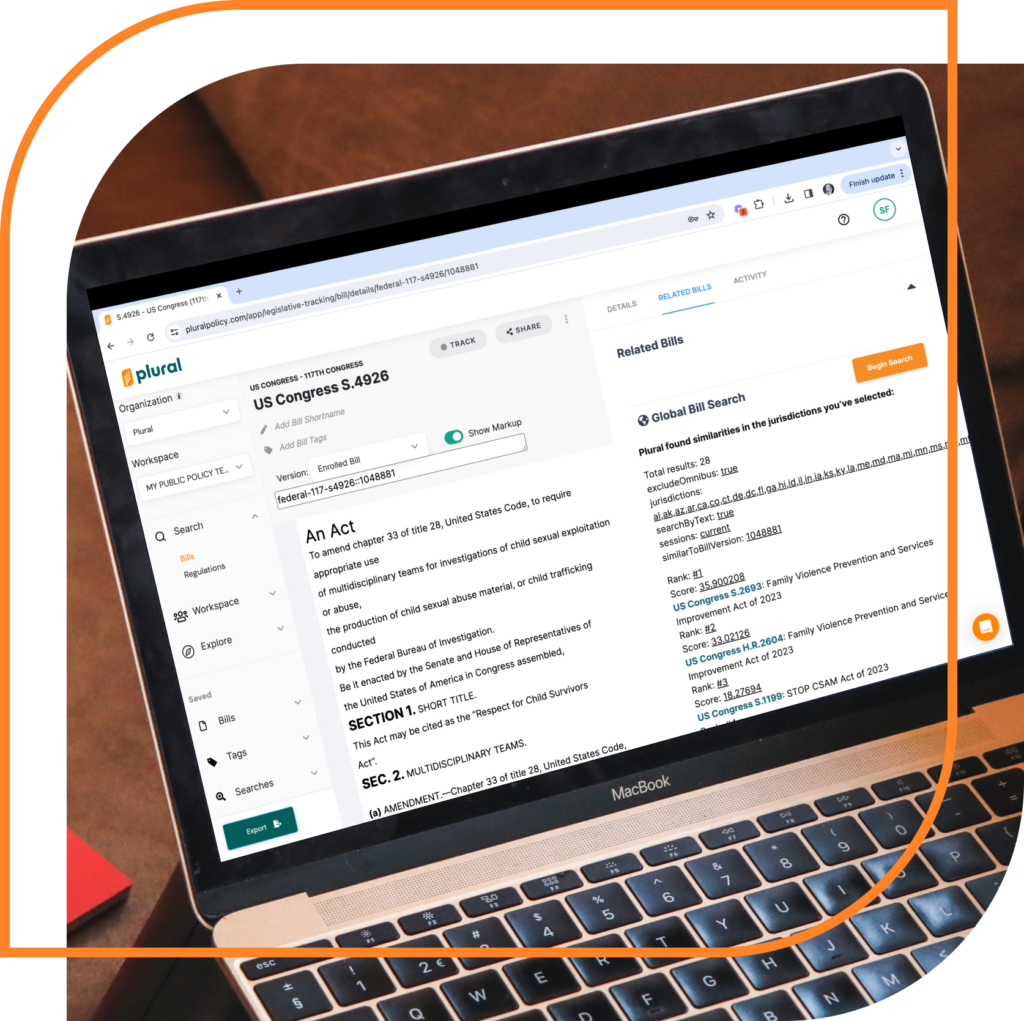
    Using Plural’s AI-Powered Tools to Better Understand Minnesota SF 3803

    When used in the context of public policy and legislation, artificial intelligence (AI) is a helpful tool in analyzing bill text. AI-powered tools can help policy teams save time and quickly understand the key aspects of a bill.

    AI-Powered Bill Summarizer

    So what does this bill propose to do? Plural’s AI-powered bill summarizer distills the 49 pages of legislative text into a helpful summary:

    “The bill proposes to legalize and regulate sports betting in Minnesota. It establishes licenses for sports betting operators, platform providers, and suppliers. It allows for mobile sports betting and retail sports betting at racetracks and sports facilities. It imposes a tax on sports betting revenue and distributes the funds to various purposes. It makes conforming changes to other gambling-related statutes. And it appropriates funds to various state agencies to implement and regulate sports betting.”

    Version-to-Version Summaries

    It’s easy to see how vital the bill summarizer is to quickly assessing the legislation that has been introduced this week. Public policy moves fast, and being able to act quickly and understand bills within a matter of seconds and minutes, rather than hours and days, is the key to success.

    As the session moves along, our AI-powered version-to-version change summarizer will also allow you to quickly track the changes that are made to any bill throughout the session. Plural’s version-to-version bill summarizer combs pages of bill text to discern the differences between different bill versions, whether big or small.

    An example can be seen comparing the introduced version of SF 1949 from last year and the final version, which did not end up passing last year. Plural provided the following summary:

    “The differences between the proposed changes of both versions are not specified in the provided text, as it only contains the new version of the bill. A comparison with the actual previous version of the bill would be required to identify specific differences.”

    Get Started With Plural

    Plural is the AI-powered policy intelligence tool of choice for teams looking to save time, collaborate effectively, and amplify their impact. Looking to get started? Create a free account or book a demo today!

  • What Are the Implications of AI for ESG?

    What Are the Implications of AI for ESG?

    Public policy is often awash in jargon and acronyms. It can be challenging for the average citizen to discern the purpose of a speech or a bill. Environmental, social, and corporate governance factors (ESG) and artificial intelligence (AI) are two recent examples of terminology that has dominated conversations in the media and in state houses. ESG and AI are both wide-ranging, quickly developing fields. As such, lawmakers and the public are seeking to better understand and regulate both. ESG and AI are also central to our current political discourse, due to their impacts across various issue areas. Any development within either field has downstream implications for labor, the environment, finance, government, and more. 

    In this article, we examine ESG and AI in more detail, including their impacts on each other, potential risks, and best practices.

    What is ESG?

    ESG is generally applied in two slightly different contexts. First, ESG investing involves investors distributing their capital based on the impact of the firm they are investing in. This a market-driven approach to corporate responsibility. It’s been around for decades, but was popularized during the 2000s due to consumer demand. 

    The second context in which ESG comes up is with government-mandated benchmarks or reporting. Regulatory bodies often require corporations to meet reporting standards regarding their impact. More rarely, corporations may be required to meet certain thresholds. Within either context, the “impact” measured by ESG criteria may include:

    • Greenhouse gas emissions
    • Supply-chain standards
    • Management of compliance risks

    ESG Around the World

    Europe has been a leader in regulating ESG. The European Union (EU) recently enacted the Corporate Sustainability Reporting Directive (CSRD) as its new mandatory sustainability reporting requirements for certain companies. The CSRD requires more detailed reporting and applies to more companies than the EU’s previous framework. Elsewhere, the United States is the center of a growing backlash against ESG regulations. Anti-ESG legislation was introduced in 37 states in 2023. Barring federal action, U.S. ESG law will likely become a confusing landscape for companies to navigate. 

    What is Artificial Intelligence?

    Artificial intelligence (AI) refers to machines’ programmed ability to “think,” or operate in a way that resembles human cognition. There are many distinct AI technologies, and countless applications. Generally, the goal of AI technology is to empower computers to complete tasks that typically require or even exceed human intelligence. 

    In 2023, the AI field saw significant progression. The most visible AI-powered projects were the subject of much attention and scrutiny from the public, media, and lawmakers. AI is rapidly advancing and has the potential to continue to develop quickly. As such, many are grappling with how to understand, use, and regulate AI.

    AI’s Benefits for ESG

    ESG reporting requires companies to gather and report data on a number of factors. This can be an overwhelming and arduous process, especially for those with the largest impacts. One area in which AI has shown its utility is in processing and summarizing large data sets. It’s easy to imagine how corporate disclosures could be made more efficiently and accurately with the help of AI. 

    Once reporting is complete, AI’s use cases continue. AI can potentially make this information easier to navigate for a citizen, investor, or customer. Much of the motivation behind requiring ESG transparency is an assumption that customers will use this information to inform where they spend their money. This leads to a feedback loop that encourages corporate responsibility. But this system only works if that information is accessible and digestible by the public. It isn’t yet clear that ESG reporting has led to a significant change in consumer attitudes so far. Generative AI, like the technology behind ChatGPT, might simplify access to this information, increasing the impact of ESG transparency on public behavior. 

    AI also has a role to play in the ongoing debate about the efficacy of ESG regulations. In the United States, much of the debate around ESG regulations has ventured into culture-war territory. However, there is still debate whether ESG investing, reporting, and mandates are effective in improving corporate responsibility. For example, some climate activists have begun to push back on the prevalence of “greenwashing” spurred by growing ESG requirements. Assessing the long-term impact of ESG regulations is a big data task, one that AI will be helpful in accomplishing. 

    What are the ESG risks of AI?

    Like any developing technology, AI comes with risks. What feels unique about AI, however, is the mystery surrounding what those risks might be. In this case, it can be helpful to isolate the risks of certain types of AI applications when assessing the impact of AI on a given field.

    Human Bias

    A primary risk of AI technology when applied to ESG is the automation of human biases in the workplace. AI technologies are heavily reliant on the data that goes into their training. It is a fact that existing human biases can impact that training data. AI-driven hiring decisions, for example, could be based on historical data that includes racial or gender biases. As more and more companies empower their processes with AI, it will be important to account for potential biases.

    Inaccurate Information

    AI may ease the process of ESG reporting for companies. However, there are risks in trusting AI-powered tools to complete these tasks with the necessary accuracy. AI models’ “hallucination” of inaccurate information has already given governments and corporations pause. Given the rapid development of ESG policy, there is risk that automating too much ESG reporting could open a company to compliance risks. 

    Environmental Concerns

    Use of AI also has the potential to reverse the progress that ESG principles aim to protect. AI-powered tools require significant energy, which in turn has a negative environmental impact. A recent Scientific American article noted that the 1.5 million server units that NVIDIA will deploy each year will consume more energy than some small countries. As we transition our electric grid away from fossil fuels and towards renewable energy, this impact will diminish — but that transition is far away. 

    AI-driven advances in technology also benefit the processes that have led to our current environmental situation. Applications of AI in the mining industry as well as in other industries that harm the environment could worsen their climate impact. At the same time, many hope that AI will unlock technological breakthroughs that help mitigate emissions and climate change. 

    Job Displacement

    Automating human cognition also invites potential for job displacement. Measuring the social impact of AI must include an assessment of any job or income losses tied to its advancement. Innovative technologies have long been blamed for job losses, especially in the short-term. This blame is not always misplaced. England’s Luddites of the early 19th century have historically been dismissed for raising alarm about the impact of automation in the manufacturing space on laborers. But arguments justifying their opposition and questioning the inequities in technology progress have gained steam recently, including in Gavin Mueller’s recent book, “Breaking Things at Work.” Whether AI will expand or minimize inequities remains to be seen, but those implementing ESG regulations should account for any short-term impact to laborers. 

    Best Practices for Balancing AI’s Risk and Benefits for ESG

    It would be impossible to comprehensively list AI’s risks and benefits for ESG. Due to the rapidly advancing nature of each field, some benefits and risks may not even be on the radar yet. Regardless, there are lessons to be learned and best practices to be implemented when it comes to the intersection of AI and ESG. 

    First, companies should be methodical and transparent in their approach to using AI. Transparency and accountability is at the heart of ESG requirements. Companies should keep this in mind when considering AI’s implications for their impact. This approach will mitigate risk and invite feedback while still allowing for AI adoption and its beneficial impacts. 

    Individuals, whether acting as a citizen, consumer, or investor, should view AI’s applications in ESG as a gateway to accessing more information. Verifying information from automated reporting or generative AI against source data is an important step in validating the model used. 

    Everyone can benefit from past experiences with new technology. Digital literacy is increasingly important as AI expands its reach. Individuals and companies should always prioritize data security and privacy protection. This need becomes ever more important when accounting for additional uses of AI. 

    Finally, staying up to date is a great way to see the benefits and risks of AI’s use in ESG in action. 2023 saw plenty of successes and lessons learned in both fields and 2024 will be no different. Staying on top of the issue is challenging, but one avenue for anticipating what is next is to track state and federal policy proposals. Plural’s advanced policy intelligence tools make this easy and accessible, and we do so by responsibly leveraging AI!

    More Resources for Public Policy Teams

  • Top Issues for State Legislatures in 2024

    Top Issues for State Legislatures in 2024

    Thirty-eight states have kicked off their legislative sessions this month, and another six will begin in the next few weeks. In more than half of these states, legislators will consider issues carried over from 2023 in addition to new proposals. Elsewhere, legislators will start with a clean slate. What are the top state government issues that legislators, lobbyists, and advocates will focus on in 2024?

    Legislative trends often emerge in the first few weeks of session. There is so much we can learn from the proposals considered across the country. In 2022, we identified trends in bills regulating discussions of race and gender in schools. That trend grew to be among the most hotly debated national issues this past year. This debate will only continue in 2024. Plural’s industry-leading open data and cutting-edge AI tools streamline and enhance legislative work.

    The Biggest State Government Issues in 2024

    It would be impossible to build a comprehensive list of the issues that each state will focus on in 2024. Instead, our research has allowed us to build a list of the topics which will be high on most state’s agendas this year. We’ve also identified specific proposals we see gathering momentum around the country. 

    2024 Elections

    Let’s get the big one out of the way first — elections will dominate political news coverage this year.  November’s elections will impact state legislative policy in a few distinct ways.

    Voting Rights

    Many bills related to voting rights will be considered across the country this year. In 2023, more than 1,100 bills expanding or restricting access to voting were introduced. Many of those same bills will come up again in 2024, and we expect hundreds more to be introduced. But prevalence alone does not make this our top legislative trend. The tenor and stakes of these debates will be extremely high. For better or worse, most voting rights proposals will be judged first by their potential impact on the 2024 elections. Advocates on both sides see these issues as central to ensuring a free and fair election. 

    Culture Wars and Partisan Conflict

    Federal elections, particularly the presidential election, will result in the nationalization of state legislative issues. Culture wars and partisan battles will prevail as legislators balance policymaking with politics. Abortion, parental rights in education, LGBTQ+ issues, and firearms regulation are areas we expect to see this dynamic play out. 

    Session Logistics

    Many state legislators themselves will be running for election in November. This being the case, we expect to see more sessions wrap up in a timely manner come spring. Legislators will be itching to get on the campaign trail. Fewer special sessions will take place this fall as election results signal priorities for 2025.

    Affordable Housing

    Housing affordability and homelessness have become a top issue at state legislatures. We recently wrote about the need for those in the housing space to monitor public policy. We expect to see proposals focused on:

    • Affordable housing development
    • State funding of shelters and emergency housing
    • Continued action legislating the landlord-tenant relationship

    Cannabis

    At this point, state-level efforts to decriminalize or legalize marijuana are not novel. Despite this, recreational marijuana use remains illegal in just over half of U.S. states. Further, medicinal marijuana use is still prohibited in ten states. In Wisconsin, Hawaii, Florida, and New Hampshire, legalization will have a serious chance at passage this year. 

    Even in states that have legalized marijuana, the subject remains prevalent. Delaware, Kentucky, Minnesota, and Ohio moved forward on legalization in 2023. However, there are significant intricacies in establishing a lucrative and regulated marijuana industry. Advocates can expect to return to their state houses frequently this year to monitor implementation plans. 

    Diversity, Equity, and Inclusion (DEI)

    DEI policies were an emerging legislative trend over the past few years. This is true especially at universities. In 2023, this trend accelerated. University policies regarding freedom of speech, antisemitism, and racism have garnered attacks from the right.

    Utah’s HB 111 would restrict the ability of private employers to require training that includes certain concepts related to race and sex. Utah legislators have already moved the bill out of its committee; it will be voted on by the full House next. 

    Education

    As always, state education committees will be busy this year. Education spending represents a significant portion of every state’s budge. Because of this, debates over spending can seem omnipresent.

    About two dozen states must pass a budget by the end of this session. Those that don’t will likely still consider supplemental budget packages. New York Governor Kathy Hochul rolled out a budget that will increase state-provided school funding by more than $800 million. Legislators and interested parties will have their say whether the increase is too significant or not enough. They’ll also weigh in on the allocation of the funds.

    Outside of education funding, other issues related to education will be hotly debated. We see continued trends in legislation relating to:

    • Parental influence in the classroom
    • Race in education
    • Dual enrollment
    • The expansion or restriction of charter schools

    Environment & Climate Change Mitigation

    In 2023, California enacted some of the most significant climate-related state action. The legislature passed laws requiring climate reporting by more large companies. As states adjust to meet their climate plans, we expect to see additional legislation. Twenty-four states have established greenhouse gas reduction targets. These states must evaluate their progress and adjust accordingly. Others may consider implementing targets of their own. 

    As climate change continues, climate-related disasters increase in frequency and impact. Many states find themselves regularly considering how to respond to these tragedies. Hawaii’s devastating fires that took place in August 2023 will be a key focus of the state legislative session. Lawmakers will aid in the recovery of affected communities and victims. Further, they will plan for future fires and other climate-related disasters.

    Criminal Justice & Law Enforcement Reform

    Criminal justice and police reform efforts have received increased attention in recent rears. The murder of George Floyd and subsequent protests in 2020 catalyzed this focus. Despite progress by advocates, there is certainly more work to be done. This session, legislators in Maryland, Georgia, Minnesota, and California will prioritize justice reform.

    Crime rates are decreasing throughout the United States. Despite this, growing public concern persists regarding increased crime rates. We expect some lawmakers to respond to this growing concern.

    In Georgia, the development of a massive law enforcement training center has been the subject of debate.. Disagreements between lawmakers, law enforcement, have persisted for years over “Cop City.” Community activists have fought to prevent the construction of Cop City. As development continues, lawmakers have advanced legislation that could further criminalize protest actions. Cop City represents just one clash between those on both sides of the debate over police reform.

    Transportation

    We will monitor many major transportation issues in 2024. Among these is the continued development of electric vehicle policy. In 2023, some states followed the federal government’s lead in encouraging the adoption of electric vehicles. Tax rebates and other incentives aimed to encourage public entities to make the switch to electric.

    While many efforts have been bipartisan, most have been led by Democrats. Some Republicans remain critical of electric vehicles. These lawmakers also oppose any encouraged transition away from gas-powered cars. In 2024, we expect to see increased opposition to electric vehicles in Republican states. This might involve increased fees on electric vehicles and reduced taxes on gasoline. 

    Using Plural to Track State Government Issues

    Hundreds of bills are introduced as sessions kick off. It can be overwhelming to analyze legislative trends in one state, let alone throughout the country. However, keeping track of legislative trends is vital to understanding public policy. Dominant issues and trends started in just one or two states before going “viral” nationwide.

    Plural makes the process of identifying and tracking legislative trends accessible and efficient. We’re committed to ensuring that every American can access high-quality legislative data. Using artificial intelligence, we leverage our data to identify trends and patterns.

    Interested in learning more? Book a demo today!

    More Resources for Monitoring State Government Issues

  • Why Everybody Involved in Housing Should be Tracking Policy

    Why Everybody Involved in Housing Should be Tracking Policy

    Housing policy in 2023 was characterized by a focus on development, relationships between tenants and landlords, and homelessness prevention. As the 2024 legislative sessions commence, housing will be one of the top issues on state legislators’ agendas. Read our analysis.

    Housing is one of the top issues on state legislators’ agendas as we head into 2024. This policy space is broad and complex. It covers issues ranging from zoning codes to social barriers to housing. There’s a diverse range of perspectives that legislators must weigh. From builders to buyers, approaches to housing issues vary. For those working in housing, tracking the development of public policy is key. Tracking policy will keep you aware of changing regulations that impact your work. It’ll also give you the opportunity to weigh in with your valuable perspective. 

    Below we summarize a few major areas of focus in housing policy in 2023. These specific issues will be the focus of debates across the country in 2024. 

    Key Developments to Housing Policy in 2023

    Housing Development

    There are a myriad of causes for the rising cost of housing. Most parties agree that an increase in housing supply is necessary. Developing housing takes time, and the COVID-19 pandemic generally slowed progress. Legislators across the country are looking to incentivize rapid growth in housing supply. 

    Financial incentives for developers are one tool lawmakers have to spur housing development. One such incentive is “gap funding.” This funding solves for the difference between building and the revenue generated from selling or renting at an affordable rate.

    Illinois SB 1484 passed into law in June. The law appropriates $5 million in grants for organizations developing cooperative housing. With cooperative housing, residents own a share of the building.

    In October, Massachusetts Governor Maura Healey unveiled a massive housing bill. The Affordable Homes Act calls for the investment of more than $4 billion to solve the housing crisis. This includes over $1 billion in incentives for affordable and sustainable housing development.

    States are also addressing regulations that make it harder to develop housing in certain areas. Allowing for more building and accessory dwelling units (ADUs) has been a popular strategy. California AB 976 and AB 1033 passed this session. Both prevent restrictive local ordinances that would make it harder to rent or sell ADUs. Similar efforts passed in Minnesota as well. SF 3035 authorized religious groups to develop “micro-unit” housing, regardless of local regulation. 

    Many bills tackle specific types of housing, including ADUs, cooperative housing and micro-units. This targeted approach often leads to innovation in housing policy. With diverse options, housing solutions are more likely to fit community needs. For those looking to engage with these specific programs, tracking policy is crucial.

    Legislation Impacting Tenants & Landlords

    The relationship between tenants and landlords has been a policy issue for centuries. However, recent developments have brought new urgency to legislating rental agreements. This includes:

    • The housing crisis
    • Increases in homelessness
    • The COVID-19 pandemic
    • Pandemic-related eviction moratoriums

    Maine provides a good example of a state making progress on protections for renters. In 2023, the state passed LD 330 and LD 45. LD 330 requires that tenants facing eviction have access to legal representation. LD 45 provides legal protections for tenants to assert their rights without retaliation. Additional legislation includes proposals to prevent discrimination and increase eviction notice requirements. 

    Some state legislators have also proposed legislation increasing the rights of landlords. North Carolina’s HB 551, though ultimately unsuccessful, is a good example of this type of legislation. The bill sought to allow landlords to refuse to rent to tenants using federal housing assistance. It also proposed holding tenants liable for certain legal actions.  

    Policy impacting rental relationships is the most divisive issue in this realm. States often move in opposite directions based on their partisan makeup. A national view of policy development ensures you’re aware of proposals made by each side. 

    Homelessness Prevention

    The most acute and visible sign of the need for legislators to act on housing is the rise in homelessness. Many policies mentioned above aid in preventing homelessness. Lawmakers have also aimed to tackle homeless as its own issue.

    In 2023, Oregon passed two massive investments in housing and homelessness prevention. HB 5019 and HB 2001 include nearly $100 million in rental assistance. The bills aim to both prevent homelessness and aid in rehousing efforts. This investment is in line with Massachusetts’s Affordable Homes Act. Measures such as these are a popular approach as states face rapid increases in homelessness. Following the development and impact of this policy will be essential for advocates and researchers alike. 

    Other proposals throughout the country include:

    • Supporting unhoused students
    • Increasing access to healthcare services
    • Promoting a “housing-first” model to end homelessness

    Get Started With Plural

    Housing policy in 2023 was characterized by a focus on development, relationships between tenants and landlords, and homelessness prevention. The amount and diversity of housing policy solutions can be overwhelming. Even following one state’s housing committee is challenging, time consuming, and inefficient. Plural’s unmatched open data and discovery tools make it easy to find and track the policy that matters to you.

  • New Laws Passed During Maine’s 131st Legislature

    New Laws Passed During Maine’s 131st Legislature

    October 25, 2023 marked 90 days since the first session of the 131st Maine Legislature adjourned. Since the adjournment, many new laws have come into effect in Maine. Democratic majorities in both chambers of the legislature passed hundreds of bills. Governor Janet Mills, also a Democrat, signed nearly all of them. Some bills took effect immediately, while others specified later dates to take effect. The majority of the newly passed laws became effective on October 25th. Below, we have highlighted a few of the new laws that Mainers may be particularly interested in. 

    Expanding Access to Naloxone

    Efforts to curb the opioid crisis have been central to recent legislative sessions in Maine. 2023 was no different. Maine lawmakers passed seven bills expanding access to the overdose-reversal drug, naloxone. This includes the following measures:

    • LD 600 – Allows municipalities to provide public access to naloxone on municipal property and in municipal buildings.
    • LD 1036 – Requires more law enforcement officers to be trained and equipped to administer naloxone.
    • LD 1315 – Requires secondary schools to offer annual training in the administration of naloxone.

    Expanding Access to Abortion

    Democrats passed several bills expanding or protecting access to abortion. While each was contentious, LD 1619 was the subject of particularly heated debates. The bill, signed in July, allows physicians to provide post-viability abortions when deemed necessary. Previously, post-viability procedures could only be performed if the mother’s life was in danger. 

    Incentivizing Workforce Development

    Workforce growth is another perennial priority for Maine lawmakers. In particular, lawmakers seek to incentivize growth in sectors experiencing shortages. Workforce incentivization bills passed this year include:

    • LD 937 – Resolve, To Establish The Commission Regarding Foreign-Trained Physicians Living In Maine
    • LD 1366 – An Act To Address Educational Technician Shortages In Public Schools By Establishing An Alternative Certification Pathway
    • LD 1539 – An Act To Promote A Diverse, More Experienced Construction Workforce And Ensure High-Quality Careers By Increasing Registered Apprenticeship Programs

    Other Notable Changes

    • LD 769 makes it easier for some small political parties to secure and maintain official party status.
    • LD 1002 requires that all school lunch periods be at least 30 minutes long.
    • LD 1029 will establish a commission to begin planning a celebration of the 250th anniversary of the founding of the United States.
    • LD 1155 will increase Maine legislative salaries beginning with the next state legislature.

    Looking Ahead to 2024

    While the 2023 legislative session was productive, over 1,000 bills will carry over to the 2024 legislative session. Lawmakers are expected to return in January to take up these bills, and offer new proposals as well. As ever, Plural will have all of the details and updates you will need to follow this activity.

    Get Started With Plural

    In the world of public policy, it’s all about sorting through the noise to get to what matters. With Plural, you’ll only get exactly what you need, and none of what you don’t.

    Unlock the power of Plural in Maine — that’s premium legislative data, advanced searching and tracking, tools for easy organization and collaboration, and AI-powered insights, catered to your needs.

    More Resources for Maine

  • VIDEO | Boolean Searching With Plural

    VIDEO | Boolean Searching With Plural

    Thousands of bills are introduced each year. In the world of public policy, finding what matters and adapting your strategy is the key to success. How can you make advanced legislative searching work for you? What is boolean searching, and how can it streamline your work? Watch the video to learn about challenges related to legislative research, what boolean searches are, and how to conduct them in Plural.

    Get Started With Plural

    Interested in supercharging your legislative research and public policy work with Plural? Create a free account or book a demo today!

  • Looking Ahead to the 2024 Legislative Sessions: What To Expect

    Looking Ahead to the 2024 Legislative Sessions: What To Expect

    The vast majority of state legislatures have finished their work for 2023. California wrapped up its legislative session in mid-September with nearly 1,200 bills sent to the Governor. Some states, like Massachusetts and Ohio, will continue their work through the fall. View our 2023 state legislative session calendar for more information. Regardless, most of us following public policy are already looking ahead to the 2024 legislative sessions.

    To best prepare ourselves (and you!) for these sessions that are just a few months away, we’ve plotted out what to expect from each state’s session. Analyzing legislative procedure and history across all 50 states, we’ve painted a picture of when legislators will be active, and what they will be working on in the 2024 legislative sessions.

    Understanding Legislative Cycles

    Most states operate on a two-year session schedule. With this schedule, the odd-numbered year following elections is the first and most active year. The even-numbered year is the second, and less active, year. Exceptions to this norm include:

    • States that operate on one-year cycles — Alabama, Mississippi, and others
    • States that only meet once every two years — Texas, Nevada, and others
    • States that start their two-year sessions during even years — New Jersey and Virginia
    • States that hold special sessions outside of their scheduled meeting times

    Because so many states follow the norm of a two-year cycle, we tend to see patterns along these lines in legislative activity. These patterns are summarized below, along with details specific to 2024.

    Legislative Session Start Dates in 2024

    Early January will remain a popular time for legislatures to begin meeting, as it was in 2023. However, many more states will begin their meetings in late January or February in 2024. This includes Arkansas and Wyoming, among others.

    Earlier than 2023Similar to 2023Later than 2023No Scheduled Meeting
    3 states36 states7 states4 states
    2024 Anticipated Session Start Dates

    2024 Legislative Session Content

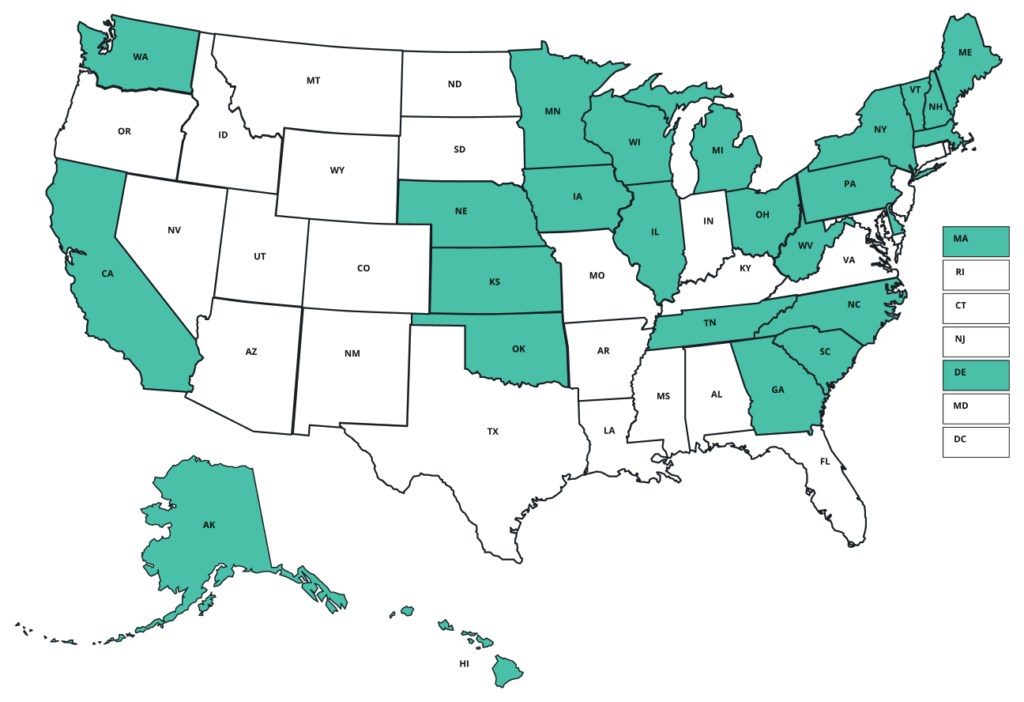
    Twenty-five states will “carry over” bills introduced in 2023 into their 2024 legislative sessions. As such, a considerable amount of the legislation they will consider is already publicly available. Further, in some cases, this legislation has already been the subject of public hearings and debates. An additional three states, Arkansas, Connecticut, and New Mexico, will limit the introduction of most non-budgetary items.

    States that will “Carry Over” Bills from 2023 to 2024

    Budgets

    Before the 2024 legislative sessions begin, sixteen states will have already passed a budget for 2025. As such, they will only consider supplemental budgets in 2024.

    Legislative Session Length

    With less legislation to debate, many legislatures schedule less time during even years. Connecticut, for example, will meet for three months in 2024, after meeting for more than five in 2023.

    Shorter than 2023Similar to 2023Later than 2023No scheduled meeting
    15 states27 states4 states4 states
    2024 Anticipated Session Lengths

    New Legislators in 2024

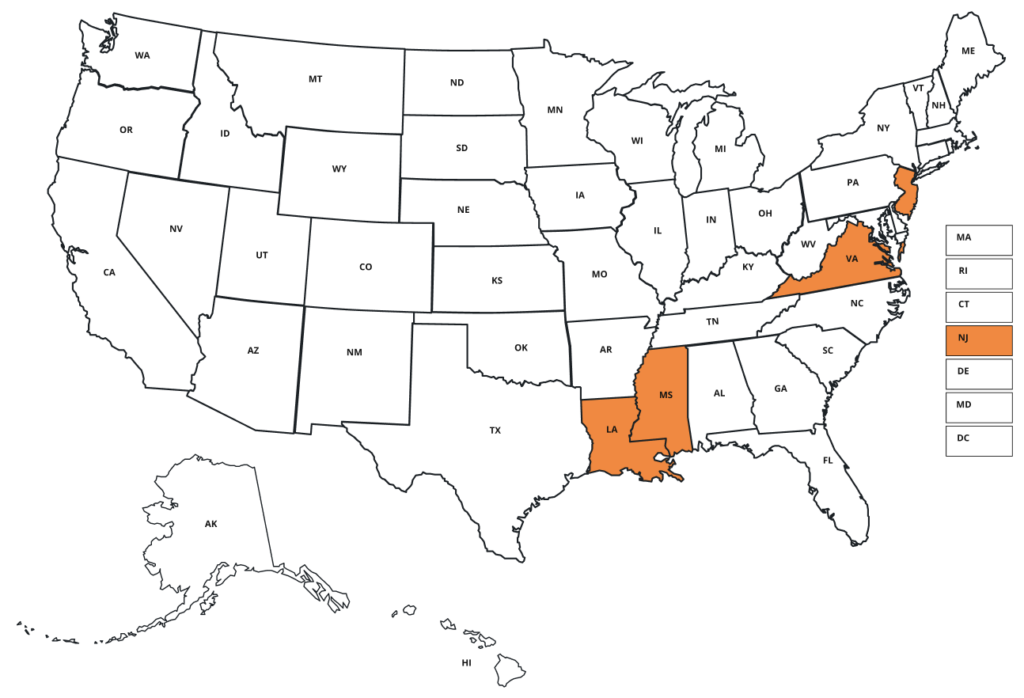
    Many states will have a few new legislators by 2024, due to retirement and replacement. Louisiana, Mississippi, New Jersey, and Virginia will enter 2024 with the most new legislators, as they each hold elections in November of 2023. Following the 2020 census, legislators in these states may also have new district numbers.

    States with Regularly Scheduled Legislative Elections in November 2023

    Looking Ahead to the 2024 Legislative Sessions

    The next few months are crucial for prepping for the 2024 legislative sessions. We can’t know for certain what the popular topics will be in next year’s legislative sessions (spoiler alert: they will likely include rehashed debates from 2023.) We can, however, anticipate the structure and timing of the sessions themselves. This data can help advocates in all issue areas map out their strategy and prioritize effectively.

    Get Started With Plural for the 2024 Legislative Sessions

    The 2024 legislative sessions are just around the corner, and the time to begin planning, strategizing, and nailing down your tools and processes is now. Interested in getting started with Plural? Create a free account or book a demo today!

  • Find What You’re Looking For With Advanced Legislative Searching

    Find What You’re Looking For With Advanced Legislative Searching

    How can you make advanced legislative searching work for you? What is boolean legislative searching, and how can it streamline your legislative research? Thousands of bills are introduced each year. In the world of public policy, finding what matters and adapting your strategy is the key to success.

    A core function of the work of any legislative analyst, lobbyist, or researcher is separating the signal from the noise. U.S. Congress and state legislatures release thousands of proposed policies each year. These range from ceremonial efforts to name post offices, to massive appropriations bills. The process of finding the policies that matter to you amidst the veritable haystack of introduced legislation is what we refer to as legislative searching.

    What is Legislative Searching?

    Before assessing the impact of legislation, a policy team must first filter out extraneous legislation. This task can be burdensome to do in one state. Analyze across many jurisdictions, and it becomes nearly impossible. Yet, the importance of an accurate and exhaustive filtering process cannot be overstated. Missing the introduction of an important bill could be disastrous.

    Many state legislative websites and tracking tools have search functions that can aid analysts in this process. However, the quality of these searches and the search hits they return varies.

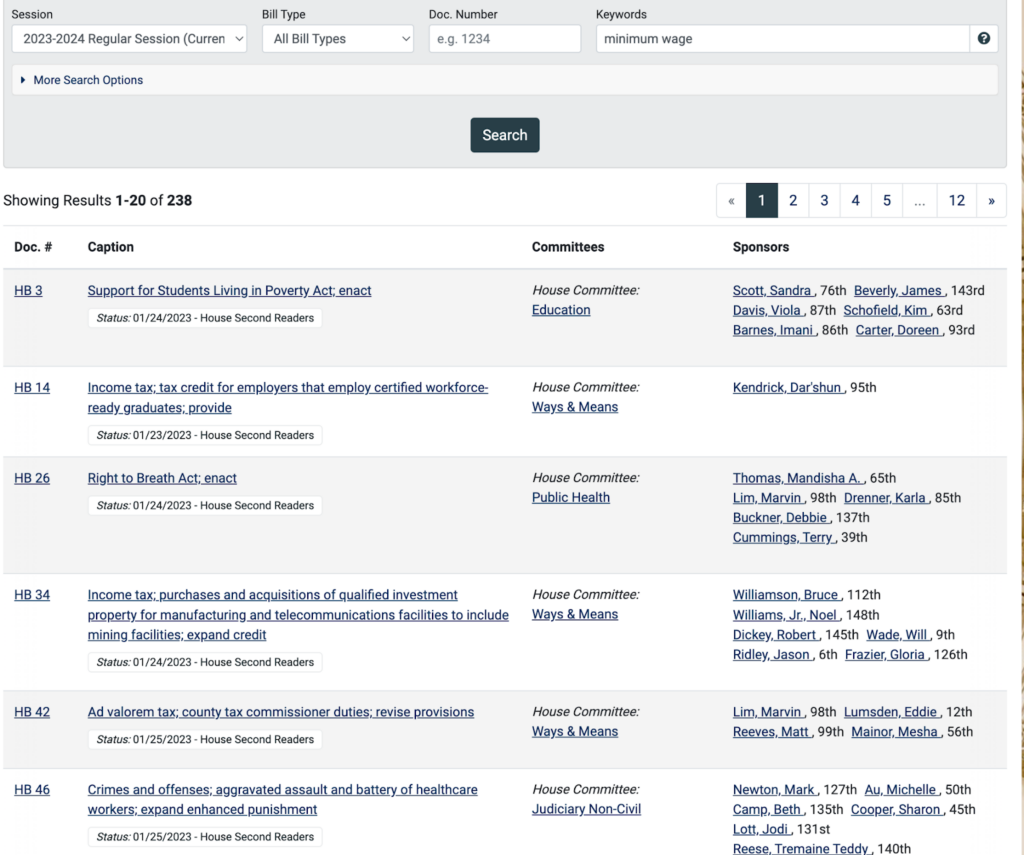
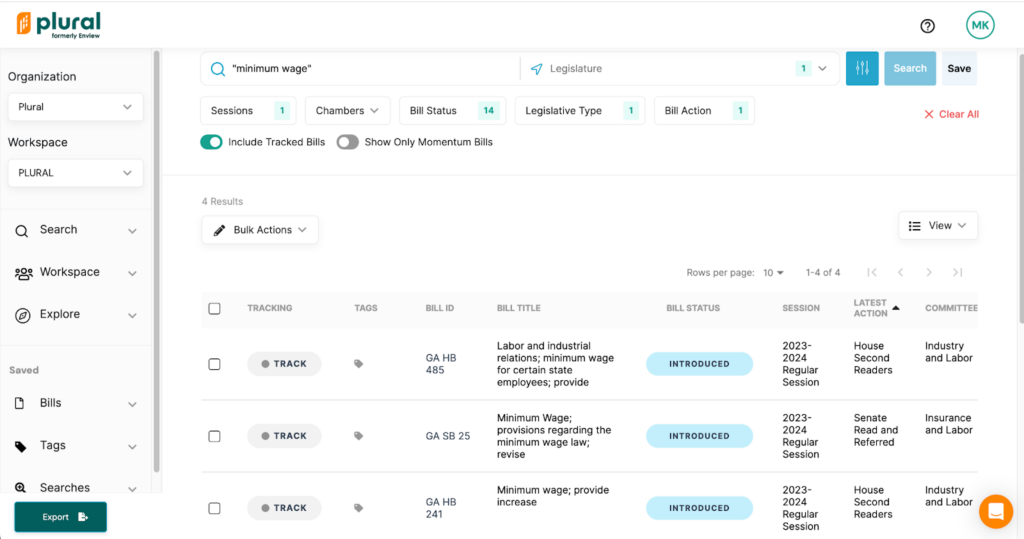
    We can make a straightforward search for “minimum wage” on Georgia’s legislative site. This search returns 238 results from the 2023-2024 session alone. Many of the results, as evidenced by their titles, don’t directly relate to compensation. For an advocacy group supporting low-income workers, this search doesn’t provide much value. Analysts would still find themselves searching through extraneous legislation. They would not have full confidence that they are capturing everything important.

    Below, we explore advanced legislative searching. How can you best use advanced search features to build refined and accurate filters in your work?

    Benefits of Advanced Legislative Searching

    Advanced legislative searching requires two components:

    1. A powerful, reliable search engine with advanced search features
    2. Well-crafted, specialized searches that generate the highest quality results

    When we think of high-quality results, what we are really measuring is the “signal-to-noise” ratio. This ratio is the total number of relevant bills returned compared to the overall number of bills returned.

    Before detailing how advanced legislative searching can work for you, let’s return to our example from Georgia. I’ve switched to a more powerful searching tool (see component #1 from above,) and adjusted our search preferences and terms (see component #2.) Our search now results in a highly targeted return of four bills. These four bills are directly related to our topic of interest.

    Advanced Searching in Plural

    Boolean Logic Searching

    For a domain as complicated as public policy, Boolean operators are key to high-quality searches. Boolean legislative searching is key to finding what you’re looking for. While it may seem intimidating at first, the logic is easy to pick up, once you get the hang of it. Just a few Boolean operators are necessary to building refined searches in Plural

    Quotation Marks

    Quotation marks are useful when searching for bills containing an exact phrase or combination of words.

    For example, searching absentee voting in Plural returns over 19,000 results from active legislative sessions. Adding quotation marks and searching for “absentee voting” limits that to just 360 bills containing that specific term.

    The OR Operator

    The OR operator allows you the flexibility to craft a search that works for your unique set of needs. OR allows you to combine multiple search terms into one search.

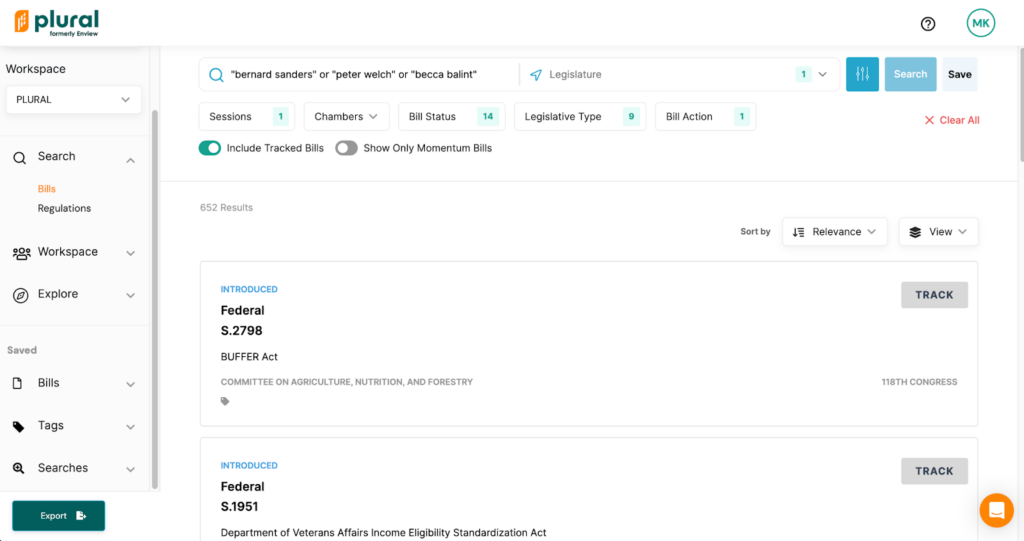
    For example, the search below would allow a Vermont resident to keep track of all legislation sponsored or co-sponsored by their entire delegation. This is done without having to build separate searches for each member.

    The AND Operator

    The AND operator can be useful to define your search by two distinct variables that must be true.

    “Marijuana banking” may be too specific of a term to show up exactly in any legislation. “Marijuana” or “banking” will return a bevy of results specific to one, but not both, of those terms. However, searching for “marijuana” AND “banking” will return any bills that include both terms, even if they aren’t directly next to each other in the text.

    Filters and Search Preferences

    Beyond Boolean logic, Plural offers further opportunities to narrow your search. Using our filters and search preferences can be key to finding what matters to you. Notable options include:

    Legislatures and Sessions

    These are the ‘where?’ and the ‘when’ of your search. Plural has decades of legislative data from across the entire United States. Our data allows you to customize your search to your needs while covering a massive amount of legislative territory.

    Bill Status

    Filtering by bill status can be especially valuable when looking back on a completed legislative session or assessing the progress of a legislature so far.

    Show Only Momentum Bills

    Plural harnesses the power of AI to help deepen your legislative insights. Our Momentum Indicator determines a bill’s likelihood of coming up for a final passage vote by the end of session. Filtering your search result to show only momentum bills enables you to see the most viable bills.

    Bill Action

    Plural’s bill action dropdown allows you to filter according to first action, latest action, introduction, passage, and so on. Many of our users take advantage of this filter to isolate bills passed in a given week, for example.

    Saved Searches

    While the searches described above are valuable, a static search is only a record of one point in time. In the world of public policy, it’s important to be the first to know the most recent updates. As such, a more dynamic search experience is the necessary key to success. This is where Plural’s saved searches come in.

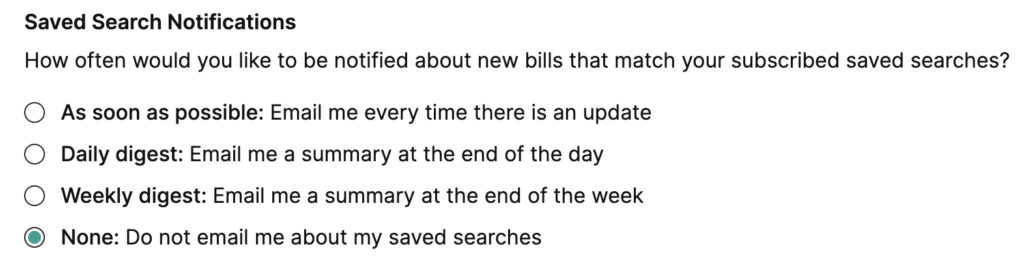
    Plural allows you to save any of your advanced searches. This means that your searches will be run continuously, so you’ll always be notified of new results. What’s more, Plural lets you customize your notification preferences.

    How Can Advanced Legislative Searching Work for You?

    During legislative sessions, teams working on the frontlines of policymaking have too much work and not enough time. Increasing efficiency while maintaining or improving accuracy is a significant win. Boolean legislative searching can help you do so. Advanced legislative searching enables advocates to spend less time in discovery. With this time saved, advocates can more effectively assess impact, lobby for their priorities, and achieve their policy goals.

    Get Started With Plural

    Plural helps you get and stay ahead in the complex public policy landscape. With Plural, you can:

    • Conduct boolean legislative searching to easily find what you’re looking for
    • Access superior public policy data
    • Be the first to know about new bills and changes in bill status
    • Streamline your day with seamless organization features
    • Harness the power of AI to gain insights into individual bills and the entire legislative landscape
    • Keep everyone on the same page with internal collaboration and external reporting all in one place

    Interested in getting started? Learn more, create a free account, or book a demo today!

  • What Happens When the Government Shuts Down?

    What Happens When the Government Shuts Down?

    UPDATE: In a surprising turn of events, Speaker McCarthy made a last-minute deal with House Democrats to pass a short-term 45-day continuing resolution to keep the government open. The Senate and President approved this legislation shortly before the midnight deadline. This deal prevented an impending government shutdown. Lawmakers now have until mid-December to pass a 2024 budget or another continuing resolution. Despite this positive development, significant challenges (many of them described below) remain. We may once again find ourselves approaching a shutdown deadline come December.

    As I write this blog on September 29th, it is virtually guaranteed that the U.S. federal government will partially shut down on Sunday, October 1st. If this is the case, it will be the first time that our government has shut down since 2018. What happens when the government shuts down? In this blog, I’ll discuss how we got here, the impact of the shutdown on policy and policymaking, and how this may end.

    How Did We Get Here?

    Back in May, I wrote a detailed explanation of the federal budget process without knowing how useful the below passage would be so quickly.

    Excerpt from “Understanding the Federal Budget Process,” posted May 24, 2023.

    Congress has failed to pass the dozen annual appropriations bills that make up the federal budget. Progress has stalled on passing a continuing resolution (CR) that would grant them more time to do so. That means that lawmakers are barreling towards a government shutdown.

    This impending shutdown is unique because there are dynamic disagreements blocking progress on a deal. These disagreements make predicting the outcome of the shutdown especially difficult. This is true for both a short-term continuing resolution or a full budget. Let’s take a look at a few of those:

    Senate vs. House Republicans

    The Senate is well on its way to passing a CR that would fund the government at current levels through mid-November. This CR would also increase funding for Ukraine aid and FEMA disaster relief funds. The CR passed through the Senate with a sizable majority. However, House Republicans generally agree that any Senate-passed C.R. will be dead on arrival. With Democratic control of the Senate and White House, any deals that come solely from the House G.O.P. are unlikely to become law.

    Moderate vs. Conservative House Republicans

    House Republicans have their own conference which holds majority control of the lower chamber. Despite this, House Republicans have disagreed on how to fund the government beyond September 30. Many Republican lawmakers have promised to oppose any CR without significant concessions on Ukraine aid and immigration policy. Rather than a CR, they are also attempting to pass partisan individual appropriations bills. Building a moderate, bipartisan coalition to pass a CR in the House, as was done in the Senate, would greatly threaten Speaker McCarthy’s job security by forcing him to work with conservative holdouts.

    Democrats vs. Republicans

    As ever, the debate over the shutdown will be framed via this partisan dichotomy, and for good reason. Policy disagreements on Ukraine aid, pandemic preparedness, and immigration policy have hampered bipartisan progress in the Senate. These issues are central to passing any long-term funding package. Procedural steps will take place within the halls of Congress, but much of the coming debate will be held in public, over TV and social media. Each party will seek to place blame on the other, especially since public pressure is often important in ending government shutdowns. This fight over public perception of the shutdown will be important to watch.

    How Is Policy, and Policymaking, Affected by a Shutdown?

    Most shutdowns affect mainly government staffing and government programs. Government staff are generally separated by agency into “essential” or “nonessential” workers. Neither category will receive pay during the shutdown period. However, essential workers, including most members of the military, will continue to work. Nonessential workers would be furloughed.

    While millions of federal staffers will go without pay, far more Americans will be impacted by changes to government programs. Federal assistance programs that require annual appropriations, like WIC and Meals on Wheels, could be quickly interrupted. SNAP benefits could be impacted if the shutdown lasts into November. Many national parks and museums are also expected to shut down or reduce operations.

    Congress will remain in session. They will, of course, be primarily focused on negotiating an end to the shutdown. Policy developments in immigration and foreign aid could be fast-tracked by the negotiations. However, other ongoing policy debates will likely be delayed until the shutdown is resolved. This includes AI regulations, confirmations of high-level government officials, and efforts to increase disaster preparedness.

    How Will a Shutdown End?

    The dynamic nature of the disagreements over the shutdown make it difficult to predict how or when this shutdown might end. In the short term, re-opening the government via a CR will require the support of President Biden, a majority of the House, and 60 Senators. Reaching that level of support will require concessions from both parties on immigration policy, Ukraine aid, and overall government spending levels. The path to get there may include uncertain votes, efforts to oust the Speaker, and strange coalitions of lawmakers. We will, of course, be following closely the whole way.

  • What Policy Topics Do California Legislators Typically Focus On?

    What Policy Topics Do California Legislators Typically Focus On?

    At Plural, we are constantly analyzing, manipulating, and learning from our data. Recently, our data insights team embarked on a project to find patterns in the troves of legislative data in our database. Our team then provided insight and guidance on the four most interesting or useful patterns. The following is the fourth in a series of four blogs digging into this work. The first blog in the series can be found here, the second can be found here, and the third here

    Key Topics in the California Legislature

    Our research has highlighted the remarkable consistency of California’s legislature. Across sessions, the CA legislature is very consistent when it comes to activity, passage rates, number of bills passed, and time to passage. General information about the legislative process can be helpful for those predicting or reacting to policy. For our final blog in this series, we wanted to dig deeper. In this blog, we will go beyond the high-level of how legislators are acting, to look at what they are acting on.

    We built and trained an AI model using Plural’s legislative datasets to categorize bills by their topics. Bills were assigned to 17 topic categories. We applied the model across two complete biennial sessions, 2019-2020 and 2021-2022, as well as the first half of the current biennium, 2023. Our analysis paints a picture of the legislative topics that attract the most activity in any given session.

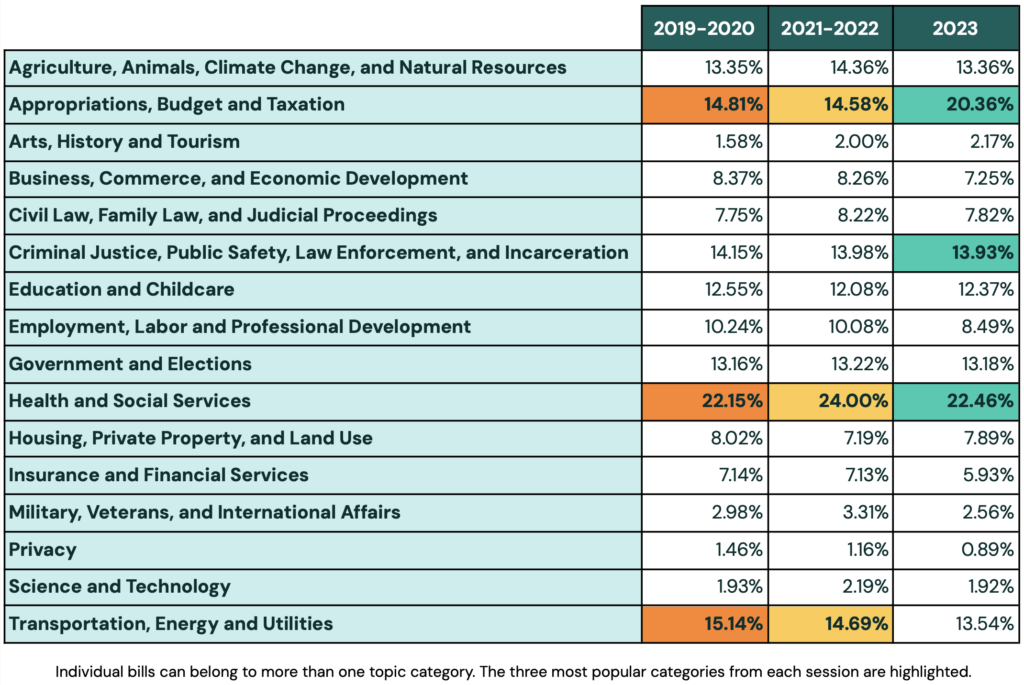
    Percent of Analyzed Bills within Each Topic Category, by Session (2019-2023)

    A few insights immediately jumped out to our team as we examined this data.

    Over the biennium examined, the legislature focused on Health and Social Services far more than other topic categories. Health and Social Services is a broad category, far broader than privacy, for example. It includes everything from pandemic-related safety measures to Medi-Cal reimbursement rates. Beyond the wide scope of the subject matter, this is also an area that lawmakers often highlight as a priority. It’s unsurprising to see more than 1 in 5 bills logged into this category.

    More than 20% of bills introduced in 2023 fell into the Appropriations, Budget and Taxation category. This is likely overweighted, as the first year in a biennium tends to have more appropriations legislation than the second year. Despite this, no other category comes close to the level of consistent focus on Health and Social Services.

    Finally, looking at this data shows the value in expanding this type of dataset. Five years of legislative data from one jurisdiction can unlock a few insights. However, the real value could come from comparing across jurisdictions or across wider spans of time.

    Analyzing California’s Legislative Activity

    Our analyses of California’s legislative activity over the past fifteen years has produced many interesting insights. We’ve learned that:

    • A majority of passage votes to come in August in September
    • Most bills receiving final passage votes will indeed pass
    • Most bills that become law have a 30-35 week lifespan between introduction and final passage

    Continuing and expanding this type of analysis can help better understand legislative activity. It can also give us insights into how legislative activity compares across jurisdiction and time. Here at Plural, we’re committed to using our data to help our community of public policy experts deepen their legislative insights.

    Get Started With Plural

    With Plural, it’s easier than ever to get and stay ahead in the public policy landscape. Get started today to:

    • Access superior public policy data 
    • Be the first to know about new bills and changes in bill status
    • Streamline your day with seamless organization features
    • Harness the power of AI to gain insights into individual bills and the entire legislative landscape
    • Keep everyone on the same page with internal collaboration and external reporting all in one place
  • Bill Passage Timelines in California

    Bill Passage Timelines in California

    At Plural, we are constantly analyzing, manipulating, and learning from our data. Recently, our data insights team embarked on a project to find patterns in the troves of legislative data in our database. Our team then provided insight and guidance on the four most interesting or useful patterns. The following is the third in a series of four blogs digging into this work. The first blog in the series can be found here and the second can be found here

    How Long Do Bills Take To Pass in California? How Much Activity Takes Place During That Time?

    A core building block of education in public policy is an explanation of ‘how a bill becomes a law’. Resources range from Schoolhouse Rock songs, to flow charts prepared by legislative information offices.

    Understanding the path a bill takes from introduction to passage is key to anticipating the work of state legislators. It takes on-the-ground experience to grasp what that path truly looks and feels like. Lobbyists and advocates with experience monitoring bills that pass, stall, or fail are often more effective.

    Plural has a wealth of details about every bill that has passed or failed in California, over the last fifteen years. This data can unlock insights that improve our understanding of the road to passage, for current and future legislation. Below, we take a look at the typical timeline for a bill from introduction to its final vote in the legislature.

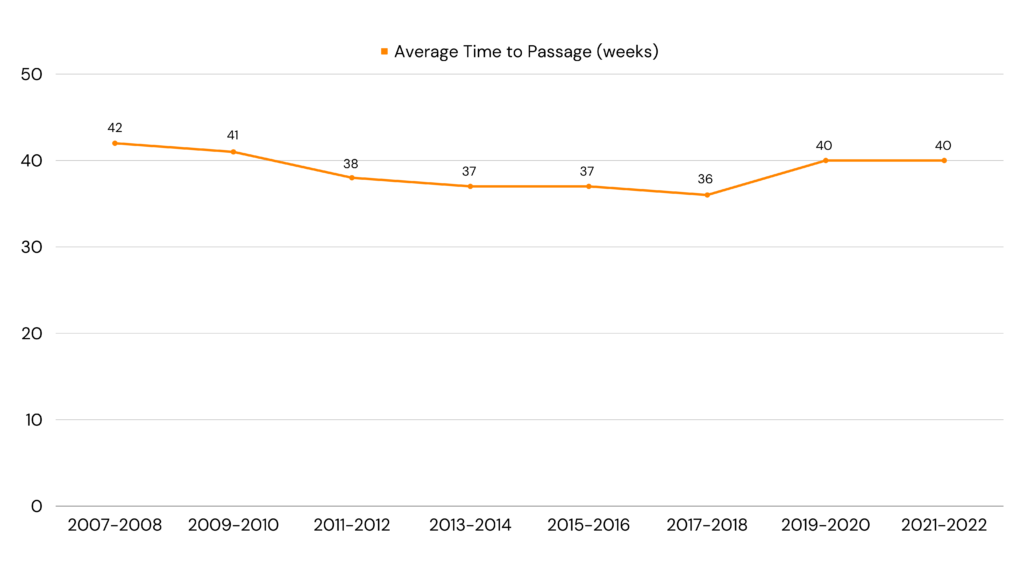
    Average Number of Weeks Between Introduction and Passage Vote in the California Legislature, 2007-2022

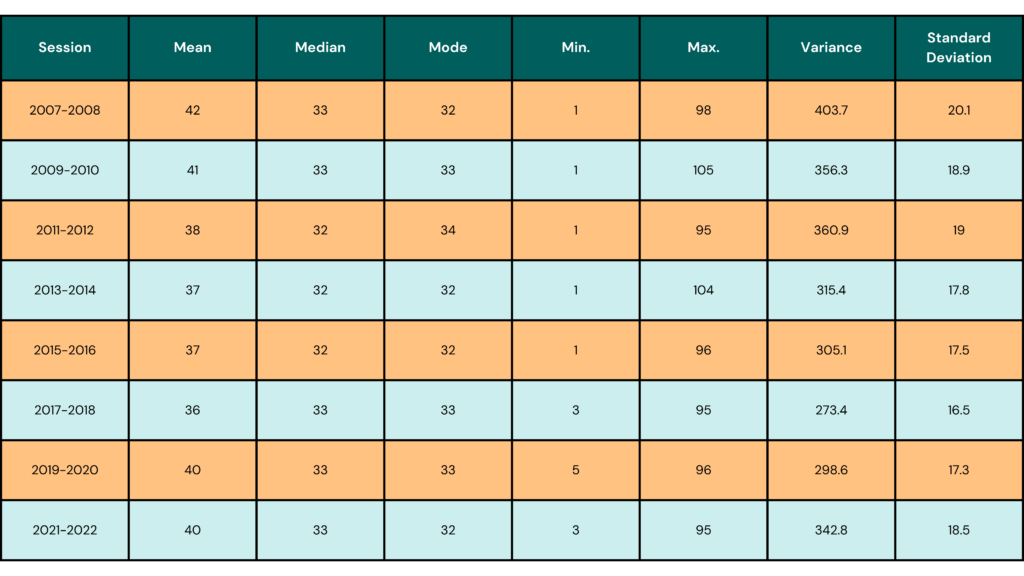
    The chart above is best understood with a key piece of context: the CA legislature operates on a biennial calendar. For instance, this means that some bills introduced in early 2007 did not receive a passage vote until late 2008. These 2-year bills (with nearly 100 weeks of lifetime!) drag our average up, but the chart shows the consistency of this average across sessions. The table below provides a fuller picture of how long bills typically take to receive a passage vote.

    Number of Weeks Between Introduction and a Passage Vote in the California Legislature, 2007-2022

    The averages shown in the chart above give us a picture of the consistency of the lifespan of a typical bill. This table grants us a better understanding of what this may mean for any individual bill.

    The average weeks-to-passage for each legislative session is between 32 and 33 weeks. This aligns with what we learned in a previous blog.

    The data we see here puts bills introduced in mid-January on a timeline to pass during the busiest part of the year, in late August and early September. This trend is consistent, holding across sessions, governorships, and turnover in the chambers. Lobbyists and advocates can use this data to map out their efforts to influence a bill on its way to passage over 8-9 months.

    The minimum and maximum columns in the table remind us that there are always outliers. There’s always the possibility of a bill moving through to passage in one week (typically at the very end of a session,) or lasting across multiple sessions and nearly 100 weeks.

    Explore More Free Public Policy Resources:

  • Using Data to Determine the California Legislature’s Productivity

    Using Data to Determine the California Legislature’s Productivity

    How can we assess the California legislature’s productivity? At Plural, we are constantly analyzing, manipulating, and learning from our data. Recently, our data insights team embarked on a project to find patterns in the troves of legislative data in our database. Our team then provided insight and guidance on the four most interesting or useful patterns. The following is the second in a series of four blogs digging into this work. The first blog in the series can be found here.

    How Many Bills Do California Legislators Introduce, Vote On, and Pass in Each Legislative Session?

    Each legislative session in California produces a massive amount of legislative text. By the end of the two-year session, those monitoring the legislature will likely have read thousands of bills. Some bills will have died in committee, while others made it all the way to a final vote. In the moment, though, the drama of each session can make an interested party think the current activity is unprecedented.

    We’ve used our data to examine the past 15 years of legislative activity in California. In particular, we examined whether there were significant swings in the legislature’s productivity or divisiveness. To do this, we looked at:

    • The total number of introduced bills
    • The number of bills that appeared for a final passage vote
    • The number of bills successfully passed by the legislature

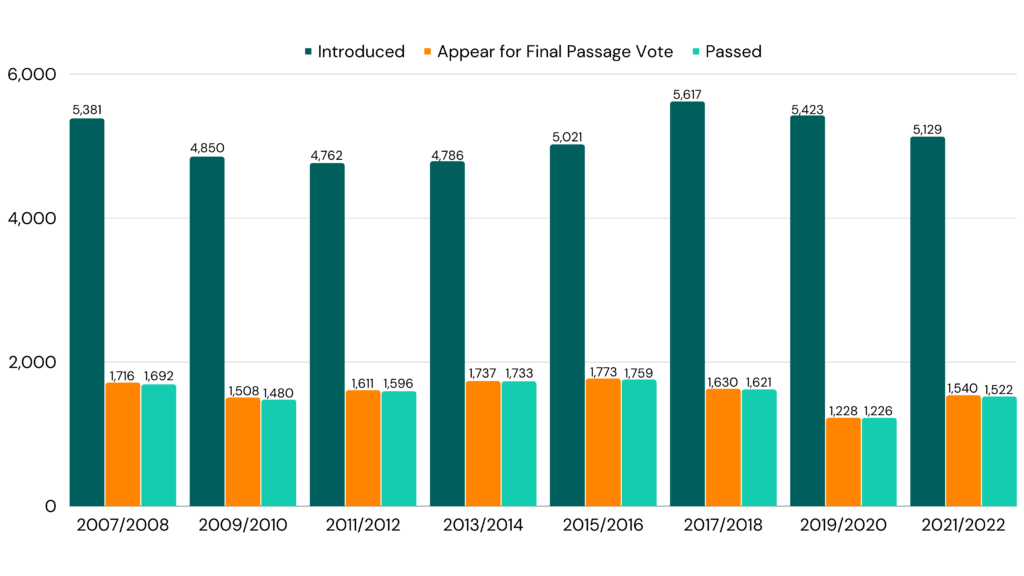
    2007-2022 Bills Introduced, Appearing for Final Passage, and Passed in the California State Legislature

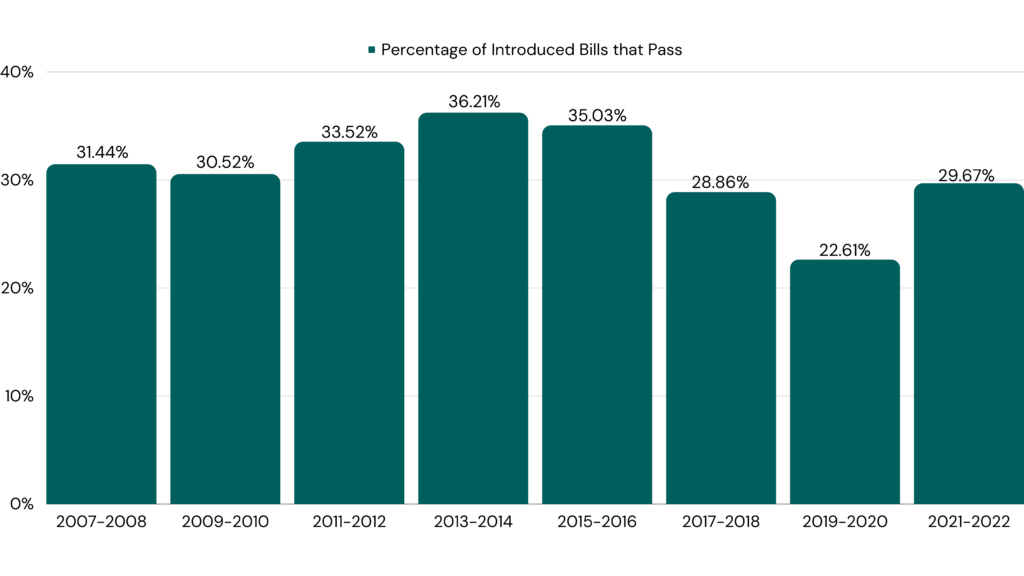
    In this analysis, two findings struck us as particularly interesting. First, while the number of bills introduced is relatively static, the number of bills appearing for final passage and passing is trending downwards. This trend can be seen even more clearly if we look at the percentage of introduced bills that passed across sessions.

    2007-2022 Percentage of Introduced Bills that Pass

    The years in which the number of bills introduced was lowest, 2009-2016, were also when legislators passed a higher proportion of bills. It’s difficult to isolate one reason for a trend, and we won’t attempt to. We’ll return to this dataset following the 2023-2024 session to see if this trend continued, or even accelerated.

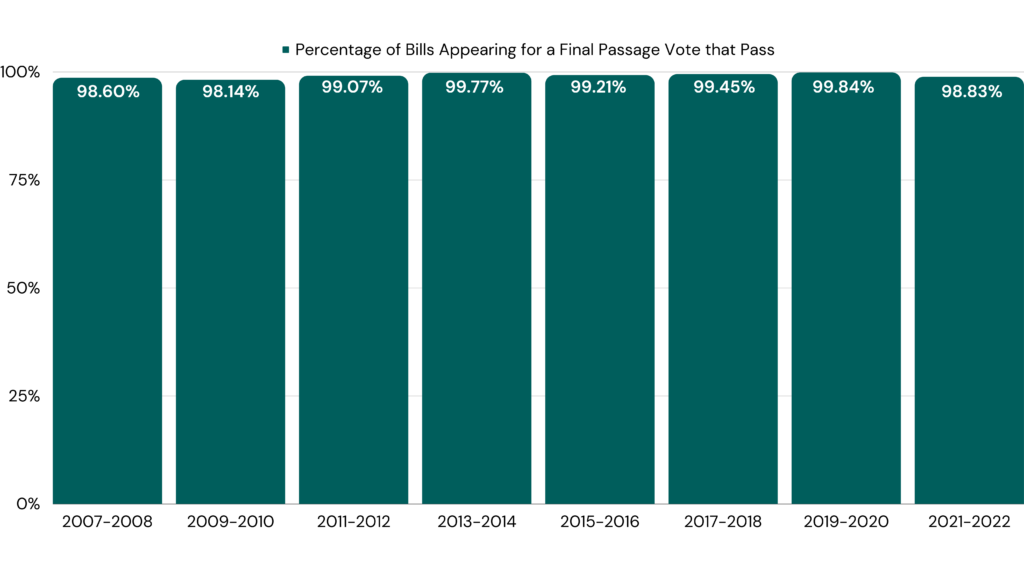
    The second interesting finding was the consistency of the rate at which bills that appear for a final passage do indeed pass. In other words, most bills that appear for a final vote end up becoming law. Of course, in order to appear for a final passage, bills must be approved by multiple legislative committees and a whole chamber. While it shouldn’t necessarily be surprising that the bills that make it through the full legislative process have robust support, we did not expect the rate of passage to be quite so high.

    2007-2022 Percentage of Bills Appearing for Final Passage that Pass

    Again, the fact that most bills that make it to a third reading in their second chamber pass is unsurprising. But, the magnitude and consistency of these passage rates can help inform models that determine the viability of a bill. It would also be interesting to compare California’s rate of passage to a state with a more even partisan split, to see if a more divided legislature has lower passage rates.

    Using Data to Understand Legislative Activity

    Zooming out and looking for patterns in legislative data can help you better understand legislative processes you already thought you knew well. Understanding a legislature’s activity, productivity, and progress requires some contextual knowledge. However, examining data at a higher level can benefit those hoping to better understand a legislature’s activity.

    Get Started with Plural

    Interested in seeing how Plural can deepen your legislative insights? Get started today!