Author: Max Knutsen

  • Pharmacy Benefit Managers in the Spotlight: How States are Regulating PBMs

    Pharmacy Benefit Managers in the Spotlight: How States are Regulating PBMs

    Divisiveness characterizes our current era in American politics. In this context, it can be hard to get lawmakers on both sides of the aisle to agree on anything. However, lowering prescription drug costs seems to be a rare uniting issue. Listen to a political rally on the left or the right, and you’re likely to hear a shared desire to lower prescription drug costs.

    Identifying a problem doesn’t necessarily lead to consensus on a solution. Regardless, bipartisan attention on prescription drug costs has shifted focus toward the drug supply chain over the past decade.

    Recently, many states have introduced proposals to reign in prescription drug prices. These proposals have included:

    • Establishing prescription drug affordability boards
    • Allowing for the import of drugs from Canada
    • Requiring greater transparency from drug manufacturers

    At the federal level, the Biden Administration has also taken action. President Biden has enacted laws that:

    • Allow Medicare to negotiate pricing on a limited number of prescription drugs
    • Require drug companies to pay rebates when they increase prices on certain drugs too quickly

    Amidst varying proposals and laws, common themes emerge. One common area of focus is the role of Pharmacy Benefit Managers (PBMs) in the drug supply chain. PBMs have become a key subject of debate in both state houses and Congress. Below, we dive into what PBMs do and how legislators are seeking to regulate their behavior.

    What is a Pharmacy Benefit Manager?

    If you have never heard of PBMs or don’t know what they do, you are not alone. PBMs work largely behind the scenes with health plans, drug manufacturers, and pharmacies. A PBM is a company that negotiates with drug manufacturers, generally on behalf of health insurers. They interact with each party in the process of buying and provisioning prescription drugs.

    Because of their behind-the-scenes role, the part PBMs play in determining how much patients pay for drugs and what drugs they’re able to access isn’t always obvious. Despite this, PBMs have a massive impact on the availability and affordability of drugs.

    PBMs provide value to pharmacies, insurers, and drug manufacturers. They take responsibility for the logistical morass that determines:

    • What drugs are available to patients
    • How they access them
    • At what cost (to the patient, the plan, the pharmacy, and the manufacturer) said drugs can be accessed

    In solving this puzzle, PBMs end up with significant leverage to negotiate with drug manufacturers. In theory, this leverage would allow them to lower costs for insurers and patients alike. 

    But PBMs are also for-profit entities, and often very successful ones. PBMs make money by:

    • Receiving rebates from drug manufacturers
    • Receiving payments from insurers for drugs that are higher than what the PBM pays the pharmacy to dispense that drug. This is commonly called “spread pricing”
    • Charging administrative fees to the insurers they work for. 

    How are Lawmakers Attempting to Regulate Pharmacy Benefit Managers?

    It’s clear that PBMs have a massive influence on drug distribution and affordability. Given this, it seems obvious that they would be a focus of legislative attempts to lower prescription drug costs. Hundreds of bills have been filed over the past two years with this intent. Proposals have primarily been aimed at increasing transparency into how PBMs make money. In April of 2024, two such proposals have passed. Learn more below.

    Oregon HB 4149

    Oregon HB 4149 became law on April 10, 2024. The new law requires PBMs to be licensed by the state. PBMs will also be subject to increased reporting requirements. The new law will also likely give state officials more latitude to investigate and penalize PBMs that violate the law.

    Idaho H 596

    Idaho H 596 became law on April 1, 2024. The new law ensures PBMs pass on rebates. It will also limit the use of “spread pricing” and require additional transparency from PBMs.

    Many other state-level proposals have followed similar themes. Other bills seek to ban “spread pricing” or require that rebates are passed along to insurers and patients. On the federal level, legislative efforts have proposed similar reforms. Though they’ve received some bipartisan report, bills have not yet been moved forward by leadership.

    The PBM industry has pushed back against these legislative proposals. They argue that rising drug prices are largely the fault of drug manufacturers. 

    Looking Ahead: Efforts to Regulate Pharmacy Benefit Managers

    Robust action on PBMs at the federal level is not imminent. Regardless, recent reforms by the Biden Administration show that prescription drug pricing is a policy area where coalition-building and legislative success are possible. Given this, it wouldn’t be surprising to see PBM reforms included in negotiations over “must pass” defense or budget legislation.

    At the state level, states that have passed PBM legislation will serve as a model for future bills. Because the PBM industry is so nationalized, legislation passed in one state could have ramifications on others.

    In a time when most policy areas are unlikely to be acted on due to political polarization, prescription drug policy represents a uniquely active space. You can discover, track, and influence the development and progress of this legislation using Plural today. Create an account or book a demo!

    More Healthcare Resources

  • The US Senate Just Voted to Overturn Another Biden Administration Rule

    The US Senate Just Voted to Overturn Another Biden Administration Rule

    What is the National Performance Management Measures Rule, and how does it fit into backlash against President Biden’s executive actions? Learn more today.

    On Wednesday, April 10th, the U.S. Senate narrowly passed SJ. Res. 61. The bill seeks to block the implementation of a rule by President Biden’s Federal Highway Administration (FHWA). If the rule is blocked, it will mark another blow to the administration’s attempts to reduce greenhouse gas emissions.

    Three Democrats, Joe Manchin, Jon Tester, and Sherrod Brown, and Independent Senator Krysten Sinema voted with Republicans. Ultimately, the resolution passed 53-47. This move marks another rebuke against the President’s executive authority. This trend has become a worrying theme for President Biden in his efforts to shape policy via rulemaking. In this blog, we discuss what this rule would do, how the Senate is seeking to nullify it, and what comes next. 

    What Is the National Performance Management Measures Rule?

    In December 2023 the FHWA released its final National Performance Management Measures Rule. The rule requires state departments of transportation to set targets to reduce transportation-related greenhouse gas emissions. Departments must also report on their progress to those targets over time. Notably, the rule did not dictate what those targets must be, only that they must be aimed at reducing emissions.

    Republicans characterized the rule as an executive overreach. As a result, many states filed lawsuits asking for the rule to be thrown out. Opponents were rewarded in late March when a Texas judge struck down the rule, blocking it from going into effect at least temporarily. That ruling is subject to an appeal that, if successful, could allow the rule to come into force. 

    What Did the Senate Do To Oppose the National Performance Management Measures Rule?

    Despite the March ruling against the FWHA rule, opponents in the Senate hoped to ensure it was blocked, even if the government were to win an appeal. Their vehicle for this was SJ. Res. 61, a Congressional Review Act (CRA) joint resolution. The CRA gives Congress the ability to overturn recently issued rules. While most legislation requires 60 votes to pass the Senate, joint resolutions require only a simple majority. Because of this, joint resolutions are a useful tool for a party with a slim majority. 

    This advantage of the CRA proved valuable in this circumstance. Republicans were able to win the support of just a few Senators outside of their party to pass the resolution. The resolution will now head to the House, where the Republican majority will likely support its passage. Unsurprisingly, many CRA resolutions that do pass are vetoed by the President. Biden appears prepared to do so in this circumstance. Opponents likely don’t have the numbers to override a veto, so it may be that SJ. Res. 61 stands little chance of becoming law. 

    But this legislative activity still matters. It contributes to a growing trend — Republicans are increasingly using the CRA to oppose President Biden’s actions. In some cases, they’re also gaining Democratic support. The President is increasingly reliant on administrative rulemaking to fulfill bold policy promises that are blocked in Congress. Growing opposition has met this trend, both from Republicans and from some in the President’s party.

    Both chambers of Congress have passed ten CRA resolutions opposing rules issued by President Biden. However, none have survived the President’s veto pen.

    Where Do We Go From Here?

    We will see in the coming weeks whether the House follows the Senate’s lead in passing SJ. Res. 61 and whether opponents can muster enough votes to override the President’s veto. The President’s veto will likely stand if the House passes the resolution. You can, of course, follow this activity with timely updates from Plural. 

    With SJ. Res. 61 unlikely to pass into law, the courts will decide the rule’s future. As of now, the rule has been nullified by the judge’s recent ruling. Whether the administration appeals, and whether that appeal is successful, will determine the responsibility of states to set greenhouse gas emissions reductions targets.

    As for the growing use of the CRA, this latest interaction with the Congressional check on executive power offers key reminders. It should serve as a reminder of the vulnerability of executive action should the President lose his bid for a second term this fall. If a Republican, presumably former President Trump, were to win in November, and Republicans held majorities in both chambers of Congress, they would be able to use the CRA to overturn many recent actions taken by President Biden. Without the power of the veto pen, President Biden wouldn’t be able to stop them.

    Get Started With Plural

    Plural is the policy and legislator intelligence tool of choice for effective government relations teams. With Plural, you’ll:

    • Access superior public policy data 
    • Be the first to know about new bills and changes in bill status
    • Streamline your day with seamless organization features
    • Harness the power of time-saving AI tools to gain insights into individual bills and the entire legislative landscape
    • Keep everyone on the same page with internal collaboration and external reporting all in one place

    Create a free account or book a demo today!

    More Resources for Public Policy Teams

  • Why Open Data Is Critical to an Open Democracy

    Why Open Data Is Critical to an Open Democracy

    Our mission at Plural is to make policy creation more transparent, responsive, and inclusive. We also seek to make full participation possible. Our work began with a focus on policymaking in the U.S. at the federal, state, and territory levels. But the vision of Plural’s founders stretches internationally beyond the United States. Last year, we expanded our services to Nigeria, one of the fastest-growing democracies in the world. 

    From the beginning, we have seen open data as a critical tool. Open data improves our democratic processes, helping ordinary citizens get involved. It provides the basis for high-quality, bilateral communication between citizens and their representatives. Clear records of legislative activity help us hold our government accountable. When citizens have access to policy proposals, politicians can provide better representation by soliciting, hearing, and acting upon the positions of their constituents.

    Key Tenets of Open Democracy

    An open democracy is one that is transparent, accountable, and inclusive. It can often be challenging to apply strict definitions to concepts like democracy. At Plural, consider an open democracy as an ideal. It goes beyond the core democratic tenet of vesting state power to the people. Rather, an open democracy actively encourages the people’s use of that democratic power.

    Democratic governments have the opportunity to be more open throughout all of their processes. However, the benefits of openness and citizen engagement are most apparent in:

    • How we elect leaders
    • How we influence their work
    • How we hold politicians accountable

    True Government by the People

    In representative democracies, leaders emerge from all backgrounds. Thus, the government is representative of the citizens they represent. This ideal is often difficult to achieve, as power can be consolidated even within democracies. However, representative government enhances a citizen’s sense of ownership of political decisions. True representation strengthens democracy.

    Democratic Power to the People

    Participatory rights in an open democracy don’t end with the ability to be elected or have your peers elected. An open democracy requires that popular opinion can hold officials accountable. Ordinary individuals, elected or not, must have influence on the policymaking process. At both the local and state levels, this may involve the ability to testify at a public hearing or collect signatures for a referendum. At the federal level, it may look like calling your legislator’s office to express an opinion. Regardless, collective public opinion expressed during an election must ensure that our representatives work in our interest. We must feel that our vote matters.

    Challenges to an Open Democracy

    You don’t have to look far in 2024 to find a discussion of the challenges that the promise of democracy faces. Discussions surrounding faith in elections and the rule of law have been brought to the fore. When these basic principles of democracy are threatened, it can be easy to write off challenges to an improved or open democratic society. But these threats to the governance we would like to see are still important to acknowledge and resolve.

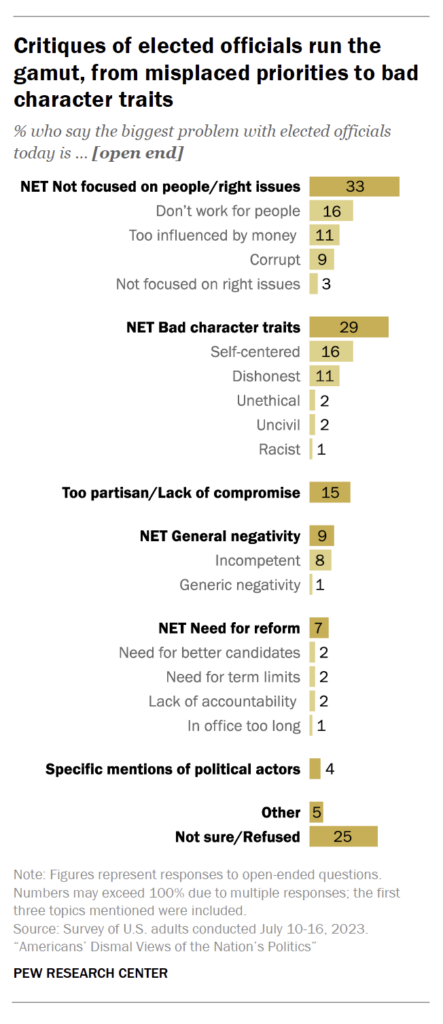
    One of the key challenges to open democracy is a perceived lack of connection between citizens and their elected officials. In 2023, one-third of Americans surveyed felt that politicians were not focusing on the people they represent or the right issues. Of this group, 16% felt that politicians do not work for the people. Eleven percent indicated that politicians are too influenced by money, and 9% feel as though politicians are corrupt. See more in the image. (Photo credit: Pew Research.)

    Particularly at the federal level, the role of money in politics contributes to this disconnect. Ever-increasing campaign spending restricts the ability of the “ordinary citizen” to be elected. This leads to the perception that issues are decided in the favor of corporate donors over broader public sentiment. This approach to politics leads to an apathetic citizenry, the antithesis of open democracy.

    An open democracy requires an engaged constituency. Shifts are needed to ensure that citizens retain a feeling of ownership over the decisions made by their representatives. These might include campaign finance reform and electoral reforms, like redistricting.

    While reforms can and should be made, true voter engagement requires a step further. An engaged voter base requires access to to the democratic process. This is where open data is key.

    What Is Open Data, and How Does It Contribute to Democracy?

    Open data is freely available for anybody to access, use, and share without hardship. In the context of democracy, open civic data generally refers to providing citizens with access to public government data. While this data is public and provided by the government, it can be difficult to access. This is where open civic data providers like Plural come in. Plural and others seek to provide citizens with an easy and intuitive path to engaging with their government.

    Accessing this data allows individuals to follow and influence policymaking at every stage. This includes:

    • Seeing the introduction of a bill
    • Testifying at a public hearing
    • Identifying which legislators supported the legislation
    • Tracking the implementation of a new policy after it becomes law

    Examples of Open Civic Data That Bolster Democracy

    ElectoralLegislativeGovernance
    Election resultsLegislator vote historiesGovernment agency spending
    Campaign finance reportsProposed legislationElection processes and procedures
    Voting locationsUpcoming public hearingsGovernment reports (on education quality, for example

    There are many more examples of open civic data that we can think of. However, each example mentioned above is connected in that access to this data is vitally important to an engaged populace. All of this data is traditionally made public. Despite this level of access, citizens often rely on non-governmental organizations, like media or civic data projects, to access it. For instance, we often see efforts by advocacy organizations to generate large-scale public input on headline issues. However, this level of engagement is not sustainable across all of the decisions our government makes. Citizens’ reliance on others to engage with their government’s activity can be problematic.

    In an ideal world, open civic data would allow each citizen to easily understand and engage with policymaking. Let’s consider our open democratic standard of bilateral communication between legislator and constituent. With open civic data, every citizen can share their opinion and compare it against the actions of their elected officials. This communication allows for better policy and accountability throughout the democratic process. 

    Plural’s Commitment to Open Data and Transparent, Open Democracy

    In 2021, Plural adopted the leading US-based open civic data project Open States. Since then, we have continued to encourage civic engagement. This includes bringing Open States data into our more accessible and powerful UI. We are proud to maintain and expand access to open civic data. Plural’s data has been used by news organizations, grassroots advocacy groups, and ordinary citizens alike, all with the goal of improving democracy. 

    At Plural, we believe that an improved democratic process can lead to policymaking that meets the needs of the people. Open data is at the heart of improving democratic processes, and our work centers access to civic data in every jurisdiction we support.

    Get Started

    Plural helps government relations teams, advocacy groups, and concerned citizens alike get and stay ahead in the public policy landscape. With Plural, you’ll:

    • Access superior public policy data 
    • Be the first to know about new bills and changes in bill status
    • Streamline your day with seamless organization features
    • Harness the power of time-saving AI tools to gain insights into individual bills and the entire legislative landscape
    • Keep everyone on the same page with internal collaboration and external reporting all in one place

    Create a free account or book a demo today!

    More Resources for Public Policy Teams

  • Freedom To Read Acts: How State Legislators Are Fighting Back Against Book Bans

    Freedom To Read Acts: How State Legislators Are Fighting Back Against Book Bans

    Over the past two years, conservatives have attempted to control curricula and literature in public schools. Pen America has catalogued nearly 6,000 instances of book bans across 41 states. The group noted a sustained focus on banning books written for young adults. Bans targeted books about “difficult” topics, like violence or racism. Books focusing on historically marginalized identities, mainly people of color and LGBTQ+ individuals, were also targeted. It’s clear that discussion of race and gender in schools has become a target for some lawmakers and advocates. Despite this, book bans have been met with significant consternation by many Americans. The American Library Association (ALA) recently found that a significant majority of voters and parent oppose efforts to remove books from school libraries.

    Since 2021, opponents of book bans have fought them at the state and local levels. Recently, opponents of book bans have shifted into the offensive as legislators in many states have filed “Freedom to Read” bills. Across jurisdictions, specific “Freedom to Read” bills vary in scope. Overall, they aim to protect access to materials that may be challenged due to partisan or doctrinal disapproval.

    Illinois HB 2789

    Illinois was the first state to pass such a law when Governor Pritzker signed HB 2789 in June 2023. HB 2789 requires the State Library officials to adopt the ALA’s Library Bill of Rights across Illinois. Generally, the Library Bill of Rights protects access to challenged literature. Under HB 2789, any Illinois library’s refusal to adopt these policies could result in a loss of state funding.

    States That Have Introduced or Passed “Freedom to Read” Legislation

    Our research team used Plural’s advanced search capabilities to analyze the issue. We found that legislators in 12 states and Congress introduced 19 “Freedom to Read” bills. See the full list here. While Illinois is the only state to have passed this legislation into law, Maryland HB 785 appears close to becoming law.

    At Plural, we use our AI-powered tools to identify legislative trends before they become national news. It can be fascinating to watch these trends develop and see how they motivate new legislative activity. In the case of book banning, increased efforts to challenge books garnered significant attention. This seems to have bolstered the “Freedom to Read” movement. We will continue to monitor these competing trends, and you can too using Plural.

    States that have introduced “Freedom to Read” legislation are indicated in orange. Illinois, the only state to pass such legislation, is indicated in light blue.

    More Resources for Illinois

  • How To Impact Regulation

    How To Impact Regulation

    Both ordinary citizens and government relations professionals can follow and impact public policy. The legislative process garners a significant amount of time and attention from both groups. This is understandable. The process by which a bill becomes a law is where policy decisions are debated and agreed upon, on both the federal and state levels. However, many citizens and policy professionals pay less attention to a similarly impactful aspect of the public policy process: regulatory rulemaking.

    Though often overlooked, the regulatory process has significant impacts on Americans. It also offers opportunities for the public to share feedback and wield influence. For government relations teams and engaged citizens alike, following rulemaking at the state and federal levels is essential. In this article, we explain all there is to know about regulations. Read on to learn what regulations are, how to follow the rulemaking process, and how to impact regulations.

    What Exactly Are Regulations?

    In general, lawmakers pass bills to make changes to their jurisdiction’s statutes. More often than not, those bills and their associated statutes are fairly descriptive. Regardless, the government must still detail how the statute will be applied. This is where rulemaking comes in. Government agencies use internal expertise and stakeholder feedback to develop regulations detailing the fineries of the law. The rulemaking process updates these regulations.

    Here’s a simplified example. State legislatures might pass a law that requires the Department of Marine Fisheries to maintain and publish a list of endangered local fish. Following the passage of this law, the Department must establish how and when they will publish this list. They must also determine what measures they’ll use to determine “endangerment,” and what fish might appear on that list. In future rulemaking, they may change any of these decisions based on the authority granted to them by the legislature to maintain that list.

    The scope of the policy choices being made through regulations across U.S. states and the federal government is massive. Further, the nature of the content being considered and the regulatory process are highly complex. These factors lead to less engagement with this key aspect of policymaking. At the same time, the effects of regulatory action are ubiquitous in our daily lives. Regulations might determine what information is presented to us on the food we buy, how much our health systems are paid for providing quality care, and how we access public transportation.

    Who Needs to Follow the Regulatory Process?

    The aviation, healthcare, and insurance industries face high levels of regulation. Government relations teams working in these industries play a crucial role. In this context, GR teams help their organizations navigate the complex landscape of regulatory rulemaking. This is true at both the federal and state levels. The regulations impacting the aforementioned industries govern everything from consumer protections, to pricing, to safety standards. It’s easy to understand how these regulations have significant business impacts.

    At the federal level, agencies like the Federal Aviation Administration and the Department of Health and Human Services issue regulations. Businesses in these sectors are directly impacted by these regulations. Operations, business practices, and profitability can all be affected by regulatory action. In order to sway the process in their favor, GR teams must engage in constructive dialogue with regulatory agencies and policymakers.

    This dynamic is similar at the state level. GR teams have an opportunity to connect with local officials with the authority to impact their industries. At this level, GR teams are in a unique position to directly influence policymakers. State-level policymakers often look to local businesses as partners and thought leaders in developing the future of policy in their issue area.

    Overall, GR teams must actively participate in the rulemaking process. In doing so, GR teams can:

    • Mitigate regulatory risks
    • Seize growth opportunities
    • Promote effective policies that benefit their organizations, the agencies initiating rulemaking, and the general public

    The Regulatory Process

    There are two ways to follow the regulatory process on the federal level. Those interested must follow public postings at Regulations.gov and the federal register. At the state level, publication of rulemaking actions is much less uniform. Many states have registers or gazettes that are published regularly with new regulatory updates. These records are often published by the Secretary of State. Other states leave it to individual agencies to publish updates on rulemaking actions. This convoluted process can make tracking regulatory updates challenging.

    The rulemaking process itself varies across jurisdictions and agencies. Generally, it includes the steps detailed below.

    Statutory Authority

    Each agency that participates in rulemaking derives its authority to do so from statute. Sometimes this authority is very specific in scope. For instance, a rent control bill might task an agency with determining and updating what “market rate” rent is in various areas.

    Agencies can also be given broad authority. As an example, the Social Security Act gives the Centers for Medicare & Medicaid Services significant control over setting reimbursement rates for healthcare services.

    Pre-Rulemaking

    Agencies often provide notice of an upcoming rulemaking cycle. Sometimes, they solicit public input ahead of rulemaking via public comments or meetings. 

    Proposed Rule

    Agencies will detail the proposed changes to regulations in what is known as a proposed rule. Regulatory proposals typically include an explanation of the proposed changes. These explanations are presented alongside the proposed changes to the regulatory text. 

    Public Comment Period

    Following the release of the proposed rule, a timeframe is established for the public to provide feedback. During this period, generally 30-90 days, Americans may submit public comments on the proposed rule. State rulemaking actions may also have public hearings, where members of the public can submit comments.

    Agency Review

    After public comment closes, the agency initiating rulemaking will take time to digest public comments. They may make changes to the proposed rule. 

    Final Rule

    The agency will publish a final rule that accounts for any changes made after the public comment and review periods. The final rule will include effective dates for any of the changes made by the rule. Often, the agency may respond to submitted public comments alongside the issuance of the final rule. This is especially true at the state level.

    How to Effectively Impact the Regulatory Process

    There’s good news for GR professionals and engaged citizens who want to get involved in the regulatory process. Many of the same principles that apply to effective advocacy at the state house also apply when working with agencies. A strong workflow to monitor and influence regulatory policy will include the following steps.

    Discovery

    Discovery is key to staying on top of legislative developments. As such, having a process to identify new regulatory actions that may impact you or your organization is essential. Effective discovery ensures you’re never left uninformed.

    Analysis

    One key aspect of the rulemaking process is ensuring that those in the field have ample time to review and assess proposed policy changes. It’s important to develop a clear and concise understanding of how a proposed action may impact you or those you represent. Aim to do so as quickly as possible following discovery. Strategies for developing this analysis include:

    • Conducting comparative political research
    • Partnering with allied organizations
    • Soliciting feedback from internal stakeholders

    Comment

    Rulemaking processes are excellent opportunities to partner with agencies to influence policy change. This is especially true at the state level. Submitting comments via email or attending a public hearing are effective ways to ensure your voice is heard. When submitting comments, it’s important to highlight your experience and expertise. Clearly detail your position on the proposed changes and any alternative solutions you might have in mind.

    Review and Compliance

    The final step of this process is to ensure you’re aware of when final rules are published. Communicate with stakeholders about the impact of your influence. Detail any impacts on your organization. Finally, begin the process to ensure compliance with any rule changes.

    Exact details of how this workflow operates in practice will, of course, vary by organization. Use this guide as a checklist to ensure that you have the core functions of regulatory monitoring and engagement covered.

    Impacting the Regulatory Process

    Active engagement in the rulemaking process is key for individuals, organizations, and industries seeking to establish influence and monitor policy risk. With active participation, stakeholders will stay informed and may be able to influence policy. This involvement will set them up as thought leaders and field-based partners for policymakers. Developing expertise in this realm will lead to better policy, which is what the rulemaking process is there for.

    More Resources for Public Policy Teams

    Plural for Policy Tracking

    Plural is the policy tracking and stakeholder engagement tool of choice for both government relations professionals and concerned citizens alike. With Plural, you’ll:

    • Access superior public policy data 
    • Be the first to know about new bills and changes in bill status
    • Streamline your day with seamless organization features
    • Harness the power of time-saving AI tools to gain insights into individual bills and the entire legislative landscape
    • Keep everyone on the same page with internal collaboration and external reporting all in one place

    Create a free account or book a demo today!

  • Understanding Illinois’s Proposed Social Media Law with Plural

    Understanding Illinois’s Proposed Social Media Law with Plural

    Our current political landscape is marked by polarization and stagnation in Congress. In this context, it’s become common for highly partisan state governments to push novel legislative proposals. For instance, California has an overwhelming Democratic majority in its state legislature. With this partisan makeup, the legislature has established the strictest data privacy and ESG disclosure laws. Meanwhile, states with large conservative majorities like Alabama and Arkansas have recently leaned further right on abortion and gun laws.

    It can be surprising to see both Republican and Democratic-controlled states moving in the same direction on legislation. But this is exactly what is happening when it comes to regulating children’s social media use. In recent years, many states have acted to regulate or restrict the use of social media by minors. This includes California, Texas, Ohio, and Arkansas, among others. Regulating children’s social media use is proving to be a uniting, bipartisan issue.

    Just this week, Governor DeSantis signed Florida HB 3 into law. The new law, passed by Florida’s overwhelmingly Republican legislature, is expected to face legal challenges. If it survives, HB 3 would ban children under 14 from using social media. It would also require parental permission for 15 and 16-year-olds.

    At the same time, Illinois’s Democratic House of Representatives is also advancing a bill that would regulate children’s activity online. HB 5380, known as the Parental Digital Choice Act or Sammy’s Law, advanced out of the House Consumer Protection Committee in mid-March. It is is expected to be voted on by the full House soon. Below, we use Plural’s AI capabilities to better understand HB 5380. How does Illinois HB 5380 fit within the bipartisan trend of regulating children’s social media use?

    Summarizing HB 5380: The Parental Digital Choice Act

    Plural provides access to both source-provided data and insights unlocked by our industry-leading, AI-powered models. As seen below, the AI summary typically adds clarity, context, and readability that can often be missing in source-provided summaries.

    Illinois HB 5380: Source-Provided Summary

    Creates the Let Parents Choose Protection Act. Provides that the Act may be referred to as Sammy’s Law. Provides that, before August 1, 2025, or within 30 days after a service becomes a large social media platform after August 1, 2025, a large social media platform provider shall create, maintain, and make available to any third-party safety software provider a set of third-party-accessible real time application programming interfaces, including any information necessary to use the interfaces, by which a child, if the child is 13 years of age or older, or a parent or legal guardian of a child, may delegate permission to the third-party safety software provider to: (1) manage the child’s online interactions, content, and account settings on the large social media platform on the same terms as the child; and (2) initiate secure transfers of user data from the large social media platform in a commonly used and machine-readable format to the third-party safety software provider. Sets forth disclosure requirements to the child and the parents or guardians of a child; requirements of third-party safety software providers; and liability of third-party safety software providers. Provides that a violation of any of the provisions of the Act is an unlawful practice under the Consumer Fraud and Deceptive Business Practices Act. Amends the Consumer Fraud and Deceptive Business Practices Act to make a conforming change. Effective June 1, 2025.

    Illinois HB 5380: Plural AI Summary

    The bill is proposing the following:

    1. Require large social media platforms to provide real-time APIs to authorized third-party safety software providers. This will allow parents/guardians to delegate permission to these providers to manage children’s online interactions and transfer user data.
    2. Define requirements for third-party safety software providers to access the APIs, including:
      • Being solely engaged in Internet safety
      • Only using user data to protect children from harm
      • Only disclosing user data as permitted
      • Disclosing how they operate and collect info to enable informed consent
    3. Provide liability protection for social media platforms that comply with the bill.
    4. Allow the Attorney General to enforce the bill under the Consumer Fraud and Deceptive Business Practices Act.
    5. Amend that Act to specify violations of this bill as unlawful practices.
    6. The bill would take effect on June 1, 2025.

    In summary, the key proposals are mandating social media platforms provide access to third-party safety software providers to help parents manage children’s accounts and protect them from harm, with regulations and enforcement mechanisms.

    How Does Illinois HB 5380 Compare to Other State Efforts?

    HB 5380 does not go as far as legislation from other states seeking to implement a firm ban on the use of social media by minors of a certain age. Regardless, there are key similarities. HB 5380 would require social media companies to make significant changes to their platforms. For this reason, social media companies and their coalitions have opposed these efforts. 

    It’s likely that the Illinois House will vote on HB 5380 in April. If successful, it will then pass on to the Senate after that. You can follow upcoming activity on HB 5380 and discover related social media regulation proposals in Plural.

    Get Started With Plural

    Plural is the policy tracking tool of choice for policy pros looking to monitor social media laws, including Illinois HB 5380. Create a free account or book a demo today!

    More Resources for Public Policy Teams

  • Chaplains in Schools: The Next Fight in the Education Wars?

    Chaplains in Schools: The Next Fight in the Education Wars?

    Education is always a central focus for state legislators. Debates over teacher pay and school funding have dominated statehouses for decades. In recent years, education policy debates in the states has shifted away from funding. Now, legislators are focusing on battles over curricula, staffing, and school environments.

    At Plural, we’ve followed these issues closely. We’ve covered legislation impacting race and education and legislation impacting transgender and nonbinary kids in school. We know that the results of this policy shift have been profound. The NAACP has issued a travel advisory for the state of Florida and advised black student-athletes against enrolling in the state. Across the country, book bans and challenges have surged, and school board meetings have become increasingly combative. 

    The most recent policy proposal to emerge from this trend has involved authorizing school districts to bring chaplains into schools. Texas Senate Bill 763, which became law in June of 2023, is one example of such efforts. The new law allows Texas public school districts to employ or otherwise allow volunteer chaplains to provide services in schools.

    The law has faced strong opposition, including from chaplains themselves. Despite this, it has sparked efforts in other states to incorporate chaplains into public school resources. Utah, Alabama, Nebraska, and Georgia are among the states to have considered similar proposals. Florida’s legislature just passed its “school chaplain” bill onto Governor DeSantis’ desk.

    What Would Florida’s School Chaplain Bill Do?

    Florida’s legislature passed HB 931 on March 7, 2024. Governor DeSantis will soon decide whether to sign the bill into law, veto it, or allow it to become law without his signature. HB 931 closely mirrors the Texas law, as well as many of the bills being considered elsewhere. It would allow school districts to adopt policies authorizing volunteer chaplains to provide support, services, and programs in public schools.

    Under HB 931, the districts’ policies must clearly define the chaplain’s role. Parents must be informed of and consent to any services provided by chaplains. Like other school employees, volunteer chaplains will be required to pass background checks.

    Summarizing Florida HB 931 With Plural’s AI-Powered Bill Summarizer

    Plural’s AI-powered bill summarizer generated the following summary of Florida HB 931. Plural distilled hundreds of words into the following summary:

    The bill is proposing to allow school districts and charter schools to adopt a policy authorizing volunteer school chaplains. If adopted, the policy must:

    1) Describe the supports, services, and programs the chaplains may provide.

    2) Require schools to inform parents about the availability of chaplains.

    3) Require written parental consent for students to participate in chaplain services. Parents can select chaplains from a list that includes religious affiliation.

    The bill also requires chaplains to meet background screening requirements. School boards and charter schools must vote by January 1, 2025 on whether to adopt such a policy. Districts that adopt the policy must publish a list of chaplains on their website.

    The bill is amending existing law to subject chaplains to the same background screening as other noninstructional personnel.

    In summary, the bill proposes allowing volunteer school chaplains and establishes requirements around policy adoption, parental consent, and background screening.

    Analyzing Florida HB 931’s Version-to-Version Summary

    The final version of the bill contains notable differences from the introduced version of Florida HB 931. Plural’s AI-powered version-to-version summarizer provides the following overview:

    Differences in Proposed Changes: 1) The previous version requires a vote by January 1, 2025, on adopting a chaplain policy, which is not mentioned in the new version. 2) The previous version specifies that only school districts must publish the list of chaplains, while the new version requires both school districts and charter schools to publish the list.

    Plural’s AI-generated summary highlights a few notable differences. The filed version of the bill excludes the requirement for a vote on the chaplain policy. This is particularly notable, since Texas legislators included a similar provision in their law. With this exclusion, Florida legislators may be attempting to avoid political backlash — many of Texas’ largest school districts recently rejected chaplain programs

    How are Education Advocates Reacting to School Chaplain Proposals?

    Proponents of these efforts include conservative and religious groups. Education policy issues of this nature tend to fall along predictable partisan divides. However, it’s notable that five House Democrats in Florida voted in support of HB 931.

    Advocates for these measures include the National School Chaplain Association, a Christian ministry aiming to serve spiritual needs in schools. Supporters argue that chaplains can play a role in meeting growing mental health needs and improving school safety. 

    Opponents include the American Civil Liberties Union (ACLU) and many chaplains themselves. They raise the uncertain constitutionality of these issues, questioning whether they violate separation of church and state. Many opponents have also noted that chaplains are already eligible to volunteer in schools, but counseling and behavioral health support should be left to trained professionals.

    Where do School Chaplain Bills Go From Here?

    More than a dozen states have considered school chaplain proposals. These efforts have stalled in most states. In Utah, state senators narrowly rejected a school chaplain bill prior to the end of their 2024 legislative session.

    In states that do pass bills, it will take some time before new policies take effect. When they do, proponents and opponents alike will certainly be watching their impact. It’s likely that more school chaplain bills to be taken up in 2025. Legislators will look to the experiences of early adopters to formulate their arguments. 

    In an unexpected twist for advocates of school chaplain bills, the Satanic Temple has voiced its support. The Satanic Temple does not actually worship Satan, but rather advocates for first amendment rights and religious freedoms. The organization has indicated its interest in participating in school chaplain programs in Florida, Iowa, and Utah.

    It’s not hard to imagine how school chaplain policies could quickly lead to litigation and controversy. At Plural, we’re committed to monitoring the newsworthy issues that impact Americans. Stay tuned for more!

    Get Started With Plural

    Plural is the legislative tracking tool of choice for policy teams monitoring issues related to education. With Plural, you’ll:

    • Access superior public policy data 
    • Be the first to know about new bills and changes in bill status
    • Streamline your day with seamless organization features
    • Harness the power of time-saving AI tools to gain insights into individual bills and the entire legislative landscape
    • Keep everyone on the same page with internal collaboration and external reporting all in one place

    Interested in learning more? Create a free account or book a demo today!

    More Resources for Public Policy Teams in Florida

  • Is Congress About to Ban TikTok?

    Is Congress About to Ban TikTok?

    Is a TikTok ban imminent? While TikTok’s virality may still feel novel, official U.S. concern over the app surfaced almost five years ago. On March 13, the House passed HR. 7521. The bill now heads to the Senate with many more eyes tracking its progress.

    The federal legislative process has always been opaque, and therefore difficult for ordinary citizens to follow and connect with. This is, after all, a driving force behind the creation of Plural as a source of open public policy data. The journey from an idea to an enacted law is far more complex than Schoolhouse Rock made it seem. This legislative process can often take years. The ongoing congressional battle over TikTok encapsulates this halting, confusing path. The recent passage of H.R. 7521 out of the House took many by surprise and has users of the app wondering how we got here.

    While TikTok’s virality may still feel novel, official U.S. concern over the app surfaced almost five years ago. At that time, the FBI and military leaders cited national security risks related to the app. ByteDance, the company that develops and owns TikTok, has a close relationship with the Chinese government. The Trump administration then pressured TikTok to agree to host all of its U.S. user data under Oracle’s infrastructure. 

    Despite this move to protect user data, lawmakers were still eager to act on TikTok. Beginning in 2022, we saw a wave of state legislation aimed at banning TikTok. Most of these bills, like Texas’ SB 1893, sought to ban the use of TikTok by government officials and on government devices. The Biden administration followed a similar path by banning the use of TikTok on federal devices. Montana’s SB 419, enacted in May 2023, went a step further. The new law banned the use of TikTok by anyone in Montana. A federal judge later blocked this ban before it went into effect. 

    After years of debate, Congress wanted to go further. After being introduced on March 5, the House of Representatives overwhelmingly passed HR. 7521, the Protecting Americans from Foreign Adversary Controlled Applications Act, on March 13. The bill now heads to the Senate with many more eyes tracking its progress.

    What would H.R. 7521 do?

    H.R. 7521 would prohibit companies from providing distribution or hosting services to “foreign adversary-controlled applications.” This would force companies like Apple and Google to remove TikTok from their app stores. It would also prevent internet service providers from supporting access to the application. The bill narrowly defines “foreign adversary-controlled applications” to apply to TikTok. However, it does provide an avenue for other applications to be banned in this way. 

    The bill doesn’t include penalties for individual users of TikTok, and it wouldn’t remove TikTok from anyone’s phone. But, without web hosting services or the support of app distributors like Apple and Google, the application would quickly become buggy and unusable.

    The bill also provides an exemption for certain action taken by ByteDance. If ByteDance divests from TikTok within 165 days of enactment, application support would not be banned. In short, the bill gives ByteDance 165 days to sell TikTok, or be banned from the U.S. 

    So – Is a TikTok Ban Imminent?

    H.R. 7521 passed out of the House by a wide margin and President Biden has signaled he will sign it if it reaches his desk. However, there are still many barriers between where we stand on March 15th and a TikTok ban. 

    First, the House vote caught many by surprise, in part because the bill moved so quickly from introduction to passage. The reaction to the House vote has ensured that any debate on this bill in the Senate will be met with significant attention from all sides. This additional attention may not change any vote, but it will certainly slow down the process. 

    Second, even if the bill does pass, its divestment exemption provisions pave the way for TikTok to stay usable in the U.S., as long as ByteDance is willing to sell the application. A sale could be complicated by a lack of willingness to sell from ByteDance or anti-trust concerns here in the U.S. 

    Finally, even if the bill does successfully pass, its enactment would be swiftly followed by litigation from ByteDance and others. ByteDance has hinted that they would continue their fight in the courts if H.R. 7521 passes. The American Civil Liberties Union is also organizing opposition to H.R. 7521. It would likely support legal challenges to the law, among many other groups.

    Taken together, these obstacles will slow the momentum of this past week. While a TikTok ban might feel imminent, it’s unlikely that any enforcement of the bill, if passed, would begin before the end of 2024. There remain many hurdles to pass before H.R. 7521 becomes law.

    Get Started With Plural

    Plural is the legislative tracking tool of choice for policy teams looking to gain greater insights into the policies that matter. With Plural, you’ll:

    • Access superior public policy data 
    • Be the first to know about new bills and changes in bill status
    • Streamline your day with seamless organization features
    • Harness the power of time-saving AI tools to gain insights into individual bills and the entire legislative landscape
    • Keep everyone on the same page with internal collaboration and external reporting all in one place

    Create a free account or book a demo today!

    More Resources for Congress

  • Oregon HB 4002: Recriminalizing Drug Possession

    Oregon HB 4002: Recriminalizing Drug Possession

    In the early 20th century, U.S. Supreme Court Justice Louis Brandeis wrote: “It is one of the happy incidents of the federal system that a single courageous State may, if its citizens choose, serve as a laboratory; and try novel social and economic experiments without risk to the rest of the country.” Justice Brandeis’s analysis popularized the idea that state legislatures are “laboratories of democracy.”

    In our highly partisan times, debate over a single state’s actions is often nationalized. It can be easy to forget this virtue of our federal system espoused by Justice Brandeis. However, this context can be helpful as we consider the progression of Oregon’s drug laws in recent years. What does the soon-to-be-enacted Oregon HB 4002 mean for drug policy in the state?

    How Did We Get Here?

    In November 2020, Oregon voters made history in their overwhelming passage of Ballot Measure 110. The Ballot Measure effectively decriminalized the possession of small amounts of illicit drugs. It also sought to increase funding for recovery resources such as rehab facilities. At the time, studies showed that Oregon had high rates of addiction, and ranked poorly for providing access to treatment. Advocates for Measure 110 believed that increased funding for recovery, combined with a transition away from punitive responses to addiction, could improve the situation in Oregon.

    Measure 110 took effect in 2021. Law enforcement entities began issuing citations and treatment referrals rather than arrests. Since then, opioid overdoses increased, both nationally and within Oregon. This spike was driven in part by an increased prevalence of fentanyl in the state. At the same time, treatment funding mechanisms established by Measure 110 were slow to get off the ground. Many programs are only just starting to feel their impact. 

    Last fall, business leaders and opponents of Measure 110 began organizing opposition to the new rules. This included gathering signatures for a referendum to roll back aspects of the Measure. Prior to the 2024 legislative session, both Democrat and Republican leaders signaled their support to revise Measure 110.

    What Is Oregon HB 4002?

    Bipartisan interest in rethinking Measure 110 resulted in HB 4002. The bill passed through the legislature, and Governor Kotek will soon sign it into law. Oregon HB 4002 directs additional resources towards the addiction recovery continuum of care, including measures:

    • Increasing funding for community-based treatment
    • Establishing additional treatment options
    • Prohibiting insurers from requiring prior authorization of medication for substance use disorder

    Most notably, HB 4002 will also recriminalize possession of illicit drugs in some circumstances. Under the bill, those found in possession of small amounts of drugs can be charged with a crime. However, they may have the opportunity to avoid conviction by seeking addiction treatment. Repeat offenders or those who break probation may serve up to six months in jail. 

    While HB 4002 provides ample opportunity for diversion from the criminal justice system, opponents are concerned that it marks a return to the criminalization of addiction. Oregon’s overburdened and under-resourced addiction healthcare system may prevent those caught with drugs from choosing treatment. Further, the Oregon Criminal Justice Commission noted that the bill may disproportionately impact communities of color.

    What Will Oregon HB 4002’s Impact on Drug Policy Be?

    The politics surrounding Measure 110 have remained impactful. Returning to Justice Brandeis’s thinking, one might argue that other states may resist decriminalization efforts based on Oregon’s experience.

    At the same time, it is worth noting that HB 4002 does not represent a full reversal of thinking by Oregon’s leaders. The bill continues to increase investment in treatment. Further, the re-criminalization of drug possession still includes pathways out of the justice system. Even after HB 4002 goes into effect, Oregon’s drug laws will be among the most progressive in the country.

    It’s expected that HB 4002 will make decriminalization efforts (beyond marijuana) difficult. In recent years, New York, Massachusetts, and Washington have introduced bills proposing expansive decriminalization of drug possession. Opponents of those efforts will point to Oregon’s experience with Measure 110 as evidence of failure.

    Get Started With Plural

    Plural is the legislative tracking and analysis tool of choice for policy professionals looking to gain greater insights into impactful bills. With Plural, you’ll:

    • Access superior public policy data 
    • Be the first to know about new bills and changes in bill status
    • Streamline your day with seamless organization features
    • Harness the power of time-saving AI tools to gain insights into individual bills and the entire legislative landscape
    • Keep everyone on the same page with internal collaboration and external reporting all in one place

    Interested in getting started? Book a demo or create a free account today!

    More Resources for Oregon

  • Understanding California’s ACA 7 Using Plural’s AI Bill Summarizer

    Understanding California’s ACA 7 Using Plural’s AI Bill Summarizer

    What is California ACA 7, and how does it fit into the state’s history of legislative activity on affirmative action? Check out ACA 7’s summary using Plural’s AI Bill Summarizer.

    As California’s legislature wraps up its legislative session, many will monitor ACA 7. If the bill passes, Californians will soon find themselves voting on a referendum related to affirmative action. Californians have voted on two affirmative action-related referendums in five years, and three since 1995. Affirmative action remains a politically charged issue across the country. As such, ACA 7 has received significant attention from supporters and opponents alike. Below we examine ACA 7, how it relates to previous actions on affirmative action, and what might come next.

    The Context Behind ACA 7

    Assembly Member Corey Jackson proposed ACA 7 as a constitutional amendment. California requires a two-thirds majority in each legislative chamber to pass a constitutional amendment. Afterwards, the proposed amendment is voted on in the next statewide election.

    ACA 7 seeks to amend a section of the state Constitution established by an amendment in 1996. At the time, 55% of voters supported the amendment, known as Proposition 209. After the successful vote, Proposition 209 was added as Section 31 to the state Constitution. Section 31 prevents discrimination or preferential treatment on the basis of race, sex, color, ethnicity, or national origin. It pertains to employment, education, and contracting.

    In 2020, California legislators sought to repeal Proposition 209 in a state-wide vote. 57% of voters rejected this effort, Proposition 16 (ACA 5).

    What Does ACA 7 Propose? California ACA 7 Summary

    We utilized Plural’s AI Bill Summarizer to gain greater insight into how ACA 7 fits into the history of affirmative action legislation in California. The Bill Summarizer distills hundreds of words to provide the following summary for ACA 7:

    The bill is proposing an amendment to Section 31 of Article I of the California Constitution. The amendment would:

    1. Prohibit the state from discriminating against or granting preferential treatment to any individual or group based on race, sex, color, ethnicity or national origin in public employment, education or contracting, except:
    2. Allow the state to utilize state funds for research-based interventions or programs targeted at specific ethnic groups or marginalized genders to improve health, education or poverty outcomes. These programs would need approval from the Governor.
    3. Clarify that the amendment does not prohibit bona fide qualifications based on sex that are reasonably necessary for public employment, education or contracting.
    4. State that the amendment does not invalidate any existing court orders or consent decrees.
    5. Specify that the amendment does not prohibit any action needed to maintain eligibility for federal funding.
    6. Define “state” and “state moneys”.
    7. Require that remedies for violations provide equal treatment regardless of race, sex, color, ethnicity or national origin.
    8. Make the amendment self-executing but severable if any part is found in conflict with federal law.

    Contextualizing California ACA 7 Summary

    As we can see, ACA 7 differs from Proposition 16 in that it attempts to amend Section 31, rather than repealing it. ACA 7 would maintain Section 31’s ban on discrimination and preferential treatment. However, health, education, and poverty programs targeted at specific ethnic groups or marginalized genders would be exempt from the ban set forth by Section 31.

    Proponents of ACA 7, including Assembly Member Jackson, argue that this exemption is necessary. Without it, programs that target marginalized groups may not exist. Disparities in education, housing, wealth, employment, and healthcare are cited as evidence of the need for change.

    Meanwhile, opponents maintain that there is a lack of public support for affirmative action. They point to the 1996 and 2020 Propositions as evidence that Californians have consistently rejected affirmative action.

    What’s Next for ACA 7?

    ACA 7 passed out of the Assembly in September of 2023. The Senate will consider it at some point in 2024. Any action on the bill will draw significant attention from both supporters and opponents of affirmative action. If approved by the Senate, ACA 7 could go before voters for approval in November of 2024.

    Get Started With Plural

    Plural is the policy tracking and legislative intelligence tool of choice for dynamic policy, government relations, and nonprofit teams working in California. Our revolutionary AI Bill Summarizer helps teams save time, get key information, and skyrocket effectiveness. Interested in getting started? Request a demo today!

    More Resources for California

  • ESG Trends To Watch in 2024

    ESG Trends To Watch in 2024

    What are the ESG trends to watch in 2024? On both the state and federal levels, ESG is a hot legislative issue. Read our analysis today!

    The last few years have taught everyone from business owners to climate advocates to regulators to care about ESG. Increasingly, those following ESG policy in the U.S. have stopped watching what Europe is doing and begun assessing the impacts of policies and proposals at home. The landscape of ESG policy in the U.S. is complex and ever-evolving. It can be challenging to follow across fifty state legislatures, each different in their partisanship and ideology.

    Despite all the action on ESG, 2023 left many questions about the future of ESG policy in the United States. To get a better understanding of what might be up next for ESG policymaking, we reviewed what happened in 2023. In this blog, we identify trends that have begun to emerge so far in 2024.

    What is ESG?

    ESG criteria are a set of standards that have application in two primary contexts. Firstly, ESG investing involves the consideration of ethical and societal impacts while making investment decisiosn. This approach is aimed at encouraging more sustainable business models. ESG investing has gained significant traction over decades. In particular, but surged in popularity during the 2000s as a response to heightened consumer demand for corporate responsibility.

    ESG can also refer to government-imposed sustainability and responsibility reporting standards. In this context, regulatory bodies mandate that corporations adhere to reporting requirements on their environmental, social, and governance practices. In rarer cases, ESG reporting standards require corporations to meet predefined benchmarks. Regardless, assessment criteria may encompass factors such as carbon emissions, supply chain ethics, and risk management compliance.

    Europe has emerged as a frontrunner in ESG regulation. The European Corporate Sustainability Reporting Directive (CSRD) is considered by many to be a model for ESG regulation. Conversely, the U.S. has seen a burgeoning trend of anti-ESG regulation. In 2023, anti-ESG regulation was released in thirty-seven states. Absent federal intervention, the landscape of ESG law in the U.S. appears poised to become increasingly complex. This will certainly pose challenges and legal risks for companies seeking to navigate regulatory frameworks.

    What Happened With ESG Trends in 2023?

    Before 2023, regulatory oversight on ESG investing in the U.S. was minimal. Last year, we saw a notable increase in legislative activity on ESG investing. Evident at both the state and federal levels, this uptick was influenced by many factors. Recent initiatives from the Biden administration focus on ESG. On the other hand, the Republican party has positioned ESG as part of a broader agenda in the “culture wars.”

    In 2023, more than two-thirds of U.S. state legislatures deliberated anti-ESG legislation. As a result, fourteen states enacted laws restricting the incorporation of ESG factors in public investments and procurements. At the same time, pro-ESG legislation struggled to gain traction outside of California. In the fall of 2023, Governor Newsom signed two bills requiring large businesses to report their greenhouse gas emissions and climate-related financial risk. 

    There were also plenty of developments in ESG policy outside of the U.S. in 2023. The European Union made progress on finalizing and implementing the CSRD. The CSRD is an expanded and revised version of the existing EU sustainability reporting criteria – the Non-Financial Reporting Directive (NFRD). Beginning with the largest public companies, CSRD requirements will begin to take effect this year. 

    The EU also advanced the Corporate Sustainability Due Diligence Directive (CS3D) which will be enacted as early as 2024. The CS3D goes further than the NFRD and CSRD in holding companies accountable. It requires that companies take an active approach in preventing and mitigating human rights and environmental harms resulting from their business practices. CS3D requirements will not take effect until at least 2027. Yet, its development and passage represent a new step in ESG policymaking. 

    Finally, the African Union began studying ESG in 2023. Africa-based ESG policies will likely begin to develop across the latter part of this decade. 

    Key ESG Trends in 2024

    Many of the ESG policies developed in 2023 will go into effect, at least partially, in 2024. Further, many of the proposals that didn’t receive passage last year will be reintroduced and reconsidered. Below we broke down a few ways in which we expect ESG policy to show up in 2024. 

    “Anti-ESG” States Double Down on Successes in 2023

    Across the country in 2023, we saw two types of anti-ESG policies have significant success. The first includes proposals to limit the factors that public pension fund managers may consider in their investment decisions. New Hampshire’s HB 457, which became law in July, is an example of such an effort. The second area includes proposals to prohibit state government agencies from entering into contracts with organizations that use their own ESG criteria to determine the businesses they work with. Alabama enacted a law of this kind, SB 261, in June. 

    Both policy areas focus on public money and state decision-making relative to ESG. Some anti-ESG proposals have waded into the private sector, like Texas’s SB 833, which regulates insurance providers. However, the majority of successful bills were aimed at ESG’s role in the public sector. 

    We at Plural expect this trend to continue in 2024. States that have yet to pass anti-ESG legislation but which have the partisan makeup to do so may find success. Additionally, states that have already passed this type of legislation may double down in 2024. Already, Alabama’s HB 61 would, if enacted, expand last year’s ESG ban to more public contract processes. 

    ESG Moves From Policymaking to Practice

    As mentioned above, we have seen a flurry of development in ESG policy across the world. As we move forward, more and more of these policies will go from the realm of the political to the practical. This year represents the first in which some companies will need to follow the EU’s CSRD protocols. Additionally, the 2023 release of voluntary standards by the International Sustainability Standards Board (ISSB) may encourage more companies to begin to report on sustainability. 

    As these policies take effect, ESG consideration and reporting will continue to become a fact of life for large corporations. This new normal does not minimize the importance or the difficulty of complying with these complex regulations. 2024 will be our best look at how companies handle these new requirements.

    More policy in effect means, of course, more data for the public to ingest. After all, ESG reporting is meant to encourage companies towards better, more transparent business practices. Good reporting and public education will be necessary for this positive feedback cycle to work as intended.

    The SEC is the Primary ESG Policymaker in the U.S.

    Significant Congressional action on ESG is unlikely in 2024, especially as we near Election Day. Instead, those monitoring federal ESG policy will watch the SEC as it moves towards finalizing sustainability reporting rules. The SEC first proposed a rule requiring expansive climate reporting by publicly listed companies in 2022. The proposal has been met with significant pushback from the large corporations it seeks to regulate. If adopted, the proposal would represent a significant shift in ESG policy in the United States.

    The SEC has delayed the release of its final rule on this proposal several times. This is due, at least in part, to the opposition it has received. Yet, all signs point to a final decision being made by the SEC in 2024. Any new policy will take years to go into effect. They will likely be challenged in court before doing so. Still, the SEC’s forthcoming decision on ESG is perhaps the most significant moment in U.S. ESG policy seen thus far. 

    ESG and the 2024 Elections

    Policy topics as wonky as ESG rarely become a headline issue in U.S. elections. It’s unlikely that candidates’ positions on ESG will be the subject of commercials or debates. Yet, there are subtle ways in which the debate over ESG will play out in election discourse.

    Conservatives have sought to tie ESG regulations to a broader agenda they claim is hurting the economy for social gains. For example, former Presidential candidate and current Florida Governor Ron DeSantis included on his campaign website that he would not “tolerate woke corporations using ESG as an end-run around our constitutional system to impose heavy-handed, left-wing edicts through concentrated private power.” It’s likely that Republicans will continue to criticize ESG proposals alongside their recent opposition to DEI policies at colleges and universities.

    Across the aisle, Democrats seek to balance climate action with corporate partnerships on the issue. As such, Democrats will highlight President Biden’s modest action on ESG as evidence of a greater commitment to climate action. It’s unlikely that Democrats, at least on the federal level, will propose significant advances in ESG policy to appease corporate powers.

    Using Plural to Monitor ESG Trends

    Plural is the policy tracking and stakeholder collaboration tool of choice for policy teams seeking to monitor ESG trends across the United States, as well as in Nigeria and South Africa. Interested in getting started? Create a free account or book a demo today!

    More Public Policy Resources

  • AI Policy in 2024: National Legislative Trends

    AI Policy in 2024: National Legislative Trends

    Artificial intelligence (AI) captivated the attention of the public in 2023. Conversations about AI’s capabilities were sparked by the rollout of ChatGPT in late 2022. These discussions were quickly followed by debates among lawmakers over how to regulate AI. Given the rapid advancement in AI technology and the slow progression of policymaking, especially at the federal level, it’s unsurprising that these discussions are still ongoing. We find ourselves in 2024 with many of the same questions about the future of the AI policy that we had in 2023. 

    As in recent ESG and data privacy debates, the European Union (EU) has raced ahead of the U.S. and other countries in developing AI policy. The EU’s proposed AI Act would apply reporting and transparency requirements broadly. It would also ban high-risk uses of AI. The Act will likely be approved this year, and will influence AI policymaking throughout the rest of the world. 

    In the United States, no such measure has passed. While there is no national framework legislation regulating AI, actions and proposals at both the state and federal levels provide insight into the direction of AI policymaking in the United States. Following state and regulatory action on AI is key, given the low probability of robust federal action. Below we summarize the trends we have seen so far in AI policy proposals, and detail what may come next. 

    Federal Approaches to AI Policy

    In recent years, federal policymaking decisions have shifted away from Congress towards regulatory agencies and the courts. Since 2011, Congressional majorities have been slim and partisan divides have been significant. This has led to challenges in passing complex, robust legislation through Congress. As a result, recent administrations have aimed to effect change through rulemaking. Without the likelihood of shepherding a bill through Congress, federal lawmakers impact policy through statements, hearings, and bill introductions. The first year of active AI policymaking followed these trends. 

    Trend 1: A Non-Legislative Approach to AI Policymaking

    Especially in an election year, the Biden administration does not want to be perceived as inactive on such a hot-button issue such as AI. Over the summer in 2023, the administration secured voluntary commitments from leading AI companies to manage risk. The White House built on these commitments in October of that year with the release of an Executive Order on Safe, Secure, and Trustworthy Artificial Intelligence. The Executive Order directs the federal government to initiate rulemaking or policy changes. New rules or policies will increase transparency and reduce risk around the use of AI. They will also promote responsible use of the technology.

    Following the release of the executive order, many of the advised actions taken place. The National Institute of Standards and Technology created a leadership group for its new AI Safety Institute. Another significant development was a Department of Commerce proposal that would require cloud providers to alert the government of foreign use of powerful AI models. 

    While these developments are significant, it’s worth noting that there are limitations to a strictly regulatory approach to policymaking. Executive orders and many administrative actions are reversible by any subsequent administration. Additionally, these rulemaking processes can be slower than the legislative process and subject to their own uncertainties, including court cases. 

    Trend 2: High-profile Hearings Drive Media Coverage

    Just like Presidents, congressional leaders can also find themselves stymied by the challenge of passing legislation through a gridlocked Congress. Recently, many legislators have turned to high profile committee meetings with industry leaders to communicate their agenda. Some of the most closely covered committee hearings of the past decade have given legislators a highly-visible opportunity to question Mark Zuckerberg, Sam Bankman-Fried, and others.

    This trend has continued with hearings on AI in 2023 and early 2024. Recent committee hearings have included a wide range of guests, including leaders from Microsoft and Nvidia as well as representatives of the music industry. Senate Majority Leader Chuck Schumer has been especially active in this regard. Senator Schumer has initiated a series of forums bringing together tech leaders, consumer rights groups, and civil rights advocates. Even if these conversations don’t directly lead to new policy, they help shape the debate on the use of AI in the U.S.

    Trend 3: A focus on Discrimination, Misinformation, and Transparency

    Executive Actions, committee hearings, and legislation proposals have made clear the areas of greatest concern for U.S. lawmakers in relation to AI. If significant action on AI does take place in 2024, it will likely relate to preventing discrimination and misinformation, or increasing transparency. 

    AI’s risk of contributing to existing societal inequities is well-established and concerning. Some lawmakers have centered their concerns about AI around issues of bias and discrimination. The recently introduced S 3478 aims to account for this risk. The bill would require federal agencies that use algorithmic systems to have an office of civil rights focused on bias and discrimination. The White House and Senator Schumer have also centered race in their discussions of AI. They have aimed to incorporate diverse voices in the conversations shaping AI policy. 

    Increased focus on AI is paired significant consternation about the safety of our democratic process. With 2024 being an election year, we can expect a focus on combating AI-related misinformation in the run up to November. In the fall of 2023, lawmakers proposed a bipartisan bill that would prohibit the distribution of deceptive AI-generated election-related content. Whether such a bill can become law, as well as whether it can be enforced, remains to be seen. 

    Finally, there does appear to be some consensus regarding the need for transparency in AI. President Biden’s executive order calls for the establishment of best practices regarding the detection and labeling of AI-generated content. Legislation calling for watermarking AI-generated content and encouraging training in the use and detection of AI for federal employees have also been introduced.

    State Approaches to AI Policy

    At the state level, lawmakers are often learning about AI as they begin to craft regulations. State activity in 2023 was widespread and it is expected that the pace of this work may increase in 2024. As “laboratories of democracy,” states play a crucial role in developing new policy to meet new needs. In an increasingly nationalized political environment, we also see policy trends moving from state-to-state more quickly. This has been seen in recent years with marijuana and gambling legalization efforts. Tracking AI policy trends across state governments is essential to ensuring compliance and in assessing what’s to come.

    Trend 1: California Leads the Way

    California is the largest sub-national economy in the world. It’s also home to one of the largest technology innovation hubs. Governor Newsom and California Democrats have shown an interest in being the first to act on hot-button issues like abortion, gun rights, and ESG regulations. It isn’t surprising that significant legislative action on AI is expected to occur in Sacramento this year. 

    California has adopted measures requiring an inventory of current “automated decision system” use in state government. The legislature has also expressed support for President Biden’s approach to AI regulation. Efforts to come in 2024 are headlined by Senator Weiner’s proposed Safe and Secure Innovation for Frontier Artificial Intelligence Systems Act. This bill would regulate the development and use of advanced AI systems. It would require AI developers to report to the state on testing protocols and safety measures.          

    Trend 2: A Focus on Labor

    One of the most common concerns associated with any new technology is its potential to cause job displacement. Because it simulates human cognition, AI poses a risk to disrupt certain industries and displace those working in them. While AI poses threats to oft-threatened industries like manufacturing, it is also places at risk industries not commonly thought of in this context. Organizations representing reporters, screenwriters, and lawyers have all sounded the alarm about the labor risks of AI. 

    There is still much we don’t know about how AI will affect our workplaces. State responses to AI’s impact on labor show a desire to learn more while preventing some overreach. New Jersey’s A 5150 and New York’s A 7838 are both propose requiring their state’s Department of Labor to collect data on job losses due to automation. Massachusetts’s An Act preventing a dystopian work environment, perhaps the most interestingly named of the bills in this category, seeks to ban the use of AI in certain hiring and workplace productivity practices. 

    Trend 3: Task Forces, Commissions, and Studies

    When it comes to complex policymaking discussions, it’s worth remembering that the vast majority of state legislators don’t come from the field which they are regulating. This isn’t a dismissal of these legislators or their ability to regulate AI; however, it underscores the need for state legislators to study these issues before they act. As such, much of the AI legislation that has passed so far have established groups dedicated to studying its impact and making recommendations. It will be important to follow the work of these groups to anticipate what their impact on policymaking will be. 

    Looking Ahead: AI Policy

    As we anticipate what action on AI awaits us through the rest of 2024, upcoming elections stand out as a monumental factor. Along with the presidency, all House seats, 34 Senate seats, and a majority of state legislator seats are up for election in November. AI policymaking will be heavily impacted by these elections, both in the lead up to and aftermath of election day. 

    As mentioned, AI poses a real risk to exacerbate the growing trend in the U.S. of election misinformation. Conversations about preventing this challenge have already begun, many focusing on preventing deep fakes or erroneous content. It seems likely that at least some misinformation will reach voters this fall. How the public and our elected officials react to it will shape any legislative action following the election.

    There doesn’t yet appear to be consensus partisan positions on AI that the average voter will weigh in their decisions. However, the impact of AI should not be underrated as a campaign issue. After all, AI will have profound effects on healthcare, education, the economy, and civil rights; the issues that are perennially on the mind of the American electorate. 

    More Resources for Public Policy Teams