In the early 20th century, U.S. Supreme Court Justice Louis Brandeis wrote: “It is one of the happy incidents of the federal system that a single courageous State may, if its citizens choose, serve as a laboratory; and try novel social and economic experiments without risk to the rest of the country.” Justice Brandeis’s analysis popularized the idea that state legislatures are “laboratories of democracy.”
In our highly partisan times, debate over a single state’s actions is often nationalized. It can be easy to forget this virtue of our federal system espoused by Justice Brandeis. However, this context can be helpful as we consider the progression of Oregon’s drug laws in recent years. What does the soon-to-be-enacted Oregon HB 4002 mean for drug policy in the state?
How Did We Get Here?
In November 2020, Oregon voters made history in their overwhelming passage of Ballot Measure 110. The Ballot Measure effectively decriminalized the possession of small amounts of illicit drugs. It also sought to increase funding for recovery resources such as rehab facilities. At the time, studies showed that Oregon had high rates of addiction, and ranked poorly for providing access to treatment. Advocates for Measure 110 believed that increased funding for recovery, combined with a transition away from punitive responses to addiction, could improve the situation in Oregon.
Measure 110 took effect in 2021. Law enforcement entities began issuing citations and treatment referrals rather than arrests. Since then, opioid overdoses increased, both nationally and within Oregon. This spike was driven in part by an increased prevalence of fentanyl in the state. At the same time, treatment funding mechanisms established by Measure 110 were slow to get off the ground. Many programs are only just starting to feel their impact.
Last fall, business leaders and opponents of Measure 110 began organizing opposition to the new rules. This included gathering signatures for a referendum to roll back aspects of the Measure. Prior to the 2024 legislative session, both Democrat and Republican leaders signaled their support to revise Measure 110.
What Is Oregon HB 4002?
Bipartisan interest in rethinking Measure 110 resulted in HB 4002. The bill passed through the legislature, and Governor Kotek will soon sign it into law. Oregon HB 4002 directs additional resources towards the addiction recovery continuum of care, including measures:
Increasing funding for community-based treatment
Establishing additional treatment options
Prohibiting insurers from requiring prior authorization of medication for substance use disorder
Most notably, HB 4002 will also recriminalize possession of illicit drugs in some circumstances. Under the bill, those found in possession of small amounts of drugs can be charged with a crime. However, they may have the opportunity to avoid conviction by seeking addiction treatment. Repeat offenders or those who break probation may serve up to six months in jail.
While HB 4002 provides ample opportunity for diversion from the criminal justice system, opponents are concerned that it marks a return to the criminalization of addiction. Oregon’s overburdened and under-resourced addiction healthcare system may prevent those caught with drugs from choosing treatment. Further, the Oregon Criminal Justice Commission noted that the bill may disproportionately impact communities of color.
What Will Oregon HB 4002’s Impact on Drug Policy Be?
The politics surrounding Measure 110 have remained impactful. Returning to Justice Brandeis’s thinking, one might argue that other states may resist decriminalization efforts based on Oregon’s experience.
At the same time, it is worth noting that HB 4002 does not represent a full reversal of thinking by Oregon’s leaders. The bill continues to increase investment in treatment. Further, the re-criminalization of drug possession still includes pathways out of the justice system. Even after HB 4002 goes into effect, Oregon’s drug laws will be among the most progressive in the country.
It’s expected that HB 4002 will make decriminalization efforts (beyond marijuana) difficult. In recent years, New York, Massachusetts, and Washington have introduced bills proposing expansive decriminalization of drug possession. Opponents of those efforts will point to Oregon’s experience with Measure 110 as evidence of failure.
Get Started With Plural
Plural is the legislative tracking and analysis tool of choice for policy professionals looking to gain greater insights into impactful bills. With Plural, you’ll:
Access superior public policy data
Be the first to know about new bills and changes in bill status
Streamline your day with seamless organization features
Harness the power of time-saving AI tools to gain insights into individual bills and the entire legislative landscape
Keep everyone on the same page with internal collaboration and external reporting all in one place
Interested in getting started? Book a demo or create a free account today!
The COVID-19 pandemic has profoundly impacted education in the United States. In 2020, the pandemic ushered in a wave of remote learning and hybrid models. Unprecedented challenges emerged, including school closures, digital disparities, and disruptions to traditional learning. These challenges forced educators, students, and families to adapt to new methods of instruction and support. In response, policymakers have also had to become creative in responding to changing educational circumstances.
The United States has a prolonged history of educational inequality. The COVID-19 pandemic only exacerbated these inequities, making them more visible in the public eye. Policymakers have been confronted with the immense need to address these challenges. Rather than rebuilding what was damaged during the pandemic, many recent education policies aim to address historical issues and build a more equitable future.
Increased public understanding of educational inequality can be an advantage for policymakers. Legislators seeking to achieve wins in education can take advantage of this momentum and pass policy improvements for their community.
Areas of emphasis for policymakers around education include:
Postsecondary school access and success
School improvement and redesigns
Financial equity
Racial equity
These will remain essential as the U.S. grapples with the ongoing educational impacts of the COVID-19 pandemic.
The State of Education Following COVID-19
Studies have shown that, throughout the COVID-19 pandemic, students have been most affected by:
Health issues, both their own and those of loved ones
Levels of institutional trust
The location and circumstances of their home life
On average, U.S. public school students in third through eighth grade lost the equivalent of half of a school year of learning in math and a quarter of a school year in reading. For students and educators to make up these significant gaps in learning and meet necessary benchmarks, it would require approximately 120-150% more lessons in each subsequent school year. Such an increase requires additional funding, time, resources, and staff.
Federal Efforts in Post-Pandemic Education Reform
President Biden was inaugurated in the midst of the COVID-19 pandemic, when many students across the country were still participating in distance learning. Since the inauguration, the Biden Administration has passed many initiatives related to education. These include support for schools to reopen safely, such as increased funding and access to resources.
American Rescue Plan
President Biden signed the American Rescue Plan (H.R.1319) into law on March 11, 2021. Aiming to accelerate and improve the nation’s response to and recovery from the COVID-19 pandemic, the Plan is a comprehensive legislative and budget proposal that includes financial provisions for a myriad of programs within the United States. A primary aspect of the Plan is a $130 Billion investment in public education. This represents one of the largest investments in public education in U.S. history.
Funding, distributed throughout the country, will go towards the initiatives outlined in President Biden’s Improving Student Achievement Agenda below. Funds are to go towards building improvements such as air quality systems, salaries and benefits for staff, and increased educational programs.
President Biden’s Improving Student Achievement Agenda
On January 17, 2024, President Biden announced the Improving Student Achievement Agenda. The Agenda focuses on proven strategies that aim to accelerate students’ academic performance. The Students Achievement Agenda emphasizes three main initiatives:
Increasing Student Attendance
There is a strong correlation between absenteeism and negative learning outcomes. As such, the Agenda places a strong emphasis on increasing student attendance. The Administration has encouraged schools to create personalized plans for students in an effort to reduce absenteeism and truancy.
Providing High-Dosage Tutoring
The Administration has also promoted access to tutoring, particularly in disadvantaged communities. The federally-funded Americorps program aims to meet this need. Americorps fellows work with disadvantaged students to address gaps in educational attainment.
Increasing Summer Learning and Extended/After-School Learning Time
Schools across the country experienced extensive loss in educational instruction throughout the pandemic. The American Rescue Plan includes funding to increase in-person instruction time. This includes summer learning opportunities, as well as after-school learning time.
State Efforts in Post-Pandemic Education Reform
Across the country, state efforts to address educational challenges vary. Approaches, effectiveness, and resource delegation in COVID-19 responses differ depending on the state. Democrats have placed emphasis on increased investment and equity initiatives. On the other hand, Republicans have prioritized parental rights in education and evaluated material taught in public schools.
Democratic-controlled legislatures have adopted many different approaches to educational investments and equity initiatives. In California, for example, Governor Gavin Newsom established the Higher Education Recovery with Equity Task Force in August of 2020. The task force was convened to discuss new approaches to post-secondary education preparation and workforce readiness. With a diversity of voices from across the state, the task force helped ensure that new initiatives were accessible and impactful for every community.
Legislators in Republican-controlled states are prioritizing enforcing control over the lessons taught in schools. There is a campaign for increased parental oversight in classroom instruction. This has led to widespread introductions of bills such as Parental Bills of Rights, book bans, and reviews of history and literature lessons with an eye towards countering the “woke” agenda.
Education Reform Efforts in the 2024 Elections
Education remains essential to the daily life of many U.S. citizens. Yet, education is often not seen as an issue that is quintessential to the deciding of votes in the ballot box. As such, education may become a less salient issue for politicians during this election year. Despite this, it remains essential to understand the state of education in the aftermath of the COVID-19 pandemic.
Track Post-Pandemic Education Reforms in 2024 With Plural
Plural is the legislative intelligence tool of choice for lobbyists and advocates monitoring post-pandemic education reforms in 2024. With Plural, you’ll:
Access superior public policy data
Be the first to know about new bills and changes in bill status
Streamline your day with seamless organization features
Harness the power of time-saving AI tools to gain insights into individual bills and the entire legislative landscape
Keep everyone on the same page with internal collaboration and external reporting all in one place
Housing policy in 2023 was characterized by a focus on development, relationships between tenants and landlords, and homelessness prevention. As the 2024 legislative sessions commence, housing will be one of the top issues on state legislators’ agendas. Read our analysis.
Housing is one of the top issues on state legislators’ agendas as we head into 2024. This policy space is broad and complex. It covers issues ranging from zoning codes to social barriers to housing. There’s a diverse range of perspectives that legislators must weigh. From builders to buyers, approaches to housing issues vary. For those working in housing, tracking the development of public policy is key. Tracking policy will keep you aware of changing regulations that impact your work. It’ll also give you the opportunity to weigh in with your valuable perspective.
Below we summarize a few major areas of focus in housing policy in 2023. These specific issues will be the focus of debates across the country in 2024.
Key Developments to Housing Policy in 2023
Housing Development
There are a myriad of causes for the rising cost of housing. Most parties agree that an increase in housing supply is necessary. Developing housing takes time, and the COVID-19 pandemic generally slowed progress. Legislators across the country are looking to incentivize rapid growth in housing supply.
Financial incentives for developers are one tool lawmakers have to spur housing development. One such incentive is “gap funding.” This funding solves for the difference between building and the revenue generated from selling or renting at an affordable rate.
Illinois SB 1484 passed into law in June. The law appropriates $5 million in grants for organizations developing cooperative housing. With cooperative housing, residents own a share of the building.
In October, Massachusetts Governor Maura Healey unveiled a massive housing bill. The Affordable Homes Act calls for the investment of more than $4 billion to solve the housing crisis. This includes over $1 billion in incentives for affordable and sustainable housing development.
States are also addressing regulations that make it harder to develop housing in certain areas. Allowing for more building and accessory dwelling units (ADUs) has been a popular strategy. California AB 976 and AB 1033 passed this session. Both prevent restrictive local ordinances that would make it harder to rent or sell ADUs. Similar efforts passed in Minnesota as well. SF 3035 authorized religious groups to develop “micro-unit” housing, regardless of local regulation.
Many bills tackle specific types of housing, including ADUs, cooperative housing and micro-units. This targeted approach often leads to innovation in housing policy. With diverse options, housing solutions are more likely to fit community needs. For those looking to engage with these specific programs, tracking policy is crucial.
Legislation Impacting Tenants & Landlords
The relationship between tenants and landlords has been a policy issue for centuries. However, recent developments have brought new urgency to legislating rental agreements. This includes:
The housing crisis
Increases in homelessness
The COVID-19 pandemic
Pandemic-related eviction moratoriums
Maine provides a good example of a state making progress on protections for renters. In 2023, the state passed LD 330 and LD 45. LD 330 requires that tenants facing eviction have access to legal representation. LD 45 provides legal protections for tenants to assert their rights without retaliation. Additional legislation includes proposals to prevent discrimination and increase eviction notice requirements.
Some state legislators have also proposed legislation increasing the rights of landlords. North Carolina’s HB 551, though ultimately unsuccessful, is a good example of this type of legislation. The bill sought to allow landlords to refuse to rent to tenants using federal housing assistance. It also proposed holding tenants liable for certain legal actions.
Policy impacting rental relationships is the most divisive issue in this realm. States often move in opposite directions based on their partisan makeup. A national view of policy development ensures you’re aware of proposals made by each side.
Homelessness Prevention
The most acute and visible sign of the need for legislators to act on housing is the rise in homelessness. Many policies mentioned above aid in preventing homelessness. Lawmakers have also aimed to tackle homeless as its own issue.
In 2023, Oregon passed two massive investments in housing and homelessness prevention. HB 5019 and HB 2001 include nearly $100 million in rental assistance. The bills aim to both prevent homelessness and aid in rehousing efforts. This investment is in line with Massachusetts’s Affordable Homes Act. Measures such as these are a popular approach as states face rapid increases in homelessness. Following the development and impact of this policy will be essential for advocates and researchers alike.
Other proposals throughout the country include:
Supporting unhoused students
Increasing access to healthcare services
Promoting a “housing-first” model to end homelessness
Get Started With Plural
Housing policy in 2023 was characterized by a focus on development, relationships between tenants and landlords, and homelessness prevention. The amount and diversity of housing policy solutions can be overwhelming. Even following one state’s housing committee is challenging, time consuming, and inefficient. Plural’s unmatched open data and discovery tools make it easy to find and track the policy that matters to you.
Advocacy work is a vital force in driving social change. Effective advocacy work propels movements that challenge and reshape our world. It’s a catalyst for transforming societal norms, influencing public policy, and altering behavior. To effectively turn passion into impactful action, a well-devised advocacy plan is essential.
Why Advocacy Work is Crucial
Advocacy has the power to shape public opinion, influence policy decisions, and drive systemic change. Effective advocacy extends beyond raising awareness. It amplifies marginalized voices, mobilizes communities, and holds power structures accountable. In today’s interconnected world, social issues are intertwined with political and digital realms. The role of advocacy is more critical than ever.
The Essence of an Advocacy Plan
An advocacy plan serves as your campaign’s blueprint. It clearly outlines your goals, strategies, and key stakeholders. A well-crafted advocacy plan should guide you through your advocacy journey. Without it, even the most fervent efforts can become unfocused, with messages getting lost amid the broader discourse.
Why You Need an Advocacy Plan
A well-structured advocacy plan brings clarity, focus, and strategic direction to your efforts. Your plan should turn your aspirations into concrete actions and measurable outcomes. Advocacy plans:
Enable more effective allocation of resources
Ensure consistency in messaging
Foster a proactive, rather than reactive, approach
Steps to Creating an Effective Advocacy Plan:
Setting the Stage
Start by identifying SMART goals. SMART stands for Specific, Measurable, Achievable, Relevant, Time-bound. This step contextualizes your goals, ensures they’re reasonable, and sets you up to achieve them.
A campaign aiming to reduce local plastic waste might set the following SMART goal.
“To achieve a 25% reduction in single-use plastic consumption in the community within two years through educational programs and local policy change.”
This goal adheres to SMART guidelines — it’s specific, measurable, and time-bound. The measures through which it seeks to achieve this goal are relevant and achievable.
Resource Allocation
Successful advocacy requires a critical assessment of available resources. This includes finances, technology, and human capital. For non-profits, budget constraints are a common hurdle. Solutions like Plural offer competitive pricing for their advocacy tools. Plural enables even small organizations to punch above their weight in their campaigns.
Engaging Change Makers
Identify who holds the power to effect the change you seek. This might be legislators, local officials, or industry leaders. Your stakeholder engagement strategy should be inclusive, reaching allies and decision-makers alike. The goal of this engagement is to turn your stakeholders from passive observers to active participants in your cause.
Your campaign’s style should reflect your organization’s strengths and the issue’s unique context. Potential styles include public campaigns, behind-the-scenes negotiations, and legal advocacy. Consistency in style across various platforms is also crucial to maintain message coherence.
Execution
Deploy your resources, launch your initiatives, and let your advocacy take flight. Embrace digital tools, like social media and email, for broader reach. Be sure to pay attention to data security, especially when your work involves sensitive information.
What’s Next?
Post-campaign, reflect on your outcomes, and gather feedback. Were there unexpected roadblocks, and how did you adapt? Consider scalability and how to evolve your successes into broader initiatives. Learn from every outcome and forge partnerships that bolster your efforts. Finally, be sure to keep an eye on emerging trends that could enhance your future advocacy.
Effective advocacy is a meticulous blend of passion, strategy, and resilience. It’s about knowing your cause, understanding your landscape, and pushing for change with every tool at your disposal. With a well-crafted advocacy plan, your efforts can light the path toward a better, more equitable future.
Get Started With Plural
Plural is the legislative tracking and stakeholder management tool of choice for advocacy teams. With Plural’s premium legislative data, tools to help you collaborate, and AI-powered insights, it’s easy to make an impact. Get started today!
In an age where technology permeates every facet of our lives, it’s no wonder it has become a pivotal force in advocacy work. From mobile technology enhancing real-time communication, to AI-driven tools analyzing complex data for precise strategy development, digital advancements are revolutionizing how we approach change. Technology is also bridging the “digital divide.” It amplifies voices from communities of color and enables impactful connections in civic affairs. This article explores the multifaceted benefits of integrating technology into advocacy, illustrating how it not only optimizes efforts but is also becoming indispensable in modern advocacy landscapes.
Incorporating Tech Into Your Advocacy Day-to-Day
Incorporating technology into advocacy work transforms efficiency, reach, and effectiveness. Digital tools streamline operations, from organizing databases to facilitating communication across distances, making coordination seamless. Social networks extend reach, mobilizing larger audiences and diverse demographics, while analytics on social networking sites provide insights into public sentiment, guiding strategy. Furthermore, technology empowers real-time updates and feedback, fostering dynamic and responsive advocacy efforts. Technology also democratizes information. It grants all stakeholders access to crucial data and a platform for their voices. This is particularly important in the advocacy context, as technology can provide information and services for underserved groups, like communities of color.
Complementing the Advocacy Cycle
The advocacy cycle, from identifying issues to mobilizing stakeholders and influencing policy, is significantly enhanced by technology. Digital technology supports robust research, comprehensive analysis, and the deployment of targeted, data-driven strategies. It allows for the tracking of legislative changes, the analysis of vast amounts of data for informed decision-making, and the ability to forecast outcomes based on current trends. In essence, technology acts as a force multiplier in advocacy, enhancing each stage of the cycle, ensuring strategies are precise, adaptable, and effective.
Use Cases: Technology for Advocacy
The real-world applications of technology in advocacy are vast and varied, demonstrating its critical role in contemporary civic engagement efforts.
Identifying Advocacy Issues
Technology aids in the swift identification of key issues, with AI-driven tools mining data from diverse sources for emerging trends, and social media providing real-time public sentiment analysis. This rapid issue identification allows organizations to stay ahead, responding proactively rather than reactively.
Mobilizing Stakeholders
Digital platforms and social networks are instrumental in mobilizing stakeholders. They facilitate the swift dissemination of information, the coordination of mass movements, and provide forums for discussion and organization, galvanizing public participation in advocacy issues.
Research and Analysis
Here, technology’s prowess is unmatched. Platforms like Plural, for instance, offer legislative tracking, ensuring users are abreast of the latest developments in their advocacy areas. They provide comprehensive data analysis, helping advocates to strategize effectively, understand the legislative landscape, and prepare data-backed positions, significantly enhancing the prospect of achieving desired outcomes.
Paths Forward: Technology for Advocacy Work
As we look ahead, the role of technology in advocacy is set to grow even more significant. The potential of AI in analyzing data, predicting trends, and personalizing outreach strategies presents opportunities for more nuanced and effective advocacy. However, this path forward isn’t without challenges. Advocates must navigate data privacy concerns, the digital divide, and the need for human-centric approaches in technology use. But, with thoughtful engagement, technology represents a frontier of possibilities for amplifying advocacy work, making it more inclusive, impactful, and representative of the diverse voices it seeks to champion.
Plural: Legislative Tracking Technology for Advocacy Teams
Plural is the legislative tracking tool of choice for public policy teams at advocacy and nonprofit organizations. Interested in getting started? Create a free account or book a demo today.
As we celebrate Pride Month, it’s essential to reflect on the significant contributions of the LGBTQIA+ community to our country’s democracy. In recent years, the queer community has been impacted by the passage of legislation that directly impacts their rights and well-being. This month, we honor the bravery and resilience of the queer community. Plural stands committed to preserving and protecting the invaluable benefits that diversity brings to our democracy.
Legislation Impacting Transgender Individuals
Recent legislation, such as Texas SB 14 and SB 1029, has brought attention to the struggle faced by transgender individuals in our current political climate. SB 14 prohibits doctors in Texas from providing gender-affirming care to Texans under the age of 18. This law, set to become effective in September of this year, forces trans youth to halt essential gender affirming treatments, adversely impacting their physical and mental well-being. SB 1029, if passed, would have made nearly all forms of gender-affirming care illegal in Texas, affecting both trans youth and adults.
Amidst these challenges, queer trailblazers in politics have emerged, breaking barriers and reshaping the political landscape. Pete Buttigieg, Maura Healey, Zooey Zephyr, Todd Gloria, and many others have made history by becoming the first openly queer individuals in their positions and have exhibited courage and determination in navigating the current political climate. For instance, Zooey Zephyr, a representative in the Montana state legislature, protested a bill that restricts trans individuals from receiving gender-affirming healthcare. Her unwavering commitment drew hundreds of protestors to the state capitol, shedding light on the importance of preserving access to inclusive healthcare.
The Power of Diversity in Democracy
At Plural, we believe that diversity is the backbone of a robust democracy. It’s crucial to ensure that all voices are heard and represented in our legislative processes. Embracing different viewpoints allows for a more inclusive and comprehensive decision-making process. With enhanced collaboration features and automatic, mobile-friendly notifications, Plural empower individuals and organizations to actively engage with legislation, never missing an update. By preserving and protecting diversity, we strive to foster a democracy that truly represents its constituency.
Pride Month serves as a reminder of the remarkable contributions and resilience of the queer community. Despite the challenges they face, queer individuals continue to shape our democracy. As we celebrate, Plural recognizes the trailblazers in politics who have shattered barriers, amplifying the voices of the queer community. Plural remains dedicated to supporting and advocating for the diversity that enriches our democratic system. Together, we can ensure a future where every individual, regardless of their sexual orientation or gender identity, can participate fully and thrive within our democracy. Happy Pride Month!
Grassroots organizations are groups of people working together to advocate for a cause in order to create change, or a positive impact. These organizations can be local, state, national or international organizations advocating for change with leaders that may range from teenagers to the elderly, what makes grassroots organizations is the actions of ordinary people working to do extraordinary feats.
The term “grassroots” comes from the political and strategic approach of advocacy organizations to either start at the “root” cause of the issue or to approach issues in need of change from a “bottom-up” perspective. Starting at the root of an issue means seeking to understand the problems that may not be visually representative but are caused by unseen factors. While starting from a “bottom-up” perspective is a strategy that is in opposition to the typical “top-down” approach, which is when decisions, strategies and communications are done only by the leadership at the top without input from those below them.
A grassroots organization seeks to build collective power from the ideas of the collective community and with those who are closely connected to the issue that the group is working to advocate for improvement.
Types of Organizations and Causes They Support
Community-Based Grassroots Organizations
Local grassroots organizations can be niche in context or broad in addressing the needs of their local community. Local organizations are often working to solve issues that arise within their communities, these can be causes such as environmental clean-up projects, immigration legal efforts within border cities, providing aid to unhoused individuals, and supporting students throughout their education. Often organizations that work on these important projects are integral to communities’ functioning. Local communities and governments can come to rely on the support, input and services that local organizations provide.
National Grassroots Organizations
National grassroots organizations work to solve a problem within their collective community but their advocacy may resonate with communities across the nation leading their organization into a collective action group that represents many. A rising example of this is Moms Demand Action, their organization was founded by the mothers who lost their children in the mass shooting at Sandy Hook Elementary School in 2012. Their response was requesting legislative and political action in response to the tragedy that took their children’s lives and later turned into a movement that many other parents and community members connected with across the United States. Now the organization is a national advocacy group on behalf of gun reform, ending violence and insisting children be safe in their schools. This group took relevant action in response to the issue they faced as a community and it became a grassroots campaign for positive change.
Further, national grassroots organizations can have a variety of focuses, for example the American Civil Liberties Union focuses on legal advocacy across the nation to combat instances of discrimination, or questions of constitutionality. The work of advocacy organizations is often non-partisan and instead mission-driven, focusing on solving the issues that face their communities without a specific political party affiliation.
International Grassroots Organizations
International grassroots organizations are similar in their focus as mission-driven organizations that are responding to crises or issues that have arisen out of their communities. What changes is the scope of the problem they are working to solve – international organizations often focus on issues such as poverty, world hunger, sustainability and climate change and the international interests of defending human rights. There are even organizations dedicated to helping people create international grassroots organizations to tackle the difficult problems we face worldwide.
Their movement as an organization will function much differently than local or national organizations because the process of coordination becomes more complex. International organizations often must partner with governments, local communities and other advocacy organizations in order to bring about the change they are seeking to achieve. This can mean communicating through multiple languages, interpreting cultural divides, finding cultural connections, and addressing humanitarian conflicts on a much larger scale.
Community-based grassroots organizations are often integral to communities’ functioning.
Examples of Successful Grassroots Organizations
There are hundreds of successful grassroots organizations that are present within the United States and internationally, what they have in common is a mission that drives their work, collective action and working to solve the ‘roots’ of the issues present in our communities. Some excellent examples are the grassroots organizations who utilize Plural to track policy, and engage critically in the legislative process.
The League of Women Voters
The League of Women Voters works to build campaigns for voter transparency, fair representation and advocate for laws that protect voters and increase access to fair elections across the United States. Their organization targets the root of the issues regarding elections and voting across the nation. Their campaign continues to be a success with more than 25 million voters protected in 2020.
Voices for Racial Justice
Voices for Racial Justice is an essential grassworks organization in Minnesota dedicated to “building power through collective cultural and healing strategies for racial justice across Minnesota using organizing, leadership training, community policy and research”. The policy emphasis of their organization seeks to co-create grassroots policy solutions by centering the communities of which would be most impacted by the policy decisions, seeking the result of BIPOC (Black, Indigenous and People of Color) communities having the tools and collective power to end systems of oppression.
Common Cause
Common Cause seeks to address voting discrimination, increase election integrity, and respond to voting disinformation within the United States. As a grassroots organization, they advocate for policies that decrease gerrymandering, improve ethics and accountability, as well as, protect democracy. Their efforts had broad impacts, in 1971, one year after establishing their organization that led the grassroots campaign to win the 26th amendment to the United States Constitution, allowing 18-year-olds to vote.
How to Become Involved in a Grassroots Organization
To get involved in grassroots organizations, or grassroots organizing the first step is often deciding, what issue are you the most passionate about or what community am I looking to engage in collective action for?
Success within organizing, and advocacy can be measured by one’s level of connection and commitment to the work they are doing. From there one may look to find people in the area that care about the same issues as them. For example, your interest may be to improve the health of the beaches in your city so you can look to see if there is already an organization that contributes to this cause.
If one does not exist, the most wonderful aspect to grassroots organizing is that you can then create the organization, and campaign yourself. The United States saw this process with the March for Our Lives founders, and the leaders of the Black Lives Matter movement. The leaders in both looked around and found that the people working to solve the problems that affected their communities were making decisions on their behalf and instead these leaders decided the bottom-up strategy of collective action was the most effective route to progress.
Benefits of Joining a Grassroots Organization
There are many benefits to joining a grassroots organization, such as finding community, making a positive impact, and potentially starting a movement to advocate for policies, changes and programs that could create more sustainable, thriving, fair and equal communities.
When people are engaged in their community and are enabled to be a part of the process of change, they are more likely to create meaningful and long lasting change that can become integral aspects of their communities for years to come.
Grassroots organizations and their approach to looking at an issue present in a community, finding the root cause and taking action to solve it are the reasons why local communities, cities, states and countries have the rights and privileges that many are afforded today. Being a part of change-making can be both challenging and rewarding for the individuals involved and their community at large – those who seek to invest their time in organizations such as these will likely find their own sense of community, growth and understanding.
Interested in exploring tools for grassroots organizations?
Earlier this month, The Movement Cooperative’s inaugural Movement Conference brought together a community of changemakers, activists, and mission-driven organizations with a strong focus on leveraging technology for impact. The event provided a platform for individuals and organizations to connect, learn, and collaborate in utilizing innovative technological tools and strategies to drive social change.
The Movement Conference: Uniting Change-Makers
The Movement Conference served as a gathering ground for passionate changemakers from diverse backgrounds, united by their shared commitment to creating a more just and equitable world. The conference created a vibrant space for attendees to engage in thought-provoking discussions, connect with like-minded individuals, and explore innovative solutions for addressing pressing societal issues.
Leveraging Technology for Impact: Key Takeaways
The conference highlighted the transformative potential of technology in empowering mission-driven organizations to make a significant impact. Read on to hear our team’s key takeaways from each focus area.
Digital Advocacy and Mobilization
Presenters and experts showcased how digital platforms and social media can serve as powerful tools for advocacy, enabling organizations to reach broader audiences, mobilize supporters, and amplify their messages. Through engaging workshops, attendees learned effective strategies for leveraging these digital tools to create awareness, drive engagement, and inspire action.
Data-Driven Insights
The use of data analytics emerged as a critical component of driving impactful change. Attendees were introduced to innovative ways to collect, analyze, and interpret data to gain insights into societal issues, identify patterns, and inform evidence-based decision-making. The integration of data-driven insights enables organizations to focus their efforts, target resources efficiently, and track progress towards their goals.
Technological Innovations for Grassroots Organizing
The conference shed light on innovative technological solutions that can strengthen grassroots organizing efforts. From community-based platforms to mobile applications, attendees discovered how technology can facilitate collaboration, resource sharing, and coordination among local activists and organizations. These tools enable communities to connect, exchange ideas, and mobilize collective action more effectively.
Plural: The Legislative Tracking Tool of Choice for Mission-Driven Organizations
Plural empowers mission-driven organizations to drive change by providing real-time updates on policy developments. Plural’s comprehensive platform equips organizations with the necessary insights to navigate the complexities of the legislative landscape. By tracking bills, identifying key decision-makers, and monitoring policy changes, organizations can strategically position themselves to influence the legislative agenda, creating an impact that aligns with their mission and values.
As mission-driven organizations continue their vital work, Plural stands as a trusted partner, empowering them with comprehensive legislative tracking capabilities. With Plural, changemakers can navigate the legislative landscape, advocate for meaningful policies, and drive lasting impact.
May is Asian American and Native Hawaiian/Pacific Islander (AANHPI) Heritage Month, a time to celebrate the contributions of AANHPI individuals to American democracy and public policy. Plural recognizes the importance of this month and the ongoing struggles faced by the AANHPI community.
AANHPI individuals have made significant contributions to leadership positions in government, serving in positions such as Cabinet Secretaries, Governors, Members of Congress, and state and local officials. This representation is crucial in ensuring that the AANHPI community is represented in policy-making and advocacy efforts.
Representative Andy Kim, a former diplomat and advisor to Generals Petraeus and Allen, is the first Democratic member of Congress of Korean descent. Former NY state assembly member Yuh-Line Niou was the first Asian American elected to the State Assembly for her district, which includes Chinatown, the Financial District, Battery Park City, and the Lower East Side. Their contributions have impacted policy-making and advocacy efforts. For example, Niou has been a vocal advocate for affordable housing and tenants’ rights, while Representative Kim has worked to address economic inequality and promote access to healthcare.
The Importance of Advocacy for the AANHPI Community
Advocacy is essential for shaping policy and promoting the interests of the AANHPI community. Organizations like NAKASEC work tirelessly to advocate for AANHPI issues and advance policy goals. At Plural, we are proud to work with and empower organizations dedicated to advancing AANHPI equity, inclusion, and civic engagement.
The AANHPI community faces many challenges, including civic engagement, immigration, and the rise of anti-Asian hate crimes following the COVID-19 pandemic. To address the issue of civic engagement, we must increase AANHPI voter turnout and political participation. This can be achieved through community outreach and education efforts. According to a recent poll from the Asian American Pacific Islander (AAPI) Civic Fund, the AANHPI voting power was key to Democratic leads in 2022.
AANHPI immigrants face unique challenges, such as language barriers and cultural differences, that require policies to take these factors into account. The AANHPI immigrant population has grown significantly over the past few decades, with immigrants from diverse origins. Immigration reform is critical in creating a more just and equitable system that ensures the rights and protections of all immigrants.
The AANHPI community also faces systemic discrimination, including employment and income disparities, as well as discrimination in housing and education. We must address these disparities and promote equal access and opportunity for all.
The COVID-19 pandemic has led to a rise in anti-Asian hate crimes, highlighting the ongoing discrimination and violence faced by the AANHPI community. We must work together to combat this issue through increased education and awareness efforts. Many organizations and individuals are working to promote understanding and solidarity, and we must continue to support these efforts.
Asian American and Native Hawaiian/Pacific Islander Heritage Month is a time to celebrate the contributions of AANHPI individuals to American democracy and public policy, but it is also a time to reflect on the ongoing struggles faced by the AANHPI community. We must continue to work together to combat issues like anti-Asian hate crimes, increase civic engagement, and promote immigration reform. Plural is proud to work with and empower organizations dedicated to advancing AANHPI equity, inclusion, and civic engagement.
Interested in learning how Plural can supercharge your advocacy?
Grassroots organizing has become an increasingly powerful force in our democratic society, giving voice to ordinary citizens who may not have the resources or connections of larger advocacy organizations. These movements are often initiated by a small group of people who share a common concern or belief and use community organizing and social media campaigns to raise awareness and build momentum. Grassroots movements have become effective advocates for change, driving progress on issues ranging from climate change to voting rights. However, these organizations face unique challenges, including decentralized communication and limited experience in legislative advocacy. In this blog, we will explore the tools available to grassroots organizers to address these challenges, empowering them to make a meaningful impact in their communities and beyond.
What Is Grassroots Organizing, and Why Is It Important?
Grassroots organizing is done by ordinary people who organize and work together to bring about change impacting their own community. These organizations can be local, regional, or national in scope and have proven to be effective advocates for change that wouldn’t be considered without their work. Part of the power of grassroots organizing is that it is a genuinely bottom-up approach to advocacy, where the people most impacted by public policy participate in collective action to influence decision-makers.
Grassroots movements are often initiated by a single individual or a small group of people who share a common concern or belief and decide to take action. Lacking the resources that larger, more structured advocacy organizations and corporations have, grassroots organizations often focus on community organizing and other forms of direct action to raise awareness and build momentum for their cause.
In our democratic process, these civil society organizations have become an effective response to issues that are not adequately addressed by existing power structures or institutions. Increasingly, grassroots movements are defining the high-priority political issues of our time, including climate change, public safety, and voting rights. Successful movements are able to use the power and passion of their community to build visibility and momentum around an issue, eventually ensuring that policy leaders are unable to ignore their calls for action.
Tools for Grassroots Organizing
Because their organizing is done by ordinary people, rather than professional lobbyists with experience in the political domain, grassroots organizers must leverage technology to reduce any efficiency or effectiveness gaps that exist between them and more traditional, professional advocacy organizations. Often, grassroots organizers leverage technology to solve two challenges that they face: decentralized communication and domain research and awareness.
These organizations, especially early in their lifetime, usually have very few, or no, full-time staff working on advocacy. The nature of their origin, often coming from a community, also lends itself to more democratic organization structures and less top-down decision making. This lack of time and distributed leadership can make communication a challenge. Technology to address this challenge must reduce the amount of time they spend recruiting and communicating with members and ensure those communications are effective.
Another hurdle that grassroots organizations tend to face is limited experience within legislative advocacy. While the goal of a democracy should be to involve its citizens in the legislative processes, it is often the case that individuals will only have experience interacting and lobbying with lawmakers if they have done so professionally, or if they have grassroots organizing experience. Knowledge gaps and imposter syndrome can be serious threats to morale and motivation within grassroots organizers. If a citizen feels overwhelmed or intimidated by the process to affect change, it will be a greater challenge to engage them. Legislative tracking and research tools can reduce these gaps and empower citizens with the knowledge and confidence they need to focus on their advocacy.
Networking and Outreach
Grassroots advocacy organizations overwhelmingly focus on their successes, their collective actions, and their unique power — it can be easy to forget that these organizations are often incredibly large and complex communities. A grassroots advocacy organization like Moms Demand Action, with nearly 10 million supporters, requires powerful communication tools in order to keep their community engaged, and to recruit new advocates. Even smaller, local organizations can benefit from spending less time tracking down volunteers or emailing newsletters.
Among the technology that these organizations use are CRM and fundraising management tools like EveryAction, ActBlue and Salesforce, outreach tools like Mobilize or one of the many peer-to-peer texting and calling solutions, and more commonplace communication technology like Zoom, Slack, and social media to keep their community updated on their actions.
Legislative Research
For organizations working to affect change in the legislative process, a legislative tracking and research tool is a particularly valuable solution. These tools simplify the legislative process, and ensure that organizers are spared from navigating clunky state websites or studying the confusing web of procedures and actions a bill takes on its path to become law. With a powerful policy intelligence tool, finding, tracking, and impacting the legislation that matters to an organization can be intuitive and efficient, rather than intimidating and time-consuming.
Legislative tracking tools couple powerful search engines and user-friendly design with boundless legislative data to ensure that a new volunteer making their first trip to the state capitol has easy access to the same information as a veteran professional lobbyist. Additional features, depending on the quality of the solution being utilized, may include artificial intelligence-driven insights, customizable alerts, or collaboration tools. Read on to learn more about Plural, the best legislative tracking solution for grassroots organizations.
Tagged Bills for Grassroots Organizing
A key similarity in the work of most, if not all, grassroots organizations is an intention to communicate with their community about their work, and the issues impacting their community. As mentioned above, the legislative process is opaque to many, and this can make a community less receptive to reports on progress, or calls to action. The “tagged bills” feature withinPlural serves as both a networking and outreach tool and as a legislative research tool, making it a particularly valuable solution for grassroots organizations.
Within Plural, users can easily categorize legislation into “tags”. These tags are user-generated, meaning they can serve any organization’s purpose, they can be built and maintained collaboratively, and they allow for teams to efficiently align on the status of a category of legislation of interest. Unlike other policy intelligence tools, Plural prioritizes collaboration by granting unlimited seats. However, public tags can be shared with those without a Plural user account. In this way Plural empowers an organization’s policy team to customize their view of the policymaking process, and to share that view with their community.
Case Study: Plural for Regional Workers’ Centers
As an example, let us think of how a regional workers’ center based in Virginia might use a tool like Plural’s tags to assess legislation impacting their community and to engage that community in their advocacy. Throughout labor history, workers’ centers have fought alongside labor unions against certain labor practices. These organizations are often formed by and made up of individuals without access to the collective bargaining process, including immigrant, low-wage, and contract workers, making them grassroots by nature.
Our example workers’ center may have just a few full-time staff, perhaps just one working on policy, and a large community of members who both benefit from and participate in the center’s legislative advocacy. The full-time policy worker cannot spend all of their working hours simply tracking legislation, as they may need to do if they were using only a state website. Instead, a policy intelligence tool like Plural would let them set up a series of saved searches and tags to ensure that they automatically captured and categorized all of the legislation pertaining to their community before the legislature. Pulling exports of these tags, or making them public, would allow for this legislative data, including important public hearing dates and bill movements, to be accessible amongst the community, thereby improving their engagement with the work.
Workers center advocacy can often focus on raising the minimum wage, especially considering they represent many communities in low-wage jobs. Beginning in 2012, the grassroots Fight for $15 movement has highlighted the fight to raise minimum wage’s through local, state, and federal legislation and has engaged many workers’ centers in the process. Among the tags our Virginia workers center might create and maintain for public access and transparency would be one tracking legislation aimed at changing the minimum wage, an example of which can be seen here: VA Minimum Wage Bills 2023.
Learn more about Plural’s solutions for your grassroots organization
Earlier this month, the Plural team attended the America Votes State Summit, a mainstay event in organizing that brings hundreds of state and national experts to Washington, D.C. for two days of strategizing, networking and energizing for the road ahead. Check out Plural team member Sophia Anwar’s recap of the event and hear her takeaways on strategies to supercharge community-led solutions and empower voter engagement.
Across the country, we’re witnessing a trend that state field organizers have long seen coming: real political fights are happening and being won, or lost, at the state and local level. Attacks on civil rights and liberties, gerrymandering, and other misuses of power are occurring in local elections, including those for secretary of state seats, school boards, and state judge seats. These actions have devastating long-term implications.
While most advocacy organizations have spent the better half of the last 20 years investing in their DC and federal offices and platforms, they have largely left their states to fend for themselves. Agile and long-term focused organizations have had their eye on the states and acknowledge that the only way to counter this attack is to provide states with resources and long term infrastructural investments.
The Plural team at the 2023 America Votes State Summit.
Empowering Community-Led Organizations
Like clockwork, state and community-led organizations are on their own for the majority of the year. They make the best with the limited resources and volunteer base that’s available to them, requiring them to get creative and pivot to the best practices they live and breathe within their community. Two weeks before the presidential elections, they see an onslaught of funding and support— but are overwhelmed with how and when to deploy those funds effectively. As the votes are counted and the winner is announced, these same hard working organizers find themselves alone yet again.
How can we break this cycle?
This answer was posed and discussed throughout the America Votes Summit panels and in conversations across organizations.
The answer is two-fold:
We need to provide state organizations or state chapters with the capacity building resources they need to be able to succeed and work smarter, to mobilize and share information daily.
Funders of these pro democratic organizations and issues must understand that their money is an investment, just like any other investment. The only way to see success at the ballot box is through long-term investments, not Election Day-specific short term investments.
Authentic Voter Engagement Strategies
There is a real debate on how to engage voters. Specifically, how to engage voters holistically throughout the year, and in their local and state elections. Authentic engagement, while the ideal, is easier said than done. Creating and fostering a space for authentic holistic engagement is a full-time job, one that state organizations and chapters are aware of and would love to be able to do, but lack the appropriate tools and resources. Sharing community insights and building genuine stakeholder relationships that can make impactful change calls for a long-term relationship.
As a platform of community organizers and advocates, Plural understands this call to action and delivers on it, with the ability for community partners to work together, share information and resources. They alone can not be tasked with shouldering this burden everyday — they need resources.
Investing in Grassroots Capacity Building and Infrastructure
Investing in long term infrastructure is an extension of capacity building. Long term infrastructure allows state organizations to have the mechanisms in place to be able to execute on effective state strategic plans. The ability to build out a 2, 5 or 10-year plan allows teams to be in a position to accept and absorb the resources that come their way, and to be thoughtful regarding their deployment and returns. The successes we are seeing in Wisconsin, Michigan, and Georgia are the result of years of resource and infrastructural investment.
Infrastructural and data advantages cannot be built in the few weeks leading up to elections, and cannot be successful with aimless short-term or one-time funds, regardless of how large the investment. Through thoughtful, focused, and continual investments, donors and funders have the power to give organizations the infrastructural and data advantages necessary to be able to create a vibrant ecosystem of voter and civic engagement.
We need to ask ourselves if we are ready to invest our time and resources in a long term relationship with community building. And if we are, the fastest way to do it is through the vehicle of technological tools.
Community building can not be subject to a specific number of stakeholders or licensing seats. Plural lends itself to a collaborative approach by allowing for an unlimited number of users to share their personal stories and to provide community insights that national organizations do not have access to.
Interested in learning more about Plural’s solutions for your team? Start a free trial today!
Advocacy efforts are most powerful and effective when all voices surrounding an issue come together and speak one unified truth. However, finding common ground amongst advocates may not always be possible. In these situations, the best way to discover points of alignment and find a path forward is through stakeholder engagement.
Stakeholder engagement is the cornerstone of a well-designed government relations strategy. It involves creating a strategic plan to identify, engage, collaborate, and communicate with key individuals or groups that may be impacted by or influential towards your advocacy priorities. Understanding and utilizing an effective strategy can set your advocacy goals up for success and help avoid any potential headaches along the way.
In this article, I’ll discuss the who, what, why, and how of an effective stakeholder engagement strategy along with some additional tips I’ve found useful in the field of government relations.
What is Stakeholder Engagement?
At its most basic level, stakeholder engagement is the process of identifying, developing and maintaining relationships with specific individuals or entities that are impacted by or have influence over the issues or goals that are important to your organization.
Understanding the groups that have a stake in your organization and their priorities, needs, and capabilities will aid in the development of shared advocacy goals and opportunities to collectively work toward achieving them.
Why is Stakeholder Engagement Important?
Stakeholders can have a dramatic impact, for better or worse, on your organizational goals and the issues you care about.In some cases, stakeholders can deliver more impact than your organization could ever hope to have on its own.
Some key benefits of developing a robust stakeholder engagement strategy for your organization include proactively identifying shared goals, common threads of understanding, and pain points within their stakeholder class. Stakeholder engagement strategies also help organizations develop a holistic approach to advocacy that brings every available voice to the table.
An effective stakeholder engagement strategy will result in all parties to the cause singing from the same sheet of music. Think of your organization as the conductor and each stakeholder as a member of the orchestra. You must bring out the best in each group and help them put their best foot forward at the right time to be an effective advocate for the issues as a collective group.
Who are Stakeholders?
Generally, stakeholders are anyone who has a stake in an organization — be it a financial stake (say a stockholder or an employee), a stake in the outcomes produced by the organization, or maybe even a personal interest as a fan or devotee of the organization’s cause. In some cases, your stakeholders will be the best messenger of your cause and could also be the most impactful people when it comes to moving the needle forward. Understanding the needs, wants, and capabilities of your stakeholders is pivotal to the success of your organization and a crucial part of a successful government relations strategy. Building relationships and nurturing lines of communication with your stakeholders will give you more insight into your issue area from multiple vantage points, allowing you to develop a more robust and nuanced advocacy approach.
For the most part, your stakeholders sit on a spectrum directly drawn from the impact your goals will have on their personal and/or professional lives. As such, the outcome you seek defines those you must engage throughout the stakeholder engagement process.
In many cases, the goals of your organization will define your stakeholders. Working backwards from the end result you seek can help illuminate the stakeholders you must engage. Ask yourself questions such as:
What is the specific desired outcome? Passing legislation, repealing regulations, winning a campaign?
Who will most effectively help achieve these goals?
Who is best situated to prevent success if not engaged properly?
When is the most impactful time to engage specific sets of stakeholders?
These questions are a good place to start, but every situation will require an additional set of specific questions you must ask yourself to build out a map out your stakeholder class and further hone your overall strategy.
How to Map Your Stakeholders
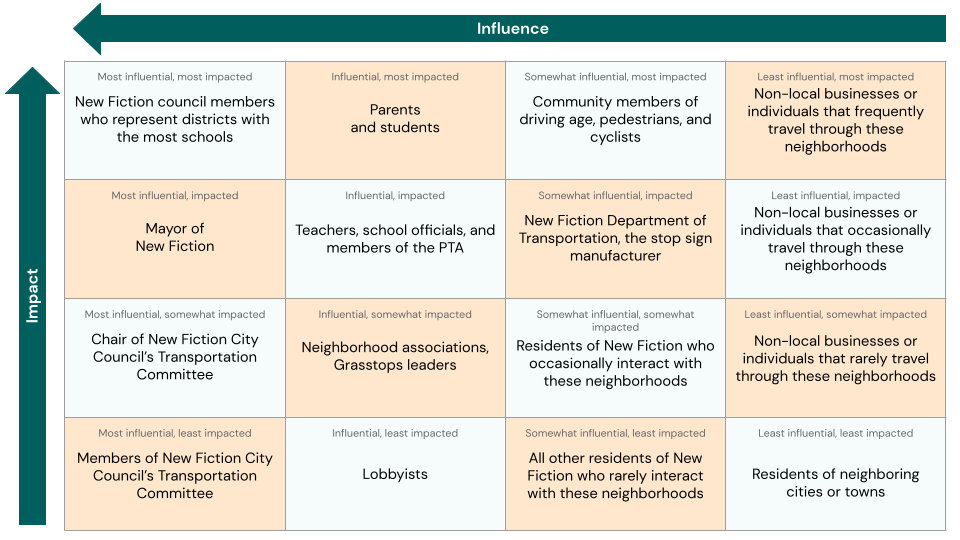
In my experience with government relations work, I’ve come across a number of ways to map out stakeholders. I’ve found it helpful to break down stakeholder groups into tiers based on level of influence and decision-making power and, further, subgroups within each tier based on the extent to which the stakeholder will be impacted by the expected outcome. This exercise illuminates two key elements that are helpful in putting together an advocacy strategy: first, the reach of a stakeholder’s potential influence on the desired goal; second, their motivation or potential motivation toward taking action to achieve the desired goal.
Example: Stakeholder Mapping in New Fiction, USA
As an example, let’s say our desired goal is to pass legislation in the town of New Fiction to increase the number of stop signs near schools.
The most influential stakeholder on this issue would likely be anyone who has a direct say or vote in determining the outcome — the chair of the city’s transportation committee, council members on the committee, and the mayor of New Fiction. Next, is who’s likely to be impacted the most — students, schools, their neighborhoods, and council members who represent districts with the most schools.
It’s at the crossroads of influence and impact that we see a fourth impacted group, council members representing districts with schools. This group has access to the most influential individuals on this issue, as well as a say in the process themselves. Therefore, they should be our most sought after and targeted stakeholder.
Want to get started on your own stakeholder mapping? Download our free, fully-customizable stakeholder mapping visualization tool today!
Before beginning the planning process, it can be useful to get a sense of the goals and priorities you share with your key stakeholders.This can be accomplished either through polling, interviews or surveys and in person meetings with one or more of your stakeholder groups. Mapping your stakeholders will likely illuminate which groups should receive more intensive engagement, such as a face-to-face meeting and ongoing communication, or a one-time survey.
The information gleaned throughout this process should guide your internal strategic planning process and help to ensure all your bases are covered regarding your stakeholder class.
Engage During
Once you have a plan in place and have mapped out your stakeholders, a communication strategy is necessary to ensure important and useful information is shared with your stakeholders. This strategy should create a two-way communication structure that will allow your organization to provide and receive pertinent updates and allow your stakeholders to deliver any feedback. Periodic check-ins, briefings, and even happy hours can be useful tools to facilitate discussion.
It’s important to remember that each group of stakeholders will require their own unique mode of communication to most effectively meet their needs and to ensure they are properly engaged in this process. For instance, stakeholders such as the community organizations that you partner with and the lobbyists you hire should probably not be on the same weekly check-in. These two entities serve separate purposes and use different approaches to achieve their desired outcomes. If there is a specific reason they should be receiving the same information, host a separate special briefing. Generally speaking, the method of engagement for each of your stakeholders should be unique in order to meet their respective needs.
Engage After
Once your strategic plan is complete, it’s time to share your findings and receive last minute stakeholder feedback before advocacy begins. Debriefs or large gatherings of your stakeholders can be a great way to disseminate this information. Holding a second round of smaller meetings with key stakeholders where you can dive into the information with a bit more detail may also be a good idea, depending on the complexity of your advocacy issues or goals.
Ongoing Stakeholder Engagement
As you and your team execute your strategic plan, remember to take advantage of opportunities to continually develop your stakeholder relationships through as many modes as possible. This includes, but is not limited to: events, check-ins, information exchanges, and feedback discussions. These interactions will provide ample opportunities for your organization to find new avenues for advocacy and deepen the bond between you and your stakeholders, which will ultimately increase trust – the secret sauce of stakeholder engagement.
Along this same line, continue to evaluate your stakeholder map as individuals and groups will evolve from year-to-year, and even month-to-month. The advocacy landscape is ever-changing and effective engagement can only be done with up-to-date information. Outdated Information leads to ill advised assessments and poor advocacy outcomes. It’s imperative to keep a close eye on the viability and accuracy of your stakeholder map along with your organization’s strategic plan.
Finally, be flexible and keep your options open. It’s best to have multiple or overlapping stakeholders with influence in key areas of your advocacy issue areas. Elected officials and their staff come and go, and stakeholder groups may shift their advocacy focus or level of involvement. Always be prepared to manage the risk of a potential gap in bandwidth and continue to cultivate relationships within your issue purview.
Ready to supercharge your stakeholder engagement? Download our free, fully-customizable stakeholder mapping visualization tool now.