Category: Issue Advocacy & Nonprofit

  • Supporting Diverse Leadership in Public Policy and Advocacy

    Supporting Diverse Leadership in Public Policy and Advocacy

    In honor of Women’s History Month, we asked our clients at Mississippi Votes and Equal Justice USA: Why does diverse leadership and representation matter in public policy and advocacy? Read on to see their responses, as well as learn more about barriers to diverse leadership and ways to support a new generation of leaders.

    In recent years, there’s been growing recognition of the importance of diverse leadership, particularly women’s leadership, in public policy and advocacy work. Women and other historically marginalized groups bring unique perspectives and experiences to the table, and their leadership can help to create more inclusive, equitable policies and programs.

    What are the benefits of women’s leadership in public policy and advocacy work?

    One of the key benefits of women’s leadership in public policy and advocacy work is that it helps to amplify the voices of underrepresented groups. Women, particularly women of color and members of the LGBTQIA+ community, have historically been excluded from positions of power and decision-making roles, and their perspectives and experiences have been overlooked in policy development. By bringing more women into leadership roles, we can ensure that a wider range of voices are heard and that policies are developed with the needs of all communities in mind.

    Research has shown that women tend to approach leadership differently than men, and these differences can be particularly beneficial in the realm of public policy and advocacy. In general, women tend to be more collaborative, inclusive, and empathetic in their leadership styles, which can help to build consensus and create more equitable policies. 

    Another important benefit of women’s leadership in public policy and advocacy work is that it can serve as a model for future generations. When girls and young women see women in positions of power, they are more likely to believe that they too can achieve their goals and make a difference in their communities, breaking down gender stereotypes and empowering young women to pursue leadership roles in a variety of fields, not just policy and advocacy.

    Barriers to Diverse Leadership

    Despite the many benefits of women’s leadership in public policy and advocacy work, there are still significant barriers that prevent women from stepping into these roles.

    One major barrier is the lack of representation of women in politics and other leadership positions. Women make up just 28% of the U.S. Congress and only 33% of state legislatures. This lack of representation can create a self-perpetuating cycle, as women may be less likely to run for office or pursue leadership roles if they do not see other women in these positions.

    Another barrier is gender bias and discrimination. Gender bias often leads to women being underestimated and undervalued, making it more difficult for them to advance into leadership roles. Women also face challenges in building professional networks and finding mentors, as many industries and organizations, particularly government and public policy, are male-dominated. Additionally, societal expectations and stereotypes about gender roles can lead to women being viewed as less assertive or decisive than their male counterparts, making it more difficult for them to assert their authority and be taken seriously as leaders.

    Empowering Women’s Leadership

    Empowering women’s leadership in public policy and advocacy is crucial for achieving gender equality and ensuring that women’s voices and perspectives are represented in decision-making processes. Here are some ways to promote and support women’s leadership in public policy and advocacy:

    1. Encourage women to pursue careers in public policy and advocacy: This can be done by promoting gender equity in education, providing mentorship and networking opportunities for women, and ensuring that workplaces have equal opportunities and are free from discrimination.
    2. Create spaces for women’s leadership: This includes establishing and supporting women-led organizations, creating opportunities for women to lead within existing organizations, and establishing quotas for women’s representation in decision-making bodies.
    3. Provide training and resources: This includes training on leadership and advocacy skills, providing access to information and resources, and creating opportunities for women to learn from experienced leaders.
    4. Amplify women’s voices: This includes promoting women’s leadership through media and public speaking opportunities, creating opportunities for women to share their stories and experiences, and ensuring that women’s voices are represented in decision-making processes.
    5. Address structural barriers: This includes addressing systemic barriers such as gender-based discrimination, unequal access to education and employment opportunities, and gender-based violence.
    6. Engage men as allies: Men can play an important role in promoting women’s leadership by being allies and advocating for gender equity and women’s rights.

    Overall, promoting women’s leadership in public policy and advocacy requires a comprehensive approach that addresses systemic barriers, promotes education and training, creates opportunities for women to lead, and engages men as allies.

  • Recapping Austin Unified Jam 2023: Solutions to Increase Civic Engagement

    Recapping Austin Unified Jam 2023: Solutions to Increase Civic Engagement

    Over the weekend, the Plural team attended Austin Unified Jam, a celebration of activist culture. Each year, Unified Jam brings together local and national voices to talk about the work they’re doing, learn from each other, and strengthen the organizer community. Read on to learn Plural team member Sophia Anwar’s takeaways from the event. Interested in learning more about Plural? Book a demo with Sophia today!

    Civic Engagement During COVID-19

    At the start of the COVID-19 pandemic in 2020, there was an outpouring of civic engagement. Americans, regardless of their demographics or socioeconomic class, were suddenly more engaged than ever. Where is that outpour of engagement today? What aspects of daily life restrict the ability of people in communities across America to engage? Prohibitively expensive childcare, long work hours, a lack of transportation, exhaustion, defeat? Unified Jam panelists brought this question to the forefront and tackled it in interesting ways throughout the event.

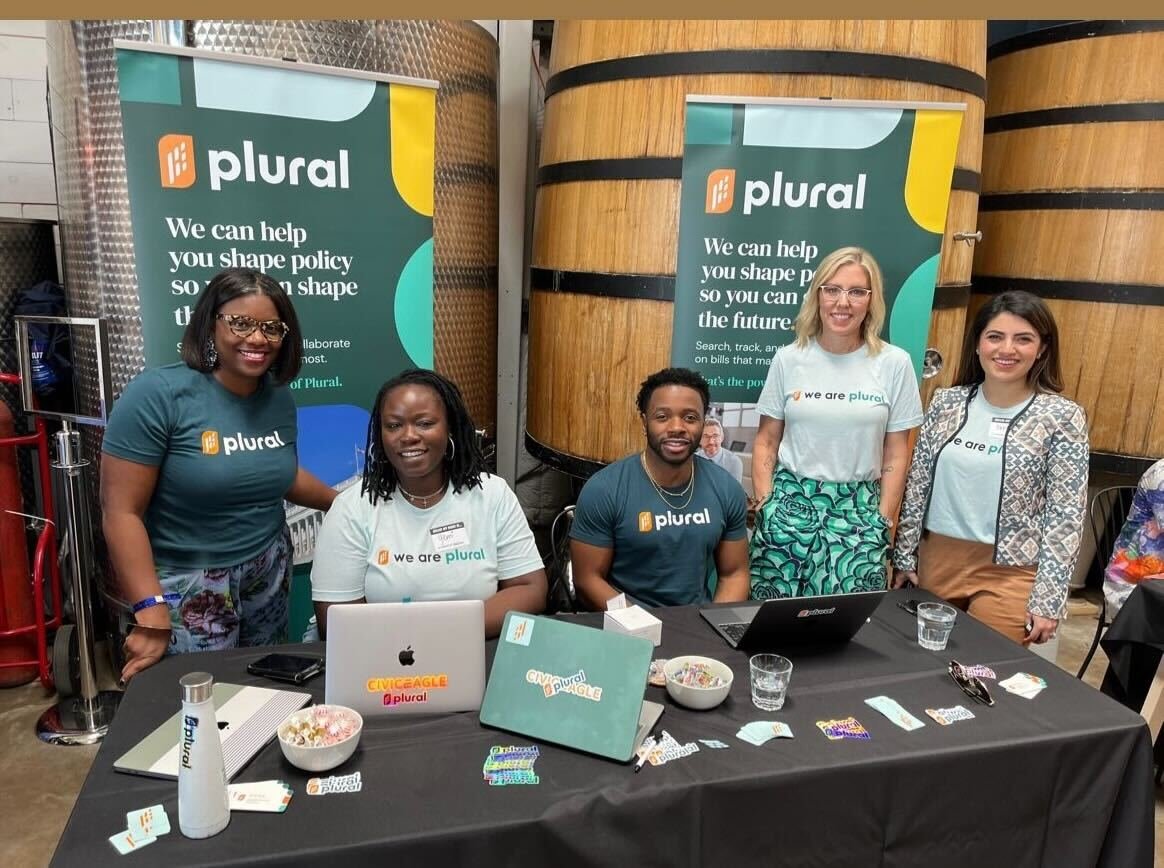
    The Plural team at Unified Jam on March 11, 2023. From left to right: Shawntera Hardy, Yemi Adewunmi, Damola Ogundipe, Carrie Fisher, and Sophia Anwar.

    The Digital Landscape of Civic Engagement

    According to the panelists, one solution to improve civic engagement is technology. The events of 2020 forced every organization and company to adapt to a virtual environment. While there was certainly a learning curve to overcome during the beginning of the virtual era, across the country, people found ways to stay connected. This connection allowed those who were previously barred from engagement to jump on a Zoom call and get started.

    The 2008 presidential campaign put digital on the map. Today, there is no civic or political engagement that occurs without a digital presence. With the plethora of social media and technology platforms, how do you build an authentic voice and utilize digital tools to reach your goals? At Plural, we recognize that tackling systemic issues or attempting to overhaul years of policy is not something that can be shouldered by one person alone. It takes a community. Community building and coalition building is a tried-and-true tactic. It’s true for our representatives in Congress as they build a majority, it’s true in our cities as we show up and represent our voting bloc, and it’s true in state houses across the country as buses pull up for lobby days with their state legislators. But community and coalition building takes time that not every organization has.

    AI as a Tool for Community Organizers

    Through the recent spur of AI technology, manual efforts to pull public data can be done in a few clicks, freeing time to strategize and work through solutions. AI can be a great tool for community organizers, allowing them to reach every member of their community all year round while also gathering timely, accurate, and accessible information, work that used to take extensive time, money, and effort.

    A New Generation of Leaders

    Another rallying cry that was voiced throughout the event was the need for authentic, diverse leaders. It’s easy to applaud the folks who are using nontraditional means to engage a wider audience, often becoming viral sensations in the process through TikTok and other social media platforms. What are we doing to support this next generation of leaders? How do we lift the voices of not just one, but many leaders who have the resources and tools to stay engaged and create change? The answer came down to leadership pipelines, supporting movement leaders, and providing tools for communities to sustain themselves.

    Key Takeaways from Unified Jam 2023

    We are a nation full of rich stories and lived experiences. Our experiences and triumphs are a part of our narrative. In the extreme polarization of today’s issues, what’s missing is the human component. We are sold stories of the other without ever knowing that the other is our neighbor. Finding connection and channeling it as our political voice will help us achieve unity. We need to listen to our storytellers, and use their gifts to cut through the noise.

    At Plural, we want to help you tell your story and help you ensure that the voices of your community are being heard at the table where decisions are being made.

    Are you ready to learn more about the power of Plural for community organizing and civic engagement?

  • Bring in More Grant Dollars With This Tech-Driven Grant Research Approach

    Bring in More Grant Dollars With This Tech-Driven Grant Research Approach

    Running a successful organization takes funding. Lots of funding. 

    Whether your organization is working to advance vital community projects, disrupt the tech industry, or establish itself as an education leader, money from grants is a critical ingredient in the recipe for success.

    To find that all-important funding, organizations spend lots of time manually searching and applying for grants. But looking through numerous websites or relying on word of mouth is inefficient and time-consuming.

    Today’s legislation tracking tools can streamline your entire search. For starters, you’ll never miss important updates, like changes to application deadlines and grant qualification criteria. You can automate reminders that will let you know when any changes occur on a bill related to a grant program you’re interested in.

    Even better, this tech-driven approach will expand your access to new opportunities and improve your overall grant win percentage. Here’s what you need to know to begin using technology to help bring in more funding.

    Make Your Grant Discovery and Management More Strategic 

    The beauty of today’s advanced technology is that if you find the right tool, it can revolutionize your plan of action for finding and securing grants with far less manual effort. 

    As you know, during each legislative session, money is allocated to existing grant programs or used to fund new grant programs. Legislative tracking software, like Plural, can help your team stay on top of grant application deadlines, enable more efficient lobbying for bills that support your agenda or mission, and even help you shape legislative language so a grant meets your organizations’ specific needs. 

    Let’s say there’s proposed legislation that will award grants to organizations like yours setting up primary care facilities in areas of need. Because you’ve set up an alert to notify your team when bills establishing relevant grant programs are in play, you’re in the enviable position of being able to lobby for the grant requirements to fit your organization.

    To qualify for this particular grant program, you have to meet the following criteria: 

    • There needs to be a documented healthcare shortage in the area of the proposed facility 
    • The proposed facility needs to be at least five miles from any existing primary care facilities
    • The facility needs to be at least 7,500 square feet

    The facility that your organization plans to build is 5,500 square feet, making it ineligible for the grant. Because you know the proposed grant program details from the get-go, you can ask the sponsor of the bill to change the requirements — from 7,500 square feet to 5,500 square feet, for example — and open up your organization’s chances of qualifying for the grant.

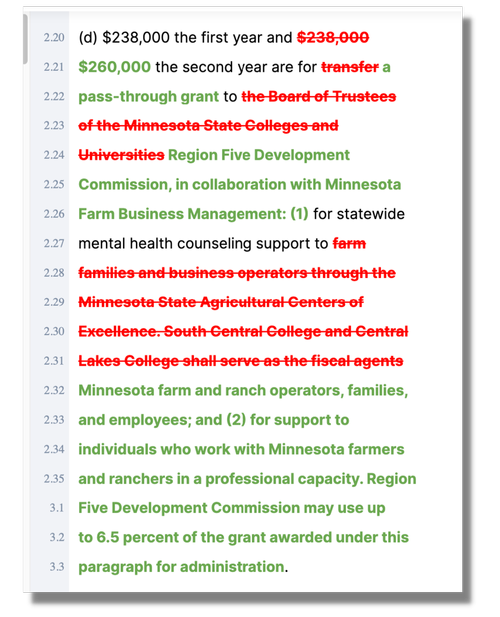
    In addition to bill monitoring, Plural allows users to take advantage of workflow and collaboration features. For example, an organization can use the interactive text feature to highlight key language and share notes on what that amended language they’d prefer to see. At the same time, interactive and real-time updates allow users to see what language has been redacted from the bill and what language has been added, so your team doesn’t waste time proposing language which has been removed. 

    Plural also has the ability to find similar bills. By seeing similar bills that either passed or didn’t, an organization can get insight into what can get their bill past the finish line. 

    Best of all, your team will be able to easily collaborate on what their conversations with legislators should look like, keep track of bill developments, and note takeaways for shaping strategy. Everything can be shared internally with chosen personnel and/or externally with partners if that’s key to your organization’s success.

    Expanding Grant Opportunities throughout the Legislative Session

    Each year, the President and most Governors release a budget proposal. From there, appropriations committees in the house and senate work on creating appropriation bills. Sometimes these bills stick close to what the Governors or President proposed, but sometimes they differ greatly. 

    At the federal and state level, following the budget process can be overwhelming. Tools like Plural grant you easy access to the information you need at every step. Early in the season, your team can use legislation tracking and automatic alerts to stay on top of any appropriations bills that may impact your organization’s grant opportunities. 

    For example, if you notice the House Appropriations bill contains funding for a grant program critical to your bottom line, but the Senate Appropriations bill does not, you’ll be able to proactively advocate for the acceptance of that House Language in conference committee. 

    Later, toward the end of the fiscal year, you can also track omnibus bills, which group many smaller appropriations bills into a single larger bill.

    Plenty of dealmaking goes on with appropriations. Advocating at the right time to your legislator can ensure bills that may have stalled earlier in session come back to life. If a bill proposing a $100,000 healthy communities grant program didn’t pass out of committee, for example, your team can lobby to have it included in the omnibus bill — and potentially reap the grant funding.

    Grant Research Tasks by the Legislative Calendar

    Here’s how you can use legislative tracking software to optimize your grant funding strategy.

    Before SessionDuring SessionEnd of SessionBetween Sessions
    Stay on top of new opportunities that may be on the agenda next session.Document interactions and conversations with legislators and legislative staff to understand when you may need to take action.Communicate progress and/or strategize for roadblocks for grant program funding with your team.Evaluate how grants were funded and which grants were failures.
    Create a wish list and strategy for talking to legislators about what you want in upcoming appropriations funding.Broaden your search and find grants where your organization meets, or comes close to meeting the criteria and plan lobbying activities.Be in the know about updates and changes so you can communicate with your team and supporters.View your funding pipeline, compare opportunity win percentage, and easily report back to your organization or supporters.
    Set up automatic alerts, so your team is notified when a new bill is proposed — or is updated.Use collaboration features, such as Workspaces, to work internally with team members and externally with partners to track bill changes, mark up bills with detailed notes, and strategize.Continue to track legislation and mark up relevant bills with proposed language favorable to getting funding.Make a list of new grants you want to keep an eye on and get updates on during the next session.

    As you can see, having an integrated platform can help your team collaborate more effectively with internal and external teams to move grant applications or funding opportunities forward. Plus, having relevant win/loss grant data in one place simplifies how stakeholders evaluate whether an organization needs more resources to win grants during the next session. 

    It’s time to modernize and automate your grant research and management process. You need a policy intelligence tool that works in today’s digital environment. With the right tools to research appropriations and grants, you can get more grant money, spend less time chasing funds, and further your impact.  

    Streamline your grant research

  • Powerful Partnerships for Justice: How your brand can take effective public policy action on social issues

    Powerful Partnerships for Justice: How your brand can take effective public policy action on social issues

    One of the biggest questions facing organizations and corporations today is how and when to get involved with prominent social issues. There’s a lot to unpack, and this can be a tricky subject for policy professionals and organizational leaders.

    Your customers and supporters are paying attention to where you stand. On issues such as voting rights, reproductive rights, climate, racial justice, and many more, there’s no such thing as a neutral position. And with more and more attention being paid to things such as corporate political donations, people will find out where you have stood in the past. We spoke with Ashley Robinson of America Votes Georgia, and the former Director and Chief of Staff of the Georgia House Democratic Caucus, among many other distinguished roles. Ashley shared with us some of her experience working with corporations and organizations on how they can make a meaningful impact in the social justice space. Here are a few of our takeaways. 

    It’s No Longer a Matter of If You Get Involved, but How

    Corporate and organizational leaders can be uncertain about engaging on hot button social issues. It may seem easier to “stay above the fray” or “just focus on our product and our customers.” Others may see engaging in activism as a distraction that would alienate consumers. While this “do no harm” approach may suffice in the very short term, more and more consumers are considering where brands stand on the issues they care about.

    It’s impossible to escape the growing demand for action on social issues. For younger generations, most notably Gen Z and millennials, where their favorite brands stand on the issues they care about is becoming a top concern. Viral videos and social posts calling out brands to speak up are not a temporary trend.

    The longer a corporation or organization stays silent on an issue that’s dominating people’s minds, the harder it can be to overcome the perception that you don’t care, or worse, are standing on the other side. It’s all the more important if your product or organization has a history of being aligned with and supported by groups with more dominant or privileged identities, or of benefitting from more marginalized groups without giving back. 

    And if you’re not taking a stand, one of your competitors certainly will.

    It’s vital to remember that consumers are real people facing real issues in their community. Responding to those issues in a meaningful way can build more trust in your brand. This is also an incredible opportunity to show you are serious about living your values.

    “Your silence is louder often, and you definitely risk your customer base, but you also risk the trust that you have developed in your customers as well. Staying at home and doing nothing doesn’t yield you anything.”

    — Ashley Robinson, America Votes Georgia

    “Customers are increasingly expecting corporations and organizations to act with social interests at heart. We want the companies we support to use their power to advance issues, whether it’s voting rights, climate, housing, or other issues affecting our lives.”

    Wintana Melekin, Plural


    It’s important to take a long view and not be reactive to a noisy but ultimately temporary negative response.

    The questions companies and organizations face are big. These are issues that can impact your company brand in a big way with bothan increasingly diverse consumer base, and also an increasingly diverse team of employees. That’s why to stay competitive, it’s vital to start having active, genuine, and even willingly vulnerable conversations about this now.

    “You may lose some customers, and you may gain some. But…I think that’s what we’re starting to see—a lot more companies that aren’t afraid to do so.”

    — Ashley Robinson

    The Key is Engaging Effectively

    Consider what issues are particularly relevant to your business or organization. Think deeply about where you may have room to put meaningful public policy action behind your support. Then talk to organizations doing work in that space. Have conversations, even if there isn’t 100% alignment on all areas of the topic, you are building a relationship with people who are experts in the topic and in the activism surrounding the issue. 

    Consumers and supporters expect that when a corporation or organization supports a social cause, they will do so in a meaningful and effective way. People will see through performative actions that make no real impact. Statements posted on social media are not enough. This is why relationship building with those who have hands-on experience is critical.

    This work will involve frank conversations with activists, employees, and in some cases shareholders. Activist groups may demand far more than you’re able or willing to provide. But that’s okay — your goal is finding a place to begin.

    However you end up engaging on an issue, actions are vital. Showing up in the community speaks volumes, and there’s always a way to engage. The benefits of doing so will pay dividends over time, and is worth the investment it requires to begin. 

    Effective action also requires thoughtful messaging to your consumers or supporters. Some consumers may resist while others rejoice. Remember, this is a process. It will take effort, but the time to start is now.

    “There is something you can do that aligns with your mission and values, no matter what industry you’re in. “If you’re making shoes, there are communities of young people who need more athletic shoes, or they may need support for their teams. We can figure out a way to insert ourselves into the community.”

    — Ashley Robinson

    Learn More

    Hear from The Pros

    Want to know more about how organizations are building coalitions in a hybrid environment? Check out our webinar on “Building Coalitions that Work”.

    Did you know….

    Plural is policy tracking built with collaboration and coalition-building in its DNA?

  • Building Winning Coalitions In A Hybrid World

    Building Winning Coalitions In A Hybrid World

    Building coalitions has long been a key strategy in the policy space, and while the pandemic has added new obstacles to overcome, it has also spurred innovation. And with hot-button legislation moving across the country, it’s never been more important for allied groups to work together. 

    Unlocking Collaboration 

    A winning coalition doesn’t come together by accident — it requires intention, planning, coordination, and excellent communication. 

    “Building coalitions is about connecting with people,” says Grace Waltz of the Minneapolis Regional Chamber. “That is still the case during the pandemic, we just do more of it through a screen.”

    Some coalitions are temporary, but most issues are won through persistence. Building a coalition that can endure and achieve big wins means investing time and energy in people-centric strategies: 

    • Outreach and relationship-building. One-to-one meetings are crucial, whether virtual or in-person. Finding the right partners means talking to those impacted by the issue, those working in the same space, and key decision makers.
    • Turning alignment into action. That means bringing together key people from each organization to develop and execute plans that draw on their unique expertise.

    Organizer and Plural Customer Success Manager, Wintana Melekin suggests asking yourself these questions to help plan and manage effective coalitions:

    1. What steps can we take to establish and maintain trust across the coalition? Partner groups need to establish common goals, and work collaboratively and transparently. Knowledge-sharing and ensuring security are also crucial to any coalition.
    2. What expertise can we leverage across coalition partners? Each group brings a unique skillset to the table, whether that expertise is geographic, subject matter, or pre-existing relationships.
    3. What tools and actions will help us to coordinate our efforts? With the many moving pieces in a coalition, it is vital to track who is doing what, and what progress is being made. Keeping everyone on the same page and preventing duplication of effort avoids lost time and resources.
    4. How can we build a sense of community in a hybrid virtual/in-person environment? Bringing partners and allies together in shared spaces is crucial to effective partnership, whether it happens virtually, in person, or both. 

    New Technology Improves Collaboration

    The last two years have seen a rapid increase in the demand for tools that allow activists and organizers to get involved from anywhere, at any time. This presents a huge opportunity to mobilize around various issues, and can eliminate some of the barriers to access. 

    Julia Freeman, Director of Community Engagement at the Voices For Racial Justice reflects, “Initially, a lot of us were not familiar with all the different ways of engaging collaboratively online. So we had to figure out what works best for us, including the security. Ensuring safety is especially important when you’re dealing with BIPOC communities.”

    Having a secure, well designed digital environment for collaboration makes it possible for more people to participate. Encouraging collaboration to happen safely and securely between meetings helps coalition organizers build community engagement and broaden who can be involved since interactions can happen from anywhere and conversations can be asynchronous.

    Learn More

    Hear from The Pros

    Want to know more about how organizations are building coalitions in a hybrid environment? Check out our webinar on “Building Coalitions that Work”.

    Did you know….

    Plural is policy tracking built with collaboration and coalition-building in its DNA?

  • 5 Steps to Make Sure Your Stakeholders Get Out the Vote

    5 Steps to Make Sure Your Stakeholders Get Out the Vote

    Whether you’re part of a corporation or a nonprofit, chances are your employees are going to be affected by what happens in the election this November. With misinformation spreading rapidly and confusing processes on how to vote safely during a pandemic, it has become more difficult than ever to know how to properly get the vote out. 

    At our recent Getting Out The Vote webinar with Fair Fight and BallotReady, we discussed five steps organizations can take to make sure their stakeholders, from employees to clients to constituents, get out the vote:

    1. Encourage people to make a vote plan

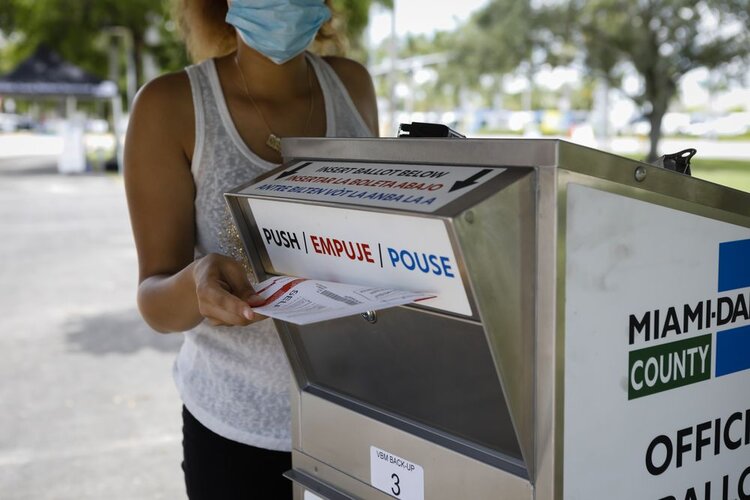
    It can be overwhelming for voters to navigate all the information about how to vote. But it’s best to have a plan. Share links to websites about your state’s early voting dates, mail-in voting drop box locations, and polling places so that your stakeholders know exactly where to go and when. Be sure to send this information as early as possible, so they have time to make plans to vote.

    Here is a list of resources to help you navigate.

    2. Communicate clearly what is at stake

    As more Americans realize just how important their vote is, some political operatives are making efforts to suppress the vote for certain demographics and regions. This suppression can come in the form of provisional ballots in different counties, purging voters due to signatures “not being an exact match,” requiring fines to be paid before being able to vote, asking for a witness to sign an absentee ballot, and much more. Yet this is exactly why it’s more important than ever to increase voter turnout and help eliminate voter suppression in the future.

    3. Be thoughtful about your voice

    Voter protection is not a partisan issue. Regardless of political affiliations, every American should have the right to vote and should be able to submit their ballot easily and quickly. Be sure to communicate this when encouraging stakeholders to get out the vote. 

    4. Engage with your audience consistently

    Attention spans are shorter than ever before, and with the overwhelming amount of information flooding social media, it’s key that you consistently communicate and engage with your audience. Send weekly emails or newsletters to your stakeholders, informing them of what’s happening regarding voting in your area, and consistently share election dates and information to keep it all top of mind. More of your audience will appreciate this information than you might think, and will also keep you top of mind.

    5. Leverage partners to amplify your voice

    There are plenty of amazing nonprofits out there who can help you in your mission to inform voters and get out the vote. BallotReady makes it easy for voters to understand every candidate and referendum on their local ballot and to cast informed votes all the way down the ticket. Fair Fight is a quickly growing organization that advocates for the right to vote and aims to combat voter suppression nationally. Each of these organizations offers stakeholders easy ways to stay informed and know what signs to look out for to prevent voter suppression.

    At Plural, we designed a toolkit for advocacy organizations to make it easier to innovate their stakeholder or audience engagement workflow. By following our guide and using its templates, you and your team will have a comprehensive plan for achieving your advocacy goals through growing an audience of engaged and informed stakeholders.

    Download our Advocacy Toolkit today:
    https://learn.civiceagle.com/toolkit 

  • The Next Wave of COVID-19 Relief Legislation and What It Means for Nonprofits

    The Next Wave of COVID-19 Relief Legislation and What It Means for Nonprofits

    As the Senate adjourned in August amidst massive gridlock surrounding the second COVID-19 federal relief bill, many Americans were left asking how they will be affected once a second stimulus bill eventually gets passed. Nonprofits in particular have been some of the hardest hit by the pandemic, as unemployment rates continue to skyrocket and families earn less money for charitable giving. In the first quarter of 2020 alone, nonprofit donations already declined by 6%

    The second wave of COVID-19 relief has largely become a battle between one Democratic-backed bill, titled the Health and Economic Recovery Omnibus Emergency Solutions Act (HEROES Act), and the Republican-backed bill, called the Help, Economic Assistance, Liability Protection and Schools (HEALS) Act. While each bill has differences, there are new portions that will benefit nonprofits if passed in the next legislative session.

    So how will the government extend help to the nonprofit industry, which is facing up to $25 billion in revenue losses in 2020? We took a deep dive into what has been discussed for the potential second stimulus bill, and three ways nonprofits may benefit: 

    1. Second Round of PPP Loans: The first relief bill which was passed in March, titled the CARES Act, unfortunately shut out a large portion of the nonprofit sector from accessing a grant under the Paycheck Protection Program (PPP). The new HEROES Act aims to fix this by extending PPP eligibility to all 501(c) nonprofits, not just 501(c)(3) and 501(c)(19) veterans organizations. Additionally, the new bill lifts the cap of 500 employees so that nonprofits of all sizes can apply for relief, and also eliminates the requirement that 75 percent of the loan through the CARES Act cover payroll expenses. These measures will ensure that a much larger number of nonprofits across the country can apply for desperately needed aid for a variety of purposes beyond payroll. 
    2. Loan Qualification & Forgiveness: The Main Street Lending Program will provide low-interest loans to nonprofits with a minimum of 10 employees through December 31, 2020. The HEROES Act aims to ensure that nonprofit organizations in economic danger can qualify for a loan and eliminates the minimum loan size. This portion of the bill will also allow nonprofits serving low-income communities to defer payments and earn loan forgiveness. The HEROES Act also hopes to incorporate a $60 billion long-term recovery loan program that targets nonprofits, low-income communities and minority-owned businesses.
    3. Liability Shield for Nonprofits: A major point of contention amongst the Democrats and the Republicans is the SAFE TO WORK Act, which aims to protect a wide variety of entities from coronavirus-related liability. These protections are designed to protect business owners unless they engage in gross negligence or consciously engage in reckless disregard for the safety of their customers and employees. Republicans argue that this will provide extra protections for businesses and nonprofits who are already struggling economically, while Democrats argue that it would allow organizations to put employees in danger with no legal consequences. It still remains to be seen whether this portion of the bill will pass or not.

    While the Senate adjourns through Labor Day without reaching a stimulus deal – and we very likely will continue to see a debate between Republicans and Democrats on the path forward – it is key for organizations to keep track of the bills that will impact them or their constituents. This legislation could affect almost every American, as well as nonprofits, advocacy organizations, employers, states and municipalities. If you have a stake in the outcome, now is the time to track what matters most and work to advocate for your members.

  • 5 things your team can do to adjust to remote advocacy

    5 things your team can do to adjust to remote advocacy

    COVID-19 has impacted the way advocacy organizations are operating. We spoke with the Executive Director of Minnesota Voice, Wintana Melekin, about how she and her statewide nonprofit are adjusting to the new normal in her industry and adapting to operating remotely. Here are 5 tips for continuing to push your organization forward while working from home.

    No. 1— Continue to leverage your ecosystem and network of partners to keep your programs and projects operating.

    “Relationships don’t stop just because [of social distancing.]”

    — Wintana Melekin; Executive Director, Minnesota Voice

    Before coronavirus, Melekin and Minnesota Voice had set a goal to register 72,000 voters in Minnesota in time for the 2020 Elections in November. In order to keep on track of reaching its goals, Melekin is focused on maintaining the relationships within her ecosystem and partnering with groups where she can. For example, she’s leaning into her network by collaborating with the Secretary of State (MN) on a project to set up online voter registration.

    No. 2— Build a process for remote work for your organization.

    Be careful to assume that your in-person experiences can be simply replicated virtually. You want to recreate a sense of community and team comradery, but accept that there will need to be some adjustments made to your organization’s processes. You can start my researching recommendations and advice from teams that already operate a “remote-first” team culture. Many tech companies have shared blog posts and other content that can help you build your own process for your team. Plural shares their tips here on this blog. 

    No. 3— Gain buy-in from your team about the new process 

    This change will be new to everyone in different ways, but transparency is key. Help your team understand what the game plan is and what they can expect in the transition to remote work. Your team wants to know: what’s changed and what’s staying the same?

    No. 4— Leverage technology to help you operate.

    It’s a good thing that over the past several years new technology has emerged to help organizations conduct business digitally. Many of these software solutions may typically be popular among private sector companies but they can certainly provide value for public sector organizations. Tip: A lot of technology providers  offer discounts on their software for nonprofit organizations – email or call them to see if you can get better pricing or extensions on free trials.

    No. 5— Don’t forget to have fun.

    Now more than ever, your team may need one another for support, encouragement or just to take their mind off of things. Remember to check-in with your team at the beginning of calls, on a personal level. Before coronavirus, those water cooler conversations, coffee breaks and team happy hours were opportunities for teams to connect. Try to reimagine these social experiences digitally — virtual happy hours and cocktail classes; book clubs; movie nights; mid-day coffee breaks. 

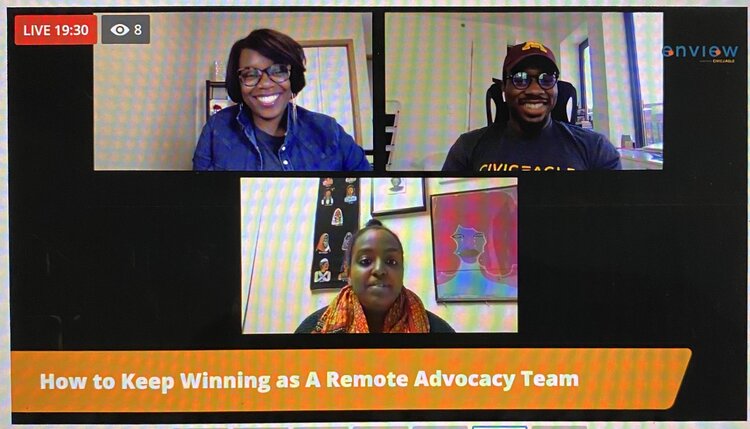
    These tips, and many more insights about remote advocacy, were shared during our webinar How to Keep Winning as a Remote Advocacy Team. You can catch the replay here: https://learn.civiceagle.com/win


    Keep track of changes to bills, your notes, files, conversations, and more.