
Category: Issue Advocacy & Nonprofit

  • What the One Big Beautiful Bill Means for: Labor & Workforce

    What the One Big Beautiful Bill Means for: Labor & Workforce

    On July 4th, President Trump signed H.R. 1, the One Big Beautiful Bill Act, into law. The 330-page act contains provisions that will reshape nearly every sector of the American economy and society. The rushed passage and sweeping scope of H.R. 1 have left many wondering:

    What’s actually in the bill and how will it affect me?


    At Plural, this opacity strikes directly against our mission. From our open data to our AI bill summarizer trained specifically on legislative text, we strongly believe in the power of technology to unlock legislative insights for policy professionals, activists, and citizens alike. With this mission in mind, we are producing a series of One Big Beautiful Bill explainers. Within each explainer, we will dive into the megabill’s impact in a specific subject area with a text-first approach that pulls impacts directly from the bill. This week we take a look at how the new law will impact American healthcare.

    We help you shape policy together,
    so you can shape the future.

    That’s the power of Plural.

    It starts with providing the most complete information about the policies that impact us.

    It takes extreme effort and vigilance just to track policy—much less to create a positive impact. If you can’t react fast or fully engage your team, laws will pass without you.

    The teams that forge the policies of tomorrow will use the latest technology to empower many voices. Plural exists to make policy creation more transparent, responsive, and inclusive. And to make full participation possible.

    We are leaders, thinkers, innovators,
    public policy wonks, and technologists.

    We are also constituents, neighbors, advocates, disruptors, and our vision is to make full participation possible.

    Our Mission

    The Power of Plural

    We help you shape policy together, so you can shape the future. It starts with providing the most complete information about the policies that impact us.

    The policymaking process is opaque, hard to access, and difficult to influence alone.

    It takes extreme effort and vigilance just to track policy—much less to create a positive impact. If you can’t react fast or fully engage your team, laws will pass without you.

    The teams that forge the policies of tomorrow will use the latest technology to empower many voices. Plural exists to make policy creation more transparent, responsive, and inclusive. And to make full participation possible.

    Created for policy wonks, by policy wonks.

    We are leaders, thinkers, innovators, public policy wonks, and technologists. We are also constituents,
    neighbors, advocates, disruptors, and our vision is to bring visibility into the policy process
    and improve the means to participate in democracy. At Plural, we’re proud to provide intuitive,
    effective solutions for mission-oriented organizations to help them meet their goals.


    Join Our Team

    Machine Learning Engineer (remote)


    Our Values

    People First

    First and foremost, we’re dedicated to our users. We take a user-centric approach to building our products, and we’re proud of our connections with our customers who use our product to do important work every day.

    Transparent

    We value trust and transparency. We want to cut the dishonesty and mistrust out of public policy, and we believe that democracy work best when information is accessible and honest.

    Audacious

    Speaking of honesty, let’s keep it real. What we’re building at Plural is bold. Our vision is audacious, and we’re passionate about taking on this challenge. We’re also passionate about innovation, good design, and making a difference.

    Ready to Amplify Your Policy Impact?

    Experience the power of Plural first-hand with a free account or schedule a demo for a live walk through of our tools. Find out how Plural can transform the way you and your team shape policy.

    Economic and labor policy is constantly at the forefront of political campaigns in the United States in part because a significant number of Americans consistently rank the economy as the nation’s “most important problem.”

    At the Federal level, we can find many recent examples of labor policy campaign promises that were delivered on as well as those that weren’t. Each of President Biden’s four major bills — the American Rescue Plan, the Bipartisan Infrastructure Law, the CHIPS and Science Act, and the Inflation Reduction Act — delivered on investments in labor he touted during the 2020 campaign. 

    Conversely, each of the past three Presidents (and plenty of members of Congress) have pledged to raise the federal minimum wage but every effort in the past fifteen years has failed. 

    Throughout the 2024 campaign, President Trump focused on economic messaging and won a sizable share of votes from union households, for a Republican candidate. Trump and Congressional Republicans know they must ask voters to retain their Congressional majorities in 2026 based, in part, on their progress on these very issues. 

    Therefore it’s unsurprising that Republicans have returned to campaign-style messaging in touting H.R. 1 as a “pro-worker” bill. To best understand how H.R. 1 will impact the American workforce, we take a look at some of the most significant labor provisions from the bill below. 

    No Tax on Tips

    Heavily touted within President Trump’s 2024 stump speech was the proposal to end the federal taxation of tips. Section 70201 of the newly passed legislation eliminates federal income taxes on up to $25,000 in tipped income for qualified workers earning less than $150,000 annually (those earning more receive an exemption on a smaller amount of tips). 

    While “no tax on tips” sounds simple enough (and makes for a compelling campaign proposal), the details in practice are more complex. The new law only applies to federal income tax and workers will still pay Medicare, Social Security, and state taxes related to this income. 

    Further, the administration still needs to define the occupations regularly receiving tips that will qualify for this deduction. 

    Finally, unlike other tax cuts within H.R. 1, section 70201 is not permanent and will expire after four years. 

    No Tax on Overtime Pay

    Coupled with “no tax on tips” in the 2024 campaign was President Trump’s proposal to eliminate federal taxes on overtime pay. Section 70202 of H.R. 1 allows qualifying taxpayers to deduct up to $12,500 in overtime pay from their income subject to federal income tax. Overtime income will still be subject to state income taxes as well as Medicare and Social Security taxes. 

    Notably, the portion of overtime pay eligible for this deduction is only the “premium” that employers are required to pay for overtime under the Fair Labor Standards Act (FLSA). If a worker makes $10 per hour and is eligible for overtime, the FLSA requires their employer to pay them $15 per hour for all hours worked over 40 in a week ($10 base pay plus a $5 premium). In this example, only the $5 per hour premium overtime pay could be deducted under H.R. 1’s new allowances. Overtime pay provided for reasons besides the FLSA requirements (like more stringent state requirements or a collective bargaining agreement) would not qualify for this deduction. 

    Other Tax Changes Impacting Employee Benefits

    Beyond changes to taxes on tips and overtime pay, H.R. 1 makes a few other notable changes that employees could factor into their taxes:

    • Section 70404 expands the maximum contribution into a Dependent Care Assistance Program flexible savings account from $2,500 to $3,750 for an individual. Allowing workers with a DCAP benefit to exclude more dependent care expenses from their taxes. 
    • H.R. 1 also makes permanent an existing tax credit allowing employers to make up to $5,250 in student loan payments on behalf of employees without an impact to an employee’s income subject to taxation. 

    Pell Grants for Workforce Training

    Section 83002 of the new law enacts the “Workforce Pell Grant Program,” which will make Pell Grants available to individuals participating in short-term (between eight and fifteen week) job training programs. Like those changes described above, many of the details of this new program will need to be sorted out in forthcoming rulemaking. 

    Existing workforce training programs, community colleges, and individuals looking to make a career change or earn an additional accredited degree will certainly be following rulemaking this fall to see what programs may qualify for this new federal assistance. 

    Changes to “Safety Net” Programs

    It is important to note that the expected benefits to workers described above are dwarfed (in size of spending) by the cuts to federal “safety net” programs like SNAP, Medicaid, and CHIP, as shown in the chart prepared by the Center for American Progress below. 

    Advocates on the left have pointed to this disparity in their arguments that the benefits to workers touted by the Administration are far outweighed by the negative impacts on low-income workers relying on government programs for assistance. 

    H.R. 1 implements work requirements for Medicaid that are expected to put more than 10 million Americans at risk of losing Medicaid coverage. Despite this massive impact on Medicaid enrollees, the Congressional Budget Office has indicated that this change is only expected to have a marginally positive impact on the size of the labor force. 

    Conclusion

    While the 2024 Presidential Campaign was unprecedented for a number of reasons, both candidates did follow the established playbook of focusing their policy priorities on jobs and the economy. With H.R. 1, President Trump and Congressional Republicans had their first and best chance to enact policy changes they campaigned on, including those they touted as “pro-worker.” 

    While campaign promises can be impactful, they lack the detail of enacted policy. And the details of “no tax on tips” and “no tax on overtime” as implemented by H.R. 1 may leave some workers confused by the limitations of the policies as enacted. Additionally, these temporary tax breaks for certain workers are due to expire just as the most significant cuts to social safety net programs are expected to come into effect and negatively impact low-income Americans. 

    As the details of these new policies are defined through rulemaking and as workers begin to feel their impact we should have a better sense of the degree to which voters feel the Administration has delivered on its promise to be “pro-worker.”

    Ready to see what your team is missing?

    Plural Legislative Intelligence powered by SAI360 gives government affairs teams real-time visibility into state and federal legislative activity — with AI-powered bill analysis, viability signals, and stakeholder engagement workflows built in. 

    And it’s the only platform that combines with integrated compliance workflow. Learn more by scheduling a live walkthrough.


  • Offensive vs. Defensive Policy Work: A Strategic Guide for Effective Advocacy

    Offensive vs. Defensive Policy Work: A Strategic Guide for Effective Advocacy

    How Policy Teams Can Balance Proactive and Reactive Strategies to Influence Public Policy

    Public policy work is often seen as reactive—responding to government proposals as they arise. While this “defensive” approach is crucial, it’s only part of the picture. Effective advocacy also requires an “offensive” or proactive strategy. Many policy professionals find themselves spending most of their time on defense, but balancing both approaches is key to long-term success.

    Though they may seem distinct, offensive and defensive policy work are interconnected. Advocates must navigate both, adapting their strategy to the political landscape and policy priorities.

    Defensive Policy Work

    Defensive advocacy involves identifying and responding to proposals that threaten the interests you support. For example, reproductive rights advocates may work against policies restricting access to care, while industry groups lobby against regulations that could harm their sector.

    Despite its reactive nature, defensive policy work starts long before a harmful proposal emerges. A strong defense begins with a deep understanding of your cause and potential threats. The broader and more complex your company or organization, the more challenging this becomes. A healthcare policy team, for instance, must grasp the intricacies of operations, finances, and regulations to respond effectively to policy threats connected to insurance, labor, or public health.

    Once you understand what you need to protect, the next step is setting up systems to detect potential threats. Your approach will depend on:

    • Geographic Scope – National organizations must track policies across the country, while state-based groups can focus on regional issues.
    • Policy Type – Some teams monitor legislation exclusively, while others track rulemaking by state or federal agencies.
    • Level of Government – Most teams monitor federal, state, and local policies but focus on the levels where they have the most influence.

    Political intelligence tools like Plural enhance defensive strategies by automatically flagging potential threats and providing AI-powered analysis of legislation. This allows policy teams to quickly assess and respond to proposals.

    The heart of defensive advocacy is action. When a threat arises, organizations must effectively communicate the policy’s impact and advocate for a solution—whether that means stopping a bill or negotiating a compromise. If successful, they can work to prevent similar threats in the future. If not, they must focus on mitigating the impact of the policy.

    Since legislative threats are ongoing, policy teams must scale their responses based on severity and have a well-defined strategy to react quickly and effectively.

    A strong defense begins with a deep understanding of your cause and potential threats.

    Offensive Policy Work

    While defensive policy work is reactive, offensive advocacy is proactive—shaping policies that align with an organization’s goals.

    Offensive policy work starts with preparation. Policy teams collaborate with stakeholders to identify regulatory challenges and opportunities. For example, a healthcare advocacy team might push for Medicaid rate increases to expand access to care or advocate for changes to regulations that create unnecessary barriers for providers and patients.

    Because time and political capital are limited, teams must prioritize their offensive efforts. Many organizations set annual goals for proactive policy work, guided by strong internal and external relationships.

    Once a policy initiative is identified, teams must build coalitions and mobilize support inside and outside the legislature. This work requires strategic planning, public engagement, and a deep understanding of legislative and regulatory processes. While a bill may be introduced and debated over a few months, the groundwork—such as stakeholder engagement and advocacy planning—often takes years.

    Conclusion

    Balancing offensive and defensive advocacy is essential for effective public policy work. Defensive strategies help teams respond quickly to harmful proposals, while offensive efforts allow them to shape the policy landscape. Managing both, however, can be overwhelming, given the volume of legislative activity across different levels of government.

    Tools like Plural help policy teams stay ahead by providing real-time alerts and AI-powered legislative analysis. By automating parts of the discovery and analysis process, Plural allows teams to focus on strategy, coalition-building, and direct engagement with policymakers. With the right tools and strategies in place, policy professionals can maintain a strong, balanced advocacy approach in an ever-changing political environment.

    Explore Plural.

    Plural Bill Tracking & Intelligence stands out for its deep policy coverage, real-time alerts, powerful AI-powered insights, and seamless collaboration features. It is designed for policy professionals, businesses, and advocacy groups that need an all-in-one solution to stay ahead of policy changes.

    Whether you’re tracking state or federal legislation affecting your industry, monitoring policy developments, or engaging in advocacy efforts, Plural offers the reliability and intelligence needed to make informed decisions.

    Try Plural today and transform the way you track and respond to public policy!

  • Developing Your Policy Knowledge Without A Policy Background

    Developing Your Policy Knowledge Without A Policy Background

    Enabling and empowering citizen input at all levels of government is key to the success of democracies. 

    At state and local levels, where legislators are often laypeople without significant research staff, policymakers rely on public input to shape their understanding of the proposals before them. Robust public participation in the legislative process also creates a positive feedback loop – citizens who feel their perspective is valued and impactful will be more apt to engage in the future. 

    Despite the need for public participation to support good public policy processes, complex policy topics, legislative jargon, and obscure procedural rules can discourage engagement. This results in legislators receiving unbalanced perspectives and individuals feeling left out of decisions that impact their lives. 

    Solving this dilemma is central to Plural’s mission to improve policy by increasing accessibility to the processes that shape it. Whether your perspective is shaped by lived experience, your education, or your profession, we know that perspective is a valuable component of a healthy democracy. 

    Below we break down a few key steps to begin to develop your comfort and knowledge within the policymaking sphere at the state legislative level, so that you can bring your expertise into it. 

    Mastering the Basics of Public Policy

    From insurance regulations to public benefits to criminal law, policymakers cover a wide array of topics in their work. But beyond the complexities specific to these domains, it can be a challenge for advocates in related industries or for concerned citizens to know how to even begin to follow the policy developments that matter to them. 

    In short, we recommend diving right into the policy process, but doing so with the resources and tools that will keep you from being overwhelmed. 

    The state legislative level is a great place to start your public policy journey as it balances a wide scope, impact, and data availability with the approachable feel of a local unit of government. 

    Most state legislatures hold legislative sessions annually at their state capitol building where they meet regularly for at least a few months to consider and pass new proposals to change state law. The exact schedule for when a legislature is in session varies significantly by state (see 2025 dates here) but most states begin their session in January and wrap up their work sometime between March and July. 

    Bills are the main instrument that legislators at the state level use to change state law. Every state legislature makes their bills available to find and review online, although most of these websites are fairly dated and not incredibly user-friendly.

    A tool like Plural can serve as a more intuitive place to find all of the information on the legislation you care about, across states. 

    Bills are generally structured to show the changes they propose to make to existing law (often called state statute). This is generally reflected by proposed additions to existing law being underlined and proposed deletions from existing law being struck through. In Plural, we show these changes in green and red text, respectively. To read a bill, you will want to examine the additions and deletions within the context of the existing state statute. This will help you understand how the author of the bill is suggesting to change public policy.

    View of legislation on Maine state legislative website
    View of legislation on Plural Bill Tracking & Intelligence

    Digesting this unique formatting can take some getting used to, and we advise that practice makes perfect. 

    Fortunately many states make summaries available, and Plural provides the option to generate an AI bill summary so that you can check your reading of the bill against what we are seeing. 

    Bill pages will also detail the “activity” of the bill, displaying its path through the public policy process. Analyzing the activity of past session’s legislation can help you identify the pathways that bills generally take on their way to becoming law. For bills in a current session, monitoring the activity will be your best way to stay updated on where the bill is in its process, and what may happen next. 

    Navigating through bills and their associated actions is a great way to build your policy knowledge. While it may be a cumbersome process at first, you will find that these intimidatingly formatted policy documents are not that hard to decipher after all. 

    Finding Your Area(s) of Expertise

    Policy enacted by our state legislatures has the potential to impact many areas of our lives. Whether you are developing your policy knowledge for personal or professional purposes, it can be best to start with the knowledge you already have. After all, your lived experience or professional expertise may very well mean that you have more existing knowledge to bring to a policy conversation than some of the legislators themselves.

    Once you have identified your focus, you can use a tool like Plural to search for proposals from past or current legislative sessions within that topic. If you’re focussed on something specific, like preventing book bans, a search for related keywords can surface what you’re looking for. 

    Searching for legislation related to “book banning” in Plural Bill Tracking & Intelligence

    If your advocacy area is more general, a good place to start is by reviewing your legislature’s committee structure. 

    Committees are where a small group of legislators will work on bills related to a few similar subject areas. The Commerce and Labor committee, for example, will be one of the first stops for all legislation directly impacting businesses and their workers. 

    Reviewing the work of a committee will give you a place to begin the exploration of what types of proposals they are considering. Additionally, the committee stage of the legislative process is generally the most accessible for public input, so you will be familiarizing yourself with the members you may soon share your perspective with.

    Viewing legislative committee information in Plural Bill Tracking & Intelligence

    Plural’s AI-assigned bill topics also neatly categorize bills by subject area, making it easier for you to discover what is happening in your field. 

    Bill search results in Plural Bill Tracking & Intelligence

    Putting This Knowledge Into Action

    There are a number of ways in which you can engage with the public policy process as you develop your policy knowledge. State legislative work represents a great place to start because the scope of the work done by state legislators is sufficiently broad, but they are generally more accessible than members of Congress. 

    One of the easiest ways to get involved is to connect with a legislator (either your representative or a sponsor of a bill you particularly support) and to have a conversation. Legislators are expected to use and value public input, and are often happy to have a conversation about what they’re working on. Advocacy groups that align with your position or are focused on your causes can be another great place to find like minds and suggested action steps. 

    Most bills will go through a public hearing process at the committee stage and testifying at a public hearing is one of the most common and impactful ways you can ensure your voice is heard. While it may sound intimidating, speaking before a committee in support or opposition to a bill provides you with a direct line to the decision makers.

    Conclusion

    If you spend time in the policymaking field, you’ll hear from lawmakers and advocates alike that they got their start in policy because a specific issue that impacted them spurred them towards action. We believe that lowering the barrier to entry into this field can positively impact our democracy and build better outcomes. By providing the tools needed for this work through Plural, we aim to empower a community of advocates and citizens to ensure their voices are heard.

  • Why Lobby as a 501(c)(3) Nonprofit?

    Why Lobby as a 501(c)(3) Nonprofit?

    The nonprofit sector has a clear stake in the legislative process. From poverty to climate change to racial injustice, nonprofits work at the frontlines of the biggest problems we face today.

    Nonprofits have reason to care about policies that could improve or worsen the issues affecting their communities. But what room do nonprofits have to influence legislation? Can’t you lose your tax-exempt status advocating for specific issues? 

    The answer is more complex than a simple yes or no.

    Let’s Talk Definitions

    A 501(c)(3) is a type of nonprofit organization, or public charity, that is exempt from paying federal income tax. Not all nonprofits have 501(c)(3) status. For example, labor unions, chambers of commerce, and higher learning institutions all qualify as nonprofits, although they technically have a different tax status. 

    In order to maintain their tax-exempt status, nonprofits have to adhere to certain rules and restrictions. One such restriction is that a nonprofit may not qualify for 501(c)(3) status “if a substantial part of its activities is attempting to influence legislation…”

    What does it mean to influence legislation? Thankfully, the IRS offers guidance:

    Legislation includes action by Congress, any state legislature, any local council, or similar governing body, with respect to acts, bills, resolutions, or similar items (such as legislative confirmation of appointive office), or by the public in referendum, ballot initiative, constitutional amendment, or similar procedure. It does not include actions by executive, judicial, or administrative bodies.

    An organization will be regarded as attempting to influence legislation if it contacts, or urges the public to contact, members or employees of a legislative body for the purpose of proposing, supporting, or opposing legislation, or if the organization advocates the adoption or rejection of legislation.

    Under this rule, these activities DO count as lobbying: 

    • Tracking legislation with the express purpose of influencing legislation
    • Urging your supporters to email lawmakers in support of a proposed bill
    • Asking the city council to oppose adding a referendum to the ballot
    • Voicing support for the appointment of a particular agency leader

    These activities DO NOT count as lobbying:

    • Tracking legislation to understand how proposed changes could impact your work
    • Meeting with a lawmaker to educate them about your work generally
    • Meeting with agency staff to share feedback on an RFP or publicly funded program
    • Filing a lawsuit in order to bring a controversial issue before an appellate court

    For more detail about what activities qualify as “influencing legislation,” see Internal Revenue Code Subtitle D, Chapter 41, here.

    How Much Lobbying is Too Much Lobbying?

    To qualify for tax-exemption, 501(c)(3) nonprofits can only engage in lobbying up to an extent. There are two key tests for determining whether or not a nonprofit has crossed that line. 

    1) Substantial Part Test

    This test assesses whether an organization’s lobbying efforts are “substantial.” According to the IRS, this is determined “on the basis of all the pertinent facts and circumstances in each case.”

    If this all sounds subject to interpretation, that’s because it is. In fact, many nonprofits prefer using the Expenditure Test, because it offers a much clearer metric for how much lobbying is permissible. 

    2) Expenditure Test

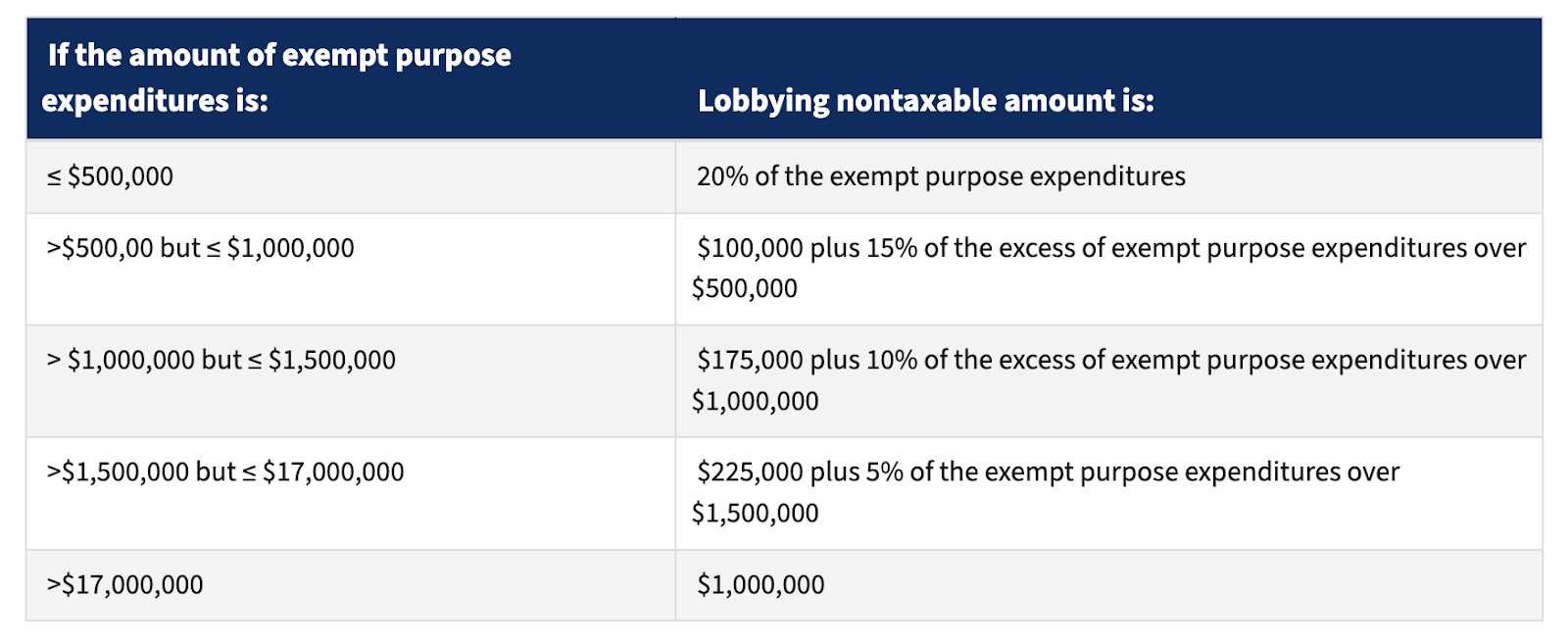
    This test is based on the size of a nonprofit’s exempt purpose expenditures compared to its lobbying expenditures. For example, any 501(c)(3) with a budget of less than or equal to $500,000 can spend up to 20% of its resources lobbying. See the full chart of permissible expenditures below.

    Source: https://www.irs.gov/charities-non-profits/measuring-lobbying-activity-expenditure-test

    Imagine, for example, a nonprofit that spent $6,200,000 in 2024. Using the chart above, we can see that they could spend up to $225,000 plus 5% of expenditures over $1,500,000. This comes out to $460,000 that they could have spent on lobbying that year.

    $6,200,000-$1,500,000 = $4,700,000

    $4,700,000 * 0.05 = $235,000

    $235,000 + $225,000 = $460,000

    Important! In order to qualify for the Expenditure Test, a 501(c)(3) nonprofit must first file IRS Form 5768.

    Resources for Staying Compliant

    As a nonprofit staffer, you’re likely operating with a limited budget, a small team, and perhaps a lack of legal expertise. While these hurdles are real, there are plenty of resources to help you stay compliant while lobbying as a 501(c)(3), even without the guidance of in-house counsel.

    • To start, the Internal Revenue Service offers a training series to help nonprofits maintain their 501(c)(3) status. This free video series walks you through all the 501(c)(3) basics, including required filings, prohibited political activity, and how to lobby appropriately. 
    • For a general overview of best practices – and common mistakes – check out the IRS resource, “How to Lose Your Tax Exempt Status Without Really Trying.”
    • The National Council of Nonprofits offers numerous resources to support nonprofit organizations across the country. Check out their helpful guide on Political Campaign Activities (which are all prohibited for 501(c)(3) nonprofits) and Lobbying Activity. 

    Start Lobbying as a 501(c)(3) with Plural. Sign Up for a Free Consultation Today! 

    Disclaimer: This article is not a substitute for professional legal or tax advice. 

  • How to Fundraise After the Election.

    How to Fundraise After the Election.

    Now that the 2024 election dust has settled, it’s time for nonprofit advocacy groups to look ahead. With the outcome decided at the top of the ticket and down-ballot, it’s crucial to think about what this means for your mission and how you’ll raise the funds you need to make an impact. Whether you’re advancing a policy agenda or defending against changes that could set things back, here’s how to get the ball rolling on your post-election fundraising.

    1. Understanding the Election’s Impact on Your Mission

    First things first, take stock of how the election results affect your work. Whether you’re a state-based group or focused on national issues, donors want to know how the outcome shifts your priorities. Be clear with donors and supporters about how the election results will impact your issues and the urgency it presents. 

    • If the new administration(s) aligns with your goals: Now’s the time to build on that momentum while you can. Tell your donors that, with their help, you can secure real wins in policy.
    • If your organization faces challenges with new policies: Emphasize the urgency of keeping up the fight. Let donors know that without their support, important progress could be at risk.

    Donors will be recalibrating their priorities too, so the more you can show how these changes impact your cause, the better. And remember, new donors might pop up that are looking to support organizations like yours that are working on policy issues you’ve been focusing on. 

    2. Craft Appeals That Highlight an Offensive or Defense Strategy

    It’s helpful to be clear with supporters about whether your group is on the offense (pushing for new policies) or defense (protecting what’s already in place). Both strategies work, but they call for different tones:

    • Playing Offense: Focus on the excitement and potential of creating change. Show donors that their support could lead to major wins and help shape a better future.
    • Playing Defense: Here, you’re aiming to build urgency. Give a glimpse of what could happen without intervention and how their support is critical to keeping positive policies in place.

    Making your strategy clear helps donors feel like they’re part of something purposeful and timely.

    3. Tailor Your Approach for State-Based vs. National Advocacy

    If you’re a state-based advocacy group, you’ll likely have different fundraising needs and goals than a national organization. Tailoring your approach can make a real difference:

    • State-Based Groups: Lean into the local impact. Make it clear how state policies hit home for people in your community and why their involvement matters. Donors often feel more connected to causes that affect them locally, so put your impact front and center.
    • National Groups: Focus on the bigger picture. Show how federal policy changes ripple across the country, and build a sense of unity around shared values. Working with partner organizations can also bring in supporters who might be less tied to local issues but still passionate about the broader cause.

    4. Leverage Plural Policy to Amplify Your Goals

    For advocacy groups, Plural Policy is a game-changer in navigating the post-election landscape. This platform allows you to track policy developments in real-time, connect with other organizations working toward similar goals, and identify decision-makers to engage for your cause. Here’s how Plural Policy can support your mission:

    • Track Legislation: Plural’s tools let you monitor the status of key bills and policy updates that matter to your organization. This can help you adjust fundraising asks in real time based on new developments and create a more responsive, informed strategy.
    • Coordinate With Allies: Plural Policy makes it easy to connect with like-minded groups and build coalitions, especially for issues that require a unified voice. This can boost your credibility, amplify your message, and bring in donors interested in seeing broad impact.
    • Identify Key Decision-Makers: With Plural Policy’s decision-maker data, you can focus your advocacy on the people and offices that matter most. Show donors that their support enables you to reach the right influencers and build relationships that will move the needle.

    Using Plural Policy isn’t just about staying informed; it’s a powerful way to drive results and keep donors engaged with relevant, timely actions.

    5. Re-Engage Supporters With Post-Election Updates

    After an election, people are tuned into political outcomes and ready to get involved. Use this time to re-engage your donor base. Send personalized thank-you emails, share an updated mission statement, and lay out specific plans for the coming year. Show them how their past support has made an impact, and outline what’s next with their continued help.

    6. Go Digital With Social Campaigns and Peer-to-Peer Fundraising

    Digital campaigns are where it’s at. Launch targeted emails and social media posts to reach supporters where they’re already spending time. Encourage people to set up peer-to-peer fundraisers, which can bring in new donors through personal networks and expand your reach without extra cost.

    The post-election season is a prime opportunity to fundraise and set the stage for the coming year. Whether you’re on the offense or defense, your strategy should lay out your group’s focus, connect with supporters’ values, and use this unique moment to build support. By adjusting your tactics based on whether you’re a state-based or national group—and by leveraging tools like Plural Policy—you’ll be well-positioned to make the most of this pivotal time. To talk to one of our policy experts, contact us today.

  • How is Infrastructure Policy Impacting the 2024 Election?

    How is Infrastructure Policy Impacting the 2024 Election?

    Infrastructure holds the country together. Will infrastructure policy divide it?

    Americans tend to agree on the importance of roads, bridges, ports, and pipes. Agreement on how to fund and get these projects going is less common. With November 5th nearing, many are wondering how infrastructure policy might impact the election. In this blog, we examine types of infrastructure, recent infrastructure policies, and each candidate’s record.

    What is Infrastructure Policy?

    Infrastructure policy is how governments manage society’s foundational structures – things like roads, bridges, water and electric utilities, telephone lines, and internet cables.

    In the United States, most funding for infrastructure projects comes from public investments by state and local governments. However, the proportion of federal spending began to increase in 2020. The federal government plays a role in infrastructure through Congress, which has the power to regulate interstate commerce and support it with legislation. Most of its funding goes to highway transportation, though spending on rail, mass transit, and water has increased in recent years.

    Reliable and resilient infrastructure is important for economic growth. Both businesses and households typically need access to electricity, water, and waste management. They rely on the movement of goods and people across roads, railroads, waterways, and air, along with the flow of information across telephone and internet cables. Infrastructure projects create jobs for workers who build and maintain them. They also raise demand for the materials needed to construct them. Thoughtful infrastructure policy can have a big impact on a local, statewide, and national scale.

    Key Topics in Infrastructure Policy

    Infrastructure policy can touch a variety of fields and industries.

    Transportation

    When people think of infrastructure, they often think of highways, bridges, and tunnels – the structures that enable transportation. Funding is needed not only to construct or replace this infrastructure but also to maintain it.

    Power and Energy

    Transmission lines bring electricity from power generation plants to communities across the country. The United States power grid is made up of several different regional grids with limited interconnection. In some areas, power plants struggle to keep up with the demand for electricity when it surges. In others, severe weather can damage equipment and interfere with power transmission on a large scale. Heat waves and fires have caused rolling blackouts in California in 2020, while an ice storm in Texas took out power for millions of people in 2021.

    Improvements to the grid can help it withstand extreme weather and adapt to surges in demand. This is especially important as electric vehicles grow in popularity. Maintenance is also critical to help keep energy infrastructure from falling into disrepair. In the meantime, encouraging energy efficiency can help bring demand down and reduce impacts on the environment.

    Due to growing concerns about fossil fuels’ impact on climate change, many advocate for cleaner alternatives such as solar, wind, hydro, and nuclear power. 

    Telecommunications

    Telecommunications infrastructure allows us to talk, work, learn, shop, and receive services across long distances. A hot topic in telecommunications infrastructure is high-speed broadband Internet access. Low-income and rural communities tend to have lower access to broadband Internet than others. This “digital divide” can lead to unequal access to schooling, job opportunities, healthcare, and more. Encouraging the expansion of infrastructure to less populated areas, along with making Internet access more affordable, helps to close this divide.

    Water and Waste Management

    Infrastructure like underground pipes and water treatment systems ensure that communities have access to clean water. Landfills, recycling centers, and wastewater treatment plants help with the sanitary management of waste.

    Water infrastructure is a more popular topic of public discussion than waste management. Government-funded projects can include updating water treatment facilities, replacing toxic lead pipes with modern ones, and improving water storage and drought resilience.

    President Biden’s Infrastructure Accomplishments

    In 2021, President Joe Biden signed the bipartisan Infrastructure Investment and Jobs Act (IIJA) into law. The $1.2 trillion legislation included $550 billion in new spending.

    Much of the funding went to transportation, including $100 billion for roads, bridges, and other major projects. The IIJA also made investments in freight and passenger rail, which Biden enthusiastically champions. The broad legislation also invested in:

    • Public transit
    • Airports
    • Port infrastructure
    • Electric vehicles
    • Low-emission buses and ferries
    • Cycling and pedestrian infrastructure
    • Broadband internet infrastructure
    • Power infrastructure
    • Clean drinking water
    • Resilience and water storage
    • Pollution removal from water and soil

    Through August 2024, about $480 billion in federal funding has been announced for more than 60,000 projects. Since the law’s passage in 2022, states with lower-rated infrastructure have received more funding than those with highly-rated infrastructure.

    Biden also signed the Inflation Reduction Act in 2022, which passed along party lines. It authorized loans to upgrade or repurpose energy infrastructure, funding for clean energy projects, tax credits for buying electric vehicles, tax credits for producing clean energy products and components, and more.

    Harris vs. Trump on Infrastructure Policy

    Both Vice President Kamala Harris and former President Donald Trump have stressed the importance of infrastructure. They’ve both proposed plans for increased infrastructure spending. But their approaches differ.

    While in office, Trump, a Republican, signed the bipartisan America’s Water Infrastructure Act into law in 2018. It authorized funding for a variety of water infrastructure improvements on navigable waterways, dams, reservoirs, public drinking water systems, and more. It contained the most substantial changes to the Safe Drinking Water Act since 1996.

    Trump also proposed a plan with $1.5 trillion in new spending on infrastructure. Just $200 billion of that would have been new federal spending. The rest would’ve come from private investment and state and local governments. While there was some bipartisan support for the plan, Congress could not agree on how it would be funded. Talks ended after Trump asked Congress to support his trade deal before working on the infrastructure bill.

    Trump has said he wants to ramp up domestic fossil fuel production and delivery to make the United States more energy-independent. This includes the construction of more pipelines and the removal of some regulations Trump sees as overly restrictive. He has also called for quicker approval and construction of nuclear power plants.

    Harris, a Democrat, likely has similar infrastructure priorities to President Biden. As Vice President, she has promoted the administration’s progress in implementing the IIJA. She supports efforts to incentivize clean energy projects and advocates for electric vehicles. During her 2020 presidential campaign, Harris opposed hydraulic fracturing (also called “fracking”) for oil and gas but recently said she would not ban fracking as president.

    Infrastructure Policy and the 2024 Election

    Infrastructure spending is popular among Americans. There is broad support for improvements to roads, bridges, ports, and water pipes. Democrats were far more likely than Republicans to support funding in the IJJA for broadband Internet, public transit, electric vehicle charging stations, and rail service.

    How will infrastructure policy impact the 2024 elections? The topic will be most important to voters who are impacted by infrastructure needs the most — including millions of Americans who have experienced blackouts, water quality problems, failing transportation infrastructure, and limited Internet access. About 30% of Americans say infrastructure is a “very big problem” in the country today. Their votes may depend on who they believe will solve it.

    Get Started With Plural

    Top public policy teams trust Plural with their legislative tracking needs. With Plural, you’ll:

    • Access superior public policy data 
    • Be the first to know about new bills and changes in bill status
    • Streamline your day with seamless organization features
    • Harness the power of time-saving AI tools to gain insights into individual bills and the entire legislative landscape
    • Keep everyone on the same page with internal collaboration and external reporting all in one place

    More Public Policy Resources

  • How Is the Economy Impacting the Election?

    How Is the Economy Impacting the Election?

    By most measures, the United States economy is booming. But most Americans aren’t convinced — they rate the economy as poor and inflation as one of their top political concerns. To work out how the economy is impacting the 2024 election, it’s helpful to look at the state of the economy, how Americans are experiencing it, and what each candidate says about economic issues. Read on to learn more.

    The Current State of the Economy

    The country entered a recession when the COVID-19 pandemic hit in early 2020. The unemployment rate shot up as millions of workers were laid off and businesses shut their doors – temporarily or permanently. Real Gross Domestic Product (GDP) contracted as production and spending slowed. Financial markets plummeted. The economic recession lasted for less than one quarter, but its effects have been felt far beyond that.

    When the economy began to recover, the inflation rate began to grow rapidly. The cost of goods climbed higher and peaked in June 2022. Inflation has now dropped close to pre-pandemic levels, but prices are much higher than they were.

    By many measures, the economy is going strong after quickly bouncing back from the pandemic. Average wages lagged at first but then rose rapidly, narrowly outpacing inflation. The labor market has rebounded with an unemployment rate near historic lows. Consumer spending continues to drive strong economic growth, though it has slowed from the immediate post-pandemic rebound.

    Poverty rates went down in 2020 and 2021, likely thanks to government assistance during the pandemic. Under both Presidents Trump and Biden, Congress approved stimulus packages that gave financial aid to most Americans, extended unemployment benefits, and offered emergency business loans.

    The Biden-Harris administration also approved an increase to the maximum child tax credit from $2,000 to $3,600 per child. It expired at the end of 2021 despite the administration’s efforts to extend it.

    Then, 2022 brought the largest one-year increase in poverty ever recorded for the United States. The national rate is now 12.4%, close to what it was in 2019. This could be explained by the loss of government assistance and the rising costs of food and housing. A national housing shortage began decades ago and worsened after the COVID-19 pandemic.

    Interest rates have soared higher since 2022, driving up mortgage rates for new homeowners. In 2020, the Federal Reserve announced interest rate cuts to help households and businesses spend during the pandemic. “The Fed” steadily raised the federal funds rate once the economy started to recover. The federal funds rate has stayed elevated through mid-2024 to help bring down inflation. Federal Reserve Chair Jerome Powell has said a rate cut is coming soon.

    Biden’s Record on the Economy

    President Joe Biden, a Democrat, worked with Congress to pass the Inflation Reduction Act (IRA) of 2022. The IRA created or extended a variety of green energy tax credits for purchases like electric cars, home solar panels, low-energy appliances, energy-efficient home upgrades, and more. It also included tax incentives for companies with clean energy projects.

    Another provision of the IRA lowered Medicare drug prices, capping the out-of-pocket cost of insulin at $35 per month and the total out-of-pocket prescription drug costs at $2,000 per year, beginning in 2024. It also allowed Medicare to negotiate directly with drug companies on prices.

    Biden has also undertaken several student loan forgiveness efforts, canceling close to $170 billion of debt for nearly 4.8 million people. One of Biden’s plans was stopped by the Supreme Court, which said he did not have the legal authority to implement the program. This year, the Biden-Harris administration proposed another plan for student loan forgiveness through a different process.

    Biden has also waged a campaign against “junk fees” – hidden or unexpected fees that businesses charge their customers. The Biden-Harris administration called for cutting credit card late fees to $8, but the proposal has been held up by court challenges. In April 2024, the Department of Transportation announced a new rule requiring airlines to tell consumers about certain fees upfront.

    Donald Trump and the Economy

    Former President Donald Trump, a Republican, has proposed:

    • Enacting a 10% to 20% tariff on imported goods, along with a 60% tariff specifically on imports from China. Economists say this is likely to raise consumer prices, but Trump argues it will boost American jobs and wages. Currently, these tariffs are about 19% for China and 3% for the rest of the world.
    • Ending Biden’s student loan forgiveness programs and increasing funding for career and technical education.
    • Increasing production of fossil fuels and nuclear energy in an effort to lower energy costs. He also promises to end many of Biden’s environmental regulations and incentives, including tax credits for electric car purchases.

    Tax Policy

    In 2017, Donald Trump signed the Tax Cuts and Jobs Act (TCJA), which made substantial changes to the federal tax code, including:

    • Lowering the corporate tax rate from 35% to 21%
    • Lowering individual income tax rates through 2025
    • Raising the maximum child tax credit from $1,000 to $2,000 through 2025

    He has said he wants to extend the temporary provisions in the TCJA and lower the corporate tax rate again to 20% or even 15%. Trump’s running mate for vice president, J.D. Vance, recently proposed raising the maximum child tax credit from $2,000 to $5,000.

    Trump, like Harris, has also proposed getting rid of taxes on tip income.

    How Will Kamala Harris Address the Economy?

    Vice President Kamala Harris, a Democrat, laid out several economic proposals in a recent campaign stop this August. She has called for:

    • Banning price gouging for food and groceries. State-level price gouging bans typically focus on crisis situations like natural disasters. It is unclear how a broad federal ban would work.
    • Canceling medical debt for millions of Americans.
    • Extending the caps of $35 per month for insulin and $2,000 per year on out-of-pocket prescription drug costs to all Americans, not just seniors with Medicare.
    • Giving $25,000 in down payment assistance to first-time homebuyers.
    • Offering tax incentives for builders who construct starter homes.

    Tax Policy

    Harris has said she would fund some of these proposals by raising the corporate tax rate from 21% to 28% and increasing taxes on the rich. This aligns with Biden’s proposed tax plan, which she supports. Biden and Harris have promised not to raise taxes for those making under $400,000, which signals that they want to renew some of the individual tax cuts in the TCJA.

    Harris has proposed permanently raising the child tax credit to $3,600. She has also proposed a $6,000 tax credit to families with newborn children in the first year of a baby’s life.

    Harris, like Trump, has also proposed getting rid of taxes on tip income.

    Conversely, How Do Election Outcomes Impact Markets?

    The stock market usually shows slightly worse performance in the 12 months leading up to a presidential election, but it tends to recover within 12 months afterward.

    Financial markets tend to be more volatile in the two months before election day and return to normal within two months after. This pattern occurs regardless of which party’s candidate wins the presidency. 

    Certain sectors may be affected by the candidates’ policy positions. For instance, energy companies might be impacted by climate regulations. However, policy doesn’t always have a predictable effect on stocks. During the Trump presidency, clean energy outperformed traditional energy stocks, and the reverse has been true while Biden is president.

    How Will Economic Issues Impact the Election?

    When economic conditions are good, this tends to favor the incumbent party in an election. The challenging party gets an advantage during a recession when the economy is shrinking.

    How is the economy impacting the election in 2024, then? Many U.S. economic indicators are positive. Yet most Americans’ view of the economy is not. Only 23% of American adults say the economy is in excellent or good shape, and 62% say inflation is a very big problem for the United States.

    Why is this? Wages have largely risen with inflation, but this rise did not necessarily happen equally. Neither did inflation itself. Food and groceries have seen some of the biggest price increases. Along with food prices, high housing costs are a pain point for many Americans.

    Americans’ views of the economy may negatively affect Harris, then, even though the country is seeing economic growth and a strong labor market. What will matter most is whether voters believe the economy is helping them financially.

    Get Started With Plural

    Top public policy teams trust Plural with their legislative tracking needs. With Plural, you’ll:

    • Access superior public policy data 
    • Be the first to know about new bills and changes in bill status
    • Streamline your day with seamless organization features
    • Harness the power of time-saving AI tools to gain insights into individual bills and the entire legislative landscape
    • Keep everyone on the same page with internal collaboration and external reporting all in one place

    Interested in getting started? Create a free account or book a demo today!

    More Public Policy Resources

  • How Is Drug Policy Impacting the 2024 Elections?

    How Is Drug Policy Impacting the 2024 Elections?

    As the 2024 elections grow closer, many Americans have drugs on the brain.

    Some call for help with the growing wave of opioid addictions and overdoses in their communities. Others want to legalize marijuana, either for recreational use or as a medical treatment for chemotherapy side effects, anxiety, and other medical conditions. Still others have trouble affording their expensive prescription drugs.

    Each of these drug policy issues could be a driving force at the polls in this year’s elections. Read on to learn about the history of drug policy in the United States, today’s biggest drug policy issues, and what the presidential candidates have to say on the matter.

    Historical Context of Drug Policies

    Throughout most of the history of the United States, drug policy has grown increasingly restrictive. However, state laws and public opinion are beginning to relax when it comes to some substances. 

    Major federal drug legislation did not begin in the United States until the 20th century. Individual states had begun to pass loose regulations in the latter half of the 19th century, mostly concerning drug labeling and requiring a doctor’s prescription for some medications. 

    Then the Smoking Opium Exclusion Act of 1909 banned the non-medical use, possession, and importation of opium. In 1914, the Harrison Narcotics Tax Act restricted the production, importation, and sale of opiates and cocaine.

    The 18th Amendment to the U.S. Constitution banned the sale of alcohol in 1919. Alcohol prohibition was short-lived, and the 21st Amendment repealed it in 1933.

    The War on Drugs

    Rising drug use in the 1960s led to President Richard Nixon signing the Controlled Substances Act in 1970. This law regulates drugs under a “schedule” system, with Schedule I having the highest risk of abuse and no recognized medical use. Schedule V is considered to have the lowest abuse potential. Nixon then declared a “War on Drugs” in 1971 and created the Drug Enforcement Administration in 1973.

    The War on Drugs expanded in the 1980s with the Reagan administration’s “Just Say No” campaign, which stressed the dangers of drug use. Mandatory sentencing laws made criminal penalties more severe and often disproportionately affected black Americans. The 21st century saw the start of sentencing reforms that relaxed some penalties and corrected inequalities.

    Public opinion on drug issues has changed along with these laws. It seems to be shifting again in recent years – at least for some substances. Amidst a growing opioid crisis, a majority of Americans say drug addiction is a “very big problem.” However, attitudes toward marijuana are growing more relaxed.

    Eighty-eight percent of U.S. adults say marijuana should be legal for medical or recreational use. A majority say it should be legal for recreational purposes, while about one-third support legalization for medical use only. Democrats are much more likely than Republicans to favor legalizing recreational marijuana. However, majorities within both parties say medical marijuana should be legal.

    Key Drug Policy Issues

    Four of the biggest drug policy issues today are the legalization of marijuana, high prescription drug prices, the opioid epidemic, and drug trafficking at the U.S.-Mexico border. Learn more below.

    Marijuana Legalization

    Marijuana  – also called cannabis – remains illegal at the federal level, even as more and more states legalize it. A 2009 memo by the Obama Administration encouraged federal prosecutors not to prosecute people for cannabis distribution in states that have legalized it. The Trump administration rescinded that memorandum in 2018. Despite this, federal cannabis laws are still largely not enforced in legal states.

    In 2022, President Joe Biden pardoned thousands of federal convictions for simple possession of marijuana. Many Americans remain in prison for marijuana possession.

    This spring, Biden endorsed a recommendation by the U.S. Justice Department to loosen federal restrictions on marijuana. If finalized, this would move the substance from Schedule I to Schedule III. Rescheduling would allow for easier research and possible drug development. It would not legalize marijuana federally, but it could make legalization easier.

    As of August 2024, 24 states have legalized cannabis for medical and adult recreational use. Another 14 now allow it for medical purposes. A handful of others have decriminalized it, which typically means that possession of a small amount does not carry a criminal penalty.

    Two of the latest states to legalize recreational cannabis are Maryland and Ohio, where voters approved ballot measures last year. Lawmakers in two others, Delaware and Minnesota, passed bills in 2023 legalizing it. Kentucky enacted a law last year creating a medical cannabis program that will go into effect in 2025.

    Prescription Drug Costs

    Sixty-four percent of Americans say healthcare affordability is a “very big problem.” One key part of that problem is prescription drug prices. For example, the average price of insulin nearly tripled between 2002 and 2013. Prices again doubled between 2012 and 2016. Insulin and its analogs are necessary life-saving drugs for many people with diabetes.

    This year, some drugmakers drastically decreased their list prices for insulin. This is largely driven by a provision of the 2021 American Rescue Plan Act that removed penalties for increasing drug prices faster than the rate of inflation. Still, the decrease may not be reflected in the out-of-pocket costs that patients pay, due to differences in insurance coverage.

    The Opioid Crisis

    The United States has faced an opioid crisis since the late 1990s, when doctors began prescribing these pain-relieving drugs more often. Overdoses related to commonly prescribed opioids steadily increased as patients became addicted. The federal government cracked down on the overprescription of these drugs starting in 2010. Some addicts turned to illegal narcotic drugs, and a wave of heroin overdose deaths followed.

    Since 2013, deaths from fully synthetic opioids like fentanyl have skyrocketed. Some who overdose may not even be aware they have taken fentanyl. Illegal drug manufacturers and dealers are increasingly lacing other substances with fentanyl to make small amounts of drugs more potent. The upward trend in opioid overdose deaths began to level off around 2017 before surging again in 2020 during the COVID-19 pandemic. While growth has slowed, more than 81,000 deaths were recorded in 2022.

    Opioids are highly addictive. Withdrawal symptoms for those who are addicted can be severe. This has led to an increased need for substance abuse treatment specifically for opioid users. Several states have responded to this need by increasing the budget allocation for drug treatment centers. Another popular state-level response to the opioid crisis is the creation of prescription monitoring programs that track the prescription of certain drugs. These programs are intended to prevent overprescription and drug abuse.

    Drugs and the Southern Border

    A related concern to the opioid crisis is drug trafficking at the U.S.-Mexico border. Most drugs that come into the United States at the southern border are smuggled at legal ports of entry. Marijuana seizures are common at illegal border crossings. Still, more dangerous drugs like cocaine, heroin, and fentanyl are commonly seized at ports of entry. People who are authorized to cross the border hide them in their vehicles or on their bodies. As the Southern Border has come into focus in the context of the 2024 presidential election, we expect discussions surrounding this issue to play out on the national stage.

    Candidates’ Stances on Drug Policy

    How will drug policy impact the 2024 elections? To help answer that question, we’ll look at each major candidate’s approach to drug policy. 

    Marijuana Legalization

    Former President Donald Trump, the Republican nominee for President, has spoken in favor of medical marijuana. He has also said that marijuana laws should be handled at the state level. However, he made no moves as president toward formally allowing either medical use or state-level legalization.

    Vice President Kamala Harris, the Democratic nominee for President, has changed her stance on marijuana over time. As a prosecutor in California, she was strict on cannabis offenses and opposed legalizing recreational use. Throughout her 2020 campaign for the presidency and still today, Harris has received harsh criticism for her actions as a prosecutor, viewed by many liberal Democrats as too harsh on non-dangerous offenses. Later, as a Senator, Harris introduced legislation to federally decriminalize and tax marijuana. As Vice President, she has called for reclassification of the drug, which is now underway. She has also spoken in favor of federal marijuana legalization.

    Prescription Drug Costs

    In 2020, the Trump administration created a voluntary, temporary program for some Medicare drug plans. Participating plans covered at least one insulin product of each dosage and type at a cost of $35 per month or less.

    Through the Inflation Reduction Act, the Biden-Harris administration expanded this $35 out-of-pocket cap to apply to all Medicare drug plans and the insulin products they cover. It also capped Medicare patients’ costs for all drugs at $2,000 per year starting in 2024. Harris says she wants to extend these two caps to all Americans.

    Using another provision of the IRA, the Biden-Harris administration has negotiated lower prices for ten of Medicare’s costliest drugs. The administration announced the new list prices this August, but they will not take effect until 2026.

    The Opioid Crisis

    As President, Trump signed the bipartisan SUPPORT for Patients and Communities Act. The Act was a package of legislation aimed at addressing the opioid crisis. It contained measures to remove barriers to medication-assisted treatment, especially for Medicaid recipients, and to make the overdose reversal drug naloxone more widely available. During his current campaign, Trump has taken a tough-on-crime stance. He has said that he wants drug dealers and smugglers to face the death penalty.

    The Biden-Harris administration has improved access to drugs used for opioid addiction treatment and permanently required state Medicaid plans to cover medication-assisted treatment. Biden and Harris have advocated for harm reduction, and the administration has expanded grants to states and tribal communities to pay for naloxone.

    Drugs and the Southern Border

    Trump often blames illegal immigration for the country’s fentanyl problem. It’s worth noting that narcotic drugs are most often smuggled through legal crossings. He advocates for stronger border enforcement.

    If elected, Harris says she will be tough on drug traffickers at the border and points to her experience prosecuting them as California’s attorney general.

    Get Started With Plural

    Top public policy teams trust Plural with their legislative tracking needs. With Plural, you’ll:

    • Access superior public policy data 
    • Be the first to know about new bills and changes in bill status
    • Streamline your day with seamless organization features
    • Harness the power of time-saving AI tools to gain insights into individual bills and the entire legislative landscape
    • Keep everyone on the same page with internal collaboration and external reporting all in one place

    Interested in getting started? Create a free account or book a demo today!

    More Public Policy Resources

  • How Is Immigration Impacting the Election?

    How Is Immigration Impacting the Election?

    How is immigration impacting the election? Immigration is a contentious political issue. Read our analysis of the impact it will have today.

    The United States has a rich history of immigration – and a rich history of controversy on the subject. Undocumented immigration has become a big concern for Americans and a contentious election issue.

    To explore how immigration is impacting the election in 2024, we need to put the issue in context. Let’s look at how immigration policies and public opinion have changed over the years.

    Historical Context of Immigration Policy

    The history of the United States began with immigration, as settlers from European countries left their homes for the “new world.” Once the United States of America became its own country, it had open borders and little in the way of immigration policy. Immigrants were broadly welcomed at first, though citizenship was heavily restricted. When a large wave of Irish and German migrants arrived in the mid-1800s, public opinion turned against them.

    The country began restricting its borders in 1875, banning immigration for criminals and later other groups. The Chinese Exclusion Act of 1882 banned immigrants from China after resentment grew toward Chinese laborers. The Immigration Act of 1917 set a literacy requirement for immigrants and banned any from most Asian countries.

    Many of these restrictions ended in the mid-20th century, but broader limits on legal immigration replaced them. Illegal immigration began to grow. Workers from Mexico, at first arriving legally to ease a labor shortage in the U.S., began to cross the border illegally for economic opportunity. In 1980, more than 100,000 migrants fleeing Cuba came to Florida’s shores by boat to ask for asylum. Some people who arrived legally, however, overstayed their visas.

    The Immigration Reform and Control Act of 1986 made most undocumented immigrants already in the U.S. eligible for legal status. It also made it illegal to knowingly hire unauthorized workers, but broad exceptions meant this was rarely enforced. Today, some people argue that undocumented immigrants are taking American jobs, while others argue that they fill the difficult and low-paying positions that Americans don’t want.

    The Southern Border: A Critical Focus

    The southern border of the United States has been an important focus in recent years. Unauthorized migrants regularly cross the land border with Mexico or make water crossings into southern states.

    Mexico has been the most popular country of origin for undocumented immigrants for a long time, but the proportion of those from other countries is increasing. Poverty, organized crime, and political instability prompt people to leave their homes in some Latin American countries. They travel to the southern border of the U.S. seeking freedom, safety, and economic opportunity.

    The impact of immigration on border states and cities puts them under stress. They can struggle to meet the needs of new arrivals, especially when there is a large influx of migrants. Under current immigration policy, migrants who apply for asylum are allowed to stay in the country until their cases can be heard. Due to a growing backlog in the U.S. immigration court system, this process can take several years.

    Democrats vs. Republicans on Immigration

    The immigration debate has become more contentious in recent decades, though the two major parties are coming closer together in the past few years. Republicans tend to call for stronger restrictions at the border and limits on some aspects of legal immigration, such as refugee resettlement. Republican voters are more likely to support efforts to deport all undocumented immigrants back to their countries of origin.

    Meanwhile, Democrats tend to advocate for policies that offer paths to legal residency and citizenship for undocumented immigrants. They are more likely to support continuing the Deferred Action for Childhood Arrivals (DACA) program, which delays the deportation of unauthorized immigrants who came to the U.S. as children.

    State-Level Action on Immigration

    State-level action on immigration varies. Some state and local governments have passed “sanctuary” policies saying they won’t comply with federal requests to detain or deport undocumented immigrants. Others have done the opposite.

    Last year, Texas legislators passed a law allowing state law enforcement to arrest people for entering the United States illegally. It was supposed to go into effect in March 2024, but a federal appeals court has temporarily blocked it. Louisiana lawmakers passed a similar bill this year, which is set to go into effect if the U.S. Supreme Court affirms the Texas law.

    This year, an Iowa law made it a crime for people to be in the state if they were previously denied admission to or removed from the United States. An Oklahoma law also made it illegal to be in the state without legal status. Both are now blocked by courts due to legal challenges.

    In 2022, Texas also began busing migrants to “sanctuary cities” in other states without their approval. Republican Governor Greg Abbott has said border cities are overwhelmed. He wants to place more of the burden of illegal immigration on government officials who support Biden’s border policies. Several of those cities are now overwhelmed and have begun sending migrants elsewhere in the country. Florida Governor Ron DeSantis, a Republican, and Arizona Governor Katie Hobbs, a Democrat, have since begun their own busing programs.

    Federal Action on Immigration

    Former President Donald Trump, the Republican candidate for president, promised during his first campaign to build a “border wall” along the entire U.S.-Mexico border. His administration did not complete this task but did construct or replace more than 450 miles of physical barriers.

    Illegal Immigration

    Trump created a requirement for asylum seekers to remain in Mexico while waiting for their hearings. Other Trump-era policies required people to seek asylum in “safe third countries” or “transit countries” before coming to the United States. His zero-tolerance policy for unauthorized adults resulted in family separations. Some parents were deported without their children. 

    The Biden-Harris administration ended these policies. President Joe Biden, a Democrat, did continue a public health order Trump enacted in March 2020. Title 42 allowed U.S. border officials to turn away migrants seeking asylum during the COVID-19 pandemic. It expired in January of 2023.

    Biden has increased the use of parole, allowing migrants into the U.S. even if they don’t qualify for a visa. Biden has used the power of parole much more broadly than other presidents, including for humanitarian and family reunification purposes.

    Legal Immigration

    While in office, Trump banned immigrants and refugees from six Muslim-majority countries, as well as North Korea and Venezuela. He also drastically cut the number of refugees allowed into the United States.

    The Biden-Harris administration reversed the ban and raised the refugee cap. This year, the administration also made it easier for noncitizen spouses of U.S. citizens to apply for lawful permanent residence.

    Border Security in 2024

    A border deal proposed in the Senate this year sought to:

    • Add restrictions for asylum seekers
    • Set up a quicker case review process
    • Required temporary asylum shutdowns at a certain threshold of illegal border crossings
    • Expand detention alternatives like ankle monitors
    • Give some immigrants more protections

    Republican leadership supported the deal at first, but they later reversed their stance and voted it down saying it would incentivize illegal immigration.

    In early June of 2024, Biden signed an executive action to “temporarily shut down asylum requests once the average number of daily encounters tops 2,500 between official ports of entry.” The shutdown took immediate effect and will end once the number of requests falls to 1,500. It makes exceptions for unaccompanied children and trafficking victims.

    How Will Immigration Impact the Election?

    Americans are increasingly concerned about immigration. They have named immigration as their top election issue for most months this year, according to Gallup public opinion polls. For the first time since 2005, a majority of Americans think immigration should decrease. How is immigration impacting the election? More polls give us a clue.

    Regardless of party affiliation, Americans are more likely to approve of deporting undocumented immigrants now than they were several years ago. A majority now also approve of constructing more barriers along the U.S.-Mexico border. Trump has promised to do both if re-elected, calling for mass deportation of illegal immigrants with the help of the National Guard.

    Vice President Kamala Harris is now the presumptive Democratic nominee. At the start of his term, Biden placed Harris in charge of addressing the root causes of migration at the southern border. She has faced criticism as illegal border crossings increased, but they are trending lower ahead of the election.

    Arrests for illegal border crossings hit a record high in December of 2023 but lowered in January as Mexican authorities raised enforcement. They dropped even more quickly after Biden’s executive action to restrict asylum. Arrests for unlawful border crossing hit a three-year low in June and kept decreasing in July. 

    Harris says she supports “comprehensive reform that includes strong border security and an earned pathway to citizenship.” She promises to be tough on border control, citing her experience prosecuting drug cartels and human traffickers as California’s Attorney General.

    Get Started With Plural

    Top public policy teams trust Plural to understand immigration policy. With Plural, you’ll:

    • Access superior public policy data 
    • Be the first to know about new bills and changes in bill status
    • Streamline your day with seamless organization features
    • Harness the power of time-saving AI tools to gain insights into individual bills and the entire legislative landscape
    • Keep everyone on the same page with internal collaboration and external reporting all in one place

    Interested in getting started? Create a free account or book a demo today!

    More Public Policy Resources

  • Education and the 2024 Elections: How Is Education Impacting the Election?

    Education and the 2024 Elections: How Is Education Impacting the Election?

    Between school curricula, book bans, teacher pay, and the cost of college, education is proving to be a hot topic in the 2024 elections.

    Education issues always impact local, state, federal, and presidential elections. In the past several years, they have intersected with social issues that draw more attention from the public. Recent state policies on these hot-button topics, like book bans and LGBTQIA+ issues, have put a spotlight on the impact of education policy. Read on to learn more about what’s happening with education and the 2024 elections in the United States.

    Democratic vs. Republican Stances on Education

    Americans’ views on education are increasingly divided based on their political affiliation. Democrats tend to hold a positive view of public schools. Democratic candidates often advocate for more funding for public K-12 and higher education. While the federal government does not have the power to control schools directly, it can tie these funds to certain requirements.

    On the other hand, Republicans are generally distrustful of public schools and the U.S. Department of Education. Candidates often push for more state and local control – and even parental control – of education issues. They may argue for less federal taxation for funding for public schools. They may also support school voucher programs, which use taxpayer funds to help parents send their children to private or religious schools.

    Key Education Policy Issues

    Today’s key education policy issues cover a wide range of topics, from universal preschool to student loan forgiveness. In the past several years, discussions of education-related issues also bring up topics of gender identity, sexual orientation, racism, and other “culture war” issues. Here are just a few of these key topics in education.

    Early Childhood Learning

    President Biden and Vice President Harris have advocated for universal pre-k, making preschool free for all four-year-olds. Harris, the presumptive Democratic nominee after Biden stepped out of the race, has pushed for more funding for Head Start and Early Head Start programs. These programs provide free school readiness services to young children of low-income families.

    Former President Trump has not focused much on early childhood learning. Rather, he has advocated for reduced federal funding for and control of education.

    K-12 Federal Funding and Oversight

    Trump has proposed getting rid of the U.S. Department of Education, but he did not do so while in office. He did shift some control and oversight to state and local governments, saying they should be the ones to handle education.

    The Biden-Harris administration has supported increasing both federal funding and oversight for K-12 education. Biden has especially focused on addressing learning loss and achievement gaps in the wake of the COVID-19 pandemic.

    Biden and Harris have both advocated for increasing Title I funding, which supports schools with a large population of low-income students. In the past, Trump has proposed cutting those funds.

    School Choice

    Trump has been a strong advocate of school choice. His Tax Cuts and Jobs Act expanded 529 college savings plans, allowing up to $10,000 per year to be used for K-12 private schools. He has proposed further expanding it to allow the tax-advantaged accounts to be used for homeschooling. Trump also supports school voucher programs, which would divert tax money from public schools for parents to use to enroll their children in private or religious schools.

    The Biden-Harris administration has preferred to fund and support public schools. It opposes Trump’s voucher proposals. Biden tightened regulations on the federal Charter School Program, which awards grants to schools that are publicly funded but privately operated. The new rules added transparency and accountability requirements. They also made it harder for schools managed by for-profit companies to get funding.

    School Curricula

    Many states have adopted laws or policies that either expand or restrict teaching certain topics involving history, race, sex, and gender. Democrat-controlled states have enacted policies that require more teaching about the history of minority groups, racial issues, and LGBTQ+ issues. Republican-controlled states have enacted policies that restrict some types of education about race and sex.

    This controversy has created a divide among “red states” and “blue states.” This divide often plays out in national politics. Curriculum content is the education topic Trump seems to talk about most. While in office, Trump established the 1776 Commission to support “patriotic education” and curricula. This was in response to the New York Times’s 1619 Project, which reframed American history by centering the consequences of slavery and the contributions of Black Americans. Biden dissolved the 1776 Commission shortly after taking office.

    Content censorship has expanded beyond classroom teaching and also impacts school library content. Conservative groups have fought to ban books from school libraries that contain certain content, especially LGBTQ+ topics. Trump has generally supported these efforts, while Harris has condemned book bans.

    In 2023, Florida passed HB 1467 requiring elementary schools to publish lists of books in their school libraries and report any complaints to the state. After the state was inundated with complaints, this year’s HB 1285 limits the number of complaints reported by people who don’t have children at the school in question.

    In response to this trend, legislators in Maryland (HB 785), Minnesota (SF 3567), and Illinois (HB 2789) all passed laws this year restricting banning books from public libraries, including the ones in schools.

    Pay for Teachers

    Biden and Harris have both advocated for increasing teacher pay. During Harris’ first presidential campaign, she released a plan to give teachers a salary increase of $13,500 each.

    Trump wants to give states and school systems an incentive to pay their teachers based on merit. He opposes teacher tenure for grades K-12.

    LGBTQ+ Students

    The Biden-Harris administration has issued regulations that broaden the scope of Title IX. The law bans discrimination in schools based on sex, and the new rules expand it to include sexual orientation and gender identity. 

    The expansion took effect in 24 states this August, but it now faces legal challenges in the rest of the country. The administration says the rule does not apply to athletics. Still, Republicans have argued that it would require schools to allow the participation of transgender students in girls’ and women’s sports. Trump has promised to roll back the new changes.

    Eight states have passed laws requiring teachers to inform students’ parents of any change in their preferred pronouns or gender identity, even without the student’s consent. These include Tennessee SB 1810 and South Carolina HB 4624. California, however, did the opposite. AB 1955, also known as the Support Academic Futures and Educators for Today’s Youth (SAFETY) Act, bans school systems from enacting such policies.

    Student Loans & College Affordability

    One of the top education priorities for Biden is college affordability and student loan forgiveness. He attempted to cancel some or all debt for 43 million people, but the Supreme Court ruled he did not have the legal authority to do so. Biden’s plan offered one-time debt forgiveness of up to $20,000 in federal student loans per borrower. In April 2024, the Biden-Harris administration used a different process to propose another plan offering relief to 25 million people, on top of nearly 4.8 million who have already had their debts canceled.

    Trump paused student loan payments during the COVID-19 pandemic but hopes to reverse Biden’s student loan forgiveness programs if reelected. While in office, Trump favored vocational education and workforce development. He pushed for a large increase in funding for career and technical education.

    Biden has also proposed a plan for two years of free community college through a federal-state partnership. Trump has offered his own free college idea — an online school called the “American Academy” funded by “taxing, fining, and suing” private university endowments. He said the curriculum would be free of “wokeness” and “jihadism,” and students would have the opportunity to attend free of charge.

    How Is Education Impacting the 2024 Elections?

    The impact of education on the 2024 elections may vary depending on the issue and who it affects. Parents with school-aged children will be watching the policies that directly impact their families. Young adults, who have historically had lower turnout, are more likely to be worried about the cost of tuition and/or vocational programs.

    In particular, student loans are a key concern for many Americans. Approximately 30% of American adults have at least some student loan debt, and nearly one in five adults say student loan debt will have a major influence over their vote in the presidential election.

    Curriculum content and social issues may play more of a role in state-level races than in the presidential election. As states continue to pass new laws affecting local school systems, this could drive more people to the polls to vote for state and local candidates who agree with their views on either side.

    Get Started With Plural

    Top public policy teams across the United States trust Plural to monitor education policy issues. Plural users:

    • Access superior public policy data 
    • Be the first to know about new bills and changes in bill status
    • Streamline your day with seamless organization features
    • Harness the power of time-saving AI tools to gain insights into individual bills and the entire legislative landscape
    • Keep everyone on the same page with internal collaboration and external reporting all in one place

    Create a free account or book a demo today!

    More Education Resources

  • Abortion and the 2024 Elections: How Is Abortion Impacting the Election?

    Abortion and the 2024 Elections: How Is Abortion Impacting the Election?

    Now that Roe v. Wade has been overturned, abortion may impact United States elections more than it has in a long time.

    Federal protections on abortion rights no longer apply since June 2022, when the U.S. Supreme Court overruled the landmark case that set them. Many states have passed outright bans or heavy restrictions on abortion. Nationwide, though, public support for abortion rights is higher than ever, and the Court’s decision will likely bring voters to the polls. Read on to learn more about abortion and the 2024 elections.

    History of Abortion Rights in the US

    America had virtually no abortion laws early in the country’s history. In the late 1800s, state governments began to pass laws that restricted abortion. Abortion was largely practiced by midwives and opposed by physicians, whose profession was becoming licensed and regulated. The practice was outlawed in every state by the early 1900s. Some women turned to costly or risky methods of ending their pregnancies. They paid a surgeon to perform an abortion secretly or, if they could not afford it, tried to perform it themselves.

    As women challenged these abortion bans in the 1960s and 70s, states began to allow exceptions for health, rape, incest, or a damaged fetus.

    Key Supreme Court Cases

    In the 1973, the Supreme Court ruled in Roe v. Wade that the right to an abortion is protected by the U.S. Constitution as part of an implied right to privacy. It prohibited most restrictions during the first trimester of pregnancy, allowed some in the second trimester, and allowed abortion bans in the third trimester with exceptions for the mother’s life or health.

    Roe v. Wade ignited nationwide controversy, and abortion is now a polarized and contentious issue. The Democratic Party had opposed abortion, but it soon joined feminists in advocating for abortion rights. Protestants joined Catholics in the anti-abortion movement as the political Christian right emerged, eventually gaining the support of the Republican Party.

    The Supreme Court changed Roe’s legal framework in 1992 with its ruling in Planned Parenthood v. Casey. States could now ban abortion at 23 or 24 weeks of pregnancy based on fetal viability. The Court also ruled that laws could not pose an “undue burden” on women’s access to abortion, replacing the more demanding “strict scrutiny” standard from Roe.

    In June of 2022, the Supreme Court overturned the Roe and Casey decisions with its ruling in Dobbs v. Jackson Women’s Health Organization. The Court ruled that there is no implied constitutional right to abortion, because it is not “deeply rooted in this nation’s history or tradition.” This allowed state governments to greatly restrict and ban abortion.

    The Current Landscape of Abortion Access

    In the years leading up to the Dobbs decision, several states passed “trigger laws” – abortion laws that were unenforceable due to Roe but went into effect when it was overturned. Since the Supreme Court ruling, more states have passed restrictions, while others have enacted protections.

    Abortion is now banned in 14 states, with most having narrow exceptions. Four states ban abortions after six weeks of pregnancy – before many women even realize they are pregnant. Another 23 states have other restrictions based on gestational age, while nine states allow abortion throughout pregnancy.

    Abortions have drastically reduced in states that have banned them and risen in states that have expanded or maintaned access. More people are now traveling out of state to end pregnancies, but some cannot afford to do so. This disproportionately impacts women of color and women in poverty.

    However, the Dobbs decision has not lowered the nationwide abortion rate. It was already growing in previous years, and some estimates indicate that it is still on the rise.

    Recent State Actions

    State action on abortion rights varies and often falls along partisan lines. In general, Democratic-controlled legislatures are aiming to expand or maintain access to abortion. Republican states, on the other hand, have taken steps to heavily restrict reproductive rights. Overall, however, the vast majority of Americans support at least some access to abortion.

    In November 2023, Ohio voters approved a ballot measure for a constitutional amendment to protect the right to “make and carry out one’s own reproductive decisions,” including decisions about abortion. This invalidated a six-week ban the state legislature had passed as a trigger law in 2019.

    Abortion laws in Florida (SB 300) and Iowa (HF 732) both took effect in 2024, banning abortions after six weeks of pregnancy. They were passed last year but temporarily blocked by court challenges.

    Abortion on the Ballot

    Abortion will appear on the ballot in several states in 2024, and it could play a major role in both state and federal elections. The two major party candidates differ greatly in their views on abortion.

    Vice President Harris is the likely Democratic nominee after President Biden dropped out of the race in July. Harris and Biden both support abortion rights, but Harris is more outspoken about the issue and will likely more aggressively campaign on it. As a senator, she co-sponsored the Women’s Health Protection Act of 2017, which sought to ban state and local restrictions on abortion before fetal viability.

    Former President Trump, a Republican, has said he prefers to allow states to decide on the issue of abortion, stopping short of calling for a national abortion ban. During his 2016 campaign, he promised to appoint judges who were likely to overturn Roe. Trump did name three justices to the Supreme Court to fill vacancies during his term, shifting the nine-member court toward a more conservative ideology. All three voted in favor of the Dobbs decision. Trump touts his Supreme Courts appointments as an administration-defining success.

    Supreme Court justices, court of appeals judges, and district court judges are appointed by the President and confirmed by the Senate. Dobbs highlighted the impact that elections for these offices can have on abortion law.

    State Ballot Measures in 2024

    As of July, seven states will let voters decide directly on abortion ballot initiatives in the 2024 election. These include both laws and amendments to state constitutions, all protecting or expanding abortion access. Most were initiated by voter petitions.

    • Arizonans will vote on a constitutional amendment protecting the right to abortion until viability. The state now bans abortion after 15 weeks of pregnancy.
    • Florida ballots will include a measure to legalize abortion until viability. The state currently bans it after six weeks of pregnancy.
    • In South Dakota, voters will decide on a constitutional amendment setting a trimester framework for abortion laws similar to Roe v. Wade. Abortion is currently banned in the state.
    • New Yorkers will have a ballot measure to ban discrimination based on pregnancy, pregnancy outcomes, and “reproductive healthcare and autonomy.” The state allows abortion until viability.
    • Colorado, Maryland, and Nevada will vote on constitutional amendments to protect abortion access until viability, which their state laws already allow.

    Four more states are waiting for approval of their ballot initiatives.

    • Arkansas voters could decide on a constitutional amendment protecting the right to abortion in the first 20 weeks of pregnancy. Abortion is banned in the state.
    • Missouri, Nebraska, and Montana may vote on constitutional amendments protecting the right to abortion before viability. Abortion is illegal throughout pregnancy in Missouri and until 12 weeks in Nebraska. It is already legal until viability in Montana.

    These measures could turn out more abortion-minded voters to the polls, affecting results in other contests on the ballot.

    Abortion and the 2024 Elections

    Before the Dobbs decision, voters who were motivated primarily by abortion tended to be Republicans who opposed it. But recent polls show that abortion-motivated voters are now mostly Democrats who support abortion rights.

    Abortion is a top issue for suburban women, a key demographic that could decide the election. The overturning of Roe seems to have mobilized pro-choice voters, while pro-life voters may be less energized by the issue.

    Sixty-nine percent of Americans, a record high, now say that abortion should be legal in the first three months of pregnancy. This view is at odds with the total and six-week abortion bans passed by many Republican-controlled state legislatures. Sixty one percent of Americans also say that overturning Roe v. Wade was a “bad thing.” Views are strongly divided by party affiliation, but overall support for abortion access continues to rise.

    The Republican Party is starting to downplay the issue, making few mentions of it at this year’s Republican National Convention. Meanwhile, the Democratic Party is stressing it as a key issue. Democrats scored wins with that strategy in the 2022 midterm elections. Abortion was a top concern for voters in Pennsylvania and Michigan, both battleground states. Voters in Pennsylvania went on to flip a U.S. Senate seat for the Democrats, and control of Michigan’s state legislature also swung to the Democrats for the first time in decades. Nationwide, every ballot initiative on abortion went in favor of protecting or expanding access.

    Looking at abortion and 2024 elections, this issue could greatly influence races up and down the ballot.

    Get Started with Plural

    Plural offers policy tracking solutions for concerned constituents and professional public policy teams alike.

    Create a Free Account

    • Legislative searching and tracking for one person.
    • Search legislative data from 53 US jurisdictions: 50 states, Washington, D.C., Puerto Rico, and U.S. Congress.
    • See comprehensive bill detailsstate-specific data, and legislator information.
    • Easily track bills and never miss an update.
    • Receive daily updates on the bills you’re monitoring.

    Book a Demo To Learn About Premium Features

    • Access superior public policy data 
    • Be the first to know about new bills and changes in bill status
    • Streamline your day with seamless organization features
    • Harness the power of time-saving AI tools to gain insights into individual bills and the entire legislative landscape
    • Keep everyone on the same page with internal collaboration and external reporting all in one place

    More Public Policy Resources

  • How Is Housing Impacting the 2024 Elections? 

    How Is Housing Impacting the 2024 Elections? 

    Shelter is a basic human need, but it has become increasingly costly. Whether they want to rent or own, Americans seeking a home are met with soaring prices and fierce competition.

    Housing is likely to be top of mind for voters in the 2024 elections. To understand how it may motivate them, this blog takes a look at the housing affordability crisis and how some elected officials are addressing it.

    The Housing Affordability Crisis

    The United States is facing a housing affordability crisis affecting both buyers and renters. A combination of low supply, high demand, high interest rates, inflation, and a global pandemic have sent prices skyrocketing. Why are housing prices so high, and what are the consequences for Americans? Let’s look deeper.

    Rising Housing Costs

    Housing prices have been rising for several years, but that rise sped up dramatically in 2020. The main reason for this is a lack of supply: not enough houses are being built or sold for the level of housing demand.

    From 2018 to 2020, the country’s housing shortage was already growing. Then, in 2020, supply chain issues from the COVID-19 pandemic slowed construction and made supplies more expensive. When construction picked up again, it couldn’t catch up with rising demand. The shortage exploded. 

    Average mortgage interest rates increased, more than doubling between 2021 and 2023. They have since decreased, but not by much. This can make available homes unaffordable for would-be buyers. It also encourages would-be sellers not to move in order to stay in their current lower-interest mortgages. As a result, fewer existing homes are going on the market.

    Seniors especially are staying in their homes longer than they used to. Today, 56% of owner-occupied homes with three or more bedrooms are occupied by only one or two people, most of them age 62 and older. Families who would otherwise need more space are making do with smaller homes until it’s easier to buy a larger one. This means there are fewer small, affordable homes on the market for first-time and low-income home buyers.

    The Rental Housing Market

    The housing affordability crisis has also hit the rental housing market. When people can’t find or afford a house to buy, they need to rent instead. This has increased the demand for rental housing, driving up costs. Rent increases are outpacing wage increases across the country. In 2022, about half of renters nationwide – a record number – spent more than 30% of their income. They may be forced to choose between their rent payments and food, healthcare, or other basic expenses.

    A Shortage of Affordable Housing Units

    High housing costs have hit those with low incomes the hardest. There is a shortage of 7.3 million affordable and available rental homes for extremely low-income renters. A growing number of people simply can’t find a place to live.

    As rent increases, so does homelessness. Not only are more people evicted or forced to leave their homes, but fewer unhoused people are able to exit homelessness as well. Homelessness grew by more than 12% in 2023, the biggest increase since records began in 2007.

    The State of Housing Policy in 2024

    Housing policy is often left to state and local governments to handle. However, federal policy can incentivize them to change certain rules and regulations. It also can provide grant funding for housing programs like vouchers and subsidized housing projects.

    Federal Housing Policy

    President Biden has repeatedly called on Congress to pass housing legislation, but so far, no significant bill on the topic has passed the House and Senate during his tenure.

    In 2022, the Biden administration released the Housing Supply Action Plan, intended to help grow the supply of housing and lower costs. The plan promises to give communities with reformed zoning and land-use policies an advantage in some federal grant programs. It also aims to provide new and expanded financing for manufactured housing, Accessory Dwelling Units (ADUs), 2-to-4-unit properties, and smaller multifamily buildings.

    Biden also has called on Congress to pass tax credits for first-time home buyers and sellers, set a cap on rent increases, and take other measures to improve housing supply and access. The administration’s goal is to enable the building or renovating of 2 million homes.

    In June of 2024, the Biden administration announced housing grant awards totaling $85 million to 21 state and local governments. The grants were made under the Pathways to Removing Obstacles to Housing (PRO Housing) program with the aim of removing barriers to home construction.

    New State Housing Policies

    Arizona and Colorado have both passed significant housing legislation in 2024. The two states legalized ADUs in major cities. An ADU, also called a secondary dwelling unit, in-law unit, or granny flat, is a smaller housing unit on the same property as a single-family dwelling. These increase the housing supply without the need for more property.

    Colorado’s suite of housing bills also include:

    • HB 24-1304, which bans mandatory residential parking minimums along major transit routes
    • HB 24-1313, which requires larger cities to allow zoning for higher-density housing near major transit lines
    • HB 24-1434, which expands the state’s affordable housing tax credit

    Arizona HB 2721 requires major cities to allow different types of housing units, such as townhomes, duplexes, triplexes, or quadplexes, within a mile of their central business districts. These units are known as “middle housing” — something between single-family homes and large apartment complexes — and they can help increase the supply of housing on a small amount of land.

    How Is Housing Policy Impacting the 2024 Elections?

    The cost of housing is one of the top financial worries of Americans right now. It’s a main driver of inflation that is keenly felt by many households across the country. When voters go to the polls in November, housing policy will likely be on the minds of many.

    Recently, President Biden announced he is exiting the presidential race, endorsing Vice President Harris in his place. While the Democratic Party has not officially chosen its nominee, Harris is the most likely candidate to replace him.

    Harris has expressed similar views to Biden on the topic of housing policy, both while in office and during her campaign for President in 2020. As a Senator, Harris and Rep. Maxine Waters introduced the Housing is Infrastructure Act. The bill, which did not pass, would have invested $70 billion into public housing and an additional $10 million into efforts to eliminate zoning requirements. It also included funding to construct rental units for low-income households.

    The Republican Party nominee, former President Trump, pushed for cuts to housing assistance programs and public housing while in office. He also removed some fair housing protections, which Biden later reinstated. His record on the issue of zoning has been mixed. During his presidency, the U.S. Department of Housing and Urban Development encouraged state and local deregulation. These efforts ended when Trump voiced support for zoning regulations that he said would protect suburbs. He recently made remarks calling zoning restrictions “a killer,” though, suggesting he would once again support removing them.

    Trump also has said he would “ban urban camping” and create tent cities for homeless people, where doctors and social workers would be on hand to help them.

    Get Started With Plural to Track Housing Policy

    Top public policy experts trust Plural for their legislative tracking needs. With Plural, you’ll:

    • Access superior public policy data 
    • Be the first to know about new bills and changes in bill status
    • Streamline your day with seamless organization features
    • Harness the power of time-saving AI tools to gain insights into individual bills and the entire legislative landscape
    • Keep everyone on the same page with internal collaboration and external reporting all in one place

    Interested in getting started? Create a free account or book a demo today!

    More Resources for Public Policy Teams