The start of the 2024 legislative sessions is right around the corner. As your team completes its legislative session prep, learn more about our strategies to supercharge your legislative impact.
Preparing for the legislative session takes a significant amount of time. To prepare for the legislative session, your team’s priorities might include researching issues, reviewing priorities, and setting goals. In this article, we’ll explore strategies to:
Research and understand the issues.
Review your constituent concerns, priorities, or your organization’s mission.
Set legislative goals – the more focused the better!
The work you put in ahead of session can be pivotal in determining your legislative success. Whether you’re an active citizen, advocate, or legislative leader, these tips can inform your policy work.
Understand the Legislative Process
Understanding the legislative process is key to successful legislative organizing and advocacy. Whether you’re working in Congress or in State House(s), there are a few important steps to understand.
Introductions
Bills are introduced between January and October, depending on the jurisdiction. Typically, prefiled bills are introduced earliest. Prefiled bills are bills from previous sessions that have not been voted through yet. They reflect the priorities of political parties and leading legislators. Taking a close look at the first introduced bills from leaders. This might include the Speaker and minority leaders of the House and Senate. These bills will give you helpful insights into priority issues for the session.
Committee Assignments
Committee assignments occur after bill introductions. These assignments are related to the bills’ topic of focus, as well as any approvals required within each bill. For instance, a bill focusing on increased budget for education would likely be assigned to two committees — the Education Committee and the Appropriations or Budget Committee. This is because the bill focuses on both education and budget. The Education Committee would determine whether the bill is appropriate and realistic. Further, the Appropriations or Budget Committee would be required to approve or deny the investment.
Committee Actions
The chair of each committee decides whether to allow the bill to be heard and debated. This can include a period for public testimony, either for or against the bill. This also means that the chair has the power to stifle the progress of legislation by not allowing for debate or hearings. This is where the phrase “died in committee” comes from. Bills that die are not be sent to the floor of the chamber for a vote by all elected members.
Floor Debates and Voting
After a bill successfully moves out of committee, it heads to the floor for debate and voting. During a floor debate, legislators provide speeches for or against the bill in front of the entire chamber. During a vote, each member has the opportunity to vote ‘yes’, ‘no’, or abstain from voting. If a bill does not pass, the presiding leader may reintroduce it for a debate and re-vote.
Preparing for the Legislative Session: What To Look Out For
There are many ways to approach organizing, advocating, and lobbying during a legislative session. Funding, personnel, time, and other factors may determine your approach. Here are a few key things to look out for as you determine how to push forward in your legislative efforts.
The Politics of Legislative Responses
With the 24-hour news cycle, legislative responses be well-timed. Researching, honing in on constituent concerns, and setting legislative goals is key. Connecting with key staff and legislators becomes crucial as the topic you’re advocating for is at the head of the news cycle. Strategizing these connections can also elevate your issue to the forefront of the conversation. For instance, say your organization’s mission is to increase access to healthcare. It’s essential to be prepared with written materials, statistics, and events by March, when annual insurance plans are renewed.
Hearings
Hearings are essential aspects of the legislative process. They can be informal, with interested constituents and elected officials. Hearings can also be more formal, in the case of committee hearings. During a hearing, experts provide essential information to the public and elected officials. They examine the legislation’s positive and negative impacts.
Legislator and Staffer Information
Paying attention to legislator and staff data is key to planning for the legislative session. Since the legislative session is the busiest time of year for legislators, oftentimes your main contact will be staff. Staffers provide legislators with information, research, and news on the bills at hand. Keeping in contact with staff members is a key step in coalition building. Gathering support from legislators is a crucial step towards collective action on the issues you care about.
With Plural, it’s easy to discover legislator and staffer data — get started today.
When Does the Legislative Session Start?
The legislative session is right around the corner. Most states will begin their sessions within the first two weeks of January. Using Plural to monitor bills, read priority statements, and learning about legislators will be essential to an educated start to the session.
Plural is the legislative tracking and intelligence tool of choice for effective public policy teams. Plural’s premium data, tools to get organized and collaborate, and revolutionary AI-powered insights will supercharge your policy impact. Book a demo today to learn more.
Lobbying at the state level is the practice of engaging with lawmakers and policymakers to advocate for a particular cause or interest and being compensated for the act of political influence. It is an organized way for individuals or groups to express their opinions, share information, and attempt to influence the decisions made by the state government. The words “advocate” and “lobbyist” are often used interchangeably, as both often work to influence politics and policy at the state and federal level. However, each fulfill a different role and are considered legally different by every state government’s regulations. The most significant difference between advocates and lobbyists is that advocates are not paid to participate, while lobbyists are. Lobbyists can work for almost any group, including corporate firms, private companies, non-profit organizations, trade organizations, political interest groups, and even individuals seeking to impact policy. Some of a lobbyist’s general functions include establishing relationships with key decision-makers, holding meetings with government officials, attending public hearings and committee meetings, and, most importantly, monitoring and tracking policy to stay informed, relevant, and strategic.
Lobbying at the State vs. Federal Level
Lobbying at the state level versus at the federal level is very similar, but there are some key differences between the two practices, including: jurisdiction, the scope of authority of each legislature, and the differences in the legislative process between state governments and the federal government.
Jurisdiction
First, the jurisdiction of the federal government encompasses all states in the United States. As such, policy objectives when lobbying the federal government are often broader. Further, federal policies impact the entire American population, generating a higher level of impact on a broad range of different groups, organizations, and communities. Laws passed by state legislatures, on the other hand, only affect the citizens of a given state.
Scope
Another key difference between state and federal policy is the type of differing types of issues that each can address. For example, state governments handle matters of education, healthcare, transportation, and other localized issues. In comparison, the federal government is tasked with handling issues that impact and regulate the entire county, such as immigration policy, the military, international relations and conflict, and commerce.
Therefore, should a lobbyist be charged with the responsibility of impacting immigration policy, their efforts are more likely to be targeted at the federal level, since the federal government has a higher scope of authority on the issue.
Legislative Processes
Lastly, the difference in legislative processes between individual state governments and the federal government are immense and often require specialized knowledge. State and Federal governments have different rules for who may introduce bills, how committees are run, and even how voting will occur in their respective legislative chambers. These differences create the need for lobbyists who understand these differences and are able to continue to leverage influence, strategize and support in order to continue to defend their respective causes within a specific legislative context.
Six Steps to Effective Lobbying
Lobbyists, in essence, are messengers who work to convey their concerns, ideas, and policy suggestions to elected officials, legislative staff, and other political decision-makers. While the specific process and legal requirements behind lobbying and policy influence do depend on each specific state and its regulations, here are six steps to help you successfully lobby at the state level:
Determine Your Legislative Priority
First, determine your legislative priority by narrowing down the “what”, “when”, and “how” parameters of your organization’s mission and goals. For example, if your goal is to increase equity within education systems in the state of California, Michigan, or Texas, ask yourself: what specific problem must be addressed in my state in order to reach my goal of educational equity? Answering this question will allow you to narrow down exactly what needs to be addressed. It is essential to consider a broad variety of ideas and conduct thorough research and analysis to understand the dynamics of your problem, and how it will be most successfully addressed.
Next, identify the “when”. When understanding a problem you are likely to come up with a laundry list of issues that must be solved, and creative solutions that are essential to implement. Answering ‘when’, reminds one to think intentionally within the context of the current legislative session, what will be most impactful, and identify the current state of political interest in your topic. For example, when seeking educational equity in California, defining ‘when’ will include analyzing what factors are necessary for your change to occur, you will want to set your strategies on when your issues will become the most salient. Such as during an election year. During election years there is momentum and will from legislators to make policy improvements that positively impact their constituents, often education is one of these all encompassing issues.
Finally, identify the “how” by creating a list of strategies and goals that will enable you to create a successful legislative plan. Defining how you will strategize comes from understanding the audiences that are both against and for your suggested policy adjustment. Continuing the example of education equity in California, it will likely be most advantageous to have a strong relationship with PTA (Parent Teacher Associations) boards, student leaders who you coordinate with to amplify the necessity of your issue and the state should be in an economic state that has space to request additional programs in the states education budget. The combination of identifying what, when, and how allows you to create a clear legislative strategy that is consistent with your mission and relevant within the current political context.
Identify Your Target Lawmaker(s)
Now that you have your legislative priorities clear, it is essential to identify your target elected officials, legislative staff members, and coalition leaders. The individuals who are essential to identify will be those with whom your goals align, or those who may be a roadblock to you achieving your goals.
In order to identify those who will work to assist you in completing your goals, conduct research on the representatives who govern the area most impacted by your policy issues and become familiar with their legislative goals for the session to determine if there is alignment. You can also identify news, politics, and academic leaders within the research that support your cause, as they will be helpful in generating knowledge and awareness of your campaign issue.
In order to identify those who may work against you, look at the voting records of the state you are planning to lobby within, seek out their voting history on the issue you are lobbying for and identify those who have a consistent track record of voting against projects like yours.
Use Plural to identify key political officials on the committees that will be reviewing your policy proposals. Within Plural you can search for any legislator and be immediately provided with the comprehensive list of their office contact information, committee assignments, vote data and all of their authored and co-sponsored bills. Further, you and your team can make notes in the legislator’s profile. Having one location for this level of essential data is critical for lobbying. Lobbying opportunities can present themselves at unexpected moments, sometimes in elevators, hallways, or post committee meetings to have the ability to look up a legislator’s name and understand their political perspective and key roles in the legislature provides a key advantage to those who utilize Plural to lobby and track policy.
Refine Your Messaging
Next, it is essential to define your messaging as an individual and organization when lobbying. Establishing your messaging involves understanding your audience, the issue at hand, and your proposed solution. Your messaging is essential to a successful lobbying campaign — how people understand and connect with your campaign can generate political will.
A unique way to refine your messaging is to connect your issue and policy solution to a compelling narrative. This can happen by connecting policymakers with the community of individuals who are directly affected by the policy you are seeking to change, humanizing the overall issue.
When engaging with individual staff members and elected officials, be sure to emphasize the local impact of your policy proposal and how it aligns with constituent needs and interests. Provide specific examples or stories that illustrate the positive effects on their district or region and be sure to personalize the issue to make it more relatable and relevant.
Consider Your Approach
When considering how to approach your lobbying efforts at the State Capitol, there are many ways to engage with the political process. Be sure to research the legislative process, the state budget, influential government officials and staff members, and, most importantly, your state’s guidelines surrounding engagement with politics and policy.
There are many different approaches to engagement with staff members and elected officials, including 1:1 meetings, organized events, volunteer efforts, fundraising dinners, state capitol protests, or simply running into them in the halls of the Capitol building. Each approach provides benefits or disadvantages, in order to make each a success focus first on building relationships as they are core to the political process.
Reach Out
Reaching out to elected officials and government employees can be an intimidating experience, especially when you are not sure where to start.
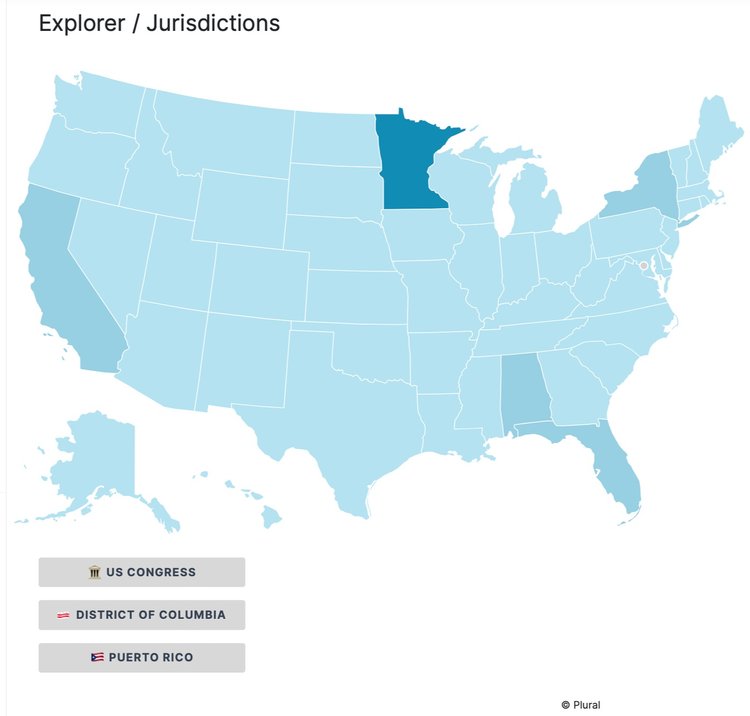
A great place to start is by researching and connecting with people on committees where many of your bills will pass through. For example, a lobbyist who works for an education non-profit will want to research the education committee members and reach out to individuals who align with their ideals. Using Plural, a lobbyist could begin with our Jurisdictions Map, locate their state, and then view all the committees in the state legislature. Plural provides the partisan party makeup of each committee and the structure of each committee. This information is valuable to a state-level lobbyist in strategizing connections and building issue awareness in order to pass essential legislation.
Remember to Follow Up
Always remember to follow up. Staying connected and relevant in today’s world can be difficult; make it a fundamental task to stay in touch with your representatives and political coalitions as a lobbyist or advocate.
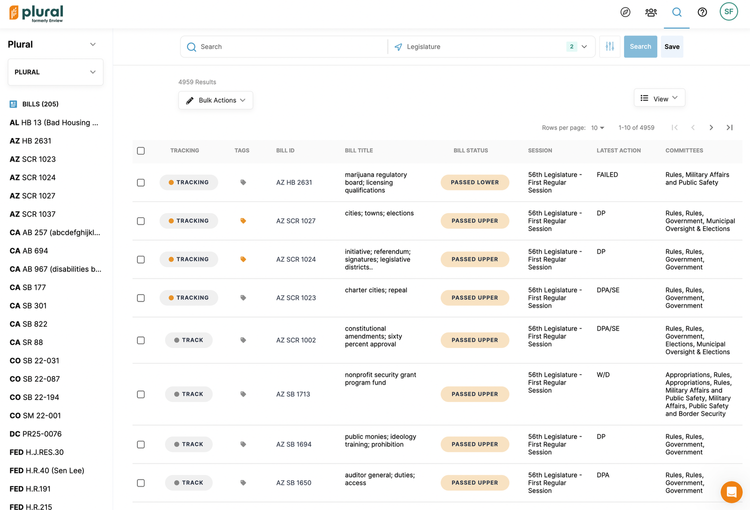
When lobbying, there will be many policies that connect to your mission and require your consistent attention. Using Plural, you can track individual bills that you are focusing on for the legislative session in your state. While tracking a bill, Plural will notify you of upcoming events and actions on the bill prior to essential vote days, or days when your bill will be read in committee you should follow up with your representatives about their necessary support. This follow-up can be a reminder of the research gathered by your organization proving that the policy would be positively impactful for the community you represent.
Plural for Lobbyists
Impacting state policy is no easy task – as such, state-level lobbying is most often a coordinated, team effort because of the level of work that it takes to make an impact on state policy. Using Plural, a small team of lobbyists can do the work of a large organization by intelligently tracking policy, keeping people connected to important events, and creating workspaces optimized for collaboration.
As a state-level lobbyist, one of your most important duties is to track multiple bills as they move through committees and chambers within your respective state capitol. Plural streamlines bill tracking so that your team can all be aware of the priority bills that will be watched most closely throughout the session. Further, as a lobbyist, it is essential to build relationships with the correct government officials, utilizing Plural you can easily find contact info for committee leadership and majority or minority leaders of the House and Senate. . Quick access to information on government officials increases democratic access by making it easier to connect with one’s representatives.
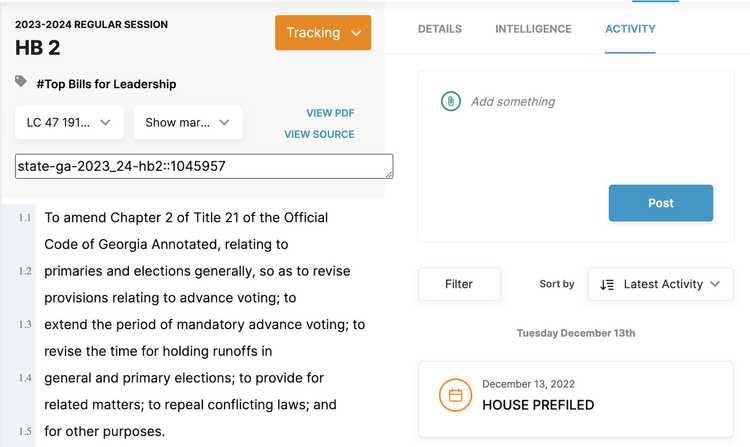
Lastly, Plural is a collaborative tool for members of your organization and team to connect with the legislative process and bill text directly. Team members can annotate bill text, highlight areas, make notes and share these actions with all members of your team to keep people informed, up to date and hold a critical eye to the text of complicated legislation.
Looking for a solution to streamline your lobbying work?
At the start of the 2023 Legislative Session, Governor Greg Abbott began his eighth year as Governor of Texas. He outlined his legislative goals in the annual State of the State address in February 2023, naming the following legislative priorities: public health initiatives, stopping the border crisis, election integrity, abortion restrictions, education, and building upon the state’s economic opportunity. Texas’ Legislative Sessions occur only every two years, making this the first session since 2021.
The Texas House of Representatives has 150 seats – 86 Republican and 64 Democratic, and the Senate has 31 seats – 19 Republican and 12 Democratic. With this balance and Abbot as Governor, all three levels of the Texan government are majority Republican-controlled.
Before the session began in January, the Republican majority shared its legislative priorities: Protect our Elections, Secure the Border, Ban Gender Modification of Children, Stop Sexualizing Texas Kids, Ban Democrat Chairs, Abolish Abortion in Texas, Defend Our Gun Rights, and Defend Parental Rights and Educational Freedom.
Key Data: 2023 Texas Legislature
Throughout this year’s Legislative Session, which took place from January 10-May 29, Texas passed 512 bills out of the 10,322 introduced that focused on economic investments, education, and healthcare. During the 2021 session, Texas passed into law 1,139 out of 12,235 introduced bills that focused on economic investments, education, public health, appropriations, and crime policy.
Legislative Trends in Texas
In 2022, the political party makeup of the federal government fluctuated from the Democrats controlling all three levels to a split government (Republican-controlled House and a Democrat-controlled Senate and Executive Branch). When a split of this nature occurs, federal legislation is less likely to pass, so the pressure was on for states to meet their parties’ legislative goals. In Texas, four key issues dominated the Legislature’s focus:
The rights of transgender individuals
Abortion access
Equity in education
Gun control
Interested in learning more? Download the full end of session report for the 2023 Texas Legislature.
Government Relations (GR) professionals often find themselves explaining their day-to-day or defining their occupation generally. When meeting non-GR folks or at family gatherings I’m consistently asked the same question: “What is it that you do again, exactly?”
I’ve even experienced this with colleagues and teams that have worked alongside GR for years.
If you’re explaining, you’re losing — right?
The Importance of Government Relations Teams
For those of us in the trade, the value of government relations is crystal clear, especially as an increasing number of industries and interests find themselves having more interaction with local, state, and federal government entities.
In the midst of the political and legislative uncertainty, government relations departments at the very least:
Make sense of the nonsense by identifying the most trustworthy and accurate tea leaves for analysis
Outline the array of legislative possibilities to come and the optimal path(s) that must be navigated to achieve our goal(s)
Manage the needs and expectations of our allies and partner organizations
Keep leadership informed and ahead of legislative outcomes, armed with the most accurate and timely information to inform their decisions
I have found one of the most valuable and useful tools to achieve each of these items outlined above is bill tracking software. But not just any bill tracking service will do. Throughout my career so far, I have used just about every tracking service out there, but none have hit the mark like Plural (formerly known as Enview).
Plural for Government Relations Teams
The timely and accurate legislative updates matched with the ease of use with Plural are phenomenal – it’s like using Facebook or Instagram but for bill tracking. Most important for my team are the collaboration capabilities, and the platform’s available options to customize the tool to the needs of our organization.
These two items have been a game changer and added so much value and impact to our work.
When we signed on with Plural, formerly Civic Eagle, in 2019, bill tracking was an occasional pesky task that usually trailed off halfway through session and would rise from the dead at some point after Sine Die when leadership asks where we landed on our priorities.
Thanks to Plural, bill tracking is now a central part of our department’s organizational operation, encompassing collaboration between multiple departments, informing decisions on the allocation of resources, and helping us illustrate the national landscape of state-based legislative sessions with specific examples and hard numbers from the more than 1,000 bills we track each year.
Defining Your Team’s Value with Collaboration and Customization
Of course, nothing in this business proves the value of GR more than outcomes. Plural has allowed us to increase our ability to engage on legislation by multiple folds. When tracking more than 1,000 bills across the country each year, the ability to create custom functions within the platform allowed us to narrow that massive, often overwhelming pile of legislation to just the most viable and impactful bills, allowing us to focus our attention on the pieces of legislation with the most effect and act accordingly.
Plural has without a doubt met our bill tracking needs with ease, providing opportunities for us to robustly engage on legislation across multiple states. However, its collaboration and customization features have really been the game changer, going beyond our expectations and helping us demonstrate our value.
I have seen first-hand how, for most, GR Departments occupy a nebulous space in the legislative process. Being couched between interest groups, trade associations, consultants, lobbyists, legal departments, and lawmakers can muddy the waters even further, leaving GR professionals searching for opportunities, examples and sometimes even the words to define their value. With Plural, that’s a problem of the past — we’re able to cut through the noise with ease and robustly define our value.
Orlando G. Jones, Jr. is the Deputy Director of Government Relations with the Secure Elections Project, dedicated to advancing pro-voter policies at the state level that modernize the voting process and ensure that every American can have their voice heard at the ballot box. A skilled government relations professional with over a decade of experience in various advocacy arenas, Orlando is a former children’s health lobbyist, U.S. Congressional House and committee staffer, and has held positions on successive presidential campaigns. Orlando graduated from Howard University with a BA in History and Philosophy and a JD from NIU College of Law.
What can we learn about upcoming legislative sessions from reviewing prefiled bills?
Midterm elections are in the rear-view mirror and (most) state legislative sessions kick off in early January. What can you do NOW to organize and prepare for the 2023 Legislative Session?
One thing you will need to stay on top of (if you haven’t already) is the release of prefiled bills. Read on for more information about prefiled bills, how they can be tracked using Plural, and trends emerging from a few key states.
What are prefiled bills?
A prefiled bill is a piece of legislation that is submitted by a legislator prior to the start of the legislative session. These bills are visible on the legislature’s website once submitted but are not formally introduced until the first day of the legislative session. Bill prefiling allows legislators and staff to have more time to draft legislation and increases the efficiency of the legislative process by allowing committee referrals and public hearings to start quickly once the session begins.
Staying on top of prefiled bills increases your awareness of top priorities for legislators heading into session and grants you extra time to organize your team so that you can prepare to act on a piece of legislation from day one.
How can I use Plural to stay on top of prefiled bills?
We expect that as many as 26 states will accept prefiled bills before their session begins and we have already seen 16 states begin to share details of prefiled bills. Once a state begins to report prefiled bills, our engineers quickly ensure that your team can view, track, and comment on that legislation right in Plural. Our Saved Search feature also allows you to notify team members when a bill matching your interests is prefiled.
Checking in on prefiled bills so far in a few key states
Georgia
The 157th Georgia General Assembly that convenes on January 9th will look quite similar to the 156th Assembly that adjourned last Spring with Republicans maintaining comfortable majorities in both the Senate and the House of Representatives. Based on the prefiled bills introduced so far, it looks like the issues of voting and abortion rights continue to remain top of mind for lawmakers. HB 1, introduced by returning Democratic Rep. Dar’shun Kendrick, would provide state financial and medical aid to pregnant women who would have chosen to terminate the pregnancy had it not been for Georgia’s newly implemented six-week abortion ban. HB 2, prefiled by Democratic Rep. Jasmine Clark, would expand early voting ahead of elections.
Texas
Texas Republicans will have slightly larger majorities in the House and Senate when their session kicks off on January 10th in Austin and lawmakers on both sides of the aisle are already busy, with more than 1,250 bills already prefiled. With so many bills already introduced, it can be challenging to identify trends, but some topics are clearly getting a lot of legislative attention:
Education & Schools – Hundreds of prefiled bills are destined for the House and Senate Public Education committees. Many bills focus on school funding, school safety, and school curricula.
Abortion Rights – Following the U.S. Supreme Court’s decision in Dobbs v. Jackson, existing laws in Texas took effect, resulting in a near-total ban on abortion access in the state. The 2023 session will see continued legislative activity on abortion rights as Democrats have prefiled bills (like SB 227 and HB 819) repealing abortion bans and Republicans have prefiled bills (like HB 61 and HB 787) seeking to limit Texans’ access out of state travel to get an abortion.
Nevada
Unlike Texas and Georgia, where Republicans control the legislative and executive branches, Nevada will open its session on February 6th with Democratic control of the House and Senate and Republican control of the Governorship. Among the bills prefiled in Nevada so far, many are focused on expanding access to behavioral healthcare, dental healthcare, and telehealth. Education will be an area of focus in Nevada as well, as Governor-elect Lombardo has indicated he will seek to expand access to charter schools and several prefiled bills offer proposed changes to how education is funded in the state.
Regardless of what state you’re working in or what issues you’re focusing on, being the first to know about legislation is key to being prepared to have an impact. Tracking prefiled bills in Plural will ensure you, and your team, have no surprises on day one.
Prep for the 2023 session
Discover more best practices for advocating your issues more efficiently and effectively. Get your copy of “How to Prepare for the 2023 Legislative Session” today!
Learn how technology can give your team a competitive edge.
Anyone who works in public policy will tell you that networking is a crucial part of the job. The nitty-gritty work of creating a coalition or gathering support often happens during in-person meetings or off-the-cuff hallway conversations.
So it was no surprise that public policy workers were skeptical of digital transformation changing how policy is created. Then the pandemic hit. Suddenly, human interaction went completely online and using digital tools to gather intelligence became crucial.
Now that we’re working in a hybrid world, technology is helping public policy teams collaborate more quickly too, whether they’re working to lift an issue up or tear it down. In-person and online.
Case in point. Public policy workers looking for key legislative data don’t have to search through slow, clunky state-run websites anymore. Today, legislative tracking software helps them understand the big picture across all 50 states.
Knowing first can mean the difference between being informed or being influential. After all, the sooner you know what bills are getting traction, the sooner you can rally your base, report back to your members, or hold legislators accountable.
Below, we’ve rounded up some ways technology is helping public policy teams do just that.
Impacting Language on Bills As They Evolve
Being in the know faster can inform your lobbying efforts for maximum effectiveness.
Let’s say your public policy team is working on legislation for police officers wearing body cameras while on duty. It’s unlikely that every bill will include your preferred clauses or sections.
If you know the phrase “Only law enforcement officers with the authority to conduct searches and make arrests shall be permitted to wear a body camera” has a better chance of passing, then you can suggest that to bill authors.
Rather than checking a legislature website or visiting the legislature yourself, you can take advantage of technology that notifies you about changes in a bill’s language. Then, you can share your preferred language directly with the bill’s author, improving your chances of getting a bill you want headed towards a vote.
You can also collaborate on legislation session strategy within your public policy software. Once the author backs your bill language, you can tell everyone on your team to begin putting their efforts behind this new version of the bill right away. A quick email to your base gets everyone on the same page about next steps.
Acting on Crucial Updates Affecting Your Issue
When Georgia passed a law making it illegal to hand out food and water to those waiting in line to vote in 2021, two Plural clients—Pro Georgia and America Votes Georgia—were notified about the law’s updated language right away via the bill monitoring feature on Plural.
With Georgia legislators using stall tactics to avoid releasing the language in the bill as long as possible, not having to rely on manual checking of the Georgia legislature website paid off. Both groups got the intelligence they needed to spring into action.
Not only did they receive a notification about the language in the bill, but the information was also easier to ingest. Plural’s color coding feature made it easy to see the changes in language from previous bills and understand the situation at hand more clearly.
Taking Advantage of Intelligent Search
Technology has also made following issue developments far more effortless, speeding up how quickly public policy teams can spring into action.
From having live news updates on our phones at all times to tools that make it as easy to collaborate across oceans as it is across a conference table, software specifically built for policy professionals can truly transform the way teams work together and supercharge their bandwidth.
For example, Plural allows you to customize your search so your team knows to take action when it matters most. You can search by state, issue, legislator, or bill number.
With its new Saved Search feature, you can also set up your search to show any movement happening within a specific period, like the first two weeks of session or the last two weeks of session. You can save that search to target key areas of information.
With a tool like this, you get to call the shots. You can set up alerts to show you what you’re most interested in, cutting down the time it takes to search through multiple state websites.
No matter your issue—climate change, voting rights, healthcare reform, immigration, education, or something completely different—public policy software can simplify and streamline your efforts.
Bottom line? Having all of your issue’s moving pieces in one central place can help your team zero in on what updates matter to you and which language changes are going to have the greatest impact on your efforts.
Did your public policy team give it their all during the home stretch of the state legislative session? It may seem like the time to rest, but if you’re between sessions, there’s still plenty your team can do to keep advancing your issue.
To help you hit the ground running, we’ve rounded up how you can use your legislative technology tools between sessions to get ahead. Trust us, you don’t want to wait until the session starts to get your ducks in a row.
Read on for tips to optimize your strategy, streamline your public policy team communications, and be prepared for any special sessions.
Tactic 1: Understand Your Impact During the Legislative Session
When the 2022 legislative session ends, it’s the perfect time to refine your strategy for 2023.
Plural client Campaign Zero uses Plural to take a deep dive into the issues, researching the bill language that passed and analyzing the data from past sessions to inform future policy.
As you look over the data, your policy team can ask:
Which issues got traction and which bills died?
Which strategies worked and which ones didn’t work?
What bill language passed that we can use going forward?
Another important part of your policy team’s audit? Communication and conversations with your community once the session is over. With legislative tracking software like Plural, you can use public tags to draw attention to key findings or export data to share at a debrief meeting.
Finally, public policy teams may know how issues played out in their own state, but between sessions is an ideal time to look at what happened in other states. Capturing those details can inform your action plan for the next session.
Tactic 2: Streamline Communication and Capture Relevant Details
Instead of reverting back to email to communicate once the session is over, continue to use your legislative tracking software to organize your public policy plans and keep everyone in the loop.
Not only can you sum up wins and losses from the previous session, but you can also use Plural’s Workspaces feature to capture relevant threads of conversations in a central place, so your public policy team can easily find what they need. You can even create a Workspace just for sharing information with your community, membership, or public policy leaders. Plural client YWCA of Minneapolis took advantage of this feature to get the word out to community members.
Tactic 3: Brush Up on Your Knowledge of Legislators and Build Relationships
Even when the legislature is not in session, your team will need to continue to build relationships with elected officials who may become authors of sponsored legislation.
For that reason, between sessions is an excellent time to see what bills legislators authored, and whether or not they ended up being co-author of a bill affecting your issue. You can use this information to decide which legislators you want to build relationships with going forward.
You can also use your legislative tracking software to update your team on any elections where a member or senator is in danger of being replaced—and make a plan of action ahead of the next session.
Tactic 4: Be Prepared to Act During Special Sessions
While a state legislative session has a finite start and end date, special sessions can be called in most states at any time.
The COVID-19 pandemic and Supreme Court decisions putting trigger laws into effect are just two recent examples of this often-overlooked tactic. You’ll want to keep using your legislative tracking software to stay on top of any emerging developments.
Just ask the Center for Economic Inclusion (CEI). During the pandemic, CEI tracked multiple special sessions in Minnesota to see what policies would impact their communities. Plural helped them stay organized and connected to their community.
At the same time, lawmakers may not be passing legislation between sessions, but your public policy team will still want to stay on top of what’s happening at the Capitol. There may be hearings or committee meetings that will affect your issue when the session returns.
Use Your Legislative Tracking System Year-Round
State legislative sessions are usually short—public policy teams must make the most of every moment.
Plural is a tool designed to keep your public policy team ready to for action at all times. So when a new session starts—or a special session is called—you don’t have to rebuild your efforts from the ground up across multiple channels. Using Plural between sessions will have your team ahead of the curve and ready to keep focusing on the win from day one.
There are only so many days in each state legislative session—your public policy team needs to make every day count.
At the beginning of a session, you’re focused on deadlines—finalizing bill language, getting your bill in front of committee chairs, earning support for your issue. But at the halfway mark, the focus shifts and it’s all about reaching the finish line, convincing members of different parties to vote for your bill when it hits the floor.
An organized legislative session strategy can help you stay in the game—and advance your issue—until the very end. Even if your bill is dead in the water during the second half of the session, you can still make an impact, especially if you use a legislative tracking system to guide your game plan.
To help you make the most of every single day in session, we’re highlighting three legislative tactics to keep in mind.
Tactic 1: Stay on Top of Legislation Still in Play
Once the session is halfway over, it may be clear your bill won’t be the one that passes and becomes a law. But you can still fight the good fight.
Did another senator sponsor legislation similar to yours? Did a representative “Frankenstein” a bill so it includes your bill too? You can use a legislative tracking system to find out.
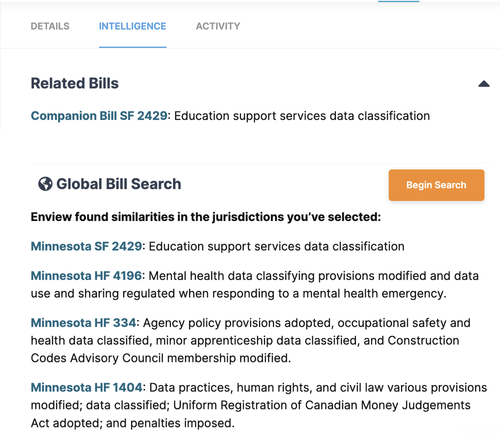
In Plural, for example, you can perform what’s called a Global Bill Search. The solution uses artificial intelligence to compare your proposed legislation to other bills being considered in the current session, enabling you to find ones like yours championing the same issue.
Soon, you will also be able to do a Possible Omnibus Search, which reveals if your bill has been packaged together with several measures into a larger bill, called an omnibus. (Plural currently offers this feature for Minnesota and plans to expand it to all states.) The solution scans the language in your bill and matches it with similar text in other bills.
If you’re unaware of the legislation still in play this late in the session, you could miss out on a chance to advance your issue. Your public policy team can use a legislative tracking system to stay organized and lend support to these similar bills.
lobal Bill Search in Plural
Tactic 2: Make a Team Member Your Early Warning System
At this later stage of a legislative session, members and senators may schedule last-minute meetings and make behind-the-scenes deals you can’t know about without some extra effort.
Keeping an ear to the ground to learn of the latest developments will help your public policy team be ready to take action. Have one person on your team take on this important role to help you remain informed. The team member reaches out to colleagues to ask if they’ve heard anything and contacts everyone on the committee reviewing your bill before reporting back with what they discover.
Time is of the essence, so email is the wrong tactic for collaborating with your public policy team. Instead, consider software like Plural, built specifically to facilitate collaboration.
The solution’s Workspaces feature allows you to capture relevant notes and easily alert your team about pressing action items. You can also find the contact information for key senators or members right in the solution, saving you time searching for policymakers outside the committee who may have influence.
Tactic 3: Organize Your Public Policy Strategy for Next Session
As the session winds down, there’s still work you can do to advance your issue, especially for the next session. (There’s also a small chance your bill may be revived and end up passing in a special session called after the regular session ends, so there’s that.)
Fine-tuning your strategy based on what you learned during this session can help you win next time. One helpful strategy is to export the relevant data—tags, notes, contacts—from your legislative tracking system into a spreadsheet for analysis. If you’ve been using Plural throughout the session, this step should be seamless.
Then, you can review all of the data you’ve tracked, organizing key tactics and measuring results to improve your strategy for next time. So your team can seize the day another day.
Policy work has changed by leaps and bounds over the last two years, as a result of digital transformations spurred by the pandemic. Political pros have had to quickly adapt to a new remote-only environment to stay on top of their political game. It’s a sharp departure from a world that depends on attending hearings and meeting with legislators, staffers, and activists face-to-face.
With continued uncertainty and new variants of COVID-19 spreading rapidly, teams that are successfully using more digital tools for efficiency and collaboration will be better positioned to influence and win legislative battles in 2022.
The Adjustment
If you work in policy, then you saw first-hand many of the bumps in the road as legislative bodies adjusted to virtual work. Not only did you have to get your teams set up to work from home, you also had to figure out ways to keep the pressure on lawmakers when you could no longer go to the statehouse.
Everything needed to be moved online — gone were the days of passing notes during hearings, stopping by offices, or counting votes on a whiteboard in the office. Knowledge needed to be shared, and situational updates on legislation needed to be stored in an accessible space.
“And then when the pandemic hit, we all went into our homes and had to figure out ways to interact with staff and members, and it was a daunting task at first, logistically, just to figure out where people were and the best way to get in contact with them… so that was a really huge mountain to climb in the beginning.”
— Orlando Jones, Secure Elections Project
As lawmakers adapted to virtual hearings, we also saw the volume of work increase. Legislation often moved faster, and policy teams that didn’t have efficient virtual teams and systems could easily fall behind.
In the year and a half since the pandemic began, we’ve learned a lot about how to manage workflow in this new, emerging environment. So what can you do now to prepare for your next legislative session — whether it’s virtual or not?
Digital Tools Are No Longer A “Nice To Have”
The transition to remote work made it immediately clear that digital collaboration tools are a necessity, not just an “extra.” This was only made more important by the observation that legislation moved faster than ever, with lawmakers jamming more and more hearings into the calendar.
This faster pace will continue in 2022 and beyond. And there are a few key areas where well-designed digital tools can provide a necessary boost:
Legislative intelligence AI tools that identify important legislation and monitor it as it moves through committee can save hours a day over manually tracking moving legislation. Discussions and assignments can even happen directly in tracking tools
Contact tracking As policy staff interact with lawmakers, staff, and activists over a variety of mediums, having all of that information in one, accessible place is crucial.
Coalition work With multiple organizations working on similar issues, or supporting or opposing the same bills, it’s never been more vital to ensure everyone is on the same page.
Before the pandemic, many organizations were using ad-hoc solutions to track the large amount of information that now needed to be shared virtually. Data lived in spreadsheets, scattered documents, email messages, texts, and chats.
Now, more than 16 months in, organizations are taking a critical look at how they work, to ensure a deliberate approach that fosters efficiency and effective collaboration.
The “New Normal” Is Here To Stay
With 2022 sessions looming around the corner, there’s little doubt that the pace of legislative work will only continue to quicken. For anyone working to influence legislation, keeping up with an ever growing workload will require new levels of efficiency.
At the same time, many facets of the pandemic environment, such as more virtual hearings, will continue. While this allows participation from any location — it also increases the likelihood of staff burnout. Utilizing tools that allow for real-time, secure sharing of notes and resources is vital not only for efficiency but to allow smooth handoff of work between staff.
Hear from The Pros
Want to know more about how teams have successfully leveraged remote work? Watch our webinar featuring speakers working on two hot button issues — voting rights and clean energy.