
Category: Government Relations

  • Your Government Affairs Team Saw It Coming. So Why Is Compliance Still Catching Up? 

    Your Government Affairs Team Saw It Coming. So Why Is Compliance Still Catching Up? 

    Every day, Government Affairs teams monitor legislative activity across Congress and state legislatures, looking for policy shifts that could affect their organizations. They track emerging issues, assess potential business impacts, and brief leadership long before most employees are aware that regulatory change may be on the horizon. As legislative activity continues to accelerate across industries, that early visibility has become an increasingly valuable business asset. 

    Yet many organizations still find themselves scrambling to implement new regulatory requirements after they take effect. 

    Why? 

    In many cases, the issue isn’t a lack of information. It’s what happens after that information is gathered. 

    Government Affairs knows what’s coming. Compliance knows how to respond. But in many organizations, those functions still operate independently, with legislative intelligence ending where compliance execution begins. Valuable context can be lost during hand-offs, implementation timelines become compressed, and teams often spend time recreating work that has already been done elsewhere in the organization. 

    As regulatory expectations continue to grow, organizations are finding it harder to justify disconnected approaches to legislative monitoring and compliance management. Increasingly, the conversation is shifting toward how those functions can work together throughout the regulatory life cycle rather than operating as separate disciplines. 

    Regulatory Preparedness Begins Long Before a Law Takes Effect 

    Many organizations still approach regulatory change as a reactive process. Compliance teams become heavily involved once legislation has been enacted or a regulatory agency publishes final guidance. From there, they begin interpreting requirements, assigning ownership, updating policies, implementing controls, and documenting organizational responses. 

    While that approach has long been standard practice, it leaves one valuable resource largely untapped: time. 

    Between the introduction of a bill and its eventual implementation is an opportunity for organizations to prepare rather than react. Government Affairs teams often have visibility into proposed legislation months before Compliance becomes involved. That window gives organizations time to evaluate operational impacts, identify potential risks, engage business stakeholders, and begin implementation planning before deadlines arrive. 

    Consider a financial institution tracking proposed state privacy legislation. Government Affairs may identify the bill early in the legislative process, giving Compliance an opportunity to assess policy changes, engage business owners, and prepare implementation plans before the law is enacted. Without that coordination, much of the work begins only after the legislation becomes effective, leaving teams to work against compressed timelines. 

    Organizations that respond effectively to regulatory change recognize that preparedness doesn’t begin when legislation becomes law—it begins when meaningful legislative activity is first identified. 

    Plural connects government affairs with regulatory affairs

    The Cost of Disconnected Workflows 

    Government Affairs and Compliance often pursue the same objective from different starting points. 

    Government Affairs focuses on monitoring legislation, analyzing policy developments, and helping leadership understand how proposed laws could affect the business. 

    Compliance translates finalized regulations into policies, controls, documentation, and operational processes that meet regulatory expectations. 

    Neither function is ineffective on its own. The challenge is making sure the work of one naturally informs the work of the other. 

    Every manual hand-off creates friction. Every disconnected workflow increases the likelihood that important context is delayed, duplicated, or overlooked. Legislative analysis completed by Government Affairs may later be recreated by Legal or Compliance. Business units receive information at different stages, making implementation more difficult to coordinate. Leadership, meanwhile, often receives separate updates from multiple departments rather than a single, enterprise-wide view of regulatory readiness. 

    Those gaps become more noticeable as legislative activity expands across federal and state jurisdictions. Organizations need more than strong legislative monitoring or mature compliance programs on their own—they need continuity across the entire regulatory change process. 

    Connecting Legislative Intelligence with Compliance 

    Many organizations are beginning to rethink how Government Affairs and Compliance work together. 

    Rather than treating them as separate business functions, they’re creating connected workflows that allow legislative intelligence to move naturally into regulatory change management. 

    Instead of waiting until a law is finalized, Government Affairs can share emerging legislative developments with Legal, Compliance, Risk, and business leaders while proposals are still evolving. Compliance teams gain additional time to evaluate potential obligations, assign ownership, prioritize resources, and prepare documentation before implementation deadlines arrive. 

    The approach doesn’t replace existing Government Affairs or Compliance programs. It gives both teams more context and more time to do what they already do well. 

    By connecting legislative awareness with operational execution, organizations can improve visibility, strengthen collaboration, and support more informed decision-making across the enterprise. 

    How Plural Bridges the Gap 

    One company addressing this challenge is Plural, whose platform is designed to connect Government Affairs with downstream compliance workflows. Rather than treating legislative monitoring as a standalone activity, Plural enables organizations to carry legislative intelligence into broader governance, legal, compliance, and risk management processes. 

    The objective is straightforward: reduce the gap between identifying regulatory change and preparing the business to respond. 

    Government Affairs teams can surface emerging policy developments while legislation is still moving through the legislative process. Compliance, Legal, and Risk teams gain earlier visibility into those developments, allowing them to assess potential obligations, coordinate internal stakeholders, and begin planning well before implementation deadlines. 

    The result is greater alignment across departments and a more proactive approach to regulatory readiness. 

    Government Affairs gains confidence that legislative insights continue driving organizational action long after a bill is identified. 

    Compliance benefits from earlier visibility into emerging requirements, allowing teams to plan strategically instead of reacting under pressure. 

    Executives gain a clearer understanding of regulatory risk, implementation progress, and organizational preparedness through a more connected governance framework. 

    The Future of Regulatory Change Management 

    Legislative and regulatory complexity shows little sign of slowing. Organizations continue to navigate expanding legislative activity, evolving regulatory expectations, and growing pressure from regulators, investors, and other stakeholders to demonstrate effective governance. 

    Success will depend not only on tracking legislation or maintaining a strong compliance program, but on how effectively organizations connect those capabilities. 

    As Government Affairs, Legal, Compliance, and Risk functions become more interconnected, organizations that can move legislative intelligence efficiently across departments will be better positioned to evaluate risk, coordinate implementation efforts, and respond before regulatory changes become operational challenges. 

    Most organizations have already invested in legislative monitoring. They’ve also invested heavily in building mature compliance programs. 

    The next step isn’t replacing either function. 

    It’s making sure they work together. 

    Get Started Today.

    Experience the power of Plural first-hand with a free account or schedule a demo for a live walk through of the platform. Find out how Plural can transform the way you and your team shape policy.

  • The Future of Lobbying: How Data, Technology & Policy Intelligence Are Reshaping Government Affairs 

    The Future of Lobbying: How Data, Technology & Policy Intelligence Are Reshaping Government Affairs 

    Relationships still win. But in a world where your counterpart may have already mapped the legislator’s voting history, tracked the coalition forming against your issue, and flagged the model bill moving in six other states, showing up unprepared in government affairs is a disadvantage. 

    The government affairs profession is not changing because technology is replacing what lobbyists do. It is changing because technology is raising the floor of what “prepared” means. 

    A generation ago, being well-prepared for a legislator meeting meant knowing the member’s background, understanding their district, and having a clear ask. That is still true. What has changed is the context surrounding that meeting: the data layer that informs who you’re meeting with, what they’ve been working on, which bills they’ve sponsored this session, how they voted on related issues two sessions ago, who else is lobbying them on this issue, and what similar legislation is moving in states that tend to predict their own chamber’s priorities. 

    That information has always existed. It was expensive to gather, time-consuming to synthesize, and largely the province of the most connected and well-resourced practitioners. Technology is now democratizing access to this information and accelerating it. And that acceleration is creating a gap between the government affairs functions operating with intelligence infrastructure and those still relying on memory, spreadsheets, and periodic email digests. 

    This post is about that gap. Where it is, how fast it is growing, and what practitioners at every stage of the adoption spectrum need to do to stay on the right side of it. 

    The best lobbyists have always been the best prepared. What has changed is what it takes to be prepared and how quickly the standard is rising. 

    Damola Ogundipe
    CoFounder, Plural Policy

    What is changing about the lobbying profession and what isn’t 

    Start with what is not changing, because the noise around technology in government affairs often obscures it. 

    Relationships are not becoming less important. Trust between a lobbyist and a legislator — built over years of credible, consistent, honest engagement — is not something data produces. A legislator who takes your call is doing so because of a track record, not because you have a good dashboard. The people in a room, the credibility of the ask, the quality of the argument, the ability to read the dynamic and adjust in real time — none of that is being automated. 

    What is changing is the preparation that precedes those moments, the coverage that makes those moments possible at the right time, and the organizational intelligence that connects what happens in one chamber or one state to what is likely to happen in another. 

    Specifically, three things are shifting in ways that matter for every practitioner and every enterprise government affairs function: 

    • The volume of relevant legislation has outscaled manual monitoring. State legislatures collectively introduce more than 200,000 bills per session. Federal regulatory activity generates thousands of additional changes annually. No team, regardless of experience or institutional knowledge, can monitor that volume manually without developing structural blind spots. 
    • The pace of cross-state legislative activity has accelerated. Model bills — identical legislation coordinated by national advocacy organizations — now spread across state lines within a single session cycle. A government affairs team that is only watching its home state is watching yesterday’s policy landscape. 
    • Client and executive expectations have risen. Clients expect real-time intelligence, not weekly summaries. Executives expect their government affairs function to brief proactively — before floor votes, not after. The standard of “keeping up” has been replaced by a standard of “seeing ahead.” 

    None of these changes make relationships less important. They make the intelligence that supports relationship-based advocacy more important and more decisive.

    Legislator intelligence: what it means to show up prepared 

    The single most underused category of data in government affairs is legislator intelligence — not as a surveillance tool, but as preparation infrastructure. 

    Every legislator has a record. The bills they have sponsored. The committees they sit on and their role within those committees. Their voting history on related issues. The advocacy organizations that have donated to their campaigns. The districts they represent and the industries that employ those districts’ residents. Their public statements on policy issues. Their track record of moving legislation to passage versus introducing bills that never advance. 

    This information is public. It has always been available to anyone willing to spend the time to compile it. What has changed is the speed and completeness with which it can be assembled, and the way it can be mapped to your specific advocacy agenda. 

    What data-informed legislator engagement looks like in practice 

    The lobbyist who walks into a meeting with a legislator knowing that the member has sponsored three bills in the current session related to consumer data privacy — two of which cleared committee — is in a different conversation than one who knows only that the member sits on the Commerce Committee. 

    Legislator intelligence does not replace the relationship. It deepens it. When a lobbyist arrives to a meeting already briefed on a legislator’s recent priorities, their conversation can move past the introductory positioning that burns so much of a limited meeting window. They can reference specific votes. They can acknowledge work the legislator has already done on the issue. They can connect their ask to the legislator’s existing legislative record rather than presenting it in isolation. 

    This is what “data determines who shows up prepared” means in concrete terms. Not that the data creates the relationship, but that it elevates the quality of the engagement that builds it. 

    What to track on every legislator in your portfolio 

    • Current session bill sponsorships and co-sponsorships — especially any related to your issue area 
    • Committee assignments and role (member, vice-chair, chair) — chair status is predictive of bill advancement 
    • Voting history on related issues across the current and prior two sessions 
    • Floor statements and public testimony on your issue area 
    • Campaign finance connections to relevant industries and advocacy organizations 
    • Whether they are in a competitive district — electoral pressure shapes policy priorities 
    • Bills they introduced that died in committee — these often return in subsequent sessions 

    How the highest-performing government affairs teams structure their intelligence cycle 

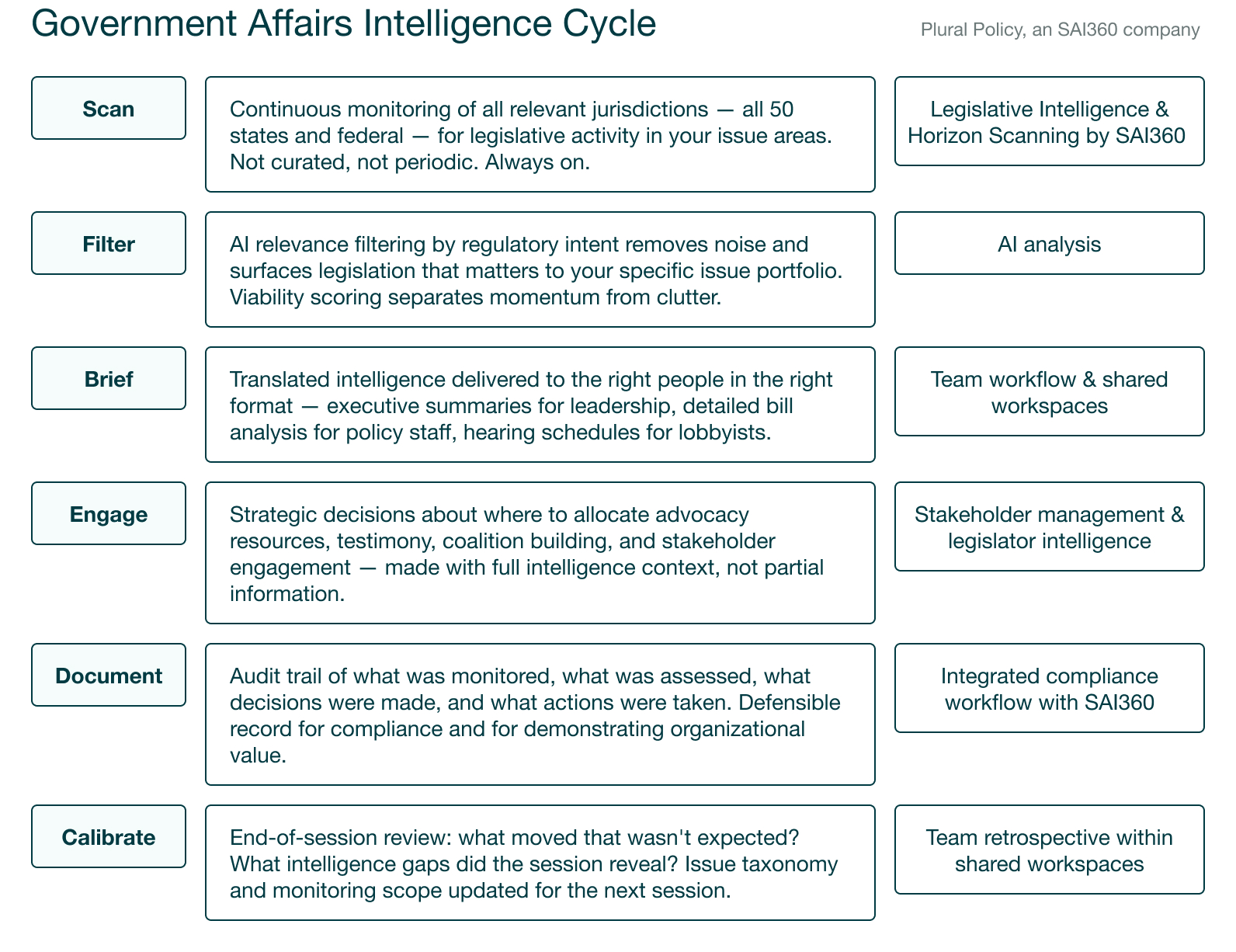
    The organizations that consistently outperform their peers in government affairs do not just have better tools. They have a more deliberate process — a structured intelligence cycle that converts legislative monitoring into organizational action, and that runs consistently whether the session is active or quiet. 

    The six-phase cycle below maps how these teams operate — and where each phase depends on data, technology, or the human judgment that no platform replaces. 

    The most important insight from this cycle is the final phase: calibration. The teams that consistently outperform are the ones that treat each session as a source of learning — reviewing their intelligence coverage, identifying what moved unexpectedly, updating their issue taxonomy, and adjusting their monitoring scope before the next session begins. 

    This discipline is not common. Most teams move from session to session without a formal retrospective. The ones that build it in compound their intelligence advantage over time, rather than starting each session with the same coverage gaps they had before. 

    What this means for the next generation of government affairs professionals 

    If you are earlier in your government affairs career, the transformation underway in the profession is not a threat to what you are building. It is a clarification of what to build. 

    The skills that made government affairs professionals valuable in the past remain valuable. What is being added is a new layer of technical fluency — not the ability to build software, but the ability to work intelligently within data and intelligence systems, interpret what they surface, and integrate that intelligence into the relationship-based practice that defines the profession. 

    The practitioners who will lead government affairs functions in the next decade will be the ones who are comfortable operating at the intersection of relationship credibility and data-informed strategy. They will use legislative intelligence platforms the way their predecessors used a Rolodex — not as a substitute for judgment, but as the infrastructure that makes judgment more reliable. 

    The transformation is already underway, the only question is where you are in it 

    The lobbying profession is in the middle of a technology transformation. The tools exist. The data is available. The organizations that have invested in building intelligence infrastructure around their government affairs functions are already operating with an advantage that compounds with each session. 

    That advantage is not primarily about technology. It is about preparation — the quality of the briefings, the precision of the engagement, the speed of the response, and the organizational confidence that comes from knowing your policy coverage has no structural gaps. 

    Relationships still win. They always will. What data and technology determine is who shows up to those relationships prepared to make them count. 

    Ready to see what your team is missing?

    Plural Legislative Intelligence powered by SAI360 gives government affairs teams real-time visibility into state and federal legislative activity — with AI-powered bill analysis, viability signals, and stakeholder engagement workflows built in. 

    And it’s the only platform that combines with integrated compliance workflow. Learn more by scheduling a live walkthrough.

  • AI Tools for Government Affairs: What Enterprise Teams Actually Need

    AI Tools for Government Affairs: What Enterprise Teams Actually Need

    If your team operates across dozens of states, inside a complex organization, with compliance and legal in the loop — you need something built to a different standard. 


    The government affairs technology market has a categorization problem. 

    When someone searches for “AI tools for lobbyists” or “digital tools for government affairs,” they get a mixed result set. Individual practitioner tools sitting alongside enterprise platforms, bill alert subscriptions next to integrated intelligence systems, software built for a single-user firm next to tools designed for a team of twenty inside a Fortune 500. 

    These are not the same product. They are not solving the same problem. And for enterprise government affairs teams, picking the wrong one does not just mean a suboptimal user experience, it means building your policy intelligence infrastructure on a foundation that will break under the weight of what you’re actually asking it to do. 

    This post draws a clear line between AI tools designed for individual lobbyists and what enterprise government affairs functions — teams operating across multiple states, inside complex organizations, with compliance and legal stakeholders in the loop — actually require. 

    Government affairs tools for both enterprises and lobbyists

    Lobbyists and enterprise government affairs leaders share a profession and many of the same skills.  

    A lobbyist at a boutique firm is typically managing a defined client portfolio, focused on a set of specific issue areas, operating in jurisdictions their clients care about, and producing outputs — briefings, reports, testimony prep — for a small number of decision-makers. Their technology needs are real and bounded: fast bill summarization, relevant alerts, clean search, and a way to export findings for client presentations. 

    An enterprise government affairs leader operates differently. Their team may span a dozen or more professionals. They monitor legislation across every state where the organization has material regulatory exposure, which, for healthcare, financial services, manufacturing, or data-intensive companies, is often all fifty. At enterprises, the intelligence needs to flow to compliance, legal, communications, and executive leadership, not just stay within government affairs. And they carry accountability for a policy posture that, if it has gaps, creates enterprise-level risk. 

    The tools built for the individual lobbyist use case are good. At scale, the organizational complexity of enterprises may need additional technical layers. 

    FeatureAI tools designed for lobbyists Enterprise government affairs tools 
    Primary user Individual lobbyist or small team Multi-person government affairs dept + compliance, legal, comms 
    Coverage needed Client-selected jurisdictions All 50 states + federal, always on 
    Issue breadth Focused client portfolios Cross-functional issue landscape across the enterprise 
    Output format Client reports, call prep notes Executive briefings, risk registers, compliance triggers 
    Collaboration model Single-user or small group Shared workspaces, role-based access, team workflows 
    Integration with GRC Not required Essential — intelligence must flow to compliance action 
    Alert logic Any change on tracked bills Stage-specific, role-aware, priority-weighted 
    Audit / documentation Not a core requirement Full trail from legislative signal to compliance response 
    Viability prioritization Helpful but not critical Required — too many bills to monitor equally at scale 

    The connection to GRC and compliance workflow is the difference for enterprise software. Individual lobbyist tools stop at the delivery of intelligence. Enterprise tools need to connect that intelligence to the systems where compliance obligations are managed, policies are updated, and organizational responses are documented. With that connection, legislative intelligence transforms from information into action. 

    What enterprise government affairs teams actually need from their AI tools 

    1. Intelligence that scans everything, not just what you’ve selected All 50 states plus federal, continuously monitored — not a curated watch list that depends on your team knowing what to include upfront.
    2. AI that reads bill intent, not just bill text Natural language analysis that surfaces relevant legislation even when your keywords don’t appear verbatim. Omnibus bill detection. Model bill identification across states. 
    3. Viability signals that focus attention Momentum scoring based on committee composition, sponsor patterns, and session dynamics, so your team knows which bills deserve deep engagement and which don’t. 
    4. Team workflows and individual dashboards Shared workspaces, role-based access, bill ownership, annotation, and collaboration tools built for a multi-person team with internal and external stakeholders. 
    5. Stage-specific alerts that give you time to act Notifications configured by lifecycle stage (committee clearance, floor referral, passage) alerts every time anything changes on a tracked bill. 
    6. Integration with compliance and GRC infrastructure The intelligence layer connects to policy management, regulatory change management, and risk registers so what your team monitors becomes what your organization responds to. 

    What good AI actually does in a government affairs context 

    The phrase “AI for government affairs” appears in a lot of vendor materials. It means different things depending on the product, and enterprise buyers should ask specifically what the AI is doing, not whether it exists. 

    These are the applications of AI in legislative intelligence that deliver genuine value for enterprise teams, in descending order of impact. 

    AI that summarizes and analyzes bill content 

    Legislative text is dense, cross-referenced, and written for legal precision rather than readability. AI that reads bill text and produces plain-language summaries — covering the bill’s scope, its key obligations, the industries it affects, and the effective date — saves meaningful time and reduces the risk of mischaracterization that comes from rapid manual review. 

    AI that identifies patterns across jurisdictions 

    State legislatures do not operate in isolation. A data privacy bill that passes in California frequently becomes a model for legislation introduced in a dozen other states the following session. An enterprise government affairs team that can identify model bills and companion legislation across states sees the regulatory landscape differently than one that monitors each bill in isolation. 

    This pattern recognition — connecting similar bills across jurisdictions, surfacing model legislation, flagging when the same regulatory concept is gaining traction simultaneously in multiple states — is where AI creates the most distinctive value for enterprise teams. It is also the capability most likely to be absent from individual lobbyist tools. 

    AI that scores momentum with real signal 

    Not every bill deserves the same level of attention. The challenge for enterprise teams monitoring hundreds of bills across dozens of jurisdictions is that without a prioritization layer, everything looks equally urgent, which means nothing gets the depth of engagement it deserves. 

    AI momentum scoring that analyzes committee composition, sponsor history, hearing schedules, floor referral patterns, and cross-session historical data gives teams a prioritization signal they can act on. The key word is signal — not a score padded by recency or surface-level activity, but a genuine predictive assessment of whether a bill is likely to advance. 

    AI that connects legislative intelligence to the compliance workflow 

    The most underappreciated application of AI in enterprise government affairs is the handoff. When a relevant bill passes and creates a new obligation, the question is not just whether your team knew about it — it is whether that knowledge triggered the right response in the right system at the right time. 

    AI that reads a newly passed bill, extracts the compliance obligations it creates, and routes those obligations to the appropriate workflow in your policy management or regulatory change management system closes the gap between knowing and doing. That is where legislative intelligence becomes compliance infrastructure. 

    The government affairs function is being redefined and the technology is catching up 

    For most of the past two decades, the government affairs function was differentiated primarily by relationships. The practitioners who had access, who knew the right people, who could get a meeting when it mattered — those were the ones who delivered value. Technology was a support tool, not a strategic asset. 

    That is changing. Not because relationships matter less — they are as important as ever. But because the volume of legislative activity has grown past what any relationship network can monitor comprehensively, and because the enterprises that are winning now are the ones whose government affairs intelligence reaches the whole organization, not just the people who attend state capital briefings. 

    The government affairs leaders who will define the next decade of the profession are the ones who are building this kind of infrastructure now by utilizing AI to give them the coverage, the prioritization, and the organizational reach to do it at a scale that was previously impossible. 

    Plural Legislative Intelligence: built for enterprise government affairs

    Our Legislative Intelligence monitors all 50 states and federal activity continuously — with AI bill analysis, predictive viability signals, team collaboration tools, and direct integration with enterprise GRC and compliance workflow. Built for the way enterprise government affairs teams actually operate. 

    Ready to see what your team is missing?

    Plural Legislative Intelligence powered by SAI360 gives government affairs teams real-time visibility into state and federal legislative activity — with AI-powered bill analysis, viability signals, and stakeholder engagement workflows built in. 

    And it’s the only platform that combines with integrated compliance workflow. Learn more by scheduling a live walkthrough.

  • Legislative Intelligence in the Enterprise: Why Manual Monitoring Is a Liability and What to Do Instead 

    Legislative Intelligence in the Enterprise: Why Manual Monitoring Is a Liability and What to Do Instead 

    The spreadsheet your team is using to track legislation isn’t just inefficient. It’s a documented risk to your compliance posture. Here’s why and what replaces it. 


    Somewhere in your organization, there is a spreadsheet. 

    It might be called “Legislative Tracker Q1” or “State Bills — Active” or something more creative. It lives in a shared drive. Someone updates it when they remember. It has columns for bill number, state, status, owner, and notes. It was built with good intentions by someone who genuinely needed a way to manage the volume of legislation your team is responsible for monitoring. 

    And it is quietly failing you. 

    Not because the person who built it was wrong, or the team using it isn’t diligent. It’s failing because it was never designed for what you’re asking it to do. Manual bill tracking, through spreadsheets, email alerts, and periodic website checks, was built for a legislative environment that no longer exists. The volume of regulatory change has grown too large, the pace too fast, and the consequences of missing too significant for that infrastructure to hold. 

    This post explains why manual bill tracking creates compliance risk, what the failure modes look like in practice, and what AI-powered legislative intelligence actually does differently. 

    What bill tracking is and what it actually requires 

    Bill tracking is the practice of monitoring legislation — from introduction through committee review, floor vote, and final passage — to identify laws and regulatory changes that affect your organization before they take effect. 

    For compliance and legal teams, effective bill tracking is not a convenience. It is a core risk management function. A regulatory change you don’t know about creates compliance gaps. A bill that passes without your team’s awareness creates obligations your policy documentation doesn’t reflect, audit trails that don’t capture the right obligations, and potentially significant exposure at exactly the moment a regulator asks how you stayed current. 

    Done well, bill tracking gives compliance teams three things: 

    1. Early warning: Identifying legislation that could create obligations before it becomes law — when there is still time to assess impact, update policies, and engage if necessary. 
    1. Prioritization: Knowing which bills have genuine momentum versus which are unlikely to advance — so the team’s attention goes where it matters. 
    1. A defensible record: Documentation that your organization monitored, reviewed, and responded to regulatory change in a systematic and auditable way. 

    Manual bill tracking, at best, delivers a partial version of these features. 

    The five ways a spreadsheet fails your compliance team  

    Manual bill tracking systems — spreadsheets, email alert subscriptions, and periodic manual checks of legislative websites — share a common set of structural failure modes.  

    1. Coverage is always incomplete 

    A team that is manually monitoring legislation can only monitor what they’ve explicitly chosen to watch. That means pre-selected states, pre-selected issue areas, and pre-selected keywords. What it doesn’t capture: the bill introduced in a state you weren’t watching, the amendment added in committee in a jurisdiction you assumed was low-risk, the emerging regulatory pattern taking shape across a cluster of states you had deprioritized. 

    Regulatory exposure does not confine itself to the states on your watch list. Legislation that passes in one state frequently triggers similar activity in others, sometimes within the same session, sometimes across multiple sessions. A manual monitoring system that covers your top-10 operating states misses exactly this kind of cascading risk until it’s too late to act. 

    2. Keyword alerts are a leaky filter 

    Most manual bill tracking relies heavily on keyword subscriptions from state legislative websites or third-party alert services.  

    You enter terms — “data privacy,” “independent contractor,” “environmental disclosure” — and receive an email when a bill containing those terms is introduced or updated. 

    The problem: legislative language is not consistent across jurisdictions or sessions.  

    A labor reclassification bill doesn’t always contain the word “reclassification.” A data handling obligation can be embedded in an omnibus financial regulation without triggering any of your terms.  

    Keyword matching is a blunt instrument applied to a precise problem. The bills that most need to be on your radar are sometimes exactly the ones that slip through. 

    3. Spreadsheets go stale 

    A bill tracking spreadsheet is a snapshot. It reflects the status of legislation at the moment someone last updated it. Between sessions, during busy periods, or whenever the person responsible for updates is unavailable, it stops being current. 

    Teams that have operated this way long enough develop a kind of learned distrust of their own tracking system — they know the spreadsheet might not reflect reality, so they do spot checks, send emails asking “is this still current?”, and hold uncertainty in their heads rather than trusting the record. That cognitive load is costly. And the moments when someone acts on stale information — filing a comment, briefing leadership, updating policy documentation — are the moments that create real exposure. 

    4. No signal on what’s likely to happen 

    Manual tracking tells you what exists. It does not tell you what matters. A team monitoring 400 bills across 25 states has no practical mechanism for distinguishing the 20 bills that have genuine momentum from the 380 that will die in committee without a vote.  

    Without that signal, teams are either doing shallow monitoring across everything or deep monitoring on a subset that may not include the bills that will actually become law. 

    This is not a failure of effort. It is a structural limitation of manual systems. Viability assessment requires pattern recognition across session histories, committee dynamics, sponsor behavior, and cross-state legislative trends — exactly the kind of analysis that is impractical at scale without AI. 

    5. Intelligence stops at government affairs 

    Even when a bill is properly tracked and identified as material, the manual system has no mechanism for automatically triggering the next step. The legislative intelligence lives in the tracking spreadsheet. The compliance obligations live in the policy management system. The two are connected by a human who needs to notice that a bill passed, assess whether it creates a new obligation, draft the policy update, route it for approval, and update the attestation record. That chain of manual handoffs is where legislative intelligence becomes compliance action.  

    The compliance risk of manual bill tracking isn’t that your team isn’t paying attention. It’s that the system they’re using was never designed to scale with the legislative environment they’re operating in. 

    What AI legislative intelligence does differently 

    AI-powered legislative tracking is not a faster version of the same system. It is a fundamentally different approach to the problem — one built for the volume, pace, and complexity of the current regulatory environment rather than the one that existed a decade ago. 

    Here is where the difference is most meaningful for GR, compliance and legal teams. 

    Continuous coverage across all jurisdictions 

    An AI legislative intelligence platform monitors all 50 state legislatures and federal regulatory activity continuously — not when someone remembers to check, not during business hours, and not only in the states that have been pre-selected. Every bill introduction, committee referral, amendment, and vote is captured as it happens and processed against your organization’s issue profile. 

    The result is a monitoring posture that has no gaps based on team bandwidth, vacation schedules, or the number of jurisdictions any individual can reasonably watch. Coverage is comprehensive by design, not by effort. 

    Relevance by meaning, not just keywords 

    AI bill analysis reads legislation the way a policy analyst reads it: for intent, scope, and impact, not just for the presence of specific terms.  

    For example, a bill that creates new data handling obligations for healthcare companies will be surfaced even if it never uses the word “privacy.” An environmental disclosure requirement will be identified even if it’s buried in a section of a larger appropriations bill. 

    This matters most for the bills your keyword filters aren’t catching. Those are also, frequently, the bills your compliance team most needs to know about. 

    Stage-specific alerts that give teams time to act 

    Effective AI legislative tracking doesn’t just tell you what passed. It tells you what is moving — specifically, at which stage it is moving and what that means for your window to act. 

    A bill clearing committee is a signal that it has survived its highest-mortality stage and may reach the floor. That’s the moment to brief stakeholders, assess impact, and decide whether to engage. A notification that a bill passed and is signed into law is news. The committee clearance alert is intelligence. The difference, for GR and compliance teams, is measured in preparation time. 

    Viability signals that focus attention 

    AI-powered bill tracking applies predictive analysis to surface which legislation has real momentum. Viability signals are built from historical session data, committee composition, sponsor patterns, and cross-state legislative activity. The result is a prioritization layer that tells teams which bills deserve deep review and which can be monitored at a lower attention level until circumstances change. 

    For a compliance team monitoring legislation across a broad operating footprint, this is the difference between a process that is manageable and one that requires constant triage. 

    A direct connection to compliance workflow 

    The most significant capability gap in standalone bill tracking is the handoff from legislative monitoring to compliance action. AI legislative intelligence platforms that integrate with enterprise GRC infrastructure close that gap systematically. 

    When a relevant bill passes and creates a new obligation, that signal flows directly into the compliance workflow, triggering a policy review, updating the obligation register, routing the assessment to the appropriate team. The chain from legislative change to compliance response becomes automated, auditable, and no longer dependent on someone in government affairs remembering to make a call. 

    When to make the switch to legislative intelligence

    The case for moving from manual bill tracking to AI legislative intelligence is clearest for organizations that meet any of the following conditions: 

    1. Operating in five or more states with material regulatory exposure in healthcare, financial services, labor, data, or environmental domains. 
    2. A compliance team that is regularly surprised by regulatory changes that were visible earlier in the legislative process. 
    3. Government affairs and compliance functions that operate independently, with legislative intelligence frequently failing to translate into compliance action. 
    4. An audit or regulatory review that surfaced questions about the completeness or traceability of the organization’s regulatory change management process. 
    5. A team that is spending significant time on manual monitoring activity rather than on the analysis and engagement work that creates genuine compliance value. 

    The transition from a manual system to an AI-powered platform does not require dismantling what currently exists. Most organizations run parallel for a period, allowing teams to validate coverage and build confidence before fully replacing manual processes. The realistic time-to-value — from implementation to meaningful reduction in manual monitoring time — is typically measured in weeks, not quarters. 

    What does not go away is the judgment, relationships, and domain knowledge your compliance and legal team brings. AI legislative tracking scales the coverage and sharpens the prioritization. It does not replace the professionals who know what a bill means for your specific operating context and what to do when it moves. 

    Ready to see what your team is missing?

    Plural Legislative Intelligence powered by SAI360 gives government affairs teams real-time visibility into state and federal legislative activity — with AI-powered bill analysis, viability signals, and stakeholder engagement workflows built in. 

    And it’s the only platform that combines with integrated compliance workflow. Learn more by scheduling a live walkthrough.

  • Legislative Tracking Software: What It Is, How It Works, and How to Choose the Right Platform

    Legislative Tracking Software: What It Is, How It Works, and How to Choose the Right Platform

    The enterprise buyer’s guide to evaluating legislative tracking tools — and understanding what separates a monitoring tool from a true intelligence platform. 


    You already know you need it. The question is which one. 

    Legislative tracking software has become a non-negotiable part of the enterprise government affairs stack. State legislatures collectively introduce more than 200,000 bills per year. Federal regulatory activity generates tens of thousands of additional data points. No team — regardless of size, expertise, or institutional knowledge — can monitor that volume manually without missing things that matter. 

    But not all legislative tracking software is built the same way. The market includes a wide spectrum of solutions — from lightweight bill monitors that send keyword alerts, to enterprise intelligence platforms that apply AI to analyze, summarize, prioritize, and connect legislation to your compliance and risk infrastructure. 

    This guide explains what legislative tracking software actually does, how the technology works, what separates entry-level tools from enterprise-grade platforms, and what questions to ask before you sign a contract. 

    What is legislative tracking software? 

    Legislative tracking software is a technology platform that monitors legislative activity — bill introductions, committee hearings, amendments, floor votes, and final outcomes — across one or more jurisdictions, and surfaces relevant information to the people who need to act on it. 

    At its most basic, a legislative tracking tool answers the question: what is happening in the legislature that affects my organization? At its most sophisticated, it answers a more valuable question: what is likely to happen, and what should we do about it before it does? 

    The core functions of any legislative tracking platform include: 

    • Monitoring: Continuously scanning legislative databases for new bills, amendments, and status changes across tracked jurisdictions. 
    • Filtering: Surfacing legislation that matches your organization’s issue areas, keywords, industry classifications, or custom criteria. 
    • Alerting: Notifying the right people when relevant bills move — ideally at the right stage of the lifecycle, not just at passage. 
    • Organizing: Providing a centralized workspace where teams can tag, annotate, prioritize, and collaborate on tracked legislation. 
    • Reporting: Generating summaries and exports that communicate legislative activity to internal stakeholders and leadership. 

    Legislative tracking vs. legislative intelligence: what’s the difference? 

    Tracking tells you what is happening. Intelligence tells you what it means and what to do next. 

    A tracking tool monitors bills and sends alerts. A legislative intelligence platform analyzes bill content, predicts viability, surfaces regulatory risk signals, and connects legislative activity to your broader compliance and governance workflow. 

    The distinction matters at scale. For a team monitoring legislation across 20 or 40 states, the difference between tracking and intelligence is the difference between being informed and being prepared. 

    How does legislative tracking software work? 

    The mechanics vary significantly by platform, but enterprise-grade legislative tracking software typically operates in four layers. 

    1. Data ingestion and normalization 

    Legislative data is notoriously inconsistent across jurisdictions. Every state legislature formats its data differently. Bill numbering conventions vary. Committee structures differ. Session calendars are incompatible.  

    The first challenge any legislative tracking platform solves is ingesting data from 50+ state legislatures and the federal government and normalizing it into a consistent, searchable format. 

    2. Relevance filtering and AI analysis 

    With a clean data foundation, the platform applies filters to surface what matters to your organization. Entry-level tools do this through keyword matching — if a bill contains “data privacy” in the text, it gets flagged.  

    More sophisticated platforms, like our Legislative Intelligence, apply natural language processing and AI to understand bill content contextually, identifying legislation that is relevant to your issue areas even when your keywords don’t appear verbatim. 

    Our AI analysis includes bill summarization (condensing dense legislative text into readable plain-language summaries), similarity detection (identifying model bills and companion legislation across states), and momentum scoring (predicting which bills are likely to advance based on committee composition, sponsor patterns, and historical session data). 

    3. Alerting and workflow management 

    Once relevant legislation is identified, the platform needs to get the right information to the right person at the right time. This is where many tools fall short. A generic alert that fires every time any change occurs on a tracked bill quickly becomes noise — teams learn to ignore it. 

    Enterprise-grade alerting is specific and role-aware. A government affairs manager needs to know when a bill passes committee. A compliance officer needs to know when it passes the chamber. An executive needs a weekly summary, not daily pings. The ability to configure alert logic — by lifecycle stage, by priority level, by audience — is a feature that separates functional tools from useful ones. 

    4. Integration with the broader enterprise stack 

    The fourth layer is where most stand-alone legislative tracking tools reach their limit. For a government affairs team that operates independently, a standalone tool may be sufficient. But for enterprises where legislative intelligence needs to flow into compliance workflows, risk assessments, and policy management systems, integration is essential. 

    This means data portability and native integrations with GRC platforms and compliance management systems like SAI360. Our partnership provides a unified platform where legislative intelligence and compliance action exist in the same environment — so the gap between knowing a regulation is changing and responding to it is measured in hours, not weeks. 

    Why integrated compliance workflow is the enterprise differentiator 

    Most legislative tracking platforms operate as standalone point solutions. They tell you what legislation exists. They do not connect that intelligence to your compliance obligations, your policy management workflow, or your risk register. 

    For enterprises where legislative change directly creates compliance requirements — healthcare, financial services, manufacturing, data-intensive industries — the disconnect between tracking and compliance action is a meaningful operational risk. 

    Plural Legislative Intelligence powered by SAI360 is the only platform in this market natively integrated with an enterprise GRC stack, meaning the gap from legislative signal to compliance response exists within a single system. 

    Ready to see what your team is missing?

    Plural Legislative Intelligence powered by SAI360 gives government affairs teams real-time visibility into state and federal legislative activity — with AI-powered bill analysis, viability signals, and stakeholder engagement workflows built in. 

    And it’s the only platform that combines with integrated compliance workflow. Learn more by scheduling a live walkthrough.

  • The risk most teams are making: using outdated government relations tools

    The risk most teams are making: using outdated government relations tools

    Here’s the scene: It’s the middle of legislative session. Your government relations and public policy team has 346 bills to track across nine states.

    Someone opens a shared Google Sheet. Someone else exports a PDF from a state legislature website. A third person starts a new email thread to coordinate who’s covering what. By end of day, there are three versions of the same tracker, and no one is entirely sure which one is current.

    This is not a hypothetical. This is Tuesday for most government affairs teams at mid-to-large enterprises — and they’re running it on infrastructure that hasn’t meaningfully changed in 12 years.

    The rest of the enterprise moved on. Finance has real-time dashboards. Marketing has predictive analytics. Sales has AI-assisted enrichment tools. Government affairs still has a spreadsheet and a prayer.

    The modern GR function deserves better than that — and more importantly, the business it protects does too.

    Legislative risk isn’t abstract. It shows up in supply chains, market access, licensing, and compliance exposure. When your team lacks the tools to see it coming, the C-suite feels it anyway — just later, and with fewer options.

    Plural’s Legislative Intelligence was built to close that gap for government relations.

    AI-powered bill analysis, continuous monitoring across all 50 states, and the kind of early signal that turns your GR team from reporters of change into architects of response.

    If you’re ready to retire the spreadsheet for good, let’s talk.

    Ready to see what your team is missing?

    Plural Legislative Intelligence powered by SAI360 gives government affairs teams real-time visibility into state and federal legislative activity — with AI-powered bill analysis, viability signals, and stakeholder engagement workflows built in. 

    And it’s the only platform that combines with integrated compliance workflow. Learn more by scheduling a live walkthrough.

    PolicyTech GovernmentAffairs LegislativeIntelligence AIForCompliance ModernEnterprise

  • The Hidden Cost of Treating Policy Tracking as a Standalone Function

    The Hidden Cost of Treating Policy Tracking as a Standalone Function

    Most organizations track policy change. Far fewer are actually prepared for it.

    In many companies, legislative and regulatory monitoring still lives in isolation, managed by government affairs teams, summarized in memos, and circulated after key decisions have already been made. Meanwhile, risk, compliance, and legal teams are working off separate systems, often reacting downstream once policy changes have already created exposure.

    That disconnect is costly.

    When policy intelligence isn’t integrated into enterprise risk and compliance workflows, organizations miss early signals, underestimate impact, and struggle to translate external change into internal action. Bills become risks too late. Regulations trigger scrambles instead of plans. Leadership gets updates, but not answers.

    This is the gap we set out to solve at Plural and why bringing policy intelligence together with enterprise GRC is so powerful.

    Policy change is not just a monitoring problem. It’s a risk identification, prioritization, and execution problem. The organizations that manage it best are the ones that connect policy signals directly to business impact, internal controls, and decision-making workflows before compliance deadlines loom or enforcement begins.

    That belief is what led to Plural joining SAI360. Together, we’re focused on helping government affairs, legal, and compliance teams move from fragmented monitoring to a more connected, proactive approach to regulatory risk.

    If your organization is still managing policy change outside of its core risk and compliance systems, it may be time to rethink the model.

    We’re actively talking with teams who are ready to do just that. Reach out to us today.

    Ready to see what your team is missing?

    Plural Legislative Intelligence powered by SAI360 gives government affairs teams real-time visibility into state and federal legislative activity — with AI-powered bill analysis, viability signals, and stakeholder engagement workflows built in. 

    And it’s the only platform that combines with integrated compliance workflow. Learn more by scheduling a live walkthrough.

  • Why Policy Intelligence Belongs Inside Enterprise GRC

    Why Policy Intelligence Belongs Inside Enterprise GRC

    I’m excited to share that Plural has been acquired by SAI360.

    From the beginning, Plural was built around a simple observation: policy change doesn’t live in isolation. Legislative activity, regulatory rulemaking, enforcement signals, and political momentum increasingly shape real business outcomes, often faster than traditional risk and compliance systems are designed to handle.

    At the same time, enterprise GRC platforms are being asked to do more than document risk. They’re being asked to anticipate it.

    Bringing Plural together with SAI360 is about closing that gap.

    Policy tracking has historically lived with government affairs teams, while GRC systems have lived with legal, compliance, and audit. In practice, those worlds collide every day. Whether it’s a bill that creates new operational risk, a regulation that triggers internal controls, or an enforcement trend that demands executive attention. Yet most organizations still manage these signals in disconnected tools and workflows.

    By combining Plural’s real-time policy intelligence and AI-driven insights with SAI360’s enterprise GRC platform, we’re creating a more connected approach: one where policy signals flow directly into risk assessment, compliance planning, and decision-making, earlier, faster, and with clearer business context.

    For organizations navigating complex regulatory environments, this isn’t just about better monitoring. It’s about turning policy change into a strategic advantage.

    If you’re rethinking how your organization tracks, interprets, and acts on regulatory risk, we’d love to start that conversation.

    Ready to see what your team is missing?

    Plural Legislative Intelligence powered by SAI360 gives government affairs teams real-time visibility into state and federal legislative activity — with AI-powered bill analysis, viability signals, and stakeholder engagement workflows built in. 

    And it’s the only platform that combines with integrated compliance workflow. Learn more by scheduling a live walkthrough.

  • Why Plural for Legislative Tracking Is Trusted by Government Relations Teams

    Why Plural for Legislative Tracking Is Trusted by Government Relations Teams

    Legislative tracking involves monitoring bills and legislative sessions to stay updated on potential law changes. It’s vital for anyone needing to stay informed about legislative developments. This article will explain why Plural is being used by organizations for legislative tracking and how to use it effectively.

    Key Takeaways

    • Legislative tracking is essential for monitoring bills and amendments across federal and state levels, helping stakeholders stay informed about legal changes.
    • Plural’s legislative tracking platform offers key features such as daily notifications and concise bill summaries, enabling efficient and informed decision-making.
    • The integration of AI technologies in legislative tracking is shaping the future of the field by enhancing efficiency, accuracy, and transparency, ensuring users can respond promptly to legislative changes.

    Understanding Legislative Tracking

    Legislative tracking involves monitoring bills, amendments, and legislative sessions across various government levels. This process is vital for organizations that need to stay informed about potential changes in laws that could affect their interests or operations. This tracking is essential for advocacy groups, businesses, associations, and everyday citizens who want to participate actively in the legislative process.

    At the federal level, the task is relatively straightforward, given that there are only two legislative bodies: the US Senate and the US House of Representatives. This limited scope makes it easier to monitor bills and amendments as they progress through the legislative process.

    However, the situation becomes significantly more complex when we move to the state level. Each state, with the exception of those with unicameral legislatures, has two legislative chambers and varying calendars, compounding the complexity. Tracking legislation across multiple states means dealing with distinct data sources and systems, each with its own nuances. This multiplicity of sources makes it challenging to keep up with policy movements across various states, highlighting the need for a robust legislative tracking system.

    Key Components of Plural’s Legislative Tracking System

    Plural’s legislative tracking platform is designed to tackle the complexities of monitoring legislation at both federal and state levels. One of its standout features is the provision of daily notifications, which keep users updated on the status of bills without the need for constant manual checks. This feature alone can save users an immense amount of time and effort.

    These alerts, delivered directly to the email inbox, ensure that users don’t miss important changes or updates to proposed legislation, which can be crucial for timely advocacy and decision-making. Imagine having a system that functions like a vigilant assistant, constantly scanning for updates and notifying you the moment something changes.

    Concise summaries of bills are also a part of Plural’s offering. These summaries allow users to quickly grasp the content and implications of a bill without wading through pages of law jargon.

    Another invaluable feature is the inclusion of voting records. Plural’s platform enables users to see how legislators voted on various issues, providing insights into their positions on a particular issue and potential future actions. This transparency can be critical for advocacy groups and lobbyists who need to understand legislative trends and align their strategies accordingly.

    Calendars outlining important legislative dates and deadlines are also part of Plural’s toolkit. These calendars help users stay ahead of critical timelines, ensuring they do not miss opportunities to influence or respond to legislative developments. Lastly, Plural allows for customized tracking of specific issues or topics based on user preferences, making the system highly adaptable to various needs.

    How Plural Uses AI in Legislative Tracking

    The future of legislative tracking is being shaped by the integration of AI technologies, which enhance efficiency and accuracy. Key advancements include:

    • Real-time tracking and alerts becoming standard features in modern legislative tracking tools powered by AI.
    • Ensuring users receive timely updates.
    • Allowing users to respond swiftly to legislative changes.

    Machine learning algorithms can analyze legislative data patterns. By identifying complex patterns in legislative activities, these algorithms can provide insights into similarities and contrasts amongst bills, and can help teams strategize with more clarity.

    As an industry leader, Plural is constantly exploring the potential applications of AI in legislative tracking; from virtual assistants that help users navigate legislative documents to generative AI models that create summaries and draft legislation. Additionally, AI agents can significantly reduce the time and effort required to stay informed about legislative activities.

    Summary

    In conclusion, legislative tracking is an essential tool for staying informed about changes in laws and regulations. Plural’s system stands out for its comprehensive features, including daily notifications, real-time alerts, concise bill summaries, voting records, and customized tracking options. These tools empower users to stay ahead of legislative changes and make informed decisions.

    The benefits of using legislative tracking tools are numerous, from enhancing policy engagement to providing valuable insights for strategic planning. Choosing the right tool involves evaluating coverage, pricing, scalability, and compatibility with existing systems. Engaging stakeholders and defining clear objectives are crucial steps in the selection and implementation process.

    Looking ahead, AI technologies will continue to shape the future of legislative tracking, and Plural will continue to offer increased efficiency, accuracy, and transparency to help organizations shape policy.

    Ready to see what your team is missing?

    Plural Legislative Intelligence powered by SAI360 gives government affairs teams real-time visibility into state and federal legislative activity — with AI-powered bill analysis, viability signals, and stakeholder engagement workflows built in. 

    And it’s the only platform that combines with integrated compliance workflow. Learn more by scheduling a live walkthrough.

  • What the One Big Beautiful Bill Means for: Healthcare

    What the One Big Beautiful Bill Means for: Healthcare

    On July 4th, President Trump signed H.R. 1, the One Big Beautiful Bill Act, into law. The 330-page act contains provisions that will reshape nearly every sector of the American economy and society. The rushed passage and sweeping scope of H.R. 1 have left many wondering:

    What’s actually in the bill and how will it affect me?


    At Plural, this opacity strikes directly against our mission. From our open data to our AI bill summarizer trained specifically on legislative text, we strongly believe in the power of technology to unlock legislative insights for policy professionals, activists, and citizens alike. With this mission in mind, we are producing a series of One Big Beautiful Bill explainers. Within each explainer, we will dive into the megabill’s impact in a specific subject area with a text-first approach that pulls impacts directly from the bill. This week we take a look at how the new law will impact American healthcare.

    Healthcare policy in the United States is a subject of significant division and impact. Healthcare spending accounts for nearly 20% of the country’s economy and the share of Americans with favorable views on US healthcare coverage and quality has steadily decreased over the past fifteen years

    Since the passage of the Affordable Care Act (ACA) in 2010 federal efforts to radically shift how Americans access and pay for healthcare have stalled. Republicans eventually abandoned serious ACA repeal efforts after the first Trump Administration and debates over Medicare-for-all or a “public option” during the 2020 Presidential campaign never materialized into enacted policy for Democrats. 

    In fact, H.R. 1 may arguably be the most impactful legislation related to healthcare coverage passed since the ACA. 

    The Congressional Budget Office’s recently released final score of the new law estimated 10 million Americans will lose health insurance due to its provisions. Relatedly, much of the last-minute consternation from opponents of H.R. 1 centered on its potential to impact small, rural hospitals and their communities. 

    We expect the law’s healthcare impacts to be central to ongoing conversations as its provisions come closer to going into effect, and as lawmakers debate their efficacy ahead of the 2026 midterms. As such, it’s vitally important to understand just how this law reshapes America’s healthcare landscape, and how lawmakers may still act to change the law in the coming years. 

    Below you’ll find an analysis of some of the most impactful healthcare provisions within President Trump’s signature legislative package.

    We help you shape policy together,
    so you can shape the future.

    That’s the power of Plural.

    It starts with providing the most complete information about the policies that impact us.

    It takes extreme effort and vigilance just to track policy—much less to create a positive impact. If you can’t react fast or fully engage your team, laws will pass without you.

    The teams that forge the policies of tomorrow will use the latest technology to empower many voices. Plural exists to make policy creation more transparent, responsive, and inclusive. And to make full participation possible.

    We are leaders, thinkers, innovators,
    public policy wonks, and technologists.

    We are also constituents, neighbors, advocates, disruptors, and our vision is to make full participation possible.

    Our Mission

    The Power of Plural

    We help you shape policy together, so you can shape the future. It starts with providing the most complete information about the policies that impact us.

    The policymaking process is opaque, hard to access, and difficult to influence alone.

    It takes extreme effort and vigilance just to track policy—much less to create a positive impact. If you can’t react fast or fully engage your team, laws will pass without you.

    The teams that forge the policies of tomorrow will use the latest technology to empower many voices. Plural exists to make policy creation more transparent, responsive, and inclusive. And to make full participation possible.

    Created for policy wonks, by policy wonks.

    We are leaders, thinkers, innovators, public policy wonks, and technologists. We are also constituents,
    neighbors, advocates, disruptors, and our vision is to bring visibility into the policy process
    and improve the means to participate in democracy. At Plural, we’re proud to provide intuitive,
    effective solutions for mission-oriented organizations to help them meet their goals.


    Join Our Team

    Machine Learning Engineer (remote)


    Our Values

    People First

    First and foremost, we’re dedicated to our users. We take a user-centric approach to building our products, and we’re proud of our connections with our customers who use our product to do important work every day.

    Transparent

    We value trust and transparency. We want to cut the dishonesty and mistrust out of public policy, and we believe that democracy work best when information is accessible and honest.

    Audacious

    Speaking of honesty, let’s keep it real. What we’re building at Plural is bold. Our vision is audacious, and we’re passionate about taking on this challenge. We’re also passionate about innovation, good design, and making a difference.

    Ready to Amplify Your Policy Impact?

    Experience the power of Plural first-hand with a free account or schedule a demo for a live walk through of our tools. Find out how Plural can transform the way you and your team shape policy.

    Medicaid Changes

    The tax cuts and spending in H.R. 1 are partially offset through an estimated $1 trillion in projected federal health care spending. Much of this is as the result of changes to Medicaid policy that will limit the benefits of the program and also tighten eligibility. 

    Amidst all the complexity, these savings generally fall into three categories: 1) reducing the number of beneficiaries on Medicaid, 2) reducing the amount Medicaid pays providers, and 3) reducing the amount the federal government reimburses state Medicaid plans. These changes largely sit within Subtitle B, Chapter 1 of the new law. 

    Eligibility Reductions

    In addition to requirements to more rigorously enforce existing eligibility requirements (discussed below) the law makes two major changes to eligibility requirements for Medicaid programs. 

    First, and most notably, the law would implement requirements that most “able-bodied” adults must work (or participate in other community engagement activities like job training) 80 hours per month to be eligible for Medicaid. This requirement is expected to result in eligibility reductions that would save more than $300 billion over ten years. 

    Second, the law will cancel Medicaid eligibility for certain lawfully present immigrants (including asylees and refugees). 

    Delay Rulemaking Intended to Streamline Medicaid Enrollment

    Sections 71101 and 71102 of the new law place a 9-year moratorium on the implementation of two Biden-era rules that would have made Medicaid enrollment easier (and automatic in certain circumstances) especially for Medicare beneficiaries. 

    The law, and its proponents, claim these rules opened the programs to fraud and made it more difficult to remove ineligible enrollees from Medicaid. Opponents argue the rules were intended to streamline the enrollment process by addressing known roadblocks in the current system that prevented individuals from receiving the benefits they were eligible for. 

    New Requirements for State Medicaid Administrators Aimed at Reducing Enrollment

    The new law also creates savings through requirements that state Medicaid plans implement measures to more regularly track and remove ineligible individuals from their rolls. These requirements include:

    • Regular checks to remove deceased individuals and providers
    • Collaboration with the Department of Health and Human Services to flag individuals enrolled in multiple state Medicaid programs for removal
    • More frequent eligibility redeterminations (to determine whether individuals remain eligible based on income changes) 

    Changing What Medicaid Will Pay Providers

    The law restricts Medicaid payments to providers in a number of specific circumstances:

    • Section 71112 changes current policy that allows most Medicaid beneficiaries to receive coverage for medical bills incurred in the three months prior to gaining coverage. Under the new law those who access coverage because of ACA Medicaid expansion will have one month of retroactive coverage and others will have two months. 
    • Section 71113 prohibits Medicaid payments to certain large providers of family planning and reproductive services that provide abortions for one year.

    Reducing Federal Reimbursement for Certain Medicaid Costs

    As part of the ACA, the federal government incentivized state expansion of Medicaid programs by increasing the FMAP (the share of Medicaid costs the federal government will cover) for expansion populations to 90% (most state FMAPs sit around 70% for traditional Medicaid populations). The new law eliminates the incentive for states that have not expanded Medicaid from doing so. Additionally, H.R.1 will reduce a similarly expanded FMAP in place to support Medicaid coverage for individuals that would be eligible for coverage if not for their immigration status. 

    Taken together, these provisions disincentivize state actions to expand their Medicaid programs and leave states that have expanded coverage to immigrants with less federal support. 

    Provider Tax

    Provider taxes, also known as provider assessments, are fees that states collect from healthcare providers to help fund their share of Medicaid costs. Providers generally support these taxes as they receive some of the money back through increased reimbursement rates.

    Under H.R. 1, provider taxes will be frozen at their current levels, disallowing a tool that states and providers use to generate revenue. Further, in Medicaid expansion states “hold harmless” thresholds that currently allow states to avoid restrictions on provider taxation will be lowered from 6% to 3.5%. This restriction on a commonly used tool to fund the state share of Medicaid expansion costs will require expansion states to make hard choices in the coming years to determine how to, or whether to, fund their expansion programs. 

    Support for Rural Hospitals

    Policymakers have been raising alarms about the financial viability of rural hospitals for quite a while now. The changes described above are expected to disproportionately impact rural hospitals, partly due to their patient populations generally relying more on Medicaid and Medicare. In response to these concerns, the authors of H.R. 1 added $50 billion in funding over five years to support “rural health transformation plans”. 

    Medicare Changes

    Relative to the scale of changes made to the Medicaid program, there are relatively few major changes to Medicare within H.R. 1. Those that made it into the final bill include:

    • Section 71201 places a restriction on Medicare eligibility based on citizenship status. Medicare eligibility was eliminated for individuals with temporary protected status, refugees, and asylees. 
    • Section 71202 makes a temporary payment increase under the Medicare physician fee schedule. 
    • Section 71203 amends exclusions within the Medicare drug price negotiation program to further exclude “orphan drugs”. 

    ACA Marketplace Changes

    The bill makes a number of changes to the individual insurance marketplace set up by the ACA. These changes generally tighten accessibility within the marketplace and reduce the use of the premium tax credit, an income-based tax credit that helps individuals afford coverage.

    • Similar to changes made to Medicaid and Medicare, the law limits access to the premium tax credit based on citizenship status thereby removing a valuable ACA tool for certain families. 
    • Sections 71303 through 71305 limit the use of the premium tax credit by expanding eligibility verification requirements before enrollment. 

    Conclusion

    Over the next five to ten years, as the provisions described above come into effect, a significant portion of the American healthcare landscape will be impacted. 

    The changes to coverage enrollments, reimbursements, and financing options will force healthcare providers and policymakers to find new ways to ensure care is available and affordable. 

    These impacts could require providers to demand more from private insurers, which will increase rates for individuals not on government plans. In this way, the impact of 10 million individuals losing health care coverage could produce changes throughout the healthcare ecosystem. 

    With many of these changes due to take effect in the coming years, debates over their impact will not go away. In fact, we should expect to see earnest efforts to reverse these changes as soon as 2027 if the makeup of the House and Senate shifts following the midterm elections. Plural will be closely following these debates as they happen and we encourage you to follow along in Plural as well!

    Ready to see what your team is missing?

    Plural Legislative Intelligence powered by SAI360 gives government affairs teams real-time visibility into state and federal legislative activity — with AI-powered bill analysis, viability signals, and stakeholder engagement workflows built in. 

    And it’s the only platform that combines with integrated compliance workflow. Learn more by scheduling a live walkthrough.

  • What the One Big Beautiful Bill Means for: Education

    What the One Big Beautiful Bill Means for: Education

    On July 4th, President Trump signed H.R. 1, the One Big Beautiful Bill Act, into law. The 330-page act contains provisions that will reshape nearly every sector of the American economy and society. The rushed passage and sweeping scope of H.R. 1 have left many wondering: What’s actually in the bill and how will it affect me?

    At Plural, this opacity strikes directly against our mission. From our open data to our AI bill summarizer trained specifically on legislative text, we strongly believe in the power of technology to unlock legislative insights for policy professionals, activists, and citizens alike. With this mission in mind, we are kicking off a series of One Big Beautiful Bill explainers. Each week we will dive into the megabill’s impact in a specific subject area with a text-first approach that pulls impacts directly from the bill. This week we kick off with a look at how the new law will impact American education.

    Education is always at the forefront of public policy debates throughout the United States. The issue area is uniquely a core responsibility of local, state, and federal levels of government. At the federal level, the primary mechanism for effecting change is through the various ways in which the federal government finances education. This proved to be the case as we read through H.R. 1, with some of the most significant changes to education policy being directly tied to federal financing. Read on for an analysis of some of the most impactful education provisions within President Trump’s signature legislative package. 

    We help you shape policy together,
    so you can shape the future.

    That’s the power of Plural.

    It starts with providing the most complete information about the policies that impact us.

    It takes extreme effort and vigilance just to track policy—much less to create a positive impact. If you can’t react fast or fully engage your team, laws will pass without you.

    The teams that forge the policies of tomorrow will use the latest technology to empower many voices. Plural exists to make policy creation more transparent, responsive, and inclusive. And to make full participation possible.

    We are leaders, thinkers, innovators,
    public policy wonks, and technologists.

    We are also constituents, neighbors, advocates, disruptors, and our vision is to make full participation possible.

    Our Mission

    The Power of Plural

    We help you shape policy together, so you can shape the future. It starts with providing the most complete information about the policies that impact us.

    The policymaking process is opaque, hard to access, and difficult to influence alone.

    It takes extreme effort and vigilance just to track policy—much less to create a positive impact. If you can’t react fast or fully engage your team, laws will pass without you.

    The teams that forge the policies of tomorrow will use the latest technology to empower many voices. Plural exists to make policy creation more transparent, responsive, and inclusive. And to make full participation possible.

    Created for policy wonks, by policy wonks.

    We are leaders, thinkers, innovators, public policy wonks, and technologists. We are also constituents,
    neighbors, advocates, disruptors, and our vision is to bring visibility into the policy process
    and improve the means to participate in democracy. At Plural, we’re proud to provide intuitive,
    effective solutions for mission-oriented organizations to help them meet their goals.


    Join Our Team

    Machine Learning Engineer (remote)


    Our Values

    People First

    First and foremost, we’re dedicated to our users. We take a user-centric approach to building our products, and we’re proud of our connections with our customers who use our product to do important work every day.

    Transparent

    We value trust and transparency. We want to cut the dishonesty and mistrust out of public policy, and we believe that democracy work best when information is accessible and honest.

    Audacious

    Speaking of honesty, let’s keep it real. What we’re building at Plural is bold. Our vision is audacious, and we’re passionate about taking on this challenge. We’re also passionate about innovation, good design, and making a difference.

    Ready to Amplify Your Policy Impact?

    Experience the power of Plural first-hand with a free account or schedule a demo for a live walk through of our tools. Find out how Plural can transform the way you and your team shape policy.

    Saving & Paying for K-12 Education

    A Federal “Voucher” Program

    “School choice” advocates scored a win in the bill with the implementation of section 70411. The section creates a $1,700 tax credit for donations made to “scholarship granting organizations” (SGOs) which award scholarships for K-12 students to attend private schools. Taxpayers will now be able to effectively redirect up to $1,700 of their tax burden to help fund private K–12 education.

    Increased Ability to Use 529 Plans for K-12 Education

    H.R. 1 broadens the range of expenses 529 plans can cover in a K-12 setting to include instructional materials, tutoring, dual enrollment costs, and more. The bill also doubles the amount parents are able to withdraw for K-12 expenses from $10,000 to $20,000.  

    Saving & Paying for Higher Education

    Employer Payments of Student Loans

    H.R. 1 makes permanent a provision from the CARES Act that allows employers to provide up to $5,250 in student loan payments as a benefit for employees on a tax-free basis. The law also adds a new provision to tie this cap to inflation so it will rise along with the cost-of-living index.

    Use of 529 Plans for Postsecondary Credentialing

    In addition to creating more 529 flexibility as it relates to K-12 education, the bill would also allow for 529 withdrawals to pay for “postsecondary credentialing expenses” including licenses and certificates. 

    Limitations on Federal Loan Programs

    Subtitles B-D of Title VIII overhaul the existing structure of student loan programs available to borrowers today. Notable changes include:

    • Places caps on annual and lifetime borrowing for graduate and professional students as well as parents of students. 
    • Limits lifetime borrowing for all student loans to just over $250,000.
    • Reduces the number of repayment plans available to most borrowers from 12 to 2.
    • Limits Pell Grant eligibility to full-time students. 
    • Eliminates deferment options that aid borrowers when they are unemployed or facing economic hardship for loans beginning in 2027.

    It is likely that these limitations on federal student loans will drive more borrowers towards private options. This is especially true for graduate students and those pursuing medical degrees who generally have to borrow hundreds of thousands of dollars to afford schooling. 

    Taxation of Private Institutions of Higher Education

    Expansion of the “Endowment Tax”

    The bill makes adjustments to section 4968 of the tax code, which applies to the taxation of private college and university endowments. While the existing law includes a flat 1.4% tax rate for eligible institutions, this bill would increase that rate based on the size of the school’s endowment. The bill exempts schools with fewer than 3,000 tuition-paying students from the tax.

    Additional Taxation of Excess Compensation at Tax-Exempt Organizations

    Section 70416 of the bill amends existing law requiring tax-exempt organizations to pay an excise tax on compensation of their five highest paid employees if they earn more than $1 million annually. The Big Beautiful Bill applies this “excess compensation” tax to all employees earning more than $1 million annually. By removing the limit of the five highest paid employees the bill creates additional tax liability for non-profit institutions of higher education with more than five employees earning in excess of $1 million. 

    Spending Cuts that Could Impact Schools

    Eliminating Spending to Address Air Pollution at Schools

    Section 60005 eliminates unobligated funding that was previously made available to address air pollution at schools. 

    Cuts to Medicaid and SNAP

    Through the implementation of work requirements and other restrictions, H.R.1 is expected to result in millions of Americans losing access to Medicaid, SNAP, and other social safety net programs. Cuts to these programs don’t just affect families – they threaten school budgets too. Medicaid helps fund school nurses, mental health services, and disability support. SNAP eligibility affects access to school meals, a key part of many students’ daily nutrition. Additionally, these cuts are expected to result in a loss of healthcare and/or food assistance for millions of students, families, and teachers. 

    Conclusion

    While education wasn’t the main focus of H.R. 1, the wide-ranging bill will have a significant impact on schools and students throughout the country. In effect, the law expands private education support, restricts federal aid for higher education, and weakens school-linked safety nets. Whether you’re a parent, student, or educator, H.R. 1 touches every level of the education system.

    Ready to see what your team is missing?

    Plural Legislative Intelligence powered by SAI360 gives government affairs teams real-time visibility into state and federal legislative activity — with AI-powered bill analysis, viability signals, and stakeholder engagement workflows built in. 

    And it’s the only platform that combines with integrated compliance workflow. Learn more by scheduling a live walkthrough.

  • The AI Advantage: What Forward-Thinking Policy Teams Are Doing Differently

    The AI Advantage: What Forward-Thinking Policy Teams Are Doing Differently

    As the volume and velocity of policy change accelerates, government relations (GR), legal, and compliance teams are facing mounting pressure to keep up. Traditional tools and workflows are no longer sufficient. Forward-thinking organizations are turning to artificial intelligence (AI) to build smarter, faster, and more strategic policy functions.

    AI isn’t just a buzzword in this space; it’s a fundamental shift in how policy work is conducted. By automating routine tasks, analyzing massive volumes of policy data, and surfacing actionable insights, AI is enabling policy teams to do more with less while dramatically increasing their impact.

    From Monitoring to Meaning: How AI Transforms Policy Tracking

    Legacy tools and manual processes typically require teams to sift through dozens of legislative websites, PDFs, newsletters, and databases to identify what matters. AI-driven platforms like Plural flip that model on its head.

    Instead of simply aggregating data, AI:

    • Classifies and prioritizes legislation based on organizational relevance, using machine learning trained on relevant policy data.
    • Extracts summaries and key provisions from lengthy bills and regulations, highlighting potential risks or opportunities.
    • Flags emerging patterns across jurisdictions, such as recurring language or shared sponsorships, that suggest broader trends in policymaking.
    Federal Regulatory Monitoring

    Faster Internal Alignment and Reporting

    In many organizations, legal, compliance, and GR teams operate in silos. AI platforms that centralize policy intelligence create new opportunities for cross-functional collaboration.

    Imagine a compliance manager gets a real-time alert that proposed legislation in California could affect disclosure obligations. With one click, they share an AI-generated summary and risk profile with legal and public affairs. Within the hour, the team develops a unified strategy and briefs leadership.

    This level of responsiveness builds trust with executives and boards — especially in environments where policy shifts can materially affect operations, reputation, or revenue.

    The Bottom Line: It’s Not Just Efficiency — It’s Strategy

    AI tools do more than save time. They elevate the role of policy professionals from trackers and responders to strategic advisors. When policy insights are timely, relevant, and actionable, they inform business decisions, shape advocacy priorities, and mitigate risk in meaningful ways.

    Forward-thinking organizations understand that policy is now a core business function, and they’re investing accordingly.

    plural policy bill tracking and intelligence

    Why Plural?

    Plural is leading the shift toward smarter, AI-enabled policy work. With features like real-time policy tracking, stakeholder mapping, bill summarization, and collaborative workflows, Plural enables public affairs and compliance teams to:

    • Reduce time spent on manual research
    • Spot trends before competitors
    • Align faster across departments
    • Influence policy with precision

    For example, a national hospital network can use Plural’s AI to track CMS updates and federal bills. The platform can aggregate bills related to value-based care and identify language likely to pass based on sponsorship history. This would allow the GR team to initiate early conversations with lawmakers and adjust their lobbying plan accordingly.

    Another instance: a bank’s risk and compliance team can use Plural AI to analyze ESG-related rulemaking. The tool compares language across legislative and regulatory proposals, creating a shared dashboard for the legal, marketing, and investor relations teams. As a result, the firm can align public disclosures with likely regulatory expectations before laws are passed and rules are finalized.

    In a world where regulatory clarity is power, the AI advantage is real, and it’s here.

    Don’t wait to adapt. Empower your team with Plural.

    Ready to see what your team is missing?

    Plural Legislative Intelligence powered by SAI360 gives government affairs teams real-time visibility into state and federal legislative activity — with AI-powered bill analysis, viability signals, and stakeholder engagement workflows built in. 

    And it’s the only platform that combines with integrated compliance workflow. Learn more by scheduling a live walkthrough.