Category: AI & Technology

  • Big Tech Regulations: Efforts to Regulate Big Tech

    Big Tech Regulations: Efforts to Regulate Big Tech

    As technology has evolved, tech giants and big tech regulations governing them have evolved alongside. Learn more today!

    The term “Big Tech” won’t be new to most readers. It’s a phrase that describes the rise and influence of technology companies. Today, large tech companies play a large role in the use of consumer technology and the economy in the United States. As technology has evolved, tech giants and the regulations governing them have evolved alongside.

    What Are Big Tech Organizations?

    In a little over two decades, the big tech moniker has been pushed and pulled between a handful of companies. The first big tech grouping centered around the rise of the internet, with Google, Microsoft, and Apple among the first well-known tech companies. Big tech rapidly changed as tech has proliferated in our daily lives. This includes the rise of Facebook, now Meta and Apple’s launch and subsequent domination of smartphones and tablets. It extends to the rapid growth of Youtube and Amazon’s push into, well, every consumer service. The perpetual popularity of social media platforms underscore the role of Big Tech as well.

    Today, Big Tech most commonly refers to a combination of Apple, Amazon, Meta (Facebook), Alphabet (Google) and Microsoft. The acronym FAANG is often used when talking about these tech companies. Netflix and Tesla are also sometimes included in big tech groupings. Each of these companies holds considerable market value:

    • Apple controls 55% of U.S. smartphone sales. Its App Store contains 2.18 million apps to download to those iPhones.
    • Microsoft controls 70% of the world’s computer operating systems. Six billion computers around the world run Windows.
    • Alphabet’s Android mobile operating system controls a 71% share of the global smartphone market. Ninety-two percent of all search queries are performed on Google.
    • Amazon has 39% of the U.S. e-commerce market, delivering over 4.75 billion packages per year in the U.S.
    • Meta’s platforms, including Facebook, Instagram, WhatsApp, and Messenger, each have over one billion users. Seventy-seven percent of global internet users use at least one Meta product.

    The History of Big Tech Regulations

    Big tech regulations largely began with the Federal Telecommunications Act of 1996. At this time, accessing information online was becoming increasingly widespread. The Act, referred to as a “digital free for all,” set the stage for the widespread growth of the internet.

    Another key provision in big tech regulation is Section 230 under the Communications Decency Act of 1996. Section 230 has been used by websites, publishers, social media platforms to escape liability around the publication of third-party content.

    Until recently, many regulations aimed to protect social media platforms and their operations. Social media platforms are hugely popular and play a key role in the economy. Today, regulations largely aim to do the opposite.

    Types of Regulations

    Big tech regulations have shifted with the growth and popularity of social media platforms. Today, many regulations focus on disinformation, misinformation, and standards for requiring fact-checking. This has given way to stricter state and federal laws around protections for minors.

    Other regulations include lawsuits over monopolistic business practices and anti-competitive actions. Big tech companies often buy their competitors. This monopolistic activity forces consumers and small business owners to use their services. It also changes default use of search engines and software on our devices.

    Many lawsuits are led by state attorneys general. Federal agencies like the Federal Trade Commission (FTC) or the Department of Justice (DoJ) also play a role.

    Current Events in Big Tech Regulation

    Big Tech regulation has advanced since 1996. In that time, telecommunications have also largely been deregulated. Currently, regulation primarily focuses on the TikTok ban, minors’ safety, and consumer protections.

    The TikTok Ban

    In April, President Biden signed a law requiring TikTok’s owner, ByteDance, to sell the app within one year. If ByteDance fails to do so, it will face a ban in the U.S.

    TikTok allegedly spent more than $7 million lobbying Congress to prevent the bill from becoming law. While not among the usual group of Big Tech companies, TikTok is one of the fastest growing social media platforms. The app reports a monthly user count of 1.5 billion.  

    Talk of a TikTok ban has floated around the federal government since President Trump was in office. Despite this, many were surprised by the seemingly sudden ban. This action signifies a shift in the approach to regulating social media companies.

    Minors’ Safety on Meta Platforms

    But TikTok isn’t the only social media app in the crosshairs of government regulation. Minors’ mental health and online exploitation are dominating public policy. In February, Big Tech CEOs sat before Congress to testify about the safety of minors using social media platforms. This included X (formerly Twitter), Meta, Discord, Snap, and TikTok. The testimony followed a 2023 lawsuit brought by 42 states, alleging that Meta engaged in a decade-long pattern of harming young adults while claiming both Instagram and Facebook were “safe.”

    The Digital Consumer Protection Commission Act

    Currently, the responsibility of regulating digital platforms is shared among many federal agencies. The Digital Consumer Protection Commission Act proposes a change to this structure. In short, the Act would charter a commission with sole discretion over the regulation and governing of digital platforms. The new federal commission would regulate digital platforms, investigating and addressing issues like transparency, competition, privacy, consumer protection, national security, and digital platform licensing.

    Other Federal Level Efforts

    Protecting Minors’ Safety Online

    Several federal efforts aim to protect kids’ and teens’ safety online. The Kids Online Safety Act is a sweeping example of such efforts. The Act would require companies to adopt:

    • A strong standard for kids privacy protections
    • Dedicated mechanisms for reporting harmful online behavior
    • Standards around mitigating dangerous content to minors and independent audits
    • Research about the impact of social media to kids and teens.

    The Children and Teens Online Privacy Act is a similar proposal. The Act would update a 1998 provision that prohibits collection of internet data from teens without consent or notice. 

    Addressing Amazon

    Regulatory actions are also being taken beyond social media. The FTC and other agencies are continuing a long-standing lawsuit against Amazon. The lawsuit challenges Amazon’s pricing, advertising, and logistics services.

    State-Level Big Tech Regulations

    Like Congress, states are not waiting around to regulate Big Tech. Several states have passed big tech regulations. Overall, many laws allow legal action against tech companies. Others deny minors access to social media accounts.

    • Florida passed a law that requires social media companies to delete accounts held by minors under 14-years-old. It also requires parental consent for some teens to create an account.  
    • Utah passed amendments to the Social Media Regulation Act that allow parents to sue social media platforms if they believe their children’s mental health has been impacted.
    • In 2023, Arkansas passed The Social Media Safety Act. The Act was later blocked by a federal judge. It required third-party validation of social media account holder ages and parental consent.
    • California has introduced the Social Media Addiction Bill. The bill would ban online platforms from sending “addictive social media feeds” to minors without their consent.

    International Action

    In March of 2024, the European Union passed a comprehensive law addressing many key big tech concerns. The law:

    • Changed how Google displays search results
    • Modified how Microsoft provides default search engine tools
    • Increased access to payment software and rival apps in Apple’s App Store.

    Top public policy teams trust Plural for their legislative tracking needs.

    Plural makes it easier than ever to discover big tech regulations. With Plural, you’ll:

    • Access superior public policy data 
    • Be the first to know about new bills and changes in bill status
    • Streamline your day with seamless organization features
    • Harness the power of time-saving AI tools to gain insights into individual bills and the entire legislative landscape
    • Keep everyone on the same page with internal collaboration and external reporting all in one place

    Create a free account or book a demo today!

    More Resources for Public Policy Teams

  • Using Plural to Craft Better AI Policy

    Using Plural to Craft Better AI Policy

    One of the most exciting parts about building top-notch legislative intelligence tools is seeing all the creative ways that people use them. Our customers use Plural to enrich their knowledge of the legislative process, and we’re proud to support efforts to make American democracy easier to understand.

    Right now, our team is watching the Brown University Center for Technological Responsibility, Reimagination, and Redesign (CNTR) with great interest. The CNTR @ Brown advocates for deeper understanding of and better policy around AI’s role in government. They aim to promote technology that “actively seeks to promote human well-being and flourishing.” It’s a vital goal, one that pairs well with Plural’s mission to use technology to make democracy more transparent and participatory.

    CNTR @ Brown’s Overview of Proposed AI Legislation Using Plural

    The team at CNTR recently published an overview of proposed AI legislation across all 50 states. It identified 610 bills on AI in general, and 114 bills that would regulate state governments’ use of AI. CNTR used Plural to find, track, and categorize these bills for analysis. The analysis identified areas where states may have gaps in AI policy, as well as opportunities to better “harmonize” a given AI procurement policy with federal guidelines. With so many states enacting new rules for AI all at the same time, avoiding unnecessarily conflicting rules through harmonization efforts could make those rules more clear and likely to be followed. The CNTR summary explains:

    CNTR’s overview is self-described as “quick and dirty.” The group plans to publish a deeper analysis of trends in this corpus of bills later this year. However, it’s clear that they’ve already found some interesting trends that policymakers should be aware of. They’ve published detailed methods as well as code for their analysis on Github.

    The CNTR @ Brown is led by Suresh Venkatasubramanian. Venkatasubramanian helped co-author the Blueprint for an AI Bill of Rights, an Executive Branch publication that creates guidelines for the implementation of AI and automated decision-making systems in a more safe and equitable way.

    Get Started With Plural

    Are you interested in joining the community of researchers, journalists, and advocates who use Plural to better understand public policy? Create a free account or book a consultation today.

    More Tech & AI Resources

  • Cybersecurity Laws and Policy: A Comprehensive Overview

    Cybersecurity Laws and Policy: A Comprehensive Overview

    Cybersecurity laws and regulations play a key role in our day-to-day lives. These important policies ensure that our information is protected from cyber threats. Nearly every aspect of our daily lives has been digitized. This includes everything from storing health information to water infrastructure and corporate emails. Unfortunately, this means that our information and infrastructure could be impacted by a cyber attack. Cyber attacks are among the greatest risks to government, companies, and individuals alike in the United States. Attacks are increasing in frequency and pose a danger to physical infrastructure, privacy, and financial systems. In 2023, IBM found that the average global cost of data breach was more than $4 million. Costs increase in industries like healthcare, where the average cost of a data breach was $11 million.

    Effective cybersecurity laws protect users from cyber attacks. This includes protections from phishing schemes, ransomware attacks, identity theft, data breaches, and financial losses. On both the state and national levels, cybersecurity laws aim to strengthen the tracking, prevention, and mitigation of cyber threats. They bolster the cybersecurity efforts undertaken by private companies and the government itself. For consumers, cybersecurity and data protections make up the foundations of online data privacy. Laws like HIPAA, the GDPR in Europe, and CCPA in California govern how personal data is transferred and processed.

    U.S. Government Approaches to Cybersecurity

    Cybersecurity is especially sensitive for the United States government. Bad actors may use cyber threats to gain access to sensitive information, government employees’ data. Further, a ransomware attack could have grave impacts. National security, the military, and critical infrastructure are all at risk.

    Threats to America’s digital infrastructure necessitate government adoption of cybersecurity best practices. Best practices should also extend to public agencies, companies, and private corporations. These efforts include:

    • Presidential strategies
    • Cybersecurity laws and regulations passed by Congress
    • Directives and initiatives by federal agencies

    The Role of Government Agencies 

    The U.S. Department of Homeland Security plays a leading role in cybersecurity. The agency aims to strengthen cybersecurity resilience across key infrastructure sectors. One key department under Homeland Security is The Cybersecurity and Infrastructure Security Agency (CISA.) CISA leads efforts to understand, manage, and reduce risks to our cyber and physical infrastructure. It serves two key roles. CISA serves as the operational lead for federal cybersecurity efforts. It also acts as a national coordinator for critical infrastructure security and resilience.

    Many other federal executive roles and agencies play key roles in cybersecurity policymaking. This includes advising the White House and ensuring that existing regulations, laws, and executive orders are followed. This includes:

    • The National Cyber Director, who advises the White House on cybersecurity policy and strategy.
    • The National Cybersecurity Strategy, which President Biden signed into law in March of 2023. The Strategy is less a cybersecurity law and more a blueprint documenting challenges and best practices in sectors reliant on cybersecurity.
    • The Cyber Safety Review Board, which operates under CISA. The Board is a public-private-partnership that reviews significant cybersecurity threats in both the public and private sector.
    • The Office of Management and Budget (OMB), which approves and enforces information security requirements under federal law for “federal systems.” OMB also oversees the Chief Information Officers Council. The Council consists of the chief information officers for each federal agency.
    • The U.S. Department of Justice handles most enforcement and prosecution. It works with other agencies like the Secret Service and Department of Defense to handle certain intelligence, law enforcement, or military-related investigations.

    Cybersecurity Laws and Regulations for Protecting Sensitive Information

    There are many cybersecurity laws and regulations that govern the United States. This legislative framework consists of state, federal, and international measures.

    U.S. Federal Laws

    The federal government has taken significant action on cybersecurity spanning decades. Read below to learn about three key laws.

    The Health Insurance Portability and Accountability Act (HIPAA)

    Passed in 1996, HIPAA is one of the first data regulation laws. HIPAA focuses solely on healthcare data. It created national standards to protect sensitive patient health information from being disclosed without the patient’s consent or knowledge. HIPAA has also evolved alongside technological advancements. The law now reflects the digitization of healthcare data, what with the implementation of electronic medical records and digital patient data.

    HIPAA also set forth reporting requirements for cybersecurity breaches. It imposes fines depending on the severity of the incident. Federal agencies like the Federal Trade Commission are also involved with investigating and collecting fines related to cyber breaches.

    The Gramm-Leach-Bliley Act

    Passed in 1999, the Gramm-Leach-Bliley Act regulates cybersecurity practices in the financial industry. It requires financial institutions offering products or services like loans, investment advice, or insurance to explain their information-sharing practices to their customers. Financial institutions must also take steps to safeguard sensitive data. The Gramm-Leach-Bliley Act created three main rules:

    1. A privacy rule that ensures the protection of consumers’ personal financial information
    2. A safeguards rule requiring security measures to prevent data breaches
    3. A provision that prohibits deceptive methods of obtaining personal financial information

    The Federal Information Security Management Act (FISMA)

    FISMA was passed as part of the 2002 Homeland Security Act. The law requires the Director of the OMB to oversee federal agency information security policies and practices. FISMA also requires each agency to provide information on their information security practices. The Act has been amended several times since its passage in 2002. In 2014, it added Homeland Security as a key partner in federal cybersecurity efforts.

    State and International Law(s)

    Beyond federal cybersecurity laws and regulations, several key state and international measures govern cybersecurity best practices in the United States.

    The General Data Protection Regulation (GDPR)

    Created in 2016 and launched in 2018, GDPR is the European Union’s (EU) cybersecurity law. GDPR created regulations and standards about collecting, storing, and managing data on companies. Any company in the world that targets or collects data related to people in the EU is subject to GDPR. GDPR also created fines against those who violate privacy and security standards. The largest fine imposed by the EU was 1.2 billion euros against Meta in 2023.

    The California Consumer Privacy Act (CCPA)

    The CCPA became law in response to GDPR. It serves as a de-facto national data privacy law. The law applies to any company – inside or outside of the state – that collects data from California citizens. The CCPA standardized privacy rights around consumer data. It includes rights for consumers to opt-out of sharing their data and personal information to websites and apps. These include:

    • The Right to Know
    • The Right to Delete
    • The Right to Opt-Out of Sale
    • The Right to Correct
    • The Right to Limit
    • The Right to Non-Discrimination

    The Importance of Understanding Cybersecurity Policy

    Cybersecurity is a key interest for national security and companies large and small. Preventing cybersecurity threats is a key aspect of CISA’s 16 critical infrastructure sectors. Any cybersecurity threat could jeopardize these critical industries and sectors, endangering Americans and our infrastructure.

    The same can be said for protecting individual data. With almost all of our data online, the risk of unwanted parties accessing and using personal, sensitive information is a almost a given. The current patchwork of laws and regulations help ensure that the public and private sectors follow cybersecurity best practices.

    Cybersecurity policy in itself is often complicated. Federal cybersecurity laws mix with international and state compliance, presidential strategic initiatives, and specific regulations in crucial sectors. Overall, cybersecurity laws and policy will continue to evolve. Best practices and emerging technologies like artificial intelligence will shape the course of this evolution.

    Plural for Insights Into Cybersecurity Laws

    Plural is the legislative tracking tool of choice for those seeking to monitory cybersecurity laws and regulations. With Plural, you’ll:

    • Access superior public policy data 
    • Be the first to know about new bills and changes in bill status
    • Streamline your day with seamless organization features
    • Harness the power of time-saving AI tools to gain insights into individual bills and the entire legislative landscape
    • Keep everyone on the same page with internal collaboration and external reporting all in one place

    Create a free account or book a demo today!

    More Resources for Public Policy Teams

  • How Is AI Affecting Knowledge Industry Jobs?

    How Is AI Affecting Knowledge Industry Jobs?

    Today’s economy is dominated by knowledge-driven roles. Sectors like technology, law, healthcare, and, notably, lobbying and government relations exist within the knowledge industry. These knowledge industry sectors depend heavily on adept information management. This is a domain where artificial intelligence (AI) excels. Many commonly-held fears dominate the narrative around AI. Contrary to common fears, AI does not act as a job usurper in this context. Rather, than replacing human workers, AI is a collaborator. Using AI enhances productivity and decision-making. In this blog, we explore how AI tools support and amplify the capabilities of knowledge workers. In particular, we explore the use of AI in the complex arena of lobbying and government relations.

    The Knowledge Industry and AI

    AI is profoundly reshaping various sectors. It automates routine tasks, optimizing complex decision-making processes, and enhancing overall productivity. Within the context of the knowledge industry, AI is particularly transformative. AI tools help professionals manage vast amounts of data with unprecedented efficiency. For example, AI systems analyze large data sets to extract trends and actionable insights. In doing so, AI assists in quicker, more informed decision-making. This capability is invaluable in environments where strategic decisions need to be made rapidly. This includes the financial services industry or in public policy work.

    AI tools support knowledge workers in many ways. With effective use of AI, workers are able to focus on more intellectually demanding and creative tasks. This shift doesn’t just improve operational efficiencies. It also enhances job satisfaction by reducing the monotony of routine tasks, such as data processing. When their organizations effectively use AI tools, workers can engage more in critical thinking and problem-solving activities. By doing so, they add greater value to their organizations.

    Furthermore, AI has the ability to learn from data and adapt over time. This leads to continuous improvements in workflows and processes. For example, machine learning models can predict outcomes based on historical data. With this information, organizations can to better anticipate market trends or customer needs. Additionally, AI-driven tools like chatbots and virtual assistants can manage customer queries, provide personalized recommendations, and improve user experiences without human intervention.

    As they evolve, AI technologies will become even more integral to the knowledge industry. AI is going beyond streamlining existing processes. It’s also creating new possibilities for innovation and efficiency. Continuously integrating AI ensures that it remains an invaluable partner in the growth and evolution of knowledge-based industries. It’s clear that AI enhances both the reach and effectiveness of professionals within these sectors.

    Fears Surrounding the Knowledge Industry and AI

    Despite clear benefits, fears persist about AI’s impact. In particular, concerns surrounding employment and ethical considerations in the knowledge industry prevail. Concerns often center around the potential for AI to automate tasks to such an extent that it displaces human workers. This is especially the case in roles that involve data processing and routine administrative tasks. There is also apprehension about the decision-making power being ceded to algorithms. Fears center around the fact that algorithms might not fully understand or respect the nuanced ethical and social implications of their outputs.

    These fears are not unfounded, but they do not capture the complete picture. AI is primarily used to augment human capabilities, not replace them. This is of particular importance in lobbying and government relations. AI tools analyze data and identify trends. However, human experts are still needed to interpret these findings within the context of existing political and social landscapes.

    Moreover, the integration of AI into the workplace includes checks and balances. Ethical AI usage involves:

    • Transparent methodologies
    • Accountability for decisions made with AI’s help
    • Continuous monitoring to ensure fair and unbiased outcomes.

    Policies and guidelines are being developed to govern AI use, ensuring that it supports workers rather than undermines them.

    Beyond these efforts, additional essential steps are needed to mitigate these fears. These include:

    • Educating the workforce about AI’s role and potential
    • Addressing misconceptions through training
    • Fostering a culture of collaboration between human intelligence and AI

    All of these steps center around focusing on AI as a tool for enhancement rather than replacement. With this mindset shift, the knowledge industry can navigate the challenges and harness AI’s potential responsibly and effectively.

    Use Cases: The Knowledge Industry and AI

    AI has many use cases in knowledge management sectors and roles. Below, we detail some potential use cases.

    Data Analysis

    AI is pivotal in transforming data analysis. Natural Language Processing (NLP) tools are capable of processing vast amounts of information and analyzing extensive text data both quickly and efficiently. This could include legislative documents, public feedback, and policy briefs. In the world of public policy and government relations, staying ahead is the key to success. AI tools help lobbyists and government relations teams stay informed about legislative changes and public sentiments.

    Content Creation

    AI is revolutionizing the field of content creation within the knowledge industry. Generative AI tools enable the automatic generation of reports, presentations, and informative materials. For example, generative AI can produce detailed analyses of proposed legislation. AI makes it easier than ever to highlight potential policy impacts and key points of interest for stakeholders.

    Organizational Knowledge Management

    AI is enhancing organizational knowledge management by streamlining data integration and retrieval processes. AI systems can organize, tag, and classify vast amounts of data, making it accessible to team members across an organization. A centralized approach to knowledge management reduces time spent searching for information. It also minimizes the risk of data silos, ensuring a more cohesive and informed decision-making process.

    AI’s Impact on Lobbying and Government Relations

    AI tools are making significant strides in enhancing the effectiveness and efficiency of policy teams. By providing insights into public policy, AI helps teams understand legislative developments and craft informed strategies. AI helps lobbyists and policy teams:

    • Monitor legislative activities
    • Analyze public opinions
    • Track regulatory changes

    The ability to quickly process and react to new information grants a competitive edge. AI helps ensure that lobbying efforts are not just reactive, but also strategic and forward-thinking. With AI, policy teams are able to more effectively influence policy.

    Plural’s AI Tools

    Plural’s AI tools are indispensable for successful public policy teams. With Plural, policy teams can anticipate legislative changes, understand their potential impact, and develop proactive strategies. Plural’s AI-driven software analyzes vast amounts of legislative data to identify trends, predict outcomes, and offer actionable insights. Learn more about Plural’s AI tools below.

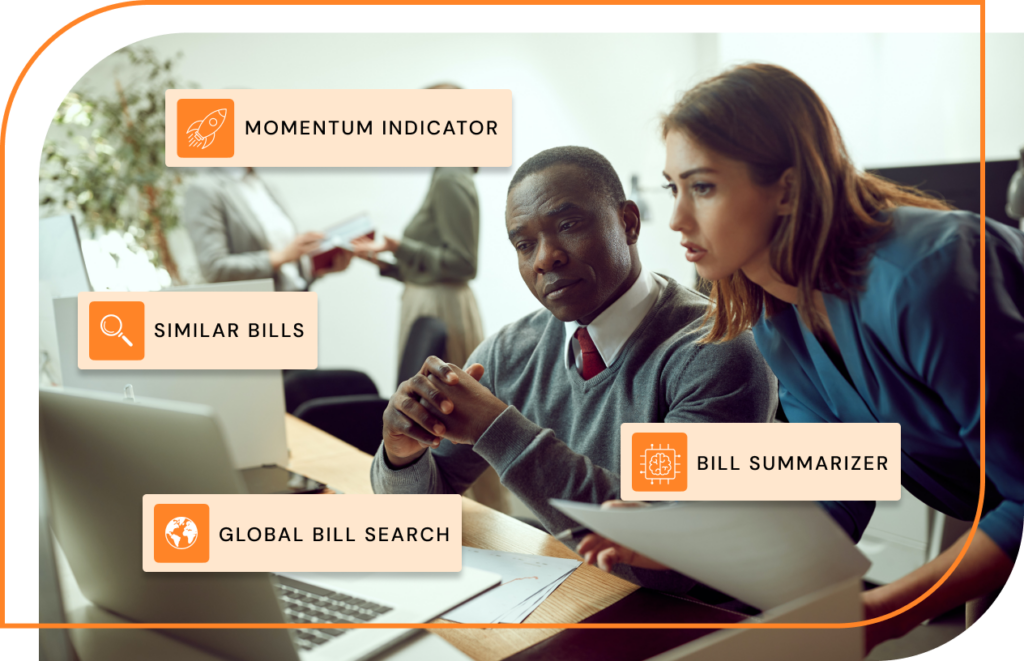
    Similar Bills

    With Plural, it’s easy to discover related and highly similar bills. This includes Omnibus bills, or bills with a high degree of text similarity, like model bills.

    Global Bill Search

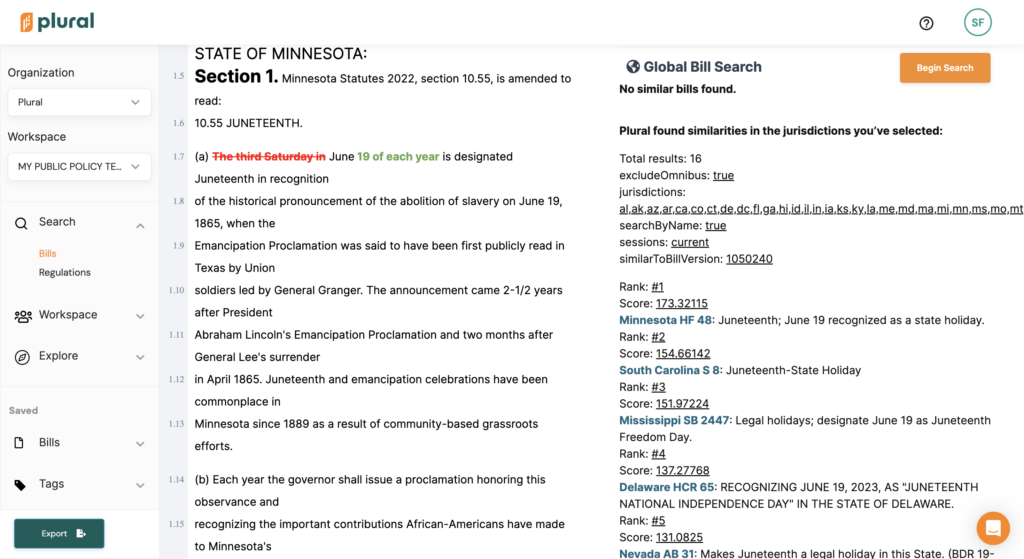
    Plural’s Global Bill Search Tool helps users see whether similar bills have been introduced across multiple jurisdictions.

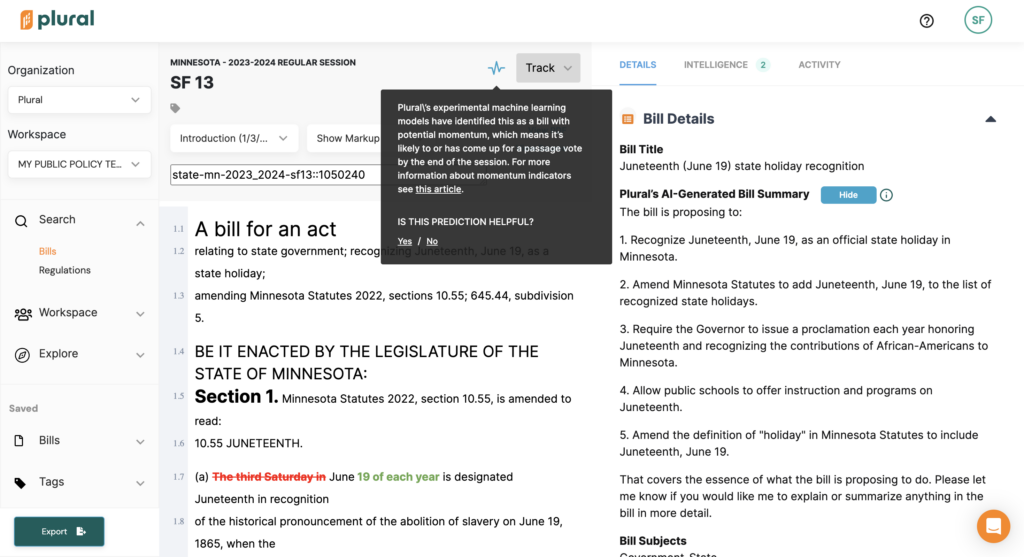
    Momentum Indicator

    During the legislative session, use Plural’s Momentum Indicator to see which bills are likely to come up for a vote by the end of session.

    Bill Summaries and Topics

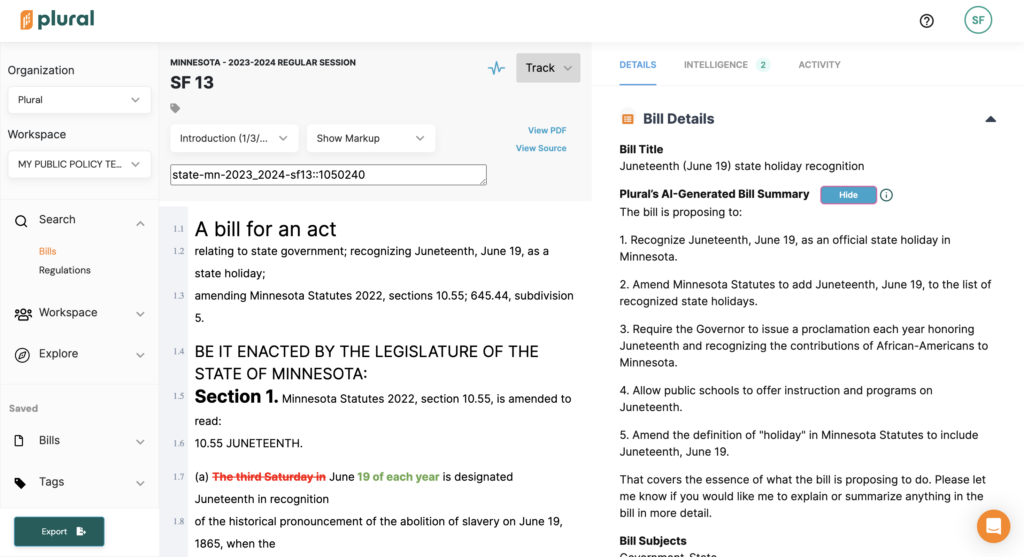
    Plural’s revolutionary AI-powered bill summarization tool condenses long, dense bill text into a short summary that retains the key details of the bill. Discover version-to-version bill summaries to see changes quickly and succinctly. Plus, unlock AI-generated bill topics to streamline your search and organization.

    Plural for Policy Teams

    Plural provides deep insights into legislation, empowering policy teams to elevate their effectiveness. As AI continues to evolve, its role as a collaborative partner in the knowledge industry is undeniable.

    Interested in getting started with Plural? Book a demo today!

    More Resources for Public Policy Teams

  • Cryptocurrency Regulation and Laws in 2024

    Cryptocurrency Regulation and Laws in 2024

    There are many good reasons to centralize data. Storing data in a single location makes it easier for an organization to access, organize, and update said data. The analyses gleaned from highly consolidated databases are more likely to be comprehensive and consistent. Administrators of centralized servers can more readily look for evidence of data quality issues and security breaches. Finally, centralizing data allows applications to operate in a cost-effective and efficient manner.

    There are also less desirable outcomes from data centralization. Concentrated power, sacrificed privacy, reduced accountability, and curbed competition are a few. We know this because the internet has become increasingly centralized over the last 25 years. This process began when a handful of companies created user-friendly applications. These apps and websites made the world wide web highly accessible. Now, the vast majority of internet activity ends up recorded in databases owned by Google, Meta, Amazon, and Microsoft, and others.

    Blockchain technology is a response to the negative side effects of data centralization. It is an alternative approach to structuring digital information. Blockchain technology allows data to be stored across multiple computers in a network. The nature of blockchain means that individual computers can reliably verify the authenticity of the information received from other “nodes” in the blockchain network. Every time data on a blockchain is shared, the transaction is automatically recorded in a distributed ledger. The distributed ledger cannot be modified.

    Helpful explanations of blockchain have been published by government entities like the U.S. Government Accountability Office, the National Institute for of Standards and Technology, and the Department of Homeland Security.

    Blockchain’s Most Prominent Application: Cryptocurrency 

    Blockchains can store virtually any kind of data, but the initial use cases enabled the creation of cryptocurrencies. Bitcoin, the first cryptocurrency, was launched in 2009. Since then, cryptocurrencies have allowed people to conduct secure financial transactions. Cryptocurrency transactions are completed without the involvement of a national authority, such as a central bank.

    Early on, critics argued that only criminal actors would benefit from such a system. Cryptocurrency has potential to fund extremist groups as well as facilitate money laundering and dark web transactions. While threats remain, cryptocurrency has many benefits. These include:

    • Increasing participation in the global economy, particularly for people from developing countries
    • Reducing the risks associated with conducting business in new markets
    • Facilitating more efficient transactions at a lower cost
    • Protecting private citizens from corrupt government seizure of their assets
    • Reducing security risks of identity theft
    • Preserving personal privacy and individual autonomy

    For better or worse, policymakers appear to be coming to terms with the fact that cryptocurrencies are “here to stay.” Policymakers have moved beyond attempting to ban the technology or ignoring it altogether. Rather, they’re now focusing on figuring out how to approach responsible crypto-asset regulation.

    Crypto and Public Policy: Multiple Dimensions of Financial Regulation

    The prospects for Congressional action on cryptocurrency remain murky. This is in part because of the sheer number of pertinent issues that must be addressed. Issues range from ensuring the stability of financial markets to determining the legal implications of smart contracts.

    Currently, at least four federal regulatory authorities are involved in managing cryptocurrency risks. This includes the Securities and Exchange Commission (SEC), the Commodity Features Trading Commission (CFTC), the Department of Justice (DoJ) and the Department of the Treasury. Each organization would take a different approach to a comprehensive regulatory framework. Below, we examine the enforcement priorities of each.

    SEC: Protecting Investors and Closing Loopholes

    The foundation of all SEC regulation is reporting requirements. These requirements are intended to help investors make sound decisions. Companies that sell shares or “securities” are required by the SEC to file a registered public offering statement prior to distributing to investors. Additionally, organizations that facilitate the buying and selling of securities, including stock exchanges and certain types of investment firms, must register as national securities exchanges. 

    From the SEC’s perspective, many cryptocurrency offerings are effectively the same as securities sales. This means that cryptocurrency companies must comply with the same investor protection standards that govern publicly-traded companies. This includes regular disclosures related to corporate governance and susceptibility to market risks.

    The SEC also seeks to classify certain cryptocurrency companies as securities exchanges. This is because they allow users to trade in their digital assets for traditional currencies. As an example, in its ongoing complaint against Coinbase, Inc., the SEC charges that the organization has been operating as an unregistered national securities exchange since 2019.

    CFTC: Deterring Market Manipulators and Stopping Scams

    The CFTC is concerned with curbing fraud and other deceptive behaviors in derivatives markets. Derivatives are financial investment contracts. Their value comes from the market price of an underlying asset, such as a currency or a commodity.  Commodities have historically included resources like wheat, gold, and oil, and, since 2015, Bitcoin.

    For nearly a decade, the CFTC has sought to regulate Bitcoin and other digital currencies. In that time, the agency has primarily focused on bringing cases against market manipulators. Mitigating the abuses brought by market manipulators is particularly important with cryptocurrency regulation. Once a person falls victim to a scam, transactions function like digital contracts that cannot be reversed or disputed. Blockchains also make it easy for scammers to hide their real identity, acting quickly to withdraw their ill-earned gains as cash before disappearing.

    DoJ: Prosecuting Fraud and Curbing Illicit Finance

    A key aspect of the DoJ’s approach to cryptocurrency is targeting criminals who use crypto to conduct nefarious activities, like funding terrorist groups and committing cyber crimes. In 2021, the DoJ’s Criminal Division announced the launch of the National Cryptocurrency Enforcement Team (NCET). As a subdivision of the Fraud Section, the NCET’s aim was to combat the use of cryptocurrency as an illicit tool. It focuses on instances of extortion, fraud, and money laundering.

    The DoJ goes beyond combatting criminal crypto activity. The Department also targets crypto exchanges that turn a blind eye to such crimes. The prosecution of former Binance CEO Changpeng Zhoa is an example of such efforts. Zhoa’s prosecution centered on his failure to implement an effective anti-money laundering program.

    Department of the Treasury: Interpreting and Enforcing Tax Law

    The Internal Revenue Service (IRS) sits within the Department of the Treasury. In its capacity to regulate cryptocurrency, the IRS evaluates crypto assets within the context of the tax code. Typically, the money an individual gains or loses from securities and commodities transactions over the course of a given year are reported to the IRS by their broker. This standard reporting practice helps deter tax evasion.

    The decentralized and private nature of cryptocurrency presents challenges for the IRS. Since crypto is inherently decentralized, determining who qualifies as a broker is challenging. The privacy-preserving nature of blockchain also complicates compliance logistics for digital asset monitoring.

    Looking Ahead: A Push to Fill in Gaps in Federal Cryptocurrency Regulation

    Many arms of the federal government are actively involved in cryptocurrency regulation. Despite this, each has also issued calls for Congressional action. No matter how creative or involved enforcement agencies may get, gaps will remain. Regulators are unable to fully mitigate the unique risks associated with blockchain. Comprehensive blockchain regulation is still

    Cryptocurrency regulation is multifaceted. It’s important for observers to keep in mind the wide range of legislative proposals. As an example, bills have been introduced to:

    • Dictate new CFTC reporting requirements for digital asset trading platforms (HR.5966
    • Expand the applicability of existing federal anti-money laundering laws to cover digital assets (S.2669)
    • Require crypto advertisements to disclose when celebrity spokespeople have been paid for their endorsements (S.1358)
    • Direct agencies to study the environmental impacts of cryptocurrency mining (S.661)

    Opinions on cryptocurrency regulation don’t fall along clear party lines. In the absence of obvious partisan signals, monitoring the details of competing proposals is especially important.

    Plural for Cryptocurrency Regulation

    Plural is the policy tracking tool of choice for those engaged in the cryptocurrency regulation space. With Plural, you’ll:

    • Access superior public policy data 
    • Be the first to know about new bills and changes in bill status
    • Streamline your day with seamless organization features
    • Harness the power of time-saving AI tools to gain insights into individual bills and the entire legislative landscape
    • Keep everyone on the same page with internal collaboration and external reporting all in one place

    Create a free account or book a demo today!

    More Resources

  • Uncovering Connections: How Related Bills Enhance Policy Analysis

    Uncovering Connections: How Related Bills Enhance Policy Analysis

    Legislative proceedings are complex and often difficult to comprehend. However, the challenge doesn’t stop at policy analysis and identifying key legislation. It extends to uncovering the network of related bills, which may impact or influence your primary areas of interest. Understanding not just individual bills, but also their connections, is vital for policy pros. Plural’s “Related Bills” feature is an indispensable tool for successful policy professionals.

    The Complexity of Legislative Analysis

    Imagine a puzzle where each piece is a bill. Focusing on a single piece, or a single bill, can provide helpful insights. However, understanding how it connects to others builds a more comprehensive picture. This holistic view of policymaking is crucial. Yet, manually mapping these connections is a daunting, time-consuming task.

    Related Bills: Your Legislative Compass for Policy Analysis

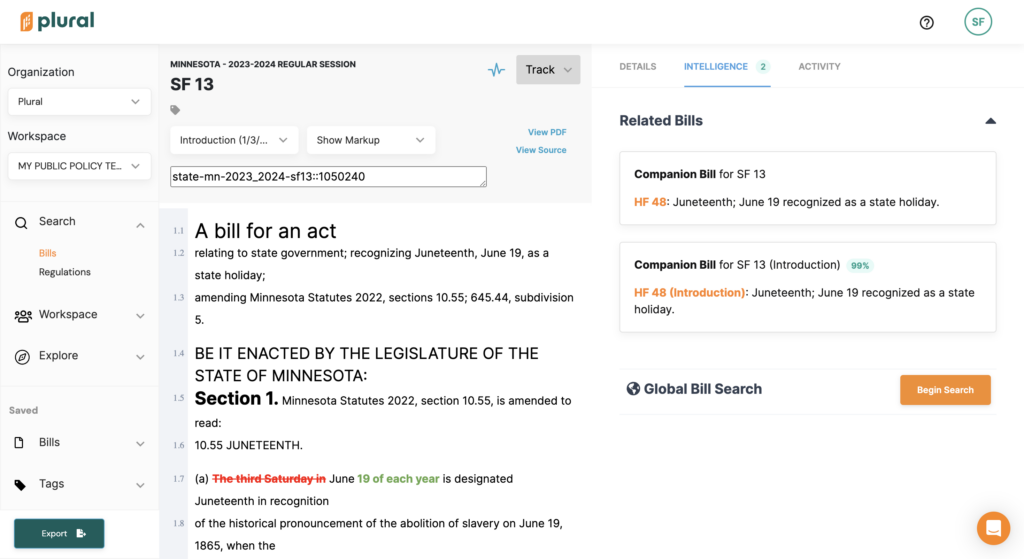
    Plural’s Related Bills feature is designed to simplify this process. Plural automatically identifies and linking related legislation using AI. Related bills go beyond illuminating the legislative landscape. They also reveal strategic insights that could otherwise be missed.

    How It Works

    Calculating Text Similarity

    Related Bill recommendations are based on the degree of text similarity between bills. Plural calculates text similarity at a sentence level. First, it removes from its analysis any “boilerplate” language that is used in most bills. It then breaks down each version of a bill into its component sentences, comparing them to versions of other bills. When two bills share at least 65% of the same substantive sentences, Plural identifies them as related.

    Labeling Relationships

    Once Plural finds bills that are related, it labels the relationship. Currently, Plural is labeling the following kinds of relationships:

    1. Companion Bills. Similar or identical legislation that are introduced in the upper and lower chambers of a legislature during the same session.
    2. Re-Introduced Bills. Bills that do not make it through the legislative process by the end of a session are often re-introduced in a later session. 
    3. Omnibus Bills. Omnibus bills consolidate various other bills — that often span a number of issues — into a single package. Plural identifies when a smaller bill has been pulled into a larger omnibus bill, and vice versa.

    Where to Find It

    Find related bills in the “Related Bills” tab of a Bill Detail page. If Plural has identified one or more related bills, you will also see an alert icon displayed to the right of the tab.

    Benefits Unpacked

    Strategic Advantage

    Discover potential allies or oppositions through related bills, enabling more informed strategy development.

    Efficiency in Research

    Save hours by instantly accessing a curated list of related legislation, rather than manually compiling connections.

    Depth of Understanding

    Gain deeper insights into the legislative ecosystem. This includes how various bills interlink and affect each other.

    Get Started With Plural

    Don’t let vital connections slip through the cracks in your policy analysis. Sign up for a demo of Plural today, and unlock the full potential of the Related Bills feature. Empower your legislative strategy with comprehensive insights and a more profound understanding of bill relationships.

    Have you leveraged Related Bills to achieve legislative success? We’re eager to hear how this tool has transformed your approach to policy work. Share your experiences and help inspire others to navigate the legislative web more effectively. Reach out to support@pluralpolicy.com to share your experience.

    More Resources for Public Policy Teams

  • Plural’s AI-Detected Bill Topics: Enhancing Policy Intelligence

    Plural’s AI-Detected Bill Topics: Enhancing Policy Intelligence

    In the ever-evolving landscape of public policy, quickly identifying impactful bills and developing policy intelligence is key. With thousands of bills introduced each session, policy pros are familiar with this time-consuming task. Identifying legislation that directly impacts your interests is not just critical—it’s a race against time. Staying organized amidst this legislative avalanche is complex. You need innovative tools to streamline this process.

    The Challenge of Keeping Up

    Imagine trying to navigate a maze without a map, where each turn introduces hundreds of new paths. For policy pros like yourself, this is a daily reality. Hours are invested in not just finding relevant bills, but also understanding their implications. Plural’s AI-detected bill topics mark a turning point in how policy teams approach this daunting task.

    AI-Detected Bill Topics: A Game-Changer for Policy Intelligence

    Plural’s suite of AI-powered features are designed to complement the work of policy teams. AI-detected bill topics automatically detect and categorize bills into topics using advanced machine learning algorithms. This feature offers a panoramic view of the legislative landscape. Bill topics enable Plural users to quickly hone in on bills that matter most to their work.

    How It Works

    Human Insight and AI Modeling

    Our Policy and Research team defined a list of common and useful topics and applied them to bills from previous sessions. Our Insights team then trained an AI model on those data to identify the topics of bills in new sessions.

    Instant Categorization

    Plural gets to work as soon as bills are introduced, classifying the bill based on its title and summary as provided by the original source.

    Personalized Alerts

    Users can set up alerts for specific topics, ensuring they never miss an important bill. This real-time notification system is pivotal for timely analysis and action.

    Where to Find It

    Find bill topics in two places in Plural:

    1. Advanced search. When searching for bills, utilize Plural’s new “Bill Topics” filter to isolate only those bills with specific topic(s) of your choosing.
    2. On a Bill Detail page. Quickly identify a list of topic(s) associated with a bill in the “Details” tab of its page. 

    Where It Works

    At this time Plural’s AI-detected bill topics feature is available for the following jurisdictions:

    • Alabama
    • Arkansas
    • Arizona
    • Colorado
    • Connecticut
    • Florida
    • Georgia
    • Iowa
    • Idaho
    • Kansas
    • Louisiana
    • Maine
    • Minnesota
    • New Hampshire
    • New York
    • Ohio
    • Rhode Island
    • Tennessee
    • Utah
    • Virginia
    • Vermont
    • Wisconsin
    • West Virginia
    • Wyoming

    Stay tuned as we continue to expand the feature for more jurisdictions!

    Benefits Unpacked

    Time Efficiency

    Reduce the hours spent manually searching for bills by leveraging AI to do the heavy lifting.

    Improved Organization

    With bills neatly categorized, maintaining an organized workflow becomes more manageable.

    Enhanced Focus

    Direct your attention to what’s most relevant, allowing for a deeper dive into the specifics of your interest areas.

    Get Started With Plural

    Ready to revolutionize how you navigate the legislative landscape and develop real-world policy intelligence? Sign up for a demo of Plural today and experience firsthand the transformative power of AI-Detected Bill Topics. Streamline your workflow, stay ahead of the curve, and make more informed decisions with Plural at your side.

    Have you experienced success using AI-Detected Bill Topics? We invite you to share your story with us. Your insights could inspire others to harness the power of AI in their public policy work to develop policy intelligence. Reach out to support@pluralpolicy.com to share your experience.

    More Resources for Public Policy Teams

  • Understanding California’s ACA 7 Using Plural’s AI Bill Summarizer

    Understanding California’s ACA 7 Using Plural’s AI Bill Summarizer

    What is California ACA 7, and how does it fit into the state’s history of legislative activity on affirmative action? Check out ACA 7’s summary using Plural’s AI Bill Summarizer.

    As California’s legislature wraps up its legislative session, many will monitor ACA 7. If the bill passes, Californians will soon find themselves voting on a referendum related to affirmative action. Californians have voted on two affirmative action-related referendums in five years, and three since 1995. Affirmative action remains a politically charged issue across the country. As such, ACA 7 has received significant attention from supporters and opponents alike. Below we examine ACA 7, how it relates to previous actions on affirmative action, and what might come next.

    The Context Behind ACA 7

    Assembly Member Corey Jackson proposed ACA 7 as a constitutional amendment. California requires a two-thirds majority in each legislative chamber to pass a constitutional amendment. Afterwards, the proposed amendment is voted on in the next statewide election.

    ACA 7 seeks to amend a section of the state Constitution established by an amendment in 1996. At the time, 55% of voters supported the amendment, known as Proposition 209. After the successful vote, Proposition 209 was added as Section 31 to the state Constitution. Section 31 prevents discrimination or preferential treatment on the basis of race, sex, color, ethnicity, or national origin. It pertains to employment, education, and contracting.

    In 2020, California legislators sought to repeal Proposition 209 in a state-wide vote. 57% of voters rejected this effort, Proposition 16 (ACA 5).

    What Does ACA 7 Propose? California ACA 7 Summary

    We utilized Plural’s AI Bill Summarizer to gain greater insight into how ACA 7 fits into the history of affirmative action legislation in California. The Bill Summarizer distills hundreds of words to provide the following summary for ACA 7:

    The bill is proposing an amendment to Section 31 of Article I of the California Constitution. The amendment would:

    1. Prohibit the state from discriminating against or granting preferential treatment to any individual or group based on race, sex, color, ethnicity or national origin in public employment, education or contracting, except:
    2. Allow the state to utilize state funds for research-based interventions or programs targeted at specific ethnic groups or marginalized genders to improve health, education or poverty outcomes. These programs would need approval from the Governor.
    3. Clarify that the amendment does not prohibit bona fide qualifications based on sex that are reasonably necessary for public employment, education or contracting.
    4. State that the amendment does not invalidate any existing court orders or consent decrees.
    5. Specify that the amendment does not prohibit any action needed to maintain eligibility for federal funding.
    6. Define “state” and “state moneys”.
    7. Require that remedies for violations provide equal treatment regardless of race, sex, color, ethnicity or national origin.
    8. Make the amendment self-executing but severable if any part is found in conflict with federal law.

    Contextualizing California ACA 7 Summary

    As we can see, ACA 7 differs from Proposition 16 in that it attempts to amend Section 31, rather than repealing it. ACA 7 would maintain Section 31’s ban on discrimination and preferential treatment. However, health, education, and poverty programs targeted at specific ethnic groups or marginalized genders would be exempt from the ban set forth by Section 31.

    Proponents of ACA 7, including Assembly Member Jackson, argue that this exemption is necessary. Without it, programs that target marginalized groups may not exist. Disparities in education, housing, wealth, employment, and healthcare are cited as evidence of the need for change.

    Meanwhile, opponents maintain that there is a lack of public support for affirmative action. They point to the 1996 and 2020 Propositions as evidence that Californians have consistently rejected affirmative action.

    What’s Next for ACA 7?

    ACA 7 passed out of the Assembly in September of 2023. The Senate will consider it at some point in 2024. Any action on the bill will draw significant attention from both supporters and opponents of affirmative action. If approved by the Senate, ACA 7 could go before voters for approval in November of 2024.

    Get Started With Plural

    Plural is the policy tracking and legislative intelligence tool of choice for dynamic policy, government relations, and nonprofit teams working in California. Our revolutionary AI Bill Summarizer helps teams save time, get key information, and skyrocket effectiveness. Interested in getting started? Request a demo today!

    More Resources for California

  • AI Policy in 2024: National Legislative Trends

    AI Policy in 2024: National Legislative Trends

    Artificial intelligence (AI) captivated the attention of the public in 2023. Conversations about AI’s capabilities were sparked by the rollout of ChatGPT in late 2022. These discussions were quickly followed by debates among lawmakers over how to regulate AI. Given the rapid advancement in AI technology and the slow progression of policymaking, especially at the federal level, it’s unsurprising that these discussions are still ongoing. We find ourselves in 2024 with many of the same questions about the future of the AI policy that we had in 2023. 

    As in recent ESG and data privacy debates, the European Union (EU) has raced ahead of the U.S. and other countries in developing AI policy. The EU’s proposed AI Act would apply reporting and transparency requirements broadly. It would also ban high-risk uses of AI. The Act will likely be approved this year, and will influence AI policymaking throughout the rest of the world. 

    In the United States, no such measure has passed. While there is no national framework legislation regulating AI, actions and proposals at both the state and federal levels provide insight into the direction of AI policymaking in the United States. Following state and regulatory action on AI is key, given the low probability of robust federal action. Below we summarize the trends we have seen so far in AI policy proposals, and detail what may come next. 

    Federal Approaches to AI Policy

    In recent years, federal policymaking decisions have shifted away from Congress towards regulatory agencies and the courts. Since 2011, Congressional majorities have been slim and partisan divides have been significant. This has led to challenges in passing complex, robust legislation through Congress. As a result, recent administrations have aimed to effect change through rulemaking. Without the likelihood of shepherding a bill through Congress, federal lawmakers impact policy through statements, hearings, and bill introductions. The first year of active AI policymaking followed these trends. 

    Trend 1: A Non-Legislative Approach to AI Policymaking

    Especially in an election year, the Biden administration does not want to be perceived as inactive on such a hot-button issue such as AI. Over the summer in 2023, the administration secured voluntary commitments from leading AI companies to manage risk. The White House built on these commitments in October of that year with the release of an Executive Order on Safe, Secure, and Trustworthy Artificial Intelligence. The Executive Order directs the federal government to initiate rulemaking or policy changes. New rules or policies will increase transparency and reduce risk around the use of AI. They will also promote responsible use of the technology.

    Following the release of the executive order, many of the advised actions taken place. The National Institute of Standards and Technology created a leadership group for its new AI Safety Institute. Another significant development was a Department of Commerce proposal that would require cloud providers to alert the government of foreign use of powerful AI models. 

    While these developments are significant, it’s worth noting that there are limitations to a strictly regulatory approach to policymaking. Executive orders and many administrative actions are reversible by any subsequent administration. Additionally, these rulemaking processes can be slower than the legislative process and subject to their own uncertainties, including court cases. 

    Trend 2: High-profile Hearings Drive Media Coverage

    Just like Presidents, congressional leaders can also find themselves stymied by the challenge of passing legislation through a gridlocked Congress. Recently, many legislators have turned to high profile committee meetings with industry leaders to communicate their agenda. Some of the most closely covered committee hearings of the past decade have given legislators a highly-visible opportunity to question Mark Zuckerberg, Sam Bankman-Fried, and others.

    This trend has continued with hearings on AI in 2023 and early 2024. Recent committee hearings have included a wide range of guests, including leaders from Microsoft and Nvidia as well as representatives of the music industry. Senate Majority Leader Chuck Schumer has been especially active in this regard. Senator Schumer has initiated a series of forums bringing together tech leaders, consumer rights groups, and civil rights advocates. Even if these conversations don’t directly lead to new policy, they help shape the debate on the use of AI in the U.S.

    Trend 3: A focus on Discrimination, Misinformation, and Transparency

    Executive Actions, committee hearings, and legislation proposals have made clear the areas of greatest concern for U.S. lawmakers in relation to AI. If significant action on AI does take place in 2024, it will likely relate to preventing discrimination and misinformation, or increasing transparency. 

    AI’s risk of contributing to existing societal inequities is well-established and concerning. Some lawmakers have centered their concerns about AI around issues of bias and discrimination. The recently introduced S 3478 aims to account for this risk. The bill would require federal agencies that use algorithmic systems to have an office of civil rights focused on bias and discrimination. The White House and Senator Schumer have also centered race in their discussions of AI. They have aimed to incorporate diverse voices in the conversations shaping AI policy. 

    Increased focus on AI is paired significant consternation about the safety of our democratic process. With 2024 being an election year, we can expect a focus on combating AI-related misinformation in the run up to November. In the fall of 2023, lawmakers proposed a bipartisan bill that would prohibit the distribution of deceptive AI-generated election-related content. Whether such a bill can become law, as well as whether it can be enforced, remains to be seen. 

    Finally, there does appear to be some consensus regarding the need for transparency in AI. President Biden’s executive order calls for the establishment of best practices regarding the detection and labeling of AI-generated content. Legislation calling for watermarking AI-generated content and encouraging training in the use and detection of AI for federal employees have also been introduced.

    State Approaches to AI Policy

    At the state level, lawmakers are often learning about AI as they begin to craft regulations. State activity in 2023 was widespread and it is expected that the pace of this work may increase in 2024. As “laboratories of democracy,” states play a crucial role in developing new policy to meet new needs. In an increasingly nationalized political environment, we also see policy trends moving from state-to-state more quickly. This has been seen in recent years with marijuana and gambling legalization efforts. Tracking AI policy trends across state governments is essential to ensuring compliance and in assessing what’s to come.

    Trend 1: California Leads the Way

    California is the largest sub-national economy in the world. It’s also home to one of the largest technology innovation hubs. Governor Newsom and California Democrats have shown an interest in being the first to act on hot-button issues like abortion, gun rights, and ESG regulations. It isn’t surprising that significant legislative action on AI is expected to occur in Sacramento this year. 

    California has adopted measures requiring an inventory of current “automated decision system” use in state government. The legislature has also expressed support for President Biden’s approach to AI regulation. Efforts to come in 2024 are headlined by Senator Weiner’s proposed Safe and Secure Innovation for Frontier Artificial Intelligence Systems Act. This bill would regulate the development and use of advanced AI systems. It would require AI developers to report to the state on testing protocols and safety measures.          

    Trend 2: A Focus on Labor

    One of the most common concerns associated with any new technology is its potential to cause job displacement. Because it simulates human cognition, AI poses a risk to disrupt certain industries and displace those working in them. While AI poses threats to oft-threatened industries like manufacturing, it is also places at risk industries not commonly thought of in this context. Organizations representing reporters, screenwriters, and lawyers have all sounded the alarm about the labor risks of AI. 

    There is still much we don’t know about how AI will affect our workplaces. State responses to AI’s impact on labor show a desire to learn more while preventing some overreach. New Jersey’s A 5150 and New York’s A 7838 are both propose requiring their state’s Department of Labor to collect data on job losses due to automation. Massachusetts’s An Act preventing a dystopian work environment, perhaps the most interestingly named of the bills in this category, seeks to ban the use of AI in certain hiring and workplace productivity practices. 

    Trend 3: Task Forces, Commissions, and Studies

    When it comes to complex policymaking discussions, it’s worth remembering that the vast majority of state legislators don’t come from the field which they are regulating. This isn’t a dismissal of these legislators or their ability to regulate AI; however, it underscores the need for state legislators to study these issues before they act. As such, much of the AI legislation that has passed so far have established groups dedicated to studying its impact and making recommendations. It will be important to follow the work of these groups to anticipate what their impact on policymaking will be. 

    Looking Ahead: AI Policy

    As we anticipate what action on AI awaits us through the rest of 2024, upcoming elections stand out as a monumental factor. Along with the presidency, all House seats, 34 Senate seats, and a majority of state legislator seats are up for election in November. AI policymaking will be heavily impacted by these elections, both in the lead up to and aftermath of election day. 

    As mentioned, AI poses a real risk to exacerbate the growing trend in the U.S. of election misinformation. Conversations about preventing this challenge have already begun, many focusing on preventing deep fakes or erroneous content. It seems likely that at least some misinformation will reach voters this fall. How the public and our elected officials react to it will shape any legislative action following the election.

    There doesn’t yet appear to be consensus partisan positions on AI that the average voter will weigh in their decisions. However, the impact of AI should not be underrated as a campaign issue. After all, AI will have profound effects on healthcare, education, the economy, and civil rights; the issues that are perennially on the mind of the American electorate. 

    More Resources for Public Policy Teams

  • What Are the Implications of AI for ESG?

    What Are the Implications of AI for ESG?

    Public policy is often awash in jargon and acronyms. It can be challenging for the average citizen to discern the purpose of a speech or a bill. Environmental, social, and corporate governance factors (ESG) and artificial intelligence (AI) are two recent examples of terminology that has dominated conversations in the media and in state houses. ESG and AI are both wide-ranging, quickly developing fields. As such, lawmakers and the public are seeking to better understand and regulate both. ESG and AI are also central to our current political discourse, due to their impacts across various issue areas. Any development within either field has downstream implications for labor, the environment, finance, government, and more. 

    In this article, we examine ESG and AI in more detail, including their impacts on each other, potential risks, and best practices.

    What is ESG?

    ESG is generally applied in two slightly different contexts. First, ESG investing involves investors distributing their capital based on the impact of the firm they are investing in. This a market-driven approach to corporate responsibility. It’s been around for decades, but was popularized during the 2000s due to consumer demand. 

    The second context in which ESG comes up is with government-mandated benchmarks or reporting. Regulatory bodies often require corporations to meet reporting standards regarding their impact. More rarely, corporations may be required to meet certain thresholds. Within either context, the “impact” measured by ESG criteria may include:

    • Greenhouse gas emissions
    • Supply-chain standards
    • Management of compliance risks

    ESG Around the World

    Europe has been a leader in regulating ESG. The European Union (EU) recently enacted the Corporate Sustainability Reporting Directive (CSRD) as its new mandatory sustainability reporting requirements for certain companies. The CSRD requires more detailed reporting and applies to more companies than the EU’s previous framework. Elsewhere, the United States is the center of a growing backlash against ESG regulations. Anti-ESG legislation was introduced in 37 states in 2023. Barring federal action, U.S. ESG law will likely become a confusing landscape for companies to navigate. 

    What is Artificial Intelligence?

    Artificial intelligence (AI) refers to machines’ programmed ability to “think,” or operate in a way that resembles human cognition. There are many distinct AI technologies, and countless applications. Generally, the goal of AI technology is to empower computers to complete tasks that typically require or even exceed human intelligence. 

    In 2023, the AI field saw significant progression. The most visible AI-powered projects were the subject of much attention and scrutiny from the public, media, and lawmakers. AI is rapidly advancing and has the potential to continue to develop quickly. As such, many are grappling with how to understand, use, and regulate AI.

    AI’s Benefits for ESG

    ESG reporting requires companies to gather and report data on a number of factors. This can be an overwhelming and arduous process, especially for those with the largest impacts. One area in which AI has shown its utility is in processing and summarizing large data sets. It’s easy to imagine how corporate disclosures could be made more efficiently and accurately with the help of AI. 

    Once reporting is complete, AI’s use cases continue. AI can potentially make this information easier to navigate for a citizen, investor, or customer. Much of the motivation behind requiring ESG transparency is an assumption that customers will use this information to inform where they spend their money. This leads to a feedback loop that encourages corporate responsibility. But this system only works if that information is accessible and digestible by the public. It isn’t yet clear that ESG reporting has led to a significant change in consumer attitudes so far. Generative AI, like the technology behind ChatGPT, might simplify access to this information, increasing the impact of ESG transparency on public behavior. 

    AI also has a role to play in the ongoing debate about the efficacy of ESG regulations. In the United States, much of the debate around ESG regulations has ventured into culture-war territory. However, there is still debate whether ESG investing, reporting, and mandates are effective in improving corporate responsibility. For example, some climate activists have begun to push back on the prevalence of “greenwashing” spurred by growing ESG requirements. Assessing the long-term impact of ESG regulations is a big data task, one that AI will be helpful in accomplishing. 

    What are the ESG risks of AI?

    Like any developing technology, AI comes with risks. What feels unique about AI, however, is the mystery surrounding what those risks might be. In this case, it can be helpful to isolate the risks of certain types of AI applications when assessing the impact of AI on a given field.

    Human Bias

    A primary risk of AI technology when applied to ESG is the automation of human biases in the workplace. AI technologies are heavily reliant on the data that goes into their training. It is a fact that existing human biases can impact that training data. AI-driven hiring decisions, for example, could be based on historical data that includes racial or gender biases. As more and more companies empower their processes with AI, it will be important to account for potential biases.

    Inaccurate Information

    AI may ease the process of ESG reporting for companies. However, there are risks in trusting AI-powered tools to complete these tasks with the necessary accuracy. AI models’ “hallucination” of inaccurate information has already given governments and corporations pause. Given the rapid development of ESG policy, there is risk that automating too much ESG reporting could open a company to compliance risks. 

    Environmental Concerns

    Use of AI also has the potential to reverse the progress that ESG principles aim to protect. AI-powered tools require significant energy, which in turn has a negative environmental impact. A recent Scientific American article noted that the 1.5 million server units that NVIDIA will deploy each year will consume more energy than some small countries. As we transition our electric grid away from fossil fuels and towards renewable energy, this impact will diminish — but that transition is far away. 

    AI-driven advances in technology also benefit the processes that have led to our current environmental situation. Applications of AI in the mining industry as well as in other industries that harm the environment could worsen their climate impact. At the same time, many hope that AI will unlock technological breakthroughs that help mitigate emissions and climate change. 

    Job Displacement

    Automating human cognition also invites potential for job displacement. Measuring the social impact of AI must include an assessment of any job or income losses tied to its advancement. Innovative technologies have long been blamed for job losses, especially in the short-term. This blame is not always misplaced. England’s Luddites of the early 19th century have historically been dismissed for raising alarm about the impact of automation in the manufacturing space on laborers. But arguments justifying their opposition and questioning the inequities in technology progress have gained steam recently, including in Gavin Mueller’s recent book, “Breaking Things at Work.” Whether AI will expand or minimize inequities remains to be seen, but those implementing ESG regulations should account for any short-term impact to laborers. 

    Best Practices for Balancing AI’s Risk and Benefits for ESG

    It would be impossible to comprehensively list AI’s risks and benefits for ESG. Due to the rapidly advancing nature of each field, some benefits and risks may not even be on the radar yet. Regardless, there are lessons to be learned and best practices to be implemented when it comes to the intersection of AI and ESG. 

    First, companies should be methodical and transparent in their approach to using AI. Transparency and accountability is at the heart of ESG requirements. Companies should keep this in mind when considering AI’s implications for their impact. This approach will mitigate risk and invite feedback while still allowing for AI adoption and its beneficial impacts. 

    Individuals, whether acting as a citizen, consumer, or investor, should view AI’s applications in ESG as a gateway to accessing more information. Verifying information from automated reporting or generative AI against source data is an important step in validating the model used. 

    Everyone can benefit from past experiences with new technology. Digital literacy is increasingly important as AI expands its reach. Individuals and companies should always prioritize data security and privacy protection. This need becomes ever more important when accounting for additional uses of AI. 

    Finally, staying up to date is a great way to see the benefits and risks of AI’s use in ESG in action. 2023 saw plenty of successes and lessons learned in both fields and 2024 will be no different. Staying on top of the issue is challenging, but one avenue for anticipating what is next is to track state and federal policy proposals. Plural’s advanced policy intelligence tools make this easy and accessible, and we do so by responsibly leveraging AI!

    More Resources for Public Policy Teams

  • AI Tools for Productivity

    AI Tools for Productivity

    In an era where time is a luxury, technological advancements, particularly Artificial Intelligence (AI), have emerged as the game-changer in daily productivity. At its core, AI is a multifaceted discipline of computer science that mimics human intelligence processes through algorithms and data-driven responses. How can it be implemented in your day-to-day? There are many tools that can increase your productivity and efficiency. Read our overview and see how Plural’s revolutionary AI-powered features can increase your productivity and policy impact.

    Types of AI Tools for Productivity

    The landscape of AI tools is vast and varied, offering solutions tailored to diverse needs:

    • AI Assistants: Beyond the familiar Siri and Alexa, AI personal assistants are revolutionizing time management and task completion with their ability to schedule meetings, set reminders, and even make reservations using natural language processing.
    • Meeting Transcript Generators: No more frantic note-taking during meetings! These tools accurately transcribe the spoken word in real-time, ensuring you capture every detail and can focus entirely on the discussion at hand.
    • Writing Tools: AI-driven writing assistants like Grammarly and the Hemingway App not only correct grammatical errors but also enhance writing style and tone, making content creation a breeze.

    Benefits of AI Tools for Productivity

    Increase Efficiency and Accuracy

    By automating mundane tasks, AI tools free up time for more strategic activities, driving efficiency. They’re not prone to human error, thereby increasing accuracy in task completion.

    Automate Repetitive Tasks

    Whether it’s data entry or sorting emails, AI takes over repetitive, time-consuming tasks, allowing you to focus on core business functions that require human creativity and intelligence.

    Create High-Quality Content

    From generating insightful data reports to creating engaging social media posts, AI tools provide high-quality content quickly, meeting the real-time demands of modern business.

    …and more!

    When it comes to sector-specific AI tools, the options and opportunities are endless. From healthcare to public policy, AI has many helpful applications.

    Considerations When Choosing an AI Tool for Productivity

    Despite the allure, AI tools are not a one-size-fits-all solution. It’s crucial to consider the specific needs of your business, the tool’s compatibility with other systems in use, and the learning curve involved in implementation. Moreover, while AI significantly enhances productivity, it doesn’t spell the end of human involvement. Instead, it augments human capabilities, allowing for a more strategic allocation of human intellect where it matters most.

    AI in Public Policy

    In the world of public policy, every decision can shape the future, and every second counts. How can artificial intelligence help?

    The opportunity exists for the legislative process to become more responsive and inclusive. The technology of artificial intelligence can be applied in any context; what it does is perform tasks in smart and efficient ways by learning from models that it’s given. The more data it is given to learn from, the smarter the technology gets at understanding the data and answering questions. The information that the system is learning can then be given back to us policy shapers and changemakers so that we can make better data-driven decisions in the legislative process. Read more from Plural co-founder Yemi Adewunmi here.

    AI is a pivotal ally for policy teams — helping to analyze patterns, predict outcomes, and unlock insights at unprecedented speed. It’s clear that AI is a transformative force for policy teams, enhancing their efficiency and driving impactful and informed decision-making. At the cutting edge of public policy work, AI isn’t just about moving faster — it’s about working smarter, turning data into decisions, and insights into results.

    Plural: Harnessing the Power of AI

    Plural’s AI-powered features are what really sets us apart from the competition. See what’s happening with similar legislation across the country, find out where bill language reappears 

    over time, and even find out which bills are gaining momentum. 

    Here are a few highlights:

    • AI-Generated Bill Summaries: Save hours reading through long, dense bill text. Quickly understand and share the impact of proposed legislation. Learn more here.
    • Related Bills: Quickly identify bills related to the one you’re viewing. See the relationship and the level of similarity, based on automated text analysis
    • Momentum Indicator: Discover which bills are likely to come up for a vote before the end of the legislative session.
    • Additional AI Insights: Discover companion bills, reintroduced bills, and omnibus bills to gain a deeper understanding of the legislative landscape.
    Plural’s AI-powered bill summarization tool condenses long, dense bill text into a short summary that retains the key details of the bill.

    Get Started With Plural’s AI Tools for Productivity

    With Plural’s AI-powered tools, it’s easier than ever to elevate your policy work from informed to insightful. Interested in learning how Plural can work for your team? Book a demo today!

    Explore More Resources

  • VIDEO | Explore Plural’s Revolutionary AI-Powered Tools

    VIDEO | Explore Plural’s Revolutionary AI-Powered Tools

    In the world of public policy, every decision can shape the future, and every second counts. How can artificial intelligence help? Plural’s AI-powered policy tracker is the legislative tracking tool of choice for impactful policy teams.

    AI is a pivotal ally for policy teams — helping to analyze patterns, predict outcomes, and unlock insights at unprecedented speed. It’s clear that AI is a transformative force for policy teams, enhancing their efficiency and driving impactful and informed decision-making. At the cutting edge of public policy work, AI isn’t just about moving faster — it’s about working smarter, turning data into decisions, and insights into results.

    Plural’s AI-Powered Tools

    Plural stands at the forefront of the AI revolution. With our Premium plan, you’ll unlock a suite of AI-powered features designed for those who demand excellence in their legislative tracking, stakeholder management, and organizational tools. Plural’s AI-powered policy tracker is the policy tracking tool of choice for impactful policy teams.

    With Plural, it’s easy to discover similar bills, like companion bills. Find all related bills in the “Intelligence” tab of a bill detail page.
    Plural’s AI-powered bill summarization tool condenses long, dense bill text into a short summary that retains the key details of the bill.
    Use Plural’s Global Bill Search Tool to see whether similar bills have been introduced across multiple jurisdictions.
    During the legislative session, use Plural’s Momentum Indicator to see which bills are likely to come up for a vote by the end of session.

    Learn more from Amber, our Administrative Director:

    Get Started With Plural’s AI-Powered Policy Tracker

    With Plural’s AI-powered tools, it’s easier than ever to elevate your policy work from informed to insightful. Interested in learning how Plural can work for your team? Book a demo today!

    Explore More Resources for Policy Teams