
Category: AI & Technology

  • The Future of Lobbying: How Data, Technology & Policy Intelligence Are Reshaping Government Affairs 

    The Future of Lobbying: How Data, Technology & Policy Intelligence Are Reshaping Government Affairs 

    Relationships still win. But in a world where your counterpart may have already mapped the legislator’s voting history, tracked the coalition forming against your issue, and flagged the model bill moving in six other states, showing up unprepared in government affairs is a disadvantage. 

    The government affairs profession is not changing because technology is replacing what lobbyists do. It is changing because technology is raising the floor of what “prepared” means. 

    A generation ago, being well-prepared for a legislator meeting meant knowing the member’s background, understanding their district, and having a clear ask. That is still true. What has changed is the context surrounding that meeting: the data layer that informs who you’re meeting with, what they’ve been working on, which bills they’ve sponsored this session, how they voted on related issues two sessions ago, who else is lobbying them on this issue, and what similar legislation is moving in states that tend to predict their own chamber’s priorities. 

    That information has always existed. It was expensive to gather, time-consuming to synthesize, and largely the province of the most connected and well-resourced practitioners. Technology is now democratizing access to this information and accelerating it. And that acceleration is creating a gap between the government affairs functions operating with intelligence infrastructure and those still relying on memory, spreadsheets, and periodic email digests. 

    This post is about that gap. Where it is, how fast it is growing, and what practitioners at every stage of the adoption spectrum need to do to stay on the right side of it. 

    The best lobbyists have always been the best prepared. What has changed is what it takes to be prepared and how quickly the standard is rising. 

    Damola Ogundipe
    CoFounder, Plural Policy

    What is changing about the lobbying profession and what isn’t 

    Start with what is not changing, because the noise around technology in government affairs often obscures it. 

    Relationships are not becoming less important. Trust between a lobbyist and a legislator — built over years of credible, consistent, honest engagement — is not something data produces. A legislator who takes your call is doing so because of a track record, not because you have a good dashboard. The people in a room, the credibility of the ask, the quality of the argument, the ability to read the dynamic and adjust in real time — none of that is being automated. 

    What is changing is the preparation that precedes those moments, the coverage that makes those moments possible at the right time, and the organizational intelligence that connects what happens in one chamber or one state to what is likely to happen in another. 

    Specifically, three things are shifting in ways that matter for every practitioner and every enterprise government affairs function: 

    • The volume of relevant legislation has outscaled manual monitoring. State legislatures collectively introduce more than 200,000 bills per session. Federal regulatory activity generates thousands of additional changes annually. No team, regardless of experience or institutional knowledge, can monitor that volume manually without developing structural blind spots. 
    • The pace of cross-state legislative activity has accelerated. Model bills — identical legislation coordinated by national advocacy organizations — now spread across state lines within a single session cycle. A government affairs team that is only watching its home state is watching yesterday’s policy landscape. 
    • Client and executive expectations have risen. Clients expect real-time intelligence, not weekly summaries. Executives expect their government affairs function to brief proactively — before floor votes, not after. The standard of “keeping up” has been replaced by a standard of “seeing ahead.” 

    None of these changes make relationships less important. They make the intelligence that supports relationship-based advocacy more important and more decisive.

    Legislator intelligence: what it means to show up prepared 

    The single most underused category of data in government affairs is legislator intelligence — not as a surveillance tool, but as preparation infrastructure. 

    Every legislator has a record. The bills they have sponsored. The committees they sit on and their role within those committees. Their voting history on related issues. The advocacy organizations that have donated to their campaigns. The districts they represent and the industries that employ those districts’ residents. Their public statements on policy issues. Their track record of moving legislation to passage versus introducing bills that never advance. 

    This information is public. It has always been available to anyone willing to spend the time to compile it. What has changed is the speed and completeness with which it can be assembled, and the way it can be mapped to your specific advocacy agenda. 

    What data-informed legislator engagement looks like in practice 

    The lobbyist who walks into a meeting with a legislator knowing that the member has sponsored three bills in the current session related to consumer data privacy — two of which cleared committee — is in a different conversation than one who knows only that the member sits on the Commerce Committee. 

    Legislator intelligence does not replace the relationship. It deepens it. When a lobbyist arrives to a meeting already briefed on a legislator’s recent priorities, their conversation can move past the introductory positioning that burns so much of a limited meeting window. They can reference specific votes. They can acknowledge work the legislator has already done on the issue. They can connect their ask to the legislator’s existing legislative record rather than presenting it in isolation. 

    This is what “data determines who shows up prepared” means in concrete terms. Not that the data creates the relationship, but that it elevates the quality of the engagement that builds it. 

    What to track on every legislator in your portfolio 

    • Current session bill sponsorships and co-sponsorships — especially any related to your issue area 
    • Committee assignments and role (member, vice-chair, chair) — chair status is predictive of bill advancement 
    • Voting history on related issues across the current and prior two sessions 
    • Floor statements and public testimony on your issue area 
    • Campaign finance connections to relevant industries and advocacy organizations 
    • Whether they are in a competitive district — electoral pressure shapes policy priorities 
    • Bills they introduced that died in committee — these often return in subsequent sessions 

    How the highest-performing government affairs teams structure their intelligence cycle 

    The organizations that consistently outperform their peers in government affairs do not just have better tools. They have a more deliberate process — a structured intelligence cycle that converts legislative monitoring into organizational action, and that runs consistently whether the session is active or quiet. 

    The six-phase cycle below maps how these teams operate — and where each phase depends on data, technology, or the human judgment that no platform replaces. 
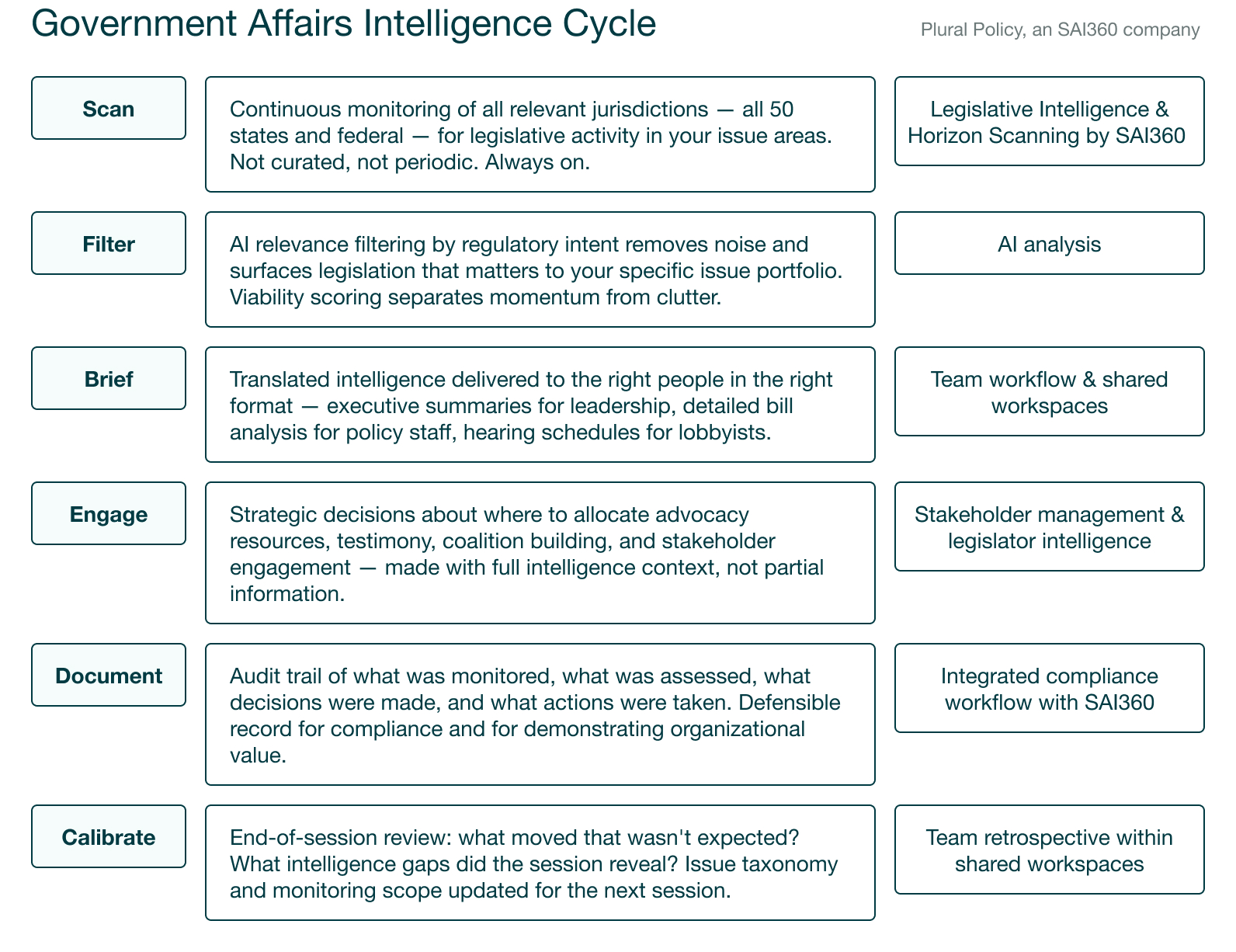
    The most important insight from this cycle is the final phase: calibration. The teams that consistently outperform are the ones that treat each session as a source of learning — reviewing their intelligence coverage, identifying what moved unexpectedly, updating their issue taxonomy, and adjusting their monitoring scope before the next session begins. 

    This discipline is not common. Most teams move from session to session without a formal retrospective. The ones that build it in compound their intelligence advantage over time, rather than starting each session with the same coverage gaps they had before. 

    What this means for the next generation of government affairs professionals 

    If you are earlier in your government affairs career, the transformation underway in the profession is not a threat to what you are building. It is a clarification of what to build. 

    The skills that made government affairs professionals valuable in the past remain valuable. What is being added is a new layer of technical fluency — not the ability to build software, but the ability to work intelligently within data and intelligence systems, interpret what they surface, and integrate that intelligence into the relationship-based practice that defines the profession. 

    The practitioners who will lead government affairs functions in the next decade will be the ones who are comfortable operating at the intersection of relationship credibility and data-informed strategy. They will use legislative intelligence platforms the way their predecessors used a Rolodex — not as a substitute for judgment, but as the infrastructure that makes judgment more reliable. 

    The transformation is already underway, the only question is where you are in it 

    The lobbying profession is in the middle of a technology transformation. The tools exist. The data is available. The organizations that have invested in building intelligence infrastructure around their government affairs functions are already operating with an advantage that compounds with each session. 

    That advantage is not primarily about technology. It is about preparation — the quality of the briefings, the precision of the engagement, the speed of the response, and the organizational confidence that comes from knowing your policy coverage has no structural gaps. 

    Relationships still win. They always will. What data and technology determine is who shows up to those relationships prepared to make them count. 

    Ready to see what your team is missing?

    Plural Legislative Intelligence powered by SAI360 gives government affairs teams real-time visibility into state and federal legislative activity — with AI-powered bill analysis, viability signals, and stakeholder engagement workflows built in. 

    And it’s the only platform that combines with integrated compliance workflow. Learn more by scheduling a live walkthrough.


  • The AI Governance Watch, April 2026: Nineteen New AI Bills Passed Into Law

    The AI Governance Watch, April 2026: Nineteen New AI Bills Passed Into Law

    The end of March often brings a flood of new laws as many of the states with shorter annual legislative sessions begin wrapping up their work. This year proved no different as it relates to AI legislation; we tracked 19 new laws regulating AI passed over the last two weeks alone. Read on for details on all of these new laws, which you can explore further in Plural.


    While some sessions are winding down, others are just starting to heat up, and that is reflected in the new bills discussed below. Over the past two weeks we also added 57 new bills to our tracker, and you can view those here.

    New Bills to Watch

    11 states (and the U.S. Congress) introduced new AI legislation over these past two weeks (again you can view those here). States that will continue to meet over the summer like California, Michigan, New Jersey, Ohio, and Wisconsin provided a significant number of the new introductions.

    You can examine our full dataset broken down by category (more explanation on that here) in Plural using the links below.

    Tracking Key Developments

    Since we last posted in mid-March, we have gone from 6 new AI laws passed in 2026 to 25! Another 27 bills have passed both chambers in their legislative process and could be on their way to becoming law soon. Each of the 19 new AI laws is detailed below, with links to explore further in Plural.

    Colorado

    • SB 11 – Relates to search warrants provided to covered platforms including social media companies and AI platforms.

    Idaho

    • S 1227 – Adds a new Chapter 70 to Title 33 (Education) of Idaho Code, establishing a comprehensive framework for the use of generative artificial intelligence in K-12 public education.
    • S 1297 – Establishes regulations for conversational AI services.

    New York

    • S 8828 – Establishes a regulatory framework for large-scale AI developers operating in New York State, focusing on transparency, safety reporting, and accountability for advanced “frontier” AI models.

    Oregon

    • SB 1546 – Establishes regulations for AI companion platforms in Oregon — systems designed to simulate human-like platonic, intimate, or romantic relationships with users.

    Tennessee

    • HB 1513 – Requires political advertisements utilizing deepfake or artificial intelligence technology to include disclaimers.
    • SB 1580 – Regulates the use of artificial intelligence systems claiming to act as mental health professionals.

    Utah

    Governor Spencer Cox (R) continues to make a name for himself (and Utah) as a skeptic of AI and a leader in the push to regulate the emerging technology. The Governor has signed 9 new AI bills into law just this year (8 of these were signed over the past two weeks).

    • HB 218 – Strengthens and formalizes the content requirements for the existing grades 7-8 digital skills course, including by ensuring coverage of artificial intelligence literacy.
    • HB 273 – Comprehensively regulates classroom technology use in Utah public schools by limiting screen-time (especially in early grades), mandating AI literacy education, establishing guardrails on AI use by both students and educators, and creating support structures for students who struggle with technology-based learning.
    • HB 276 – Bans the non-consensual generation and distribution of counterfeit intimate images (AI-generated deepfake intimate/sexual images) by both generation services and online platforms. Also requires transparency about the origin and authenticity of digital content from large online platforms, AI providers, government agencies, and others.
    • HB 289 – Reorganizes and addresses offenses related to artificially generated child sexual abuse material.
    • HB 320 – Amends Utah’s Office of Artificial Intelligence Policy statutes (Title 13, Chapter 72) enacted in 2024 including by expanding the scope of covered public entities, strengthening oversight, and more.
    • SB 256 – Amends defamation and personal identity protection laws to address artificial intelligence (AI) and digitally manipulated content.
    • SB 267 – This bill requires the Utah State Board of Education (state board) to study best practices for software use in public schools including as it relates to data privacy and AI.
    • SB 319 – This bill amends Utah’s health insurance preauthorization laws (Section 31A-22-650) with several significant changes including increased disclosure requirements for the use of AI by insurers.

    Washington

    • HB 1170 – Requiring large AI providers (1M+ monthly users) and government agencies to inform users when content is modified using artificial intelligence.
    • HB 2225 – Requiring chatbot operators to meet requirements around transparency disclosures and protections (for minors and against self-harm generally).
    • SB 5105 – Expands and strengthens existing laws against sexually explicit depictions of minors, with a particular focus on AI-generated content.
    • SB 5395 – Increases restrictions on the use of AI in prior authorizations by health insurance carriers.

    Ready to see what your team is missing?

    Plural Legislative Intelligence powered by SAI360 gives government affairs teams real-time visibility into state and federal legislative activity — with AI-powered bill analysis, viability signals, and stakeholder engagement workflows built in. 

    And it’s the only platform that combines with integrated compliance workflow. Learn more by scheduling a live walkthrough.

  • What the One Big Beautiful Bill Means for: Artificial Intelligence

    What the One Big Beautiful Bill Means for: Artificial Intelligence

    On July 4th, President Trump signed H.R. 1, the One Big Beautiful Bill Act, into law. The 330-page act contains provisions that will reshape nearly every sector of the American economy and society. The rushed passage and sweeping scope of H.R. 1 have left many wondering:

    What’s actually in the bill and how will it affect me?


    At Plural, this opacity strikes directly against our mission. From our open data to our AI bill summarizer trained specifically on legislative text, we strongly believe in the power of technology to unlock legislative insights for policy professionals, activists, and citizens alike. With this mission in mind, we are producing a series of One Big Beautiful Bill explainers. Within each explainer, we will dive into the megabill’s impact in a specific subject area with a text-first approach that pulls impacts directly from the bill. This week we take a look at how the new law will impact American healthcare.

    We help you shape policy together,
    so you can shape the future.

    That’s the power of Plural.

    It starts with providing the most complete information about the policies that impact us.

    It takes extreme effort and vigilance just to track policy—much less to create a positive impact. If you can’t react fast or fully engage your team, laws will pass without you.

    The teams that forge the policies of tomorrow will use the latest technology to empower many voices. Plural exists to make policy creation more transparent, responsive, and inclusive. And to make full participation possible.

    We are leaders, thinkers, innovators,
    public policy wonks, and technologists.

    We are also constituents, neighbors, advocates, disruptors, and our vision is to make full participation possible.

    Our Mission

    The Power of Plural

    We help you shape policy together, so you can shape the future. It starts with providing the most complete information about the policies that impact us.

    The policymaking process is opaque, hard to access, and difficult to influence alone.

    It takes extreme effort and vigilance just to track policy—much less to create a positive impact. If you can’t react fast or fully engage your team, laws will pass without you.

    The teams that forge the policies of tomorrow will use the latest technology to empower many voices. Plural exists to make policy creation more transparent, responsive, and inclusive. And to make full participation possible.

    Created for policy wonks, by policy wonks.

    We are leaders, thinkers, innovators, public policy wonks, and technologists. We are also constituents,
    neighbors, advocates, disruptors, and our vision is to bring visibility into the policy process
    and improve the means to participate in democracy. At Plural, we’re proud to provide intuitive,
    effective solutions for mission-oriented organizations to help them meet their goals.


    Join Our Team

    Machine Learning Engineer (remote)


    Our Values

    People First

    First and foremost, we’re dedicated to our users. We take a user-centric approach to building our products, and we’re proud of our connections with our customers who use our product to do important work every day.

    Transparent

    We value trust and transparency. We want to cut the dishonesty and mistrust out of public policy, and we believe that democracy work best when information is accessible and honest.

    Audacious

    Speaking of honesty, let’s keep it real. What we’re building at Plural is bold. Our vision is audacious, and we’re passionate about taking on this challenge. We’re also passionate about innovation, good design, and making a difference.

    Ready to Amplify Your Policy Impact?

    Experience the power of Plural first-hand with a free account or schedule a demo for a live walk through of our tools. Find out how Plural can transform the way you and your team shape policy.

    The rapid advancement in artificial intelligence technology and its availability has been a defining theme of this decade so far. The speed at which large language models have become a part of our daily lives has seemingly shocked everybody, from industry leaders to policymakers. Lawmakers have just started to respond to these developments with proposals encouraging and regulating the use of AI across industries (we’ve written extensively about these actions here). 

    While most legislative action has been focused at the state level, the development of H.R. 1 gave President Trump an opportunity to attach AI policy to a large legislative package due to be passed on a party-line vote. 

    Indeed, the Trump administration responded to this opportunity with a bold proposal to impose a 10-year moratorium on the enforcement of state-level AI regulations. This provision was supported by industry but opposed by a bipartisan group of state executives and lawmakers. In the end, the measure failed to gather the support necessary to remain in the final version of the bill and was left on the sidelines as H.R. 1 became law. 

    While the removal of the moratorium may have been the most impactful H.R. 1 policy development related to AI, the final bill still has implications for the industry and its users. Below we detail some of those important changes.

    Government Funding for Artificial Intelligence

    One of the federal government’s primary tools to support specific industries is through appropriations. H.R. 1 authorizes billions in federal funding for artificial intelligence projects including:

    • $450 million for AI in naval shipbuilding
    • $124 million for AI enhancements to the Test Resource Management Center within the Department of Defense
    • $145 million to develop AI-powered aerial and naval attack systems
    • $500 million for the advancement and expansion of “the artificial intelligence ecosystem” at the Department of Defense and the “Cyber Command artificial intelligence lines of effort”
    • $200 million for the deployment of AI to accelerate financial audits at the Department of Defense 
    • $115 million for nuclear national security missions tied to artificial intelligence

    Supporting Transformational Artificial Intelligence Models

    Section 50404 of the new law directs the Secretary of Energy to work with industry leaders to ensure the scientific data of the Department of Energy is suitable for use in artificial intelligence and machine learning models.

    The law further directs the Secretary to initiate “seed efforts” for self-improving artificial intelligence models powered by this data. This data and these models are intended to be used to develop microelectronics to accelerate innovation especially in the energy sector. 

    H.R. 1 appropriates $150 million for these efforts. Taken together, this funding and direction indicates a desire from the Trump administration to lead on AI in the microelectronics and energy sectors. 

    Conclusion

    By the time H.R. 1 arrived on President Trump’s desk, the biggest news in the AI policy world was the exclusion of the moratorium on the enforcement of state-level regulations. That provision’s failure opens the door for recently-passed state policy to be implemented and new policy to be developed when 2026 state legislative sessions begin.

    Navigating the AI regulatory patchwork in the absence of a national framework will therefore remain an essential task for legal and compliance teams across various industries. 

    Although the most important takeaway from H.R. 1 as it relates to AI may be what was not included in the bill, a number of important changes in the package will change how AI is developed and utilized in the coming years. Through the appropriations and provisions included in H.R. 1, the Trump administration and Congressional Republicans have shaped the near-future of federal involvement in AI development. Given the global context surrounding the rapid advancement of AI, the decisions made in H.R. 1 will have massive implications for decades to come. 

    Ready to see what your team is missing?

    Plural Legislative Intelligence powered by SAI360 gives government affairs teams real-time visibility into state and federal legislative activity — with AI-powered bill analysis, viability signals, and stakeholder engagement workflows built in. 

    And it’s the only platform that combines with integrated compliance workflow. Learn more by scheduling a live walkthrough.

  • Here’s Why Leadership Wants Your GR, Legal & Compliance Teams to Use AI

    Here’s Why Leadership Wants Your GR, Legal & Compliance Teams to Use AI

    In an era of accelerating regulation, geopolitical uncertainty, and rising stakeholder expectations, the margin for error in corporate governance has never been thinner. For senior leaders — CEOs, GCs, COOs, and Chief Risk Officers — ensuring that their legal, compliance, and government relations (GR) teams are equipped to respond quickly and strategically is essential.

    Enter AI.

    Artificial intelligence is fundamentally changing how organizations manage risk, interpret regulation, and engage with the policy landscape. And yet, many legal, compliance, and GR teams are still relying on outdated workflows: manual research, static spreadsheets, and reactive analysis.

    If this sounds like your team, here’s why that needs to change, and why senior leadership is asking you to make the shift towards innovation in your work.

    1. Faster, Smarter Decision-Making

    AI tools can analyze legislation, regulatory filings, and public policy trends in seconds. They convert mountains of dense information into digestible, actionable insights.

    Why it matters to leadership: Time is money. Speed to insight means speed to decision, which enables organizations to act before competitors or regulators do.

    2. Stronger Risk Mitigation and Compliance

    AI platforms can proactively flag risks—like pending rules, global sanctions, or enforcement activity—long before a human team might spot them. These tools can also identify patterns across jurisdictions and industries.

    Why it matters to leadership: Staying ahead of compliance risk protects the brand, avoids costly penalties, and reassures shareholders and regulators.

    3. Cost Savings and Efficiency Gains

    Legal, GR, and compliance professionals spend countless hours manually tracking policy updates or digging through databases. AI automates that grunt work, allowing teams to focus on strategy and response.

    Why it matters to leadership: Freeing up internal expertise means leaner teams can do more—with less reliance on external counsel and lower overhead.

    4. Competitive Advantage Through Intelligence

    AI enables teams to review their lobbying activity, committee hearing events, and stakeholder positions with more automation. This creates new opportunities to stay ahead of regulations and anticipate industry shifts.

    Why it matters to leadership: In regulated industries, understanding the policy landscape before others do is a strategic edge.

    5. Future-Proofing for the Policy-Driven Economy

    From AI governance to data security rules, the future is full of smart, tech-driven regulation. AI tools will increasingly be required just to keep up.

    Why it matters to leadership: Early adoption signals that your organization is forward-thinking, compliant, and ready for tomorrow’s regulatory environment.

    6. Improved Cross-Functional Collaboration

    Modern AI platforms are built for collaboration—allowing legal, compliance, and GR teams to share insights, track issues, and co-develop strategies in real time.

    Why it matters to leadership: Breaking down silos improves enterprise-wide risk management and helps the organization speak with one voice to regulators and policymakers.

    7. Clearer Reporting to Executives and Boards

    AI can generate board-ready dashboards and reports that distill complex policy activity into simple visuals and summaries.

    Why it matters to leadership: Clear, timely insights lead to better governance—and fewer surprises.

    Conclusion: A Strategic Imperative, Not Just a Tech Upgrade

    Empowering policy-facing teams with AI isn’t just about modernizing tools — it’s about enabling strategic foresight, reducing regulatory exposure, and creating operational agility.

    In short: AI in legal, compliance, and GR isn’t a “nice to have.” It’s a business imperative.

    Looking for a place to start? Explore the AI-driven solutions provided by Plural Policy —an AI-powered platform built to help policy professionals cut through complexity and stay ahead of the curve.

    Ready to see what your team is missing?

    Plural Legislative Intelligence powered by SAI360 gives government affairs teams real-time visibility into state and federal legislative activity — with AI-powered bill analysis, viability signals, and stakeholder engagement workflows built in. 

    And it’s the only platform that combines with integrated compliance workflow. Learn more by scheduling a live walkthrough.

  • What I Learned from Working at a Startup Company as a College Student

    What I Learned from Working at a Startup Company as a College Student

    By Jay Oliveira

    My time at Plural has been transformative. 

    As a third-year policy student at Suffolk University in Boston, I had already spent hours pouring over legislative websites for my coursework. I struggled to use legislative sources that would open up dozens of unreadable files, or would make it unclear what chamber the bill had originated in.

    Plural was a tool that I knew students like myself needed to have in their toolbelt, and I wanted to be part of the team that created it. 

    As a Legislative Research Intern at Plural, I was tasked with verifying the information on its platform across multiple jurisdictions and data categories, including bills, committees, people, events, and vote data. 

    My work at Plural consisted of two main things: detective work and reporting. I looked at our data to see if I could find any issues, and if soI, I’d report those errors to our data team and give them the information they needed to correct any bugs. Navigating legislative sources online was by far the hardest part of every data quality check, and often the most time-consuming. 

    State legislatures are able to present information in unique and often convoluted ways. Unfortunately, not all legislative websites are intuitive. I spent hours navigating sources that felt like a maze, clicking from one tab to the next trying to find out how many votes a bill received, or where relevant committee data was stored.

    Plural, on the other hand, is a software tool that is easy to navigate and customizable for my use. As a student, Plural was exactly what I needed to efficiently navigate legislative websites. 

    When tracking bill progress for policy analysis, I was asked to visualize a bill from the point of introduction in the chamber, all the way to its implementation. This process involves analyzing several bill versions, assessing markups made in both chambers, and searching through countless committee meetings for the correct vote. 

    With Plural’s comprehensive bill features, such as Bill View, the Details page, and the Activity section, these questions are streamlined into one workspace.

    In real-time, I saw my research time being cut in half, with more room left in the development process to focus on analysis and comparison. 

    Jay OLiveira
    Legislative Research Intern

    Finding My Place

    Plural was an opportunity to grow my skills and learn from a team that was built on the tenets of collaboration. My involvement in team meetings allowed me to learn about the work of other departments and implement solutions that would impact our users positively. These opportunities helped me define my own role by understanding what the rest of the team accomplishes day-to-day. 

    Learning the Legislative Process

    I had assumed that policymaking was inherently slow in nature. But during my time with Plural, I realized that in legislatures of all sizes there is an enormous amount of progress made daily. Elected representatives regularly work to propose, review, and pass legislation for their constituents—and things move fast. Most legislatures begin with thousands of bills at the start of the session and must decide what priorities come first.

    With this in mind, I learned that information truly is power. The difference between advocating for a bill and letting it die in committee can be as small as knowing the correct date for its first hearing. Advocacy requires sustained effort to ensure that the proposed policy reaches the governor’s desk before the session ends. 

    Jay OLiveira
    Legislative Research Intern

    Looking Forward

    The process I used for running data quality checks has allowed me to streamline my work flow. Through trial and error, I was able to perfect how I approach and analyze discrepancies in data. These are skills that I will use in every research project I tackle in the future. 

    Additionally, the networking opportunities I was given at Plural were boundless. In one-to-one meetings with the Plural team, I was able to demystify the so-called informational interview. I learned how to talk to people about their expertise, experiences, and their hobbies. In turn, I discovered that I can share my own interests and professional goals, opening up conversations for feedback and growth. 

    Final Takeaways

    Plural has been a stepping stone into the world of legislative information services and policy tracking. The company structure, connections made, and the work I’ve done has allowed me to develop and transform my skills. My goal was to contribute meaningfully to a product that I believed in. At the end of my time here, I can boast that I was given every opportunity to use my knowledge, voice, and passion for policy analysis. 

    I’d like to thank the team who have taken the effort to make my time at Plural so impactful. To everyone I’ve met, I have appreciated the time spent with each of you and your insight. I can’t wait to see what Plural has in store for the future.


    A mini Plural meetup at Ben’s Chili Bowl in Washington, DC with my partner and my colleagues Yemi, Jesse and Alex!
  • Making the Case for Using a Legislative Tracking Tool

    Making the Case for Using a Legislative Tracking Tool

    As someone who follows legislative developments closely, you know that staying on top of proposed bills and regulations is crucial. But with thousands of bills introduced across various legislatures each year, keeping track manually can feel overwhelming. Here’s why using a legislative tracking tool can make all the difference.

    You Want to Stay Ahead of What’s Happening in Your State Capitol Early

    Legislation can move quickly, and being informed about new bills from the start is essential. By using a legislative tracking tool, you can receive alerts as soon as relevant bills are introduced. This enables you to monitor issues of interest from day one, giving you a significant advantage. Knowing what’s on the horizon early lets you prepare your advocacy strategy, engage with stakeholders, and participate in the legislative process proactively.

    Early knowledge of bills isn’t just for peace of mind. It can also give you time to mobilize resources, gather support, and even potentially influence legislative outcomes. If a bill aligns with your interests, being informed early lets you begin advocacy efforts right away. Conversely, if a bill could have negative implications, you have the time to plan a response. In either case, early awareness is a strategic advantage that only a reliable tracking tool can provide.

    Thousands of Bills Are Introduced Into Legislatures, and You Need a Tool to Keep You Organized

    Legislative sessions can be overwhelming. In a single session, thousands of bills may be introduced, and filtering through them all can be a full-time job. A legislative tracking tool helps you stay organized by allowing you to categorize and monitor bills by topic, jurisdiction, or even specific keywords. With so much data, having a streamlined way to organize information ensures nothing falls through the cracks.

    This organization is essential because it prevents you from missing important developments in the sea of legislative activity. By using filters, you can zero in on the bills that are truly relevant to your work, saving you from sifting through irrelevant updates. Furthermore, some tracking tools, like Plural, offer dashboards and summaries that provide a quick snapshot of the status and impact of the bills you’re following, helping you maintain an efficient workflow even when the volume of information is high.

    You Have Multiple Priorities—Use a Tool to Help You Keep Track

    From public health and education to environmental policies and economic regulations, legislative topics are as varied as the issues they aim to address. If you’re juggling multiple priorities, a legislative tracking tool can help you stay informed on several fronts at once. Some tools, like Plural, allow for custom notifications and detailed categorization, so you’ll know when a bill impacts one of your key areas.

    A tracking tool allows you to compartmentalize your priorities, giving each area the focus it deserves. You can tailor alerts so that you’re only notified when specific developments occur, ensuring you won’t be distracted by unrelated information. Additionally, tracking tools often come with collaboration features, which are invaluable if you’re working within a team. With these tools, you can assign tasks, share updates, and collectively keep track of the issues most relevant to your group’s goals.

    Automate and Simplify Your Life—Use an Easy-to-Use Solution, Because Life is Hectic, Tracking Doesn’t Have to Be. State Websites Are Tough to Use

    Navigating state legislative websites can be cumbersome, often requiring users to sort through multiple pages just to find relevant updates. Legislative tracking tools offer a more user-friendly experience with intuitive interfaces and customizable settings. Platforms, like Plural, automate routine tasks, such as tracking changes to bill statuses and compiling summaries, so you can focus on strategy rather than administration.

    Furthermore, these tools often provide centralized access to multiple state legislatures, eliminating the need to visit each state’s website individually. This not only saves time but also ensures you have a consistent user experience. With mobile-friendly, cloud-based platforms, you can access updates on the go, making it easier to stay informed no matter where you are. Ultimately, a tracking tool can reduce the stress and complexity of legislative monitoring, allowing you to stay organized and informed with minimal effort.

    Conclusion

    In a world where legislative developments can influence countless aspects of life and business, staying informed is non-negotiable. Plural, for legislative tracking, equips you with the tools you need to monitor, organize, and act on important issues efficiently. By automating and simplifying the tracking process, it frees you up to focus on what matters most: your goals and your impact. So why not make the switch and simplify your legislative tracking today? Contact us to get started!

  • Harnessing AI-Powered Insights to Inform Policy Decisions

    Harnessing AI-Powered Insights to Inform Policy Decisions

    Only 36% of teams are currently using an AI-powered public policy tool. Plural is a leader in the field with best-in-class tools. Learn more today.

    Public policy is a rapidly evolving landscape. Within this context, innovation is not just beneficial — it’s essential. As the conversation around AI has intensified, many have begun considering its application in public policy work. However, only 36% of government affairs teams are currently using AI-powered tools. Plural has established itself as a vanguard in the integration of AI in the field of public policy. Not only is Plural at the forefront of AI innovation but it’s also battle-tested. Our suite of AI tools was fully operational throughout the entire 2024 legislative session, unlike other AI-powered legislative tracking tools. It’s clear that Plural’s comprehensive suite of AI tools is both pioneering and practical for teams looking to have the biggest impact. Learn more below.

    The Power of AI in Policy Making

    AI is reshaping countless industries. With its ability to automate complex processes and provide new insights, the field of public policy is no exception. AI in policy work brings several transformative benefits:

    • Efficiency: AI dramatically reduces the time needed to analyze vast quantities of data. With better insights in a shorter amount of time, policy teams can respond to legislative changes swiftly.
    • Accuracy: AI algorithms minimize human errors by providing precise data analysis. With AI tools in their arsenal, policy teams ensure that their decisions are based on reliable information.
    • Predictive Capabilities: AI tools forecast legislative trends and outcomes, helping policy teams anticipate changes and plan accordingly.

    Plural’s AI Tools: A Closer Look

    Plural’s suite of AI tools is meticulously designed to address the specific challenges faced by policy professionals. Here’s a detailed look at each tool and its impact:

    AI Bill Summarizer

    In the maze of legislative paperwork, quick access to the substance of a bill is crucial. Plural’s AI Bill Summarizer distills complex documents into manageable, accurate summaries. With thousands of words cut down to just hundreds, it’s easier for policy teams to quickly understand and react to new information.

    Version-to-Version Summaries

    Legislation often undergoes several amendments before final approval. Plural’s Version-to-Version Bill Summarizer uses AI to track these changes and provide clear, concise summaries of each version. The version-to-version summarizer helps policy teams stay up-to-date with the latest developments without having to manually compare multiple documents.

    Global Bill Search and Related Bills

    Public policy doesn’t happen in a vacuum. Say you’re tracking a bill related to elementary education in California — are similar bills showing up elsewhere? Understanding the legislative ecosystem requires recognizing connections between different bills, both within and across jurisdictions. Plural’s Global Bill Search tool allows users to efficiently sift through thousands of bills across various jurisdictions to find bills related to those they’re interested in, all without purchasing additional jurisdictional access. Similarly, Plural’s Related Bills tool uses sophisticated algorithms to link related legislation, like omnibus bills. These results offer insights into larger trends, both state-wide and nationally. Whether you’re looking for specific legislation or trying to identify trends across states, Global Bill Search and Related Bills streamline your research and save hours of manual work.

    AI-Generated End-of-Session Reports

    Thousands of bills are considered and passed each legislative session. At the end of a session, synthesizing the outcomes is crucial for assessing the effectiveness of policy work. Plural’s AI-generated topic-specific End-of-Session Reports automate this process. The reports provide detailed analyses that help teams measure success and prepare for future challenges.

    Momentum Indicator

    Plural’s Momentum Indicator is a unique tool that offers visual cues about a bill’s progress through the legislative process. The Momentum Indicator uses AI to analyze legislative data and predict the likelihood of a bill moving forward. With strategic use of the Momentum Indicator, policy teams can effectively prioritize their time and resources.

    Bill Topics

    With new legislation constantly being proposed, staying organized is a formidable challenge. Plural’s AI-detected bill topics automatically categorize new bills into topics, allowing users to quickly focus on what’s most relevant to their interests and needs. With AI-detected bill topics, searching for and analyzing new bills is easier than ever.

    Integration and Synergy: Beyond Individual Tools

    It’s clear that each of Plural’s AI-powered tools offers distinct advantages. But their real power lies in how they work together. This integrated approach ensures that data flows seamlessly between different tools. As a whole, Plural’s AI-powered tools can provide a cohesive and comprehensive view of the legislative landscape. This synergy not only enhances the functionality of each tool but also transforms the strategic capabilities of policy teams.

    Experience the Future of AI in Policy Making With Plural

    As AI advances, its applications in policy work will become more widespread and sophisticated. Plural’s AI-powered public policy tool remains at the forefront of this evolution. We’re constantly developing new technologies and improving existing ones to better serve the needs of policy professionals.

    Experience the power of Plural’s AI-driven tools by booking a demo today. Discover how these innovative solutions

    More Resources for Public Policy Teams

  • Civil Liberties and Government Surveillance

    Civil Liberties and Government Surveillance

    Civil liberties and their foundations have been around since the dawn of civilization. Concepts enshrined in the Biblical Ten Commandments, the English Magna Carta, the U.S. Constitution and Bill of Rights are fundamental examples of the rights and freedoms guaranteed to individuals.

    Today, many of these rights and freedoms are enshrined in a country’s constitution or legal framework. We all know them well. For instance, the Bill of Rights protects and guarantees freedom of speech, privacy, and assembly. It also protects against unwarranted governmental intrusion.

    But critics argue that modern technology has intruded on individual rights and civil liberties. In particular, social media and smartphones have accelerated this intrusion. Government surveillance on individual technology tools was unimaginable just decades ago. Surveillance programs often aim to enhance national security and prevent crime. Often, however, critics determine that they infringe upon personal privacy and freedom.

    Following 9/11, many governments expanded their surveillance capabilities in an effort to counter terrorism. They employed technologies like data mining, wiretapping, and online monitoring. Critics argue that these practices often lack transparency and oversight. They claim that they enable an abuse of power. Overall, critics argue that mass surveillance erodes trust in government, degrades free speech, and targets marginalized communities.

    Balancing civil liberties with security needs is complex. Legal frameworks like the Fourth Amendment are designed to protect against unreasonable searches and seizures. Modern laws and rapid technological advancement have outpaced existing protections in the name of national security.

    What Is Government Surveillance?

    Government surveillance involves monitoring and collecting information on individuals, groups, or activities.. State and/or federal law enforcement work with regulatory agencies to oversee this effort. This can include:

    • Intercepting communications like phone calls and emails
    • Observing physical movements through CCTV and drones
    • Gathering data from financial transactions, travel records, and social media

    Some argue that surveillance is essential for national security, crime prevention, and public safety. However, many share significant concerns about privacy, civil liberties, and power abuses. These concerns are especially prevalent in our increasingly digitally-connected culture. Almost any piece of electronic equipment can be used for listening or watching.

    In particular, mass surveillance involves extensive monitoring of large populations. It harnesses the power of advanced technology and data analytics. Mass surveillance techniques only intensify debates surrounding the balance between security and individual rights. Ensuring transparency and accountability is essential to addressing these concerns.

    Before the advent of the internet, smart phones, and social media, government surveillance was less reliant on technology. It involved practices like mail interception, informants, spies, and even monitoring the press.

    The History of Government Surveillance in the United States

    In the United States, government surveillance has evolved over time. In the 19th century, surveillance techniques relied on practices like mail interception and the use of informants. Modern surveillance relies heavily on digital tools and technologies. Key moments include the establishment of the Secret Service in 1865, the Federal Bureau of Investigations (FBI) in 1908, and the National Security Agency (NSA) in 1952.

    Passed in 2001, the Patriot Act expanded digital surveillance in the aftermath of 9/11. Later, whistleblower Edward Snowden’s 2013 revelations highlighted extensive NSA data collection. His claims sparked debates over privacy rights and civil liberties.

    Pre-9/11 vs. Post-9/11 Government Surveillance 

    Government surveillance has a long history, evolving significantly in the 19th century.

    Pre-9/11 Government Surveillance

    Below, we detail key tactics utilized by the U.S. government. We assess how these tactics and the agencies that employ them have evolved over time.

    Mail Interception (1875-1890s)

    Unsurprisingly, mail was one of the most common forms of communication before the advent of the telephone. The U.S. Postal Service began monitoring mail for illegal or subversive content in the mid 1800s. The Comstock Act of 1873 allowed for the inspection of mail for obscene materials.

    The Bureau of Investigation (1908)

    The predecessor to the FBI was established in 1908. It focused on anarchists and political radicals active in the early 1900s. Anarchist organizations were considered by many to be early terror groups. They claimed responsibility for the assassination of President William McKinley in 1901. Later, their assassination of Archduke Franz Ferdinand was a catalyst for the beginning of World War I. Between 1919 and 1920, the Bureau conducted the Palmer Raids, which targeted leftist organizations.

    The Espionage Act (1917) and Sedition Act (1918)

    These acts criminalized dissent against the war effort. They led to increased surveillance of suspected anti-war activists and socialists. Similar acts were passed during World War II.

    COINTELPRO (1956-1971)

    The FBI’s Counter Intelligence Program aimed to disrupt the communist, socialist, and civil rights movements. It targeted prominent individuals and organizations within these movements, including the Black Panther Party and Martin Luther King, Jr.

    Project SHAMROCK (1945-1975)

    The predecessor to the NSA monitored international telegraph and telephone communications.

    Church Committee (1975)

    In the 1970s, Congressional investigations revealed widespread abuses by intelligence agencies. Calls for reforms led to the establishment of the Foreign Intelligence Service Act (FISA) in 1978. The CIA employed Operation CHAOS as a domestic surveillance program. It targeted anti-war activists and political dissidents.

    Post-9/11 Government Surveillance

    After 9/11, the United States significantly expanded its surveillance capabilities. It created various programs and laws to this end. Key programs and laws included:

    The Patriot Act (2001)

    Passed just weeks after 9/11, the Patriot Act armed law enforcement agencies with new tools to detect and prevent terrorism. In particular:

    • Section 215 allowed the FBI to obtain “any tangible things” for investigations to protect against terrorism. This led to mass collection of telephone metadata.
    • Section 206 permitted “roving wiretaps” on suspected terrorists. As such, the Act allowed surveillance on multiple communication devices.
    NSA Surveillance Programs

    In this time period, the NSA also created and employed various surveillance programs. This included:

    • Authorized by President George W. Bush, the Stellar Wind program involved the warrantless surveillance of domestic communications, including email and phone calls. The program was employed with the legal justification of the Authorization for Use of Military Force (AUMF) and subsequent presidential orders.
    • The PRISM Program enabled the NSA to collect internet communications from major tech companies like Google, Facebook, and Apple. This was justified under the Protect America Act of 2007 and the FISA Amendments Act of 2008.
    • The Upstream Collection program involved tapping into the internet backbone to capture communications directly as they traveled across network switches. This was conducted under Section 702 of the FISA Amendments Act.
    Terrorist Surveillance Program (TSP)

    Implemented by the NSA, the TSP monitored international communications involving suspected terrorists. This activity was conducted without warrants. It was justified by the AUMF and President Bush’s executive authority.

    FISA Court

    Though established in 1978, the FISA court gained prominence in the aftermath of 9/11. The court authorized broader surveillance requests, including bulk data collection, under Section 215 of the Patriot Act.

    National Security Letters (NSLs)

    NSLs allowed the FBI to demand data from companies without court orders. Complemented by the Patriot Act, NSLs could compel internet service providers, financial institutions, and others to provide customer information.

    Enhanced Border and Immigration Surveillance

    Post-9/11 government surveillance programs also involved enhanced border and immigration surveillance. Programs like the Automated Targeting System used data analytics to screen travelers and cargo. Operating under the Homeland Security Act of 2002, they are largely credited with enhancing border security.

    The Legal Framework for Government Surveillance

    Today, the legal framework for government surveillance includes:

    These laws and orders authorize surveillance with oversight from the FISC and various congressional committees.

    The Fourth Amendment

    The Fourth Amendment protects citizens from unreasonable searches and seizures, ensuring that any government surveillance or search must be justified by a warrant issued upon probable cause. Today, the Fourth Amendment remains crucial in balancing the needs of law enforcement and national security with individual rights to privacy. Below, we examine its role in the context of modern surveillance.

    Warrant Requirement

    The Fourth Amendment mandates that, in most cases, law enforcement must obtain a warrant from a neutral judge before conducting a search or surveillance. This warrant must be based on probable cause and must specify the place to be searched and the items to be seized.

    Expectation of Privacy

    In interpreting the Fourth Amendment, courts assess whether individuals have a reasonable expectation of privacy. This principle extends to various contexts, including homes, vehicles, digital communications, and personal data.

    Exclusionary Rule

    Evidence obtained in violation of the Fourth Amendment is generally inadmissible in court. This is due to the exclusionary rule. The exclusionary rule serves as a deterrent against unlawful searches and seizures.

    Judicial and Legislative Oversight

    The FISC oversees surveillance requests related to national security, ensuring they comply with the Fourth Amendment. Congress also enacts laws to regulate surveillance activities and protect civil liberties. Learn more about judicial and legislative oversight here.

    Overall, the Fourth Amendment remains a fundamental safeguard against intrusive government surveillance.

    USA PATRIOT Act

    The USA PATRIOT Act enhances government surveillance capabilities. It does so primarily through Section 215, which permits the collection of “any tangible things” relevant to terrorism investigations.

    This provision was used to justify the bulk collection of telephone metadata by the NSA until 2015. Additionally, Section 206 allows for roving wiretaps on suspects who frequently change communication devices. Section 213 enables delayed notification of search warrants, called sneak and peek warrants, aiding in investigations by preventing suspects from tampering with evidence. Finally, Section 214 expands the use of pen registers and trap and trace devices to monitor internet and phone communications. These measures have sparked debates over privacy rights and government overreach. They influenced subsequent legislative efforts to balance national security with civil liberties.

    Public Perception of Government Surveillance

    Over time, Americans have become more disapproving of government surveillance programs. Edward Snowden’s 2013 revelations about NSA surveillance played a large role in this growth. By January 2014, 53% of Americans signaled their disapproval of government collection of phone and internet data. In response to growing surveillance concerns, most Americans changed their technology habits.

    There are partisan differences in surveillance concerns. In 2021, 75% of Democrats, compared to 57% of Republicans, reported concerns about domestic extremist threats.

    The COVID-19 pandemic also impacted surveillance views. Compared with their Republican counterparts, Democrats were more supportive of measures like temperature checks and cameras to enforce social distancing. Partisan differences were smaller for contact tracing apps.

    Overall, Americans share significant concerns about government surveillance and data collection. Regardless of variations along partisan lines and the specifics of different policies, there is a common desire for more control over personal information and limitations on government surveillance.

    Recent Topics in Government Surveillance

    Recent concerns around government surveillance continue to grow. The NSA uses PRISM and Upstream to conduct mass surveillance programs. Current events highlight the extent to which government surveillance remains present in our society. In particular:

    • Throughout the Israel-Gaza Protests, Pro-Israel groups urged Congress and other lawmakers to reauthorize FISA to help monitor “foreign involvement in domestic anti-Semitic events.”
    • A 2023 report from the Government Accountability Office found that federal agencies use face recognition with little to no accountability, transparency, or training. Learn more here.
    • The Electronic Frontier Foundation (EFF) filed a lawsuit against California’s San Bernadino County, citing their “aggressive” tracking activities through cell towers.

    Get Started With Plural

    Top public policy teams trust Plural to track legislation pertaining to government surveillance and civil liberties. With Plural, you’ll:

    • Access superior public policy data 
    • Be the first to know about new bills and changes in bill status
    • Streamline your day with seamless organization features
    • Harness the power of time-saving AI tools to gain insights into individual bills and the entire legislative landscape
    • Keep everyone on the same page with internal collaboration and external reporting all in one place

    Interested in getting started? Create a free account or book a demo today!

    More Resources for Public Policy Teams

  • Public-Private-Partnerships in Telecommunications Infrastructure Development

    Public-Private-Partnerships in Telecommunications Infrastructure Development

    Telecommunications infrastructure connects us, no matter where we are. It’s what we rely on to communicate quickly with anyone who isn’t right next to us. It allows individuals, governments, and businesses to stay in contact across vast distances.

    It’s the technology that lets a mother hear her son’s voice when they live thousands of miles apart. It empowers employees to work from home, students to take online courses, patients to have virtual doctors’ visits, businesses to find customers, job seekers to find work, and citizens to take advantage of e-government services. Telecommunications infrastructure is a vital part of today’s society. Read on to learn what it is, who provides it, and how public-private partnerships can help expand its development.

    What is Telecommunications Infrastructure?

    Telecommunications infrastructure allows the transmission of information over a long distance. This includes telephone lines, internet cables, wireless networks, and satellite systems – anything that enables remote communication. In the United States, private companies often build and maintain this infrastructure.

    Examples of Telecommunications Infrastructure

    Telecommunications infrastructure can refer to several different systems, structures, and services.

    Broadband

    Broadband is the transmission of a wide range of frequencies over distances at high speeds. Coaxial cable, fiber optics, cellular networks, and satellite signals can all be used for high-bandwidth transmission.

    Internet Backbone Cables

    The infrastructure that connects wired broadband throughout the world is known as the “Internet backbone.”  Much of this “backbone” is built with fiber-optic cables, which can cover long distances with little loss of signal. Massive undersea cables transmit data across oceans, enabling near-instantaneous communication around the world.

    Mobile Connectivity

    Mobile connectivity is used for cell phones and other wireless communication devices. This infrastructure can include cellular towers and satellites, which relay signals between two wireless devices.

    A Wi-Fi router or access point can transform a wired internet connection into a short-range wireless one. Some companies use this technology to offer wireless connectivity to customers in public spaces.

    “The Last Mile”

    The “last mile” is the final leg of infrastructure that brings telecommunications services to a customer. Examples include telephone cables that run to individual homes or cell towers that connect customers’ devices to wireless networks.

    Examples of Telecommunications Infrastructure Companies

    The largest telecommunications infrastructure companies in the United States are AT&T, Verizon, Comcast, and Charter.

    While smaller providers may focus on one service, these companies own and operate multiple types of infrastructure. They may also let other companies use their infrastructure as part of a business agreement. For example, Comcast uses Verizon’s wireless infrastructure to run its own cellular network. While Comcast is an internet service provider with its own telecommunications infrastructure, this agreement allows it to offer mobile service to customers without building its own cell towers.

    Large telecommunications industry companies in other countries include América Móvil, China Mobile, China Telecom, China Unicorn, Deutsche Telekom, KDDI, Nippon Telegraph & Telephone, Orange, Softbank, Telefónica, and Vodafone Group.

    The Importance of Telecommunications Infrastructure

    Telecommunications infrastructure is a vital resource for modern communities. It attracts businesses, helping to create jobs and economic growth. Employers and job seekers can find and communicate with one another more easily. Phone lines and internet connections allow people to work remotely, which became critically important during the COVID-19 pandemic.

    Education also relies on telecommunications infrastructure. A broadband internet connection not only makes distance learning and virtual schooling possible but also helps students complete their homework and research. It connects teachers with resources they can use to enrich their classroom lessons.

    Telecommunications infrastructure also strengthens the relationship between governments and their constituents. Citizens can easily contact the offices of their government representatives, and governments can send emergency alerts to the public. Wired telephone lines or wireless networks instantly connect people to emergency services with a dedicated number.

    Telecommunications infrastructure also saves lives. Healthcare professionals can use connected devices to monitor vital signs and other patient data in real time. Patients who have trouble physically going to a doctor or therapist’s office can visit one virtually. And, of course, families and friends can talk to each other when they can’t be together.

    Unfortunately, not everyone has equal access to telecommunications infrastructure. People living in poverty and residents of rural areas are less likely to have broadband internet or even telephone connectivity. If a service is available, it may be poor quality or unaffordable. This is one problem that public-private partnerships can help to address.

    What Are Public-Private Partnerships?

    Public-private partnerships (PPPs) are collaborations between government entities and the private sector to provide a public service or asset. Depending on the role each partner plays, PPPs can take many different forms. A private entity may enter a contract to finance, design, build, operate, and/or maintain the project. The government still owns the project, either outright or as a joint partner with the private company.

    A company may fund a project upfront in exchange for later repayment. The government can repay the company directly based on performance, or it may pass along user fees like road tolls, bus fares, or utility payments. These two repayment methods can also be combined.

    One key benefit of PPPs is the innovation and cutting-edge technology that the private sector can bring to public-sector projects. Governments can build capacity to provide services to areas or populations that are underserved by the private sector. In addition, risk is shared between the partners instead of falling entirely on the government.

    These partnerships also come with challenges. Financing may be easier to get for private entities, but it costs more than public financing. This can push project costs higher, and the public must eventually help pay back debt through user fees or taxes. PPPs may be less transparent than fully public projects, making accountability more difficult.

    For a PPP to succeed, it should account for these challenges and plan for how to meet them. Setting clear expectations upfront – for both the partners and the public – can help avoid problems down the road.

    How Do PPPs Work With Telecommunications Infrastructure?

    Public-private partnerships for telecommunications infrastructure can take many forms. Some provide broadband or wireless services directly to community residents, especially to reach underserved locations. The ConnectMaine Authority, a public organization owned by the Maine state government, has partnered with several private companies to provide broadband to rural areas and other communities throughout the state.

    Other partnerships focus on improving connectivity for schools, libraries, and other public buildings. In Minnesota, Scott County created its own “fiber ring.” County leadership decided that financing the construction would provide higher-speed internet at a lower cost than the copper lines it was leasing. They partnered with the state of Minnesota and private companies to build this network. When companies built the fiber-optic lines, they installed strands for their own use and agreed to maintain the network.

    Governments also can build networks to provide wholesale telecommunications services. Telecommunications companies then pay for access to the networks, which they use to sell services to their retail customers. These private companies may own and provide the “last-mile” infrastructure. One example of this is the Eastern Shore of Virginia Broadband Authority, a partnership between Accomack and Northampton counties. The Authority built a “middle-mile” broadband backbone throughout the two rural counties. It also invited local communities and private service providers to connect to it.

    Government Involvement in PPPs for Telecommunications Infrastructure

    Government agencies can assist in public-private partnerships even if they don’t take ownership of a project. Often, this takes the form of grants and loans for projects with a public benefit, and both public and private entities can apply. Examples of federal funding include:

    State governments may also provide funding for local-level partnerships, either with pass-through federal funds or their own collected taxes. Grant funding can give private companies an incentive to build infrastructure that may be less profitable but serves a community’s needs.

    Many states have passed laws specific to public-private partnerships. This type of legislation creates a legal framework that enables PPPs while giving oversight and guidance. Most only allow PPPs in certain fields, such as transportation, education, or telecommunications. States also may have regulations regarding the participants, procurement, financing, construction, maintenance, user fees, evaluation, transparency, and other aspects of the project.

    As public-private partnerships become more common, we may see more states pass laws to formally allow and regulate these joint ventures.

    Get Started With Plural

    Top public policy teams trust Plural for their legislative tracking and stakeholder engagement needs. Plural users:

    • Access superior public policy data 
    • Be the first to know about new bills and changes in bill status
    • Streamline your day with seamless organization features
    • Harness the power of time-saving AI tools to gain insights into individual bills and the entire legislative landscape
    • Keep everyone on the same page with internal collaboration and external reporting all in one place

    Interested in getting started? Create a free account or book a demo today!

    More Resources for Public Policy Teams

  • Communicating in a Crisis: Understanding Crisis Management Tools

    Communicating in a Crisis: Understanding Crisis Management Tools

    There’s an old saying about crisis communications: “A crisis never happens between nine and 5 on a weekday.” Crisis and reputational issues by their nature are unpredictable. With the advent of social media, a seemingly small issue can quickly spiral into an emergency. Effective crisis management requires careful coordination, meticulous monitoring and a swift response.

    Communicating in a crisis may be one of the most difficult communications tactics. Any and all communications are highly scrutinized. Any misstep in a response to employees or the public can create more challenges or crisis issues. Companies and those responding to a crisis in real-time must have the right crisis management tool and planning in place.

    What Is Crisis Management?

    Crisis management and crisis communications cover a wide umbrella of reputation issues that can happen to a company, business or individual. Nearly all crisis issues have a negative impact on the business or person they are targeting. Many traditional crises include:

    • A political scandal
    • Negative media coverage stemming from an investigative news story
    • Class action lawsuit or legal action for alleged wrongdoing
    • A viral social media or internet post

    For many, the risk around reputation issues depends on their industry and focus. Publicly traded companies could lose stock value or senior leaders could be fired. Congress could call hearings to demand CEOs or whistleblowers testify about reputational challenges. Political crises could mean the end of a political career, or investigation by law enforcement or government ethics committee. For those in healthcare, a cybersecurity breach could result in HIPPA violations, fines, investigations and a lack of public trust.

    Crisis management determines how a business or person responds to a perceived threat. These plans can include everything from a simple statement on social media to building a crisis response team and monitoring a possible threat to the company or customer.

    Crisis Communications Case Studies

    There are many examples of crisis communications case studies that received public attention. Of course, the outcomes of these incidents vary widely. Learn more about successful crisis communications below.

    Johnson & Johnson Tylenol Recall

    In 1982, seven people died after taking Tylenol capsules laced with cyanide. Johnson & Johnson immediately recalled 31 million bottles of Tylenol, established a toll-free consumer hotline, and worked closely with the media to provide transparent information. The company’s quick and transparent actions were a positive example of rebuilding public trust.

    Airbnb’s Response to a Host’s Ransacked Home

    In 2011, an Airbnb host’s home was vandalized and burglarized by a guest. Initially, Airbnb faced criticism for their slow response. However, they then revamped their policies, offering a $50,000 guarantee for damages and improving their customer service. These measures helped reassure users and improve Airbnb’s reputation of safety and customer care.

    Starbucks’ Response to Racial Bias Incident

    In 2018, two African American men were arrested at a Philadelphia Starbucks while waiting for a friend, sparking accusations of racial bias. Starbucks closed 8,000 stores for racial bias training, apologized to the men, and engaged in a public discussion about the issue. While the incident was damaging, Starbucks’ proactive and sincere response was seen as a positive step towards addressing systemic issues. 

    There are also a few high profile examples of companies failing at their crisis communications response.

    BP Oil Spill

    The Deepwater Horizon oil rig explosion led to a massive oil spill in the Gulf of Mexico in 2010. BP’s response was seen as slow and inadequate. CEO Tony Hayward made several controversial statements, such as “I’d like my life back,” which were perceived as insensitive. The poor handling of the crisis resulted in significant reputational damage and financial loss for BP.

    United Airlines Passenger Dragging Incident

    In 2017, a passenger was forcibly removed from an overbooked United Airlines flight. Several viral videos showed the passenger being dragged off the plane. Initally, United blamed the passenger and evaded responsibility, leading to widespread public outrage. United faced severe backlash, a drop in stock prices, and long-term reputational damage.

    Pepsi’s Kendall Jenner Ad

    A Pepsi commercial featuring Kendall Jenner was accused of trivializing social justice movements. It was widely criticized for being tone-deaf in 2017. Pepsi quickly pulled the ad and issued an apology. However, the initial release showed a lack of awareness and sensitivity to current social issues. The incident highlighted the importance of understanding social context, and Pepsi faced significant criticism for the misstep. 

    Why Have a Crisis Management Tool?

    Crisis management tools are crucial to effectively handle unforeseen emergencies. These tools enable real-time monitoring of public sentiment and media coverage. They allow organizations to respond to emerging issues and maintain control over the narrative. Crisis management tools also facilitate comprehensive planning and preparedness, helping organizations identify vulnerabilities and develop robust response strategies. Overall, crisis management tools minimize disruption to operations and maintain organizational stability.

    There are many types of crisis management tools, each with a specified use case. These include:

    Data analytics tools provide valuable insights into key data points. They enable informed decision-making and strategic adjustments in response to evolving situations.

    Collaboration and documentation tools enhance team coordination. They ensure that all members are aligned and working towards common goals.

    Training and simulation tools prepare employees for real-life scenarios. These tools boost confidence and effectiveness in crisis response.

    Legal and compliance tools help manage regulatory risks. They help ensure that the organization’s actions comply with relevant laws and standards.

    Crisis management tools ensures that organizations can respond quickly, transparently, and effectively. Effective crisis response helps organizations safeguard their reputation, maintain stakeholder trust, and ensure business continuity amidst challenging circumstances.

    Key Considerations in Your Crisis Management Tool

    Crisis management tools and plans should have one goal: helping a company or individual effectively manage a crisis. There are several factors to consider when selecting a crisis management tool. This includes:

    Ease of Use

    Teams should be able to use and engage the crisis management tool in real time. Access to or management of the tool should sit across more than one department to ensure adequate coverage or access.

    Clear Decisionmakers

    When managing a crisis, speed will be key. Any crisis management tool should have a clear decisionmaker who has the final say.

    Measurement

    Any crisis management tool should have a form of measurement to analyze the crisis response. Without any measurement, it’s difficult to analyze whether a response has it’s intended effect on key audiences.

    Streamlined Communications

    Pushing out or compiling communications should be streamlined in a crisis management tool. Since multiple audiences will need to be contacted at once, it’s important to consider a tool that can help compile these communications.

    Other key considerations include:

    • Transparency: Openly sharing information and being honest about the situation.
    • Speed: Responding quickly to manage the narrative and control misinformation.
    • Responsibility: Taking accountability and showing empathy towards those affected.
    • Consistency: Providing clear and consistent messages across all communication channels.
    • Preparedness: Having a crisis communication plan in place before a crisis occurs.

    Types of Crisis Management Tools

    Crisis management tools are essential to effectively navigate emergencies and mitigate their impact. These tools can be broadly categorized into a few subgroups, including:

    • Monitoring
    • Communication
    • Planning
    • Incident management
    • Data analytics
    • Collaboration
    • Training
    • Legal compliance

    Monitoring tools track public sentiment and media coverage. Examples of monitoring communities include Hootsuite for social media and Meltwater for media.

    Communication tools ensure timely and accurate dissemination of information. Examples include Slack for internal communications and Everbridge for mass notifications.

    Planning and preparedness tools help organizations identify potential risks and develop response strategies. Examples of such tools include Resolver for risk assessment and Noggin for crisis management planning.

    Next, incident management platforms include tools like JIRA Service Management. These platforms facilitate the coordination of response efforts.

    Data analytics tools like Tableau visualize trends to inform decisionmaking.

    Collaboration and documentation tools enhance team coordination. Examples include SharePoint for document management and Trello for task management.

    Training tools include CrisisSim for simulations and Coursera for e-learning. These tools prepare employees for real-life scenarios.

    Lastly, legal compliance tools ensure regulatory adherence and manage legal risks. An example of such a tool is NAVEX Global.

    By integrating these tools, organizations can better prepare for, respond to, and recover from crises. Crisis management tools aid in maintaining stakeholder trust and ensuring business continuity.

    Plural for Crisis Management

    Policy tracking during a crisis may be important for companies monitoring a big impact. Lawmakers may read about negative media coverage or hear about a company crisis from the public. They might introduce legislation, hold a hearing or call senior leaders to come testify about the challenges. Staying up-to-date and learning about updates in real-time is key.

    Top organizations trust Plural as a key component of their crisis management efforts. With Plural, you’ll:

    • Access superior public policy data 
    • Be the first to know about new bills and changes in bill status
    • Streamline your day with seamless organization features
    • Harness the power of time-saving AI tools to gain insights into individual bills and the entire legislative landscape
    • Keep everyone on the same page with internal collaboration and external reporting all in one place
  • How to Use AI to Elevate Your Own Public Policy Work

    How to Use AI to Elevate Your Own Public Policy Work

    AI solutions are uniquely suited to public policy workflows. Policy professionals must understand how public policy AI tools can improve their workflow, both today and in the future. Learn more today!

    Artificial intelligence (AI) has become ubiquitous in our daily lives. The pace at which AI, machine learning, and natural language processing has taken over is astonishing. AI technology not only impacts how we shop for clothes, find a recipe, and settle debates with friends, but also how we work. Employees in every industry must consider how AI can improve their workflow, both today and in the future. Naturally this includes those engaged in public policy work. Whether tracking, researching, advocating for, or proposing changes to public policy, there is much to be gained by utilizing AI in the right ways. 

    The Complexity of Policy Work: Why Use AI?

    Let’s consider the strengths of AI and large language models. We know that tools like Gemini, Perplexity, and ChatGPT can efficiently search through vast amounts of data. AI-backed Robotic Process Automation can automate complex processes and workflows that previously required human intervention, making them more consistent and efficient. Plural’s own AI bill summarizer shows the strength of generative AI tools. Our model understands and digests complex legislative language, producing a customized, clear, and concise summary. 

    There is significant overlap between AI’s strengths and common challenges faced by public policy professionals. As public policy professionals, we find ourselves navigating a complex workflow. We must retrieve and analyze new policy developments, translate them to solicit feedback, notify our internal stakeholders. Then, we use the information gathered to decide on an advocacy strategy. We do this dozens or hundreds of times per year across the distinct levels of government and jurisdictions we’re responsible for. Juggling these responsibilities and catching all of the key bills is challenging.

    It’s not just useful to incorporate AI into public policy workflows — it’s essential. AI’s strengths are uniquely aligned with the challenges public policy professionals face. Utilizing AI correctly will free them up to become more effective in their roles.

    What Does the Rise of AI Mean for Public Policy Work?

    Blindly using AI is risky. Public policy professionals are experts in their domain, understanding the minutiae of complicated policy topics and the dynamic public policy process itself. Most AI models aren’t trained with public policy work in mind — although Plural’s tools are — and may approach the domain from a layperson’s perspective. For these reasons, carefully considering the ways in which one integrates AI is key. Simply asking a chatbot trained on general data to draft testimony or assess whether a bill has a chance at passage will likely result in an incomplete analysis. This will waste time and allow for risk.

    As AI usage grows, we can expect to see examples of where blind trust in AI has led to poor outcomes across all fields, including public policy. Those who successfully incorporate AI into their policy work will do so in a way that is measured, has human oversight, and optimizes the most time-intensive aspects of their work.

    Benefits of AI for Public Policy Work

    The solutions that successfully implement AI into public policy work as well as those who take advantage of them will have at least one thing in common. They’ll use AI to supplement the manual, inefficient aspects of their current processes, rather than replacing these processes altogether. At Plural, one of our foundational values is providing access to a massive amount of organized public policy data. We pair our data with intuitive design and in-app productivity tools to provide the perfect baseline workflow. Introducing AI into this workflow is simple. Plural supplements bill discovery with AI-powered searches that identify the top bills to monitor using bill salience detection powered by machine learning, identifying bill relationships through text analysis. Plural replaces manual, time-intensive, and imperfect processes with trustworthy, verifiable AI insights.

    Data-Driven Decision Making

    As mentioned, policy professionals are responsible for regularly reviewing a massive amount of data. Let’s use legislation as an example. A policy team may only track 30 bills during a legislative session. However, they must review thousands of bills to ensure that they’re not missing anything else that must be tracked. When we consider the proper application of AI-based analytical tools, we don’t center the decisions that only policy professionals are most trusted to make. This includes developing legislative agendas and strategies to get bills over the finish line. AI should augment our ability to make the thousands of small decisions that, individually, take only a small fraction of our time but together weaken our capacity to focus on that larger strategy.

    For policy professionals, one such example of these small decisions is sorting the bills they don’t care about from those they do. A policy professional can utilize and trust technology to develop an understanding of their scope of policy and to filter out legislation that they need not be aware of. Depending on their level of safety and need for efficiency, they should also be able to widen or narrow these filters. Doing so helps to find a balanced discovery process that works best for their team. 

    Predictive Analysis for Policy Changes

    Of course, policy professionals must go beyond identifying important legislation. They also must to track and, sometimes, influence it on its way to passage. Relationship-building and strategy development are important in this aspect of public policy work. Neither is optimal for AI intervention. They require customization and precision without a source of cleanly organized data to learn from. But those with an understanding of legislative history and patterns, as well as a lot of data, can unlock analysis about the future of legislation. 

    Plural uses machine learning to identify whether a new proposal has been considered before. Users can analyze the history of a previous iteration and identify whether the new version is destined for the same fate. Of course, many lobbyists who’ve spent decades in the state house are able to do similar calculations by memory. However, only with AI enables the ability to do so consistently, across every bill and every legislature in the country.

    Again, this is the power of AI. AI makes individually small, informed decisions on a grand scale. It allows policy professionals to prioritize their focus where it matters most.

    Personalized Communication

    AI is a democratizing force. It possesses the ability to customize information for the intended audience of that information. While currently imperfect, AI has already built on the ability to make complex subjects highly digestible. When properly utilized, AI tools can do the same for any public policy workflow.

    Plural’s AI bill summarizer is already being used by advocacy organizations. These organizations want to involve community members in their policy work, but find that they are justifiably intimidated by the format and content of legislation. Tools built with this audience in mind deliver the necessary information, and make it actionable for those receiving it. For public policy professionals, this clear “translation” of information could save time and effort. It can also improve the impact of those communications. This is true whether they’re customizing communications for constituents, legislators, internal stakeholders, or community members.

    Get Started With Plural

    Plural is the policy tracking, stakeholder engagement, and legislative intelligence tool of choice for those looking to incorporate AI into their public policy workflows. Top government relations and advocacy tools trust Plural as their public policy AI tool. With Plural, you’ll:

    • Access superior public policy data 
    • Be the first to know about new bills and changes in bill status
    • Streamline your day with seamless organization features
    • Harness the power of time-saving AI tools to gain insights into individual bills and the entire legislative landscape
    • Keep everyone on the same page with internal collaboration and external reporting all in one place

    Interested in getting started? Book a demo today!

    More Resources for Public Policy Teams

  • Deepfake Laws: A Comprehensive Overview

    Deepfake Laws: A Comprehensive Overview

    Artificial intelligence is leading to a massive shift in the way voice, video, and created content is consumed and shared. Deepfake content facilitates the creation and sharing of misleading, fake, explicit, or incorrect information that appears real. Proponents argue that deepfakes, or synthetic content, could have a legitimate use in movies, entertainment, and education. However, they also pose significant risks, including:

    • Spreading misinformation
    • Creating non-consensual explicit content
    • Perpetrating fraud

    In particular, deepfakes pose a significant threat to politics, national security, and government. Deepfakes can infiltrate anything from a candidate statement or video, to fake footage of an emergency or fabricated audio of recordings from government officials or politicians.

    The rapid advancement of AI has made deepfakes increasingly sophisticated. Legislators and the Americans they serve share concerns about their potential misuse. The need for effective detection and regulation methods is clear. Read on to learn more about efforts to regulate deepfakes at the state and federal levels.

    What Are Deepfakes?

    A deepfake is a fake piece of media that is created using AI. The AI creates fabricated images, video clips, or audio snippets. The main issue with deepfakes is their “believability.” Deepfakes are often used to deceive viewers or users of social media on any number of controversial issues. This might include politics, national security, social issues, or notable people. AI-generated content is becoming more convincing and can closely mimic the appearance and voice of real individuals.

    Why Regulate Deepfakes?

    Deepfakes can cause significant harm. One of the primary concerns related to deepfakes is the spread of misinformation across various platforms, including social media and news organizations. Since 2016, misinformation has been a consistent target of federal legislation and regulatory efforts. Efforts to curb misinformation led to fact checking of posts and user content on Meta (then-Facebook). Currently, X offers a community notes function for users to correct or add context to misleading posts. A similar regulation or standard across social media could be adopted for deepfakes.

    Without regulation, deepfakes could manipulate public opinion, interfere with elections, or incite unrest. The ability to produce highly convincing fake content is a serious threat to our democracy.

    Privacy and personal security are also at risk with an increase in deepfakes. Citizens can be exploited with inappropriate and non-consensual content that is explicit. Everyday citizens must be protected from being victimized by deepfake content.

    Deepfakes could also ramp up financial fraud – especially for seniors. While phishing emails and robocalls are already common attempts to defraud seniors, deepfake audio could be employed to impersonate state or federal officials or agencies looking for access to sensitive information.

    How Are Legislators Approaching Deepfake Laws?

    Congress has taken several steps to address the regulation of deepfakes. Legislators recognize the threats deepfakes pose to national security, privacy, and public trust. Efforts to understand deepfakes mirror those with big tech. Congress has held hearings to better understand the implications of deepfakes and explore technological solutions for detection and prevention.

    In March of 2024, the House Committee on Oversight and Accountability held a hearing on deepfakes, called “Addressing Real Harm Caused by Deepfakes.” The hearing focused not only on the national security and political implications of deepfakes, but also their impact on everyday citizens, including children.

    A follow-up report from the hearing found that improved technology will make it more difficult to distinguish deepfakes from real content. Technological advancement will further erode public trust in social media and the news. It also found that women and children were more likely to be targets of a deepfake video. 

    Federal Deepfake Laws

    The 2019 National Defense Authorization Act mandates that the U.S. Department of Homeland Security (DHS) produce annual reports on the use of deepfakes. This law was among the first targeting deepfakes. Since then, Congress, agencies, and the White House alike have taken significant steps on deepfake regulation.

    Congress has recently passed several efforts to regulate and oversee deepfakes. These include:

    • The Preventing Deep Fakes Scams Act. H.R. 5808 establishes the Task Force on Artificial Intelligence in the Financial Services Sector. The Task Force reports to Congress on issues related to AI in the financial services sector.
    • The DEEPFAKES Accountability Act. H.R. 5586 protects national security organizations from threats posed by deepfake technology. It also provides a legal recourse to victims of harmful deepfakes.
    • The Protecting Consumers From Deceptive AI Act. H.R. 7766 requires the National Institute of Standards and Technology to establish task forces on AI and deepfakes. The Task Forces aim to facilitate and inform the development of technical standards and guidelines related to the identification of content created by generative AI. These standards will ensure that audio or visual content created or substantially modified by AI includes a disclosure acknowledging the origin of such content.
    • The No AI Fraud Act. H.R. 6943 provides for individual property rights in likeness and voice.

    Agency and White House Involvement

    Beyond Congress, the White House and federal agencies have also taken steps to address deepfakes. The White House has conducted meetings and consultations with technology companies, researchers, and policymakers to discuss deepfake legislation and regulation.

    Along with the DHS’s annual reports on deepfakes, mentioned above, other federal agencies have launched programs aimed at developing technologies to detect and counteract deepfakes. This includes the Department of Defense’s Advanced Research Projects Agency (DARPA). DARPA’s Media Forensics program creates automated tools to identify deepfake content.

    The Federal Trade Commission has also engaged in efforts to protect consumers from the deceptive practices enabled by deepfakes. The Agency emphasizes the need for transparency and accountability in digital content creation.

    State-Level Deepfake Laws

    Several states have already passed or are looking at legislation to regulate deepfakes.

    • California is a pioneer in deepfake regulation with laws enacted as far back as 2019. A.B. 602, passed in 2019, allows victims of non-consensual deepfake pornography to sue creators. Also passed in 2019, A.B. 730 prohibits the distribution of deceptive media aimed at influencing elections within 60 days of an election​.
    • With H.B. 1766 and S.B. 2396, Hawaii has focused on preventing misinformation or communications that could be considered deepfakes or fraudulent before or during elections.
    • Laws in Arizona, including S.B. 1078 and S.B. 1336, aim to prevent the false use of digitized audio recordings or the unauthorized dissemination of deepfake videos, audio or communications for financial gain or malicious intent.
    • Washington legislators have passed S.B. 5152, which targets deceptive media and election integrity. The law mandates disclosure of manipulated media that could influence elections. It also requires clear identification of any AI-generated content used in political campaigns​.
    • Similar to other states, Florida has implemented S.B. 850, which requires the labeling of political ads or other election related communications if they were created with generative AI​.
    • In New York, Governor Hochul signed S. 1042 in October of 2023. The legislation aims to regulate the use of deepfakes in various domains, including non-consensual pornography and election interference. It will provide clear guidelines and penalties for the misuse of deepfake technology.

    Looking Ahead: The Future of Deepfake Laws

    Deepfake laws and regulations must be multifaceted. This technology is rapidly advancing and avenues for potential misuse are many. Federal and state attempts to regulate this technology may aim to reign in bad actors or set common standards. Legislators must develop more comprehensive and specific laws targeting the malicious creation and dissemination of deepfakes, particularly those intended to deceive, defraud, or harm individuals and public institutions.

    Key aspects of future regulations may include mandatory labeling of deepfake media. Measures such as these would ensure transparency and help viewers identify altered content. This might include the use of a blockchain system or immutable codes that identify original videos from deepfake content. Legal frameworks could impose severe penalties for creating or distributing harmful deepfakes, such as those used for political manipulation, financial fraud, or non-consensual explicit content.

    Deepfake threats are global. International cooperation between countries and regulatory bodies will be crucial. Global leaders must share technological solutions and best practices for detection and regulation.

    Advancements in deepfake detection will play a significant role in the future of regulation. Governments may fund research into and development of AI-driven tools to identify deepfakes accurately and swiftly. Public awareness campaigns will also be vital to educate citizens about the existence and potential dangers of deepfakes. These efforts will foster a more informed and critical media consumption.

    Overall, the evolving legal and regulatory landscape will aim to balance protecting society from the risks of deepfakes while allowing for legitimate use in fields like entertainment and education.

    Using Plural to Monitor Deepfake Laws

    Top public policy professionals trust Plural for their legislative tracking and stakeholder management needs. With Plural, you’ll:

    • Access superior public policy data 
    • Be the first to know about new bills and changes in bill status
    • Streamline your day with seamless organization features
    • Harness the power of time-saving AI tools to gain insights into individual bills and the entire legislative landscape
    • Keep everyone on the same page with internal collaboration and external reporting all in one place

    Create a free account or book a demo today!

    More Tech & AI Resources