
Author: Grayson Wormser

  • How Affirm Streamlines Multi-State Bill Tracking with Plural

    How Affirm Streamlines Multi-State Bill Tracking with Plural

    The Challenge

    Affirm’s Government Affairs team tracks legislation across high-priority states like California, New York, Florida, Texas, and Illinois, while also monitoring federal financial services activity. Before Plural, the process was manual and fragmented across spreadsheets, lobbyist emails, state legislative websites, and PDF markups in Google Docs.

    Before using Plural, it was difficult to:

    1. Quickly identify relevant bills across multiple jurisdictions
    2. Keep legal, federal, and state stakeholders aligned in one place
    3. Maintain updated status, analysis, and ownership for each bill
    4. Produce internal reporting without spending hours formatting

    As the volume of bills increased – especially around consumer finance and “Buy Now Pay Later” regulation – the team needed a way to centralize tracking and move faster.

    The Solution

    Affirm adopted Plural as its central workspace for multi-state and federal bill tracking.

    Plural enabled the team to:

    1. Summarize new legislation instantly with AI-powered bill summaries
    2. Use Saved Searches and Alerts to surface bills earlier in the process
    3. Consolidate state and federal bill tracking into one shared workspace
    4. Tag bills by priority level, responsible owner, stage in analysis, and issue area
    5. Share clean, ready-to-read bill summaries and exports with Legal and lobbyist teams

    With Plural, I’m not spending hours digging through legislative sites. It surfaces and summarizes what matters so I can stay focused on advocacy and stakeholder engagement.

    Chey-anne Corona
    Senior Manager Government Relations & Public Affairs, Affirm

    As they scale, Affirm is now expanding usage to issue-specific workspaces (AI, privacy, product compliance) and preparing legal leadership to collaborate directly inside Plural.

    Impact

    Plural has helped Affirm dramatically reduce manual effort and improve cross-team coordination.

    Time Saved

    • 20+ hours per month saved that was previously spent searching state sites and formatting bill reports

    Speed to Insight

    • 150+ bill versions summarized in seconds using AI Summarization
    • 200+ bills seamlessly tracked across states throughout the legislative cycle

    Improved Collaboration

    • Legal, Federal Affairs, State Affairs, and in-state lobbyists now reference a single source of truth
    • Custom tagging and workspace organization reduced reliance on spreadsheets

    By streamlining bill discovery, analysis, and internal coordination, Plural enables Affirm to focus on strategy, not administrative work. The result: more time influencing policy and engaging stakeholders where it counts.

    Plural has saved me time from going to legislative website to legislative website and allowed me to streamline my bill tracking reports and formatting to share internally.

    Chey-anne Corona
    Senior Manager Government Relations & Public Affairs, Affirm 


    Get Started Today.

    Experience the power of Plural first-hand with a free account or schedule a demo for a live walk through of the platform. Find out how Plural can transform the way you and your team shape policy.

  • How Vote Mama Lobby Empowers Moms By Using Plural for Tracking Policy

    How Vote Mama Lobby Empowers Moms By Using Plural for Tracking Policy

    Vote Mama Lobby is dedicated to transforming the political landscape for moms. Its team advocates to break the institutional barriers moms face in running for and serving in office, and gives voice to the solutions that allow everyday families to thrive. 

    The Challenge: Overcoming Barriers to Political Participation for Moms

    Vote Mama Lobby is the only organization in the country advocating for Campaign Funds for Childcare in all 50 states. Before using Plural, the Vote Mama policy team had to search individual legislative websites to find and monitor relevant bills nationwide. Instead of a streamlined tracking system, they searched manually for daily updates, upcoming hearings, and how to submit testimony in individual states. Keeping track of everything across multiple legislative contexts was incredibly difficult and time-consuming

    The Solution: Facilitating Advocacy and Legislative Success with Plural

    To bolster its mission and enhance its effectiveness, Vote Mama Lobby needed a tool that worked with them, not against them. The team integrated Plural’s policy tracking, legislative intelligence, and stakeholder management software into its strategy.

    Vote Mama uses Plural for policy and advocacy
    Vote Mama Founder and CEO Liuba Grechen Shirley and her children

    Plural’s features have empowered Vote Mama Lobby with:

    • Real-Time Legislative Tracking: The ability to closely monitor new bill activity, scheduled hearings, and votes saved Vote Mama hours of staff time.
    • Intelligent Bill Discovery: With Plural’s boolean and AI-powered Global Bill Search, Vote Mama staff were able to discover relevant bills in states where they didn’t have a direct presence. In 2025, staff have already used Plural to find three key bills in jurisdictions where they weren’t expecting legislation. 
    • Effective Policy Research: Plural’s robust legislative data supports Vote Mama’s comprehensive policy research and streamlines staff efforts to provide testimony and advocate for family-friendly legislation.

    The services offered through Plural help our policy team stay organized throughout the year, juggle different legislative sessions at once, and help us maintain our engagement in multiple states. We have been able to streamline our advocacy efforts and increase our outreach with the support of Plural.

    Sarah Hague

    Chief Program Officer

    The Outcome: Advancing Family-Friendly Legislation and Support for Moms

    With Plural, Vote Mama Lobby streamlined and enhanced its advocacy efforts to make it easier for moms to participate in politics:

    • Legislative Impact: Vote Mama Lobby has helped achieve policy wins across the country through its work to advocate for Campaign Funds for Childcare.
    • Strengthened Engagement: With Plural, Vote Mama Lobby has enhanced its ability to engage and provide technical expertise to legislators across the country.
    Vote Mama uses Plural Policy for legislative intelligence and advocacy

    Learn more about Vote Mama’s important and impactful work at: https://www.votemama.org/


    Need help building your team’s policy strategy?

    Reach out to us to schedule a consultation, get a downloadable copy of our AI policy guide, or see how we help clients lead with confidence in the age of artificial intelligence.

    Plural’s AI-powered legislation tracker offers not just data, but foresight, providing real-time updates, predictive analytics, and strategic insights. No matter your needs, we have a plan for you. 

  • Why Lobby as a 501(c)(3) Nonprofit?

    Why Lobby as a 501(c)(3) Nonprofit?

    The nonprofit sector has a clear stake in the legislative process. From poverty to climate change to racial injustice, nonprofits work at the frontlines of the biggest problems we face today.

    Nonprofits have reason to care about policies that could improve or worsen the issues affecting their communities. But what room do nonprofits have to influence legislation? Can’t you lose your tax-exempt status advocating for specific issues? 

    The answer is more complex than a simple yes or no.

    Let’s Talk Definitions

    A 501(c)(3) is a type of nonprofit organization, or public charity, that is exempt from paying federal income tax. Not all nonprofits have 501(c)(3) status. For example, labor unions, chambers of commerce, and higher learning institutions all qualify as nonprofits, although they technically have a different tax status. 

    In order to maintain their tax-exempt status, nonprofits have to adhere to certain rules and restrictions. One such restriction is that a nonprofit may not qualify for 501(c)(3) status “if a substantial part of its activities is attempting to influence legislation…”

    What does it mean to influence legislation? Thankfully, the IRS offers guidance:

    Legislation includes action by Congress, any state legislature, any local council, or similar governing body, with respect to acts, bills, resolutions, or similar items (such as legislative confirmation of appointive office), or by the public in referendum, ballot initiative, constitutional amendment, or similar procedure. It does not include actions by executive, judicial, or administrative bodies.

    An organization will be regarded as attempting to influence legislation if it contacts, or urges the public to contact, members or employees of a legislative body for the purpose of proposing, supporting, or opposing legislation, or if the organization advocates the adoption or rejection of legislation.

    Under this rule, these activities DO count as lobbying: 

    • Tracking legislation with the express purpose of influencing legislation
    • Urging your supporters to email lawmakers in support of a proposed bill
    • Asking the city council to oppose adding a referendum to the ballot
    • Voicing support for the appointment of a particular agency leader

    These activities DO NOT count as lobbying:

    • Tracking legislation to understand how proposed changes could impact your work
    • Meeting with a lawmaker to educate them about your work generally
    • Meeting with agency staff to share feedback on an RFP or publicly funded program
    • Filing a lawsuit in order to bring a controversial issue before an appellate court

    For more detail about what activities qualify as “influencing legislation,” see Internal Revenue Code Subtitle D, Chapter 41, here.

    How Much Lobbying is Too Much Lobbying?

    To qualify for tax-exemption, 501(c)(3) nonprofits can only engage in lobbying up to an extent. There are two key tests for determining whether or not a nonprofit has crossed that line. 

    1) Substantial Part Test

    This test assesses whether an organization’s lobbying efforts are “substantial.” According to the IRS, this is determined “on the basis of all the pertinent facts and circumstances in each case.”

    If this all sounds subject to interpretation, that’s because it is. In fact, many nonprofits prefer using the Expenditure Test, because it offers a much clearer metric for how much lobbying is permissible. 

    2) Expenditure Test

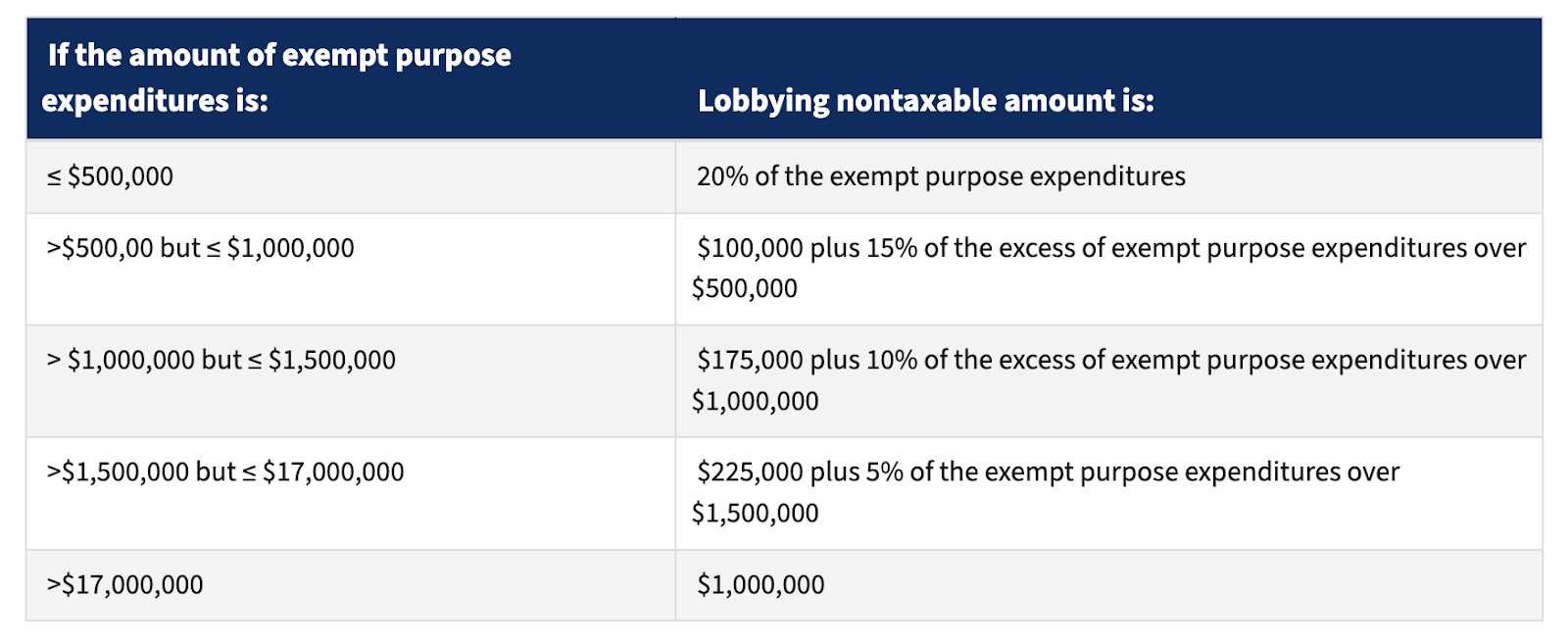
    This test is based on the size of a nonprofit’s exempt purpose expenditures compared to its lobbying expenditures. For example, any 501(c)(3) with a budget of less than or equal to $500,000 can spend up to 20% of its resources lobbying. See the full chart of permissible expenditures below.

    Source: https://www.irs.gov/charities-non-profits/measuring-lobbying-activity-expenditure-test

    Imagine, for example, a nonprofit that spent $6,200,000 in 2024. Using the chart above, we can see that they could spend up to $225,000 plus 5% of expenditures over $1,500,000. This comes out to $460,000 that they could have spent on lobbying that year.

    $6,200,000-$1,500,000 = $4,700,000

    $4,700,000 * 0.05 = $235,000

    $235,000 + $225,000 = $460,000

    Important! In order to qualify for the Expenditure Test, a 501(c)(3) nonprofit must first file IRS Form 5768.

    Resources for Staying Compliant

    As a nonprofit staffer, you’re likely operating with a limited budget, a small team, and perhaps a lack of legal expertise. While these hurdles are real, there are plenty of resources to help you stay compliant while lobbying as a 501(c)(3), even without the guidance of in-house counsel.

    • To start, the Internal Revenue Service offers a training series to help nonprofits maintain their 501(c)(3) status. This free video series walks you through all the 501(c)(3) basics, including required filings, prohibited political activity, and how to lobby appropriately. 
    • For a general overview of best practices – and common mistakes – check out the IRS resource, “How to Lose Your Tax Exempt Status Without Really Trying.”
    • The National Council of Nonprofits offers numerous resources to support nonprofit organizations across the country. Check out their helpful guide on Political Campaign Activities (which are all prohibited for 501(c)(3) nonprofits) and Lobbying Activity. 

    Start Lobbying as a 501(c)(3) with Plural. Sign Up for a Free Consultation Today! 

    Disclaimer: This article is not a substitute for professional legal or tax advice.