

Tag: government relations

  • Your Government Affairs Team Saw It Coming. So Why Is Compliance Still Catching Up? 

    Your Government Affairs Team Saw It Coming. So Why Is Compliance Still Catching Up? 

    Every day, Government Affairs teams monitor legislative activity across Congress and state legislatures, looking for policy shifts that could affect their organizations. They track emerging issues, assess potential business impacts, and brief leadership long before most employees are aware that regulatory change may be on the horizon. As legislative activity continues to accelerate across industries, that early visibility has become an increasingly valuable business asset. 

    Yet many organizations still find themselves scrambling to implement new regulatory requirements after they take effect. 

    Why? 

    In many cases, the issue isn’t a lack of information. It’s what happens after that information is gathered. 

    Government Affairs knows what’s coming. Compliance knows how to respond. But in many organizations, those functions still operate independently, with legislative intelligence ending where compliance execution begins. Valuable context can be lost during hand-offs, implementation timelines become compressed, and teams often spend time recreating work that has already been done elsewhere in the organization. 

    As regulatory expectations continue to grow, organizations are finding it harder to justify disconnected approaches to legislative monitoring and compliance management. Increasingly, the conversation is shifting toward how those functions can work together throughout the regulatory life cycle rather than operating as separate disciplines. 

    Regulatory Preparedness Begins Long Before a Law Takes Effect 

    Many organizations still approach regulatory change as a reactive process. Compliance teams become heavily involved once legislation has been enacted or a regulatory agency publishes final guidance. From there, they begin interpreting requirements, assigning ownership, updating policies, implementing controls, and documenting organizational responses. 

    While that approach has long been standard practice, it leaves one valuable resource largely untapped: time. 

    Between the introduction of a bill and its eventual implementation is an opportunity for organizations to prepare rather than react. Government Affairs teams often have visibility into proposed legislation months before Compliance becomes involved. That window gives organizations time to evaluate operational impacts, identify potential risks, engage business stakeholders, and begin implementation planning before deadlines arrive. 

    Consider a financial institution tracking proposed state privacy legislation. Government Affairs may identify the bill early in the legislative process, giving Compliance an opportunity to assess policy changes, engage business owners, and prepare implementation plans before the law is enacted. Without that coordination, much of the work begins only after the legislation becomes effective, leaving teams to work against compressed timelines. 

    Organizations that respond effectively to regulatory change recognize that preparedness doesn’t begin when legislation becomes law—it begins when meaningful legislative activity is first identified. 

    Plural connects government affairs with regulatory affairs

    The Cost of Disconnected Workflows 

    Government Affairs and Compliance often pursue the same objective from different starting points. 

    Government Affairs focuses on monitoring legislation, analyzing policy developments, and helping leadership understand how proposed laws could affect the business. 

    Compliance translates finalized regulations into policies, controls, documentation, and operational processes that meet regulatory expectations. 

    Neither function is ineffective on its own. The challenge is making sure the work of one naturally informs the work of the other. 

    Every manual hand-off creates friction. Every disconnected workflow increases the likelihood that important context is delayed, duplicated, or overlooked. Legislative analysis completed by Government Affairs may later be recreated by Legal or Compliance. Business units receive information at different stages, making implementation more difficult to coordinate. Leadership, meanwhile, often receives separate updates from multiple departments rather than a single, enterprise-wide view of regulatory readiness. 

    Those gaps become more noticeable as legislative activity expands across federal and state jurisdictions. Organizations need more than strong legislative monitoring or mature compliance programs on their own—they need continuity across the entire regulatory change process. 

    Connecting Legislative Intelligence with Compliance 

    Many organizations are beginning to rethink how Government Affairs and Compliance work together. 

    Rather than treating them as separate business functions, they’re creating connected workflows that allow legislative intelligence to move naturally into regulatory change management. 

    Instead of waiting until a law is finalized, Government Affairs can share emerging legislative developments with Legal, Compliance, Risk, and business leaders while proposals are still evolving. Compliance teams gain additional time to evaluate potential obligations, assign ownership, prioritize resources, and prepare documentation before implementation deadlines arrive. 

    The approach doesn’t replace existing Government Affairs or Compliance programs. It gives both teams more context and more time to do what they already do well. 

    By connecting legislative awareness with operational execution, organizations can improve visibility, strengthen collaboration, and support more informed decision-making across the enterprise. 

    How Plural Bridges the Gap 

    One company addressing this challenge is Plural, whose platform is designed to connect Government Affairs with downstream compliance workflows. Rather than treating legislative monitoring as a standalone activity, Plural enables organizations to carry legislative intelligence into broader governance, legal, compliance, and risk management processes. 

    The objective is straightforward: reduce the gap between identifying regulatory change and preparing the business to respond. 

    Government Affairs teams can surface emerging policy developments while legislation is still moving through the legislative process. Compliance, Legal, and Risk teams gain earlier visibility into those developments, allowing them to assess potential obligations, coordinate internal stakeholders, and begin planning well before implementation deadlines. 

    The result is greater alignment across departments and a more proactive approach to regulatory readiness. 

    Government Affairs gains confidence that legislative insights continue driving organizational action long after a bill is identified. 

    Compliance benefits from earlier visibility into emerging requirements, allowing teams to plan strategically instead of reacting under pressure. 

    Executives gain a clearer understanding of regulatory risk, implementation progress, and organizational preparedness through a more connected governance framework. 

    The Future of Regulatory Change Management 

    Legislative and regulatory complexity shows little sign of slowing. Organizations continue to navigate expanding legislative activity, evolving regulatory expectations, and growing pressure from regulators, investors, and other stakeholders to demonstrate effective governance. 

    Success will depend not only on tracking legislation or maintaining a strong compliance program, but on how effectively organizations connect those capabilities. 

    As Government Affairs, Legal, Compliance, and Risk functions become more interconnected, organizations that can move legislative intelligence efficiently across departments will be better positioned to evaluate risk, coordinate implementation efforts, and respond before regulatory changes become operational challenges. 

    Most organizations have already invested in legislative monitoring. They’ve also invested heavily in building mature compliance programs. 

    The next step isn’t replacing either function. 

    It’s making sure they work together. 

    Get Started Today.

    Experience the power of Plural first-hand with a free account or schedule a demo for a live walk through of the platform. Find out how Plural can transform the way you and your team shape policy.

  • The Future of Lobbying: How Data, Technology & Policy Intelligence Are Reshaping Government Affairs 

    The Future of Lobbying: How Data, Technology & Policy Intelligence Are Reshaping Government Affairs 

    Relationships still win. But in a world where your counterpart may have already mapped the legislator’s voting history, tracked the coalition forming against your issue, and flagged the model bill moving in six other states, showing up unprepared in government affairs is a disadvantage. 

    The government affairs profession is not changing because technology is replacing what lobbyists do. It is changing because technology is raising the floor of what “prepared” means. 

    A generation ago, being well-prepared for a legislator meeting meant knowing the member’s background, understanding their district, and having a clear ask. That is still true. What has changed is the context surrounding that meeting: the data layer that informs who you’re meeting with, what they’ve been working on, which bills they’ve sponsored this session, how they voted on related issues two sessions ago, who else is lobbying them on this issue, and what similar legislation is moving in states that tend to predict their own chamber’s priorities. 

    That information has always existed. It was expensive to gather, time-consuming to synthesize, and largely the province of the most connected and well-resourced practitioners. Technology is now democratizing access to this information and accelerating it. And that acceleration is creating a gap between the government affairs functions operating with intelligence infrastructure and those still relying on memory, spreadsheets, and periodic email digests. 

    This post is about that gap. Where it is, how fast it is growing, and what practitioners at every stage of the adoption spectrum need to do to stay on the right side of it. 

    The best lobbyists have always been the best prepared. What has changed is what it takes to be prepared and how quickly the standard is rising. 

    Damola Ogundipe
    CoFounder, Plural Policy

    What is changing about the lobbying profession and what isn’t 

    Start with what is not changing, because the noise around technology in government affairs often obscures it. 

    Relationships are not becoming less important. Trust between a lobbyist and a legislator — built over years of credible, consistent, honest engagement — is not something data produces. A legislator who takes your call is doing so because of a track record, not because you have a good dashboard. The people in a room, the credibility of the ask, the quality of the argument, the ability to read the dynamic and adjust in real time — none of that is being automated. 

    What is changing is the preparation that precedes those moments, the coverage that makes those moments possible at the right time, and the organizational intelligence that connects what happens in one chamber or one state to what is likely to happen in another. 

    Specifically, three things are shifting in ways that matter for every practitioner and every enterprise government affairs function: 

    • The volume of relevant legislation has outscaled manual monitoring. State legislatures collectively introduce more than 200,000 bills per session. Federal regulatory activity generates thousands of additional changes annually. No team, regardless of experience or institutional knowledge, can monitor that volume manually without developing structural blind spots. 
    • The pace of cross-state legislative activity has accelerated. Model bills — identical legislation coordinated by national advocacy organizations — now spread across state lines within a single session cycle. A government affairs team that is only watching its home state is watching yesterday’s policy landscape. 
    • Client and executive expectations have risen. Clients expect real-time intelligence, not weekly summaries. Executives expect their government affairs function to brief proactively — before floor votes, not after. The standard of “keeping up” has been replaced by a standard of “seeing ahead.” 

    None of these changes make relationships less important. They make the intelligence that supports relationship-based advocacy more important and more decisive.

    Legislator intelligence: what it means to show up prepared 

    The single most underused category of data in government affairs is legislator intelligence — not as a surveillance tool, but as preparation infrastructure. 

    Every legislator has a record. The bills they have sponsored. The committees they sit on and their role within those committees. Their voting history on related issues. The advocacy organizations that have donated to their campaigns. The districts they represent and the industries that employ those districts’ residents. Their public statements on policy issues. Their track record of moving legislation to passage versus introducing bills that never advance. 

    This information is public. It has always been available to anyone willing to spend the time to compile it. What has changed is the speed and completeness with which it can be assembled, and the way it can be mapped to your specific advocacy agenda. 

    What data-informed legislator engagement looks like in practice 

    The lobbyist who walks into a meeting with a legislator knowing that the member has sponsored three bills in the current session related to consumer data privacy — two of which cleared committee — is in a different conversation than one who knows only that the member sits on the Commerce Committee. 

    Legislator intelligence does not replace the relationship. It deepens it. When a lobbyist arrives to a meeting already briefed on a legislator’s recent priorities, their conversation can move past the introductory positioning that burns so much of a limited meeting window. They can reference specific votes. They can acknowledge work the legislator has already done on the issue. They can connect their ask to the legislator’s existing legislative record rather than presenting it in isolation. 

    This is what “data determines who shows up prepared” means in concrete terms. Not that the data creates the relationship, but that it elevates the quality of the engagement that builds it. 

    What to track on every legislator in your portfolio 

    • Current session bill sponsorships and co-sponsorships — especially any related to your issue area 
    • Committee assignments and role (member, vice-chair, chair) — chair status is predictive of bill advancement 
    • Voting history on related issues across the current and prior two sessions 
    • Floor statements and public testimony on your issue area 
    • Campaign finance connections to relevant industries and advocacy organizations 
    • Whether they are in a competitive district — electoral pressure shapes policy priorities 
    • Bills they introduced that died in committee — these often return in subsequent sessions 

    How the highest-performing government affairs teams structure their intelligence cycle 

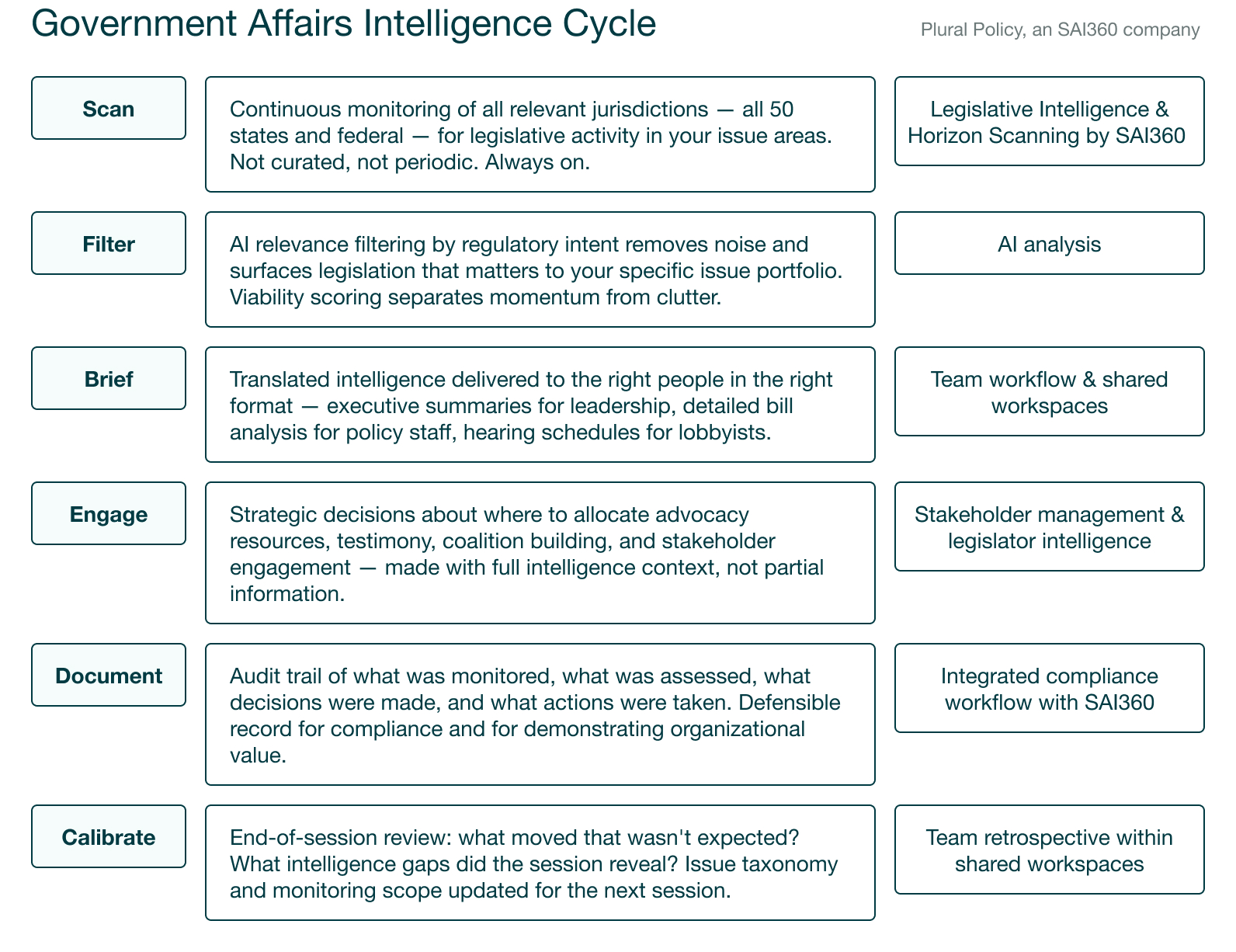
    The organizations that consistently outperform their peers in government affairs do not just have better tools. They have a more deliberate process — a structured intelligence cycle that converts legislative monitoring into organizational action, and that runs consistently whether the session is active or quiet. 

    The six-phase cycle below maps how these teams operate — and where each phase depends on data, technology, or the human judgment that no platform replaces. 

    The most important insight from this cycle is the final phase: calibration. The teams that consistently outperform are the ones that treat each session as a source of learning — reviewing their intelligence coverage, identifying what moved unexpectedly, updating their issue taxonomy, and adjusting their monitoring scope before the next session begins. 

    This discipline is not common. Most teams move from session to session without a formal retrospective. The ones that build it in compound their intelligence advantage over time, rather than starting each session with the same coverage gaps they had before. 

    What this means for the next generation of government affairs professionals 

    If you are earlier in your government affairs career, the transformation underway in the profession is not a threat to what you are building. It is a clarification of what to build. 

    The skills that made government affairs professionals valuable in the past remain valuable. What is being added is a new layer of technical fluency — not the ability to build software, but the ability to work intelligently within data and intelligence systems, interpret what they surface, and integrate that intelligence into the relationship-based practice that defines the profession. 

    The practitioners who will lead government affairs functions in the next decade will be the ones who are comfortable operating at the intersection of relationship credibility and data-informed strategy. They will use legislative intelligence platforms the way their predecessors used a Rolodex — not as a substitute for judgment, but as the infrastructure that makes judgment more reliable. 

    The transformation is already underway, the only question is where you are in it 

    The lobbying profession is in the middle of a technology transformation. The tools exist. The data is available. The organizations that have invested in building intelligence infrastructure around their government affairs functions are already operating with an advantage that compounds with each session. 

    That advantage is not primarily about technology. It is about preparation — the quality of the briefings, the precision of the engagement, the speed of the response, and the organizational confidence that comes from knowing your policy coverage has no structural gaps. 

    Relationships still win. They always will. What data and technology determine is who shows up to those relationships prepared to make them count. 

    Ready to see what your team is missing?

    Plural Legislative Intelligence powered by SAI360 gives government affairs teams real-time visibility into state and federal legislative activity — with AI-powered bill analysis, viability signals, and stakeholder engagement workflows built in. 

    And it’s the only platform that combines with integrated compliance workflow. Learn more by scheduling a live walkthrough.

  • What Is a State Legislature — and Why Every Enterprise Should Be Monitoring One

    What Is a State Legislature — and Why Every Enterprise Should Be Monitoring One

    State legislatures introduced more than 200,000 bills last year. Most of your competitors are not tracking them. That gap is either your biggest risk or your greatest advantage.

    When most people hear “state legislature,” they picture a high school civics lesson. A chamber of elected representatives. A committee hearing. A floor vote. The slow machinery of democracy doing its work. 

    But for a government affairs leader at a major enterprise, a state legislature is something else entirely. It is the single most active source of regulatory change in the country — and one of the most systematically undermonitored. 

    Fifty state legislatures. Thousands of bills introduced every session. Committees moving at different speeds, under different rules, with different timelines. A bill that looks dormant in January can pass committee in March and become law in May. One missed amendment to a healthcare licensing bill, a labor classification statute, or an environmental disclosure requirement can reshape an entire operating environment overnight. 

    This post explains what state legislatures are, how they work, and — most importantly — what effective monitoring looks like for enterprises that cannot afford to be the last to know. 

    What is a state legislature? 

    A state legislature is the lawmaking body of a U.S. state government. Every state has one — and with the exception of Nebraska, every state legislature is bicameral, meaning it has two chambers: a Senate and a House (or Assembly, depending on the state). 

    The legislature’s core function is to introduce, debate, amend, and pass laws. Those laws govern nearly every domain that affects enterprise operations: employment and labor, environmental compliance, healthcare regulation, data privacy, financial services, real estate, transportation, insurance, and more. 

    A few numbers that put the scale in perspective: 

    • There are 99 state legislative chambers across 50 states (Nebraska’s unicameral legislature is the exception). 
    • In a typical two-year session cycle, state legislatures collectively introduce upward of 200,000 bills. 
    • Approximately 20,000 to 25,000 of those bills become law. 
    • Most enterprise government affairs teams are actively monitoring a small fraction of them. 

    The question is not whether state legislation will affect your business. It will.
    The question is whether you find out before or after it passes. 

    How state legislatures work — the lifecycle of a bill 

    Understanding the bill lifecycle is the foundation of effective legislative tracking. Here is how legislation typically moves from introduction to law. 

    Introduction 
    Any member of the legislature can introduce a bill. Bills are assigned a number and referred to a relevant committee. At this stage, the bill is a proposal — nothing more. Most bills never make it past committee. 

    Committee review 
    The committee is where most bills live and die. A committee chair controls whether a bill gets a hearing. The committee can amend, pass, table, or kill the bill entirely. For your government affairs team, this is the most important stage to monitor — it is where there is still time to engage. 

    Floor debate and vote 
    If a bill passes committee, it moves to the full chamber for debate and a vote. Amendments can still be introduced here. If the chamber passes the bill, it moves to the other chamber and goes through a similar process. 

    Conference and reconciliation 
    If both chambers pass different versions of the same bill, a conference committee reconciles the differences. The reconciled version goes back to both chambers for a final vote. 

    Governor’s desk 
    Once both chambers pass identical versions, the bill goes to the governor. The governor can sign it into law, veto it, or in some states allow it to become law without a signature. A vetoed bill can sometimes be overridden by a supermajority vote. 

    Why the lifecycle matters for enterprise teams 
    Each stage of the bill lifecycle is a potential intervention point. Committee hearings are your window for testimony and stakeholder engagement. Floor votes signal urgency. Conference committees can introduce late-stage changes that alter a bill’s impact significantly. 

    Monitoring is not just about tracking outcomes. It is about knowing which stage a bill is at — and acting at the right moment. 

    Why state legislative monitoring is a C-suite issue 

    State legislation used to be something an enterprise could manage with a regional lobbyist and a government affairs coordinator who knew the capitol well. That approach worked when the volume of relevant legislation was manageable and the pace of change was predictable. 

    Neither is true anymore. 

    Over the past decade, the regulatory activity at the state level has accelerated substantially. Following the retreat of federal regulatory expansion in several areas, states have moved aggressively to fill the gap — particularly in data privacy, labor, climate disclosure, healthcare, and technology. The result is a patchwork of obligations that can vary dramatically from state to state and shift from session to session. 

    For an enterprise operating in ten, twenty, or forty states, that is not a government affairs problem. That is an operational risk problem. 

    Consider what happens when a key piece of legislation passes without your team’s awareness: a data privacy requirement you’re not prepared for. A labor classification law that upends your contractor model. A licensing change that affects product distribution in three states. 

    None of these scenarios start as emergencies. They start as bills in committee — visible months before they become law to anyone who is monitoring. 

    Organizations that treat state legislative monitoring as a government affairs function rather than an enterprise intelligence function will continue to be surprised by the same kinds of regulatory changes, session after session. 

    What enterprise-grade legislative monitoring actually looks like 

    There is a wide spectrum of how enterprises monitor state legislation. On one end: a spreadsheet, a Google Alert, and a lobbyist who calls when something urgent happens. On the other: a continuous intelligence system that scans every chamber in real time, surfaces relevant bills automatically, and delivers prioritized briefings to the people who need them. 

    Most enterprises are somewhere in the middle — and most are closer to the spreadsheet end than they realize. 

    Here is what effective state legislative monitoring requires: 

    Comprehensive coverage across all 50 states 
    Relevant legislation does not announce which state it will emerge from. A bill that passes in California often signals what is coming in New York and Illinois. A labor law that gains traction in Colorado frequently becomes a model bill in other states. Effective monitoring cannot be limited to your top five operating states — it requires visibility across all 50. 

    Bill tracking by relevance, not just keyword 
    Keyword searches miss context. A bill that never mentions “data privacy” by name can still impose significant data handling obligations. Effective legislative tracking uses AI-powered bill analysis to surface legislation based on meaning and regulatory impact — not just surface-level text matching. 

    Real-time alerts at the right stage 
    Getting a notification that a bill passed is not intelligence. It is news. Intelligence is knowing a bill has cleared committee and is heading to the floor — with enough lead time to brief stakeholders, assess impact, and decide whether to engage. Legislative tracking software needs to be calibrated to alert teams at the right lifecycle stage, not just at the outcome. 

    Stakeholder engagement workflows 
    Monitoring without action is just surveillance. The most effective government affairs teams connect their legislative tracking directly to stakeholder engagement — identifying the right legislators, briefing internal teams, coordinating with industry partners, and scheduling testimony. The platform and the workflow need to be integrated. 

    Predictive signals on bill viability 
    Not every bill deserves equal attention. An effective legislative intelligence platform helps teams prioritize — surfacing which bills have meaningful momentum, which are stalled, and which represent emerging patterns worth watching even if they’re unlikely to pass this session. 

    What Legislative Intelligence by SAI360 does 
    Legislative Intelligence by SAI360 monitors federal and state legislative activity continuously — scanning all 50 states, categorizing bills by relevance, delivering prioritized alerts, and giving government affairs teams the predictive signals they need to act ahead of the curve rather than react to outcomes. 

    It is the difference between legislative tracking and legislative intelligence. 

    The government relations function is being transformed 

    For decades, government relations was a relationship business. The value a government affairs leader delivered was measured in access — who they knew, how quickly they could get a meeting, how reliably their intelligence network surfaced the right information. 

    That still matters. But it is no longer sufficient on its own. 

    The enterprises with the strongest government affairs functions today are combining the relationship expertise of experienced practitioners with AI-powered legislative intelligence that scales coverage and sharpens prioritization. The result is a team that covers more ground with greater precision — and one that shows up to every stakeholder conversation already briefed, already prepared, and already thinking three moves ahead. 

    State legislatures are not slowing down. The volume of bills introduced each session will not decrease. The complexity of operating across a patchwork of fifty state regulatory environments will only increase. 

    The only sustainable response is smarter monitoring. 

    The government affairs leaders who will define this decade are not the ones who work harder. They are the ones who work with better intelligence. 

    Ready to see what your team is missing?

    Plural Legislative Intelligence powered by SAI360 gives government affairs teams real-time visibility into state and federal legislative activity — with AI-powered bill analysis, viability signals, and stakeholder engagement workflows built in. 

    And it’s the only platform that combines with integrated compliance workflow. Learn more by scheduling a live walkthrough.